類題 大問I 蚊に刺されやすい人
- 3つの英文は,すべてTMPS医学館のオリジナルです(人物・大学・団体・数値は架空)。本番の英文より短く作ってあります。
- 選択肢は番号(1〜4)で答える。語数・行数の指定がある問題は,指定を守ること。
Read the following passage and answer the questions that follow.
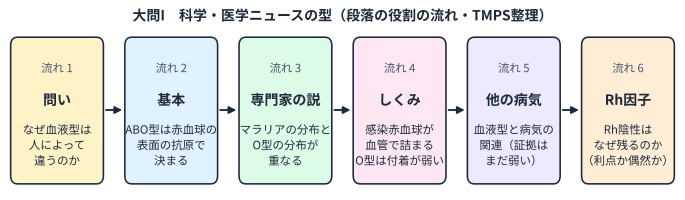
If you have ever spent an evening outside with friends and come home with twenty bites while they had none, you are not imagining things. Mosquitoes really do prefer some people to others, which raises a question: why are some of us so much more attractive to them?
Mosquitoes find their targets with several senses at once. From a distance of about thirty metres, they follow the carbon dioxide that every person breathes out. Closer in, they respond to body heat and to the chemicals on the skin, a mixture of smells that is ( A ) partly by the bacteria living there. "Each of us carries a chemical signature as individual as a voice," said Dr. Iris Calder, an entomologist at the Brandt Institute. "Mosquitoes can hear it from across the garden."
In a laboratory test published in 2019, 64 volunteers each held a hand in a cage of mosquitoes for two minutes. The insects landed on some hands within seconds but ( B ) others almost entirely. The researchers then tested pairs of twins. Identical twins, who share all of their genes, gave much more similar results than fraternal twins, who share only about half. This suggests that ( C ) plays a part in who gets bitten.
Other studies point to behaviour. People who have just exercised, who are pregnant, or who have been drinking beer seem to be bitten more often, perhaps because they give off more heat and carbon dioxide. Dark clothing may also help mosquitoes find a target from a distance.
Calder does not find any single explanation ( D ), though. "Every study looks at a small group of people, and the numbers differ from one study to the next," she said. These studies showed that certain traits and bites go together, but they did not prove a ( E ) relationship: a trait that is common among people who are bitten may not be what attracts the mosquitoes.
For now, Calder's advice is simple. Wear long sleeves in the evening, use a repellent, and remove standing water near the house, where mosquitoes lay their eggs. "We cannot change our genes," she said, "but we can change how many mosquitoes find us."
問1 Choose the best word from the list to fill in blanks ( A )〜( E ) and write the number in the space on the answer sheet.
(A)
1. hidden2. praised3. shaped4. refused
(B)
1. ignored2. supported3. trained4. repaired
(C)
1. hesitation2. hospitality3. hygiene4. heredity
(D)
1. invisible2. decisive3. generous4. tropical
(E)
1. steady2. distant3. causal4. spoken
問2 How do mosquitoes find people from a long distance?
1. They sense the heat of the skin.2. They follow the carbon dioxide in people's breath.3. They recognize the colour of people's clothes.4. They listen to the sound of people's voices.
問3 Why did the researchers test pairs of twins?
1. To find out whether twins breathe out more carbon dioxide.2. To prove that hygiene decides who is bitten.3. To compare bites on the hands with bites on the feet.4. To see whether genes might affect how often a person is bitten.
問4 According to Calder, why can the studies not settle the question?
1. Each study used a small group, and the results were not the same.2. They were carried out only on children.3. Mosquitoes bite people completely at random.4. No laboratory has ever tested human skin.
問5 Why might people who have just exercised be bitten more often?
1. They wear darker clothes.2. Their skin bacteria become less varied.3. They give off more heat and carbon dioxide.4. They spend more time outdoors in the evening.