TMPS英語作戦室 慈恵医大 英語2025
2025年度 一次試験 全3大問・全25小問選択肢・語数をスクリプトで検算済みそっくり類題セット

東京慈恵会医科大学
医学部 英語
2025年度 解答・解説

問題文は掲載できませんが、
解説を読むだけでどんな問題かもわかる!

さらに、そっくり類題PDFを見れば、実際の問題イメージもわかるよ!

各大問を「どういう問題か」から説明し、答えの根拠を1つずつ解説。最後に、本番と同じ3大問の構成で作ったそっくり類題セット(全問解答つき)で、2025年度を丸ごと演習できます。

Mio先生
解説:Mio先生・ニックニ先生(TMPS医学館) / 更新:2026.10.21 / 読了 約30分

📌 このページの使い方

  1. 過去問集をお持ちの方:英語60分で解き、末尾の答え一覧で採点してから解説へ(解説は大問ごとに答えも書いてあります)
  2. お持ちでない方:各大問の「どういう問題か」を読めば、問題の中身がそのまま分かります
  3. 最後にそっくり類題セット(PDF版あり)を60分で解き、初見の英文でも同じ解き方ができるか確かめる

※ 著作権に配慮し、入試問題の英文・設問文は掲載していません(引用は短い語句まで)。図はTMPSが作成した解説用の図です。※ 「どの選択肢が最も適切か」の判断は機械で確かめられないため、迷う所を「要確認」と示しています。公式の解答は公表されていないため、答え・英作文の解答例はTMPSが自力で作ったものです。

⚠️ 問題等で誤りを発見された場合、修正しますので、TMPS医学館までLINEを下さい。(迅速に確認・更新いたします)

LINEで誤りを連絡
SUMMARY

3分で分かる 2025年度の慈恵医大の英語

Yuiちゃん
Yuiちゃん
長い英文を読んでいる間に、時間がなくなってしまいます…。
Mio先生
Mio先生
全部の文を読もうとしないで。まず設問を読んで、「何を探すか」を決めてから本文へ。空所の問題は、前後の1文で決まることが多いよ。
ニックニ先生
ニックニ先生
時間は、大問I・IIを各17分、大問IIIを21分で。残りの5分は、番号の書き間違いとXの語数を数え直すために使うんだ。
Yuiちゃん
Yuiちゃん
わかりました!英作文は最後にしても大丈夫ですか?
Mio先生
Mio先生
書く時間(目安8分)を必ず先に確保しておくこと。大問IIIの空所は4分、Xは1分で片づけて、残りを英作文にあてよう。
STRATEGY MAP

英語60分の立ち回りマップ

時間はTMPSの目安です。本番の英語は60分(他の科目と時間は共有しません)。

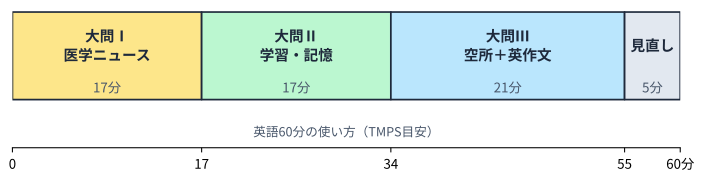
英語60分の時間配分。大問Iは17分、大問IIは17分、大問IIIは21分、見直しは5分
図A 英語60分の使い方(TMPS作成)
🧭 おすすめの解く順番
大問II → 大問I → 大問III(得意な順でも可。ただし大問IIIは最後に回しても、英作文の8分は必ず残す)
大問IIは身近な話題で、一番読みやすい英文です。ここで勢いをつけてから、専門語の多い大問Iへ。大問IIIは論説文で、空所と英作文があるので時間の見積もりが大切です。
大問I / 目標:17分(医学ニュース)

大問I 医学ニュース ── 空所補充(語の選択)と内容把握

免疫の状態から「体の中の年齢」を測る研究を紹介した記事です。問1の5つの空所は語の選択、問2〜5は4択の内容把握。小問は独立しているので、取れる所から取ります。

現場戦略試験会場でのリアルな立ち回り(大問I)
⏱ 目標時間 & 死守ライン目標17分。問1を6分 → 問2〜5を11分。
⚠️ 損切り・警戒ライン問3・問5は選択肢が似ているので、2つに絞れたら印をつけて次へ。最後の見直しで戻る。
💡 初手の思考トリガー空所は「直後の語(to / for / as)」から、内容把握は「設問の語が本文の何段落目に出るか」から入る。
📝 どういう問題か?

免疫(炎症)の数値から老化の速さを測る研究の流れを読み取る大問。専門的な話題だが、問われるのは「目的・定義・確かめ方・最後の実験」という記事の骨格。

  • 問1:空所(A)〜(E)に入る語を、4つの選択肢から選んで番号で答える(動詞・名詞・形容詞が混ざる)
  • 問2:研究者が「炎症」に注目した理由を、4つの文から選ぶ
  • 問3:「炎症時計」とは何かを、4つの説明から選ぶ
  • 問4:新しい研究で、炎症時計が正確かをどう確かめたかを、4つから選ぶ
  • 問5:最後の被験者グループで、研究者が何を調べたかを、4つから選ぶ
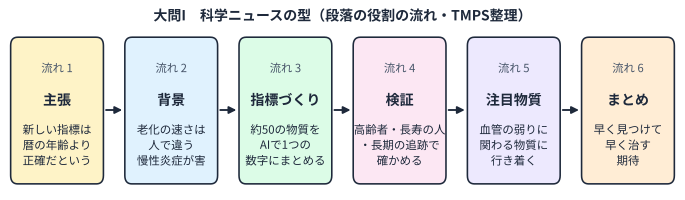
大問Iの段落の役割の流れ:主張、背景、指標づくり、検証、注目物質、まとめ
図B 大問Iの文章の流れ(TMPSによる整理・本文ではありません)

問1:空所(A)〜(E)。5つとも、空所の直後を見れば決まります。

(A)=4 promotes。空所の直前の動詞(原因となる=害をもたらす)と並んでいて、「脆弱性(vulnerability)を高める」の意味になるのは promotes だけ。harms なら vulnerability が目的語として成り立たず、declines は「断る」に近く合いません。

(B)=2 subjected。空所の直後は 「to a barrage of ~」。「~の連続攻撃にさらされる」= be subjected to ~ の型で、血液サンプルが一連の分析にかけられる意味です。exposed も to と続きますが、分析の「手順にかけられる」は subjected の型。要確認

(C)=1 composite。データを「ひとつの( )」にまとめた、という文脈なので、複数の値を合成した指標= composite。combination でもほぼ同じ意味になるので迷いますが、「ひとつの数字にまとめたもの」を指す語として composite を取ります。要確認

(D)=2 proxy。直後の for とつながり、「(サイトカイン量の)代わりの指標」= proxy for ~。associate は for と続きません。

(E)=3 implicated。「ある物質が心血管の病気に関わっている」= be implicated in ~。直後の in に注目。

問2:なぜ炎症に注目したか。要確認記事の前半は「年を取る速さは人によって違い、その違いは免疫の衰え方に関わる。慢性的な炎症が体を傷める」という流れ。その理由を述べた選択肢は、「悪い炎症が人を早く老けさせる」の1です。3は「炎症と死亡率の関係」で、研究の結果に近く、「注目した理由」ではありません。

問3:炎症時計とは。要確認本文は、多数のサイトカインのデータをAIで1つの数値にまとめたものを「炎症時計」と呼びます。「AIがまとめたデータで、その人の(体の中の)年齢を示す」という4が一番近い。1は「タンパク質の集まり」で、時計そのものではなく材料。2は「患者の年齢」だけの話。3は「炎症が続く期間」で本文にありません。

問4:正確さをどう確かめたか。高齢者の血液データをもとにした炎症年齢が、7年後の身体機能(歩く速さ・自立度)をよく予測したという段落が、正確さの確認です。これを言い換えたのが2。1は長寿の人を調べた別の検証、3はボローニャとフラミンガムを混同(フラミンガムは遺伝子の活動を調べた)、4は特定の物質の話です。

問5:最後のグループで調べたこと。要確認最後の段落は、見かけ上とても健康な高齢者を集め、炎症年齢が高い人ほど動脈が硬い(心血管の傷みのサイン)かどうかを調べた実験です。「心臓・血管の健康と、炎症年齢の高さの関係を調べた」という3を取ります。4は「健康に見える人の心臓・血管の弱り」を確かめるという文の前半だけに近く、炎症年齢との結びつきを欠くので、3より弱い、という判断です(4も有力)。

🎯 大問Iの答え
問1:(A) 4 promotes / (B) 2 subjected / (C) 1 composite / (D) 2 proxy / (E) 3 implicated問2:1問3:4問4:2問5:3
⚠️ 問1(B)・(C)は「似た選択肢」。(B) exposed と subjected、(C) composite と combination は、どちらも意味が近いので、直後の語(to a barrage of ~)や「ひとつの数字にまとめた」という言い方で決める。問5は3と4が紛らわしいので、「炎症年齢との関係」まで入っている3を取る。
Yuiちゃん
Yuiちゃん
(B)も(C)も、2つで迷いました…。
Mio先生
Mio先生
(B)は直後の to a barrage of。「連続攻撃を受ける」と来たら subjected。型で決めるのが一番速いよ。
ニックニ先生
ニックニ先生
迷う選択肢は、消せる理由を1つ探す。1つも見つからなかったら、印をつけて次へ進むんだ。
Mio先生の総整理表

大問I:医学ニュースの型

小問やること着眼点
問1空所の前後の語を見て選ぶ直後の前置詞(to / for / in)/動詞どうしの並び
問2「注目した理由」を探す記事の前半(背景の段落)
問3定義を選ぶ「AIで1つの数字にまとめた」という言い方
問4「どう確かめたか」の段落を探す7年後の身体機能との照らし合わせ
問5最後の段落の方法を選ぶ誰を集めて何を測ったか
TMPSコーチング診断

🩺【自己診断】大問Iで手が止まった人への処方箋

  • 問12択で迷う → 直後の前置詞を指で押さえて、ついてこない方を消す
  • 問2〜5本文のどこか分からない → 設問の語(inflammation / clock / accurate / final group)を本文で探して、その段落だけ読む
  • 時間17分を超えそう → 問5を後回しにして、問1〜4の番号を先に書き切る
大問II / 目標:17分(学習・記憶)

大問II 幼いころの記憶 ── 空所補充(語の選択)と内容把握

「3歳以前のことを、なぜ覚えていないのか」を、子どもへの聞き取り調査から探る研究記事。構成は大問Iと同じで、問1が空所5つ、問2〜5が内容把握(4択)です。

現場戦略試験会場でのリアルな立ち回り(大問II)
⏱ 目標時間 & 死守ライン目標17分。問1を6分 → 問2〜5を11分。
⚠️ 損切り・警戒ライン問2・問5は「根拠の1文」を探して一致する選択肢を取る。2分考えて決まらなければ次へ。
💡 初手の思考トリガー空所は「前後の語とのつながり(目的語・that節)」、内容把握は「人名(Freud / Bauer)や数字が出てくる段落」から入る。
📝 どういう問題か?

幼児期健忘(幼いころの記憶が薄れる現象)についての、新しい研究の内容を、人名・数字・比較を手がかりに読み取る大問。

  • 問1:空所(A)〜(E)に入る語を、4つの選択肢から選んで番号で答える
  • 問2:昔の精神分析の考え方(Freud)が、幼いころの記憶が失われる理由をどう説明したかを選ぶ
  • 問3:幼い子どもが記憶を保つのに役立つことを選ぶ
  • 問4:3歳のときの出来事についての、子どもたちの記憶の特徴(意外な点)を選ぶ
  • 問5:年長の子どもの記憶のほうが詳しい理由として、本文が挙げることを選ぶ
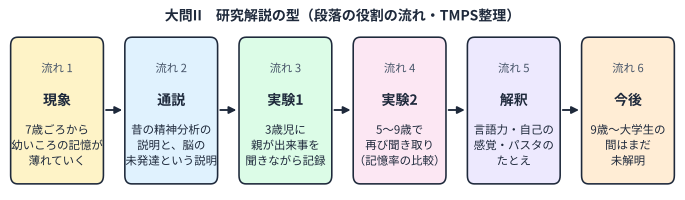
大問IIの段落の役割の流れ:現象、通説、実験1、実験2、解釈、今後
図C 大問IIの文章の流れ(TMPSによる整理・本文ではありません)

問1:空所(A)〜(E)。

(A)=1 documented。「新しい研究が、7歳ごろに記憶が薄れ始めることを( )」。研究が「記録して示した」= documented。accepted / recognized は「広く認められている」で、「新しい研究が」という主語に合いません。

(B)=4 empirical。「初めての( )な実証」。直前の「私たちは実際に記録し、追跡した」と対応して、観察にもとづく= empirical。theoretical は「理論上の」で逆の意味です。

(C)=2 prompting。親が子どもに質問して、思い出すのを促す場面。prompt A with B(AにBで働きかける)の型で、with questions とつながります。suggesting も近いですが、「記憶を引き出す」ことを表すのは prompting。要確認

(D)=2 elaborate。「言語能力が高いほど、記憶をよりよく( )できる。それがさらに記憶を固める」。出来事を詳しく語り直す= elaborate。share でも意味は通りそうですが、後ろの「固める」とのつながりで elaborate。要確認

(E)=3 perspective。「自分の( )は他人のものと違うという理解」。自己の感覚の話で、「視点」= perspective。experience も候補ですが、「他人と違う」とつなぐと視点が自然です。要確認

問2:精神分析の説明。要確認本文は、Freudが「幼いころの記憶を、その内容が(性的で)ふさわしくないために抑え込んだ」と考えたと述べ、そのあとに「しかし今の研究は、幼児の脳はまだ複雑な記憶を保てない」と続けます。つまり後半は現代の説明で、Freud の説明ではありません(4は不正解)。Freud の説明に合うのは、「思い出したくない、つらい内容だから忘れた」という2です。1は「性を理解していなかったから」という別の理由で、本文と違います。

問3:記憶を保つのに役立つこと。親が子どもの話の流れについていったとき、より豊かな記憶が引き出された、という段落です。これを言い換えたのが2(子どもに会話をリードさせる)。1は「質問する」だけ、3・4は子どもが別の話をしても同じ質問を続けるやり方で、本文は「子どもが話題を変えたら、それについていく」親のほうが良いと述べています(3・4は逆)。

問4:3歳のときの記憶の意外な点。5〜6歳のグループは、思い出せた出来事の割合は高いが、語りは不完全で、8〜9歳のグループは思い出せた割合は低いが、残った記憶は詳しい、という対比です。選択肢の中で、この「割合」の差を言っているのは1(年下の子のほうが多くの出来事を思い出せた)。2は逆、3は「成長するにつれて回復する」が本文にありません。4は極端すぎます。

問5:年長の記憶が詳しい理由。要確認本文は「長く残る記憶は詳細を伴っている」「言語能力が高いほど、出来事を詳しく語り直せる」と述べます。後者を言い換えたのが1(語彙が豊かで、出来事を理解しやすい)。4(親との会話が多い)は3歳のときの話で、年長の子の詳しさの理由としては本文に書かれていません。

🎯 大問IIの答え
問1:(A) 1 documented / (B) 4 empirical / (C) 2 prompting / (D) 2 elaborate / (E) 3 perspective問2:2問3:2問4:1問5:1
⚠️ 問2は「前半と後半を混ぜない」。同じ段落に「昔の説明」と「今の研究」が並んでいるので、設問が聞いているのがどちらかを先に確認する。問5は旧ページ(4)と答えが違うので、本文の「言語能力」という語に戻って確かめること。
Yuiちゃん
Yuiちゃん
問2で、昔の説明と今の説明がごちゃごちゃになりました。
Mio先生
Mio先生
設問に Freud と書いてあるから、Freud の説明が書いてある文だけを見る。「But now」の前までが昔の説明だよ。
ニックニ先生
ニックニ先生
逆接(But / However)の前後で、主語(誰の考えか)が入れ替わる。印をつけると一瞬で見分けられるよ。
Mio先生の総整理表

大問II:研究解説の型

小問やること着眼点
問1前後のつながりで語を選ぶ目的語の形(with questions)/ 対応する語(actually recorded)
問2「誰の考えか」を確認逆接の前後
問3実験の「良かった方法」を探す親の関わり方の段落
問4数字の比較を読む5〜6歳と8〜9歳の割合・詳しさ
問5「理由」の1文を探すlanguage skills などの理由を述べる文
TMPSコーチング診断

🩺【自己診断】大問IIで手が止まった人への処方箋

  • 問1語の意味が分からない → 後ろの語(with / of / that)との相性だけで2つ消す
  • 問2・3人物名や方法が混ざる → 設問の固有名詞(Freud)を本文で探し、その1文だけで決める
  • 問4・5数字・理由が見つからない → 設問の語(3 years old / older children)を本文に探して、その段落の最後の1文を読む
大問III / 目標:21分(論説+英作文)

大問III 人体の商品化 ── 句の選択、語数制限つきの文の完成、自由英作文

人体や組織を「商品」として扱うことの是非を論じた英文です。空所A〜Eは句の選択(4択)、Xは語数制限つきの文の完成(記述)、最後がWriting Question(自由英作文)。大問Iと違い、語ではなく句を選ぶ点に注意します。

現場戦略試験会場でのリアルな立ち回り(大問III)
⏱ 目標時間 & 死守ライン目標21分。空所A〜Eを5分 → Xを2分 → Writing Questionを10分 → 見直し4分。
⚠️ 損切り・警戒ラインWriting Questionは「約19.5cm×11行」に70〜100語で書く。書き始めが遅れそうなら、空所は先に番号だけ書いて、残りを英作文にまわす。
💡 初手の思考トリガー空所は「直前の文の言い換えか、逆か」、Xは「直前の疑問文を、別の言葉で言い直す」、英作文は「立場→理由→例→結論」。
📝 どういう問題か?

人体の価値と、それを商品にする危うさを論じた英文を、論理の流れ(主張→疑問→反対)で読み、最後に自分の意見を書く大問。

  • 空所A〜E:本文の空所に入る句を、4つの選択肢から選んで番号で答える(Dは「後ろに来る語」と合わせて読む)
  • 空所X:「What is the problem ____ ?」の空欄を、8語未満の英語で埋めて、疑問文を完成させる
  • Writing Question:「医学・科学の目的で人の組織を使うことのうち、何を認めるべきか」について、理由と例をあげて英語で答える(約19.5cm×11行)
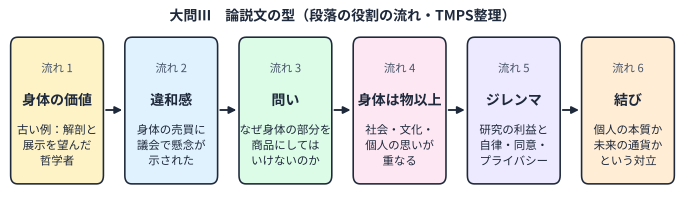
大問IIIの段落の役割の流れ:身体の価値、違和感、問い、身体は物以上、ジレンマ、結び
図D 大問IIIの文章の流れ(TMPSによる整理・本文ではありません)

空所A:4 This ought to be an exception。直前では「市場に任せれば問題は解決する」という考え方が紹介され、その直後に「それは正しい(It is very true)」と続き、空所Aのあと because で「人間に財産権を持たせたくないから」と理由が来ます。「例外であるべきだ、なぜなら…」とつながるのは4。2は because の前に not が入り、文の形が合いません。

空所B:3 becoming controversial。「人の組織の摘出・保存・加工という技術の進歩は( )のだろうか?」という疑問文。直後の「なぜ訴訟や抗議があるのか」とつながる「議論を呼ぶようになっている」の3。

空所C:4 without reference to the individual。「組織を取り出して使い、特許をとることは、( )、または本人の望みや社会的な必要を考えることなしに行える」。or の後ろの consideration of ~ と並ぶのは、「個人を考慮せずに」という4(reference と consideration が対応)。

空所D:1 the venture capital necessary to support。「遺伝子の特許は、お金のかかる研究を支えるために必要なベンチャー資金を呼び込む。一方で、特許がとれる見込みは、略奪的な行動も呼ぶ」という流れ。動詞 encourages の目的語になれるのは、名詞句の1。2〜4は encourages の後ろに続けると文が成り立ちません。

空所E:1 a sacred part of the human inheritance。「組織や遺伝子は、個人の本質であり( )なのか、それとも(取締役が言ったように)未来の通貨なのか」という二者択一。「通貨(市場の見方)」の反対側にあたる、「人間の受け継ぐ神聖なもの」の1。

空所X:文の完成。「What is the problem ____ ?」は、直前の「身体の断片化と商品化の何が問題なのか」を、別の言い方で聞き直す疑問文です。with + 動名詞で「~することの問題は何か」と書けます。

解答例:with treating the body as a commodity(7語)/ with treating body parts as commodities(6語)。「身体を商品として扱うこと」が書けていて、8語未満なら通ります。語数の数え間違い(冠詞・前置詞も1語)に注意。要確認

Writing Question:自由英作文。聞かれているのは「医学・科学の目的で人の組織を使うことのうち、何を認めるべきか」。賛成・反対ではなく、「どこまでを認めるか」の線引きを書く問題です。

型は4文:① 立場(条件つきで認める)→ ② 理由 → ③ 例 → ④ 結論。本文のテーマ(同意・プライバシー・商品化)を1つ使うと、内容が深くなります。

解答例(TMPS作成・92語):

I think human tissue may be used for medical or scientific purposes only when the donor has given clear consent and the research can save lives. For example, cord blood or tissue removed in surgery can help to develop treatments if patients are told how it will be used. However, selling body parts or patenting a person's genes without his or her permission should not be allowed, because it treats people as products. Therefore, laws should protect donors' privacy and require honest explanations, so that science can progress without harming human dignity.要確認

🎯 大問IIIの答え
空所A:4 This ought to be an exception / B:3 becoming controversial / C:4 without reference to the individual / D:1 the venture capital necessary to support / E:1 a sacred part of the human inheritanceX:(例)with treating the body as a commodity(7語)Writing Question:解答例は本文の通り(TMPS作成)
⚠️ Xの語数は、冠詞・前置詞も1語に数える。空所Dは「後ろに続く形」を見て、句が動詞 encourages の目的語になるかを確かめる。英作文は、日本語で考えてから英語にしない。簡単な文で、文法の誤りを避ける。
Yuiちゃん
Yuiちゃん
英作文は、何を書けばいいか思いつきません…。
Mio先生
Mio先生
「条件つきで認める」って決めちゃうのが一番安全。「同意を得た提供なら認める。売り買いは認めない」。これだけで4文書けるよ。
ニックニ先生
ニックニ先生
時間がなければ、先に結論の1文を書いておく。そのあとに理由と例を足せば、途中で時間切れになっても形が残る。
Mio先生の総整理表

大問III:論説+英作文の型

小問やること着眼点
A〜E句を選ぶ直前の文との関係(言い換え/逆)/ 後ろに続く語
X疑問文を完成with + 動名詞/8語未満/直前の疑問文の言い換え
Writing意見を書く立場→理由→例→結論/70〜100語/文法優先
TMPSコーチング診断

🩺【自己診断】大問IIIで手が止まった人への処方箋

  • A〜E選べない → 直前の1文が「賛成」か「反対」かを決め、同じ向きの選択肢に絞る
  • X書けない → 直前の疑問文の名詞を動名詞に変える(commodification → treating ~ as a commodity)
  • Writing何も浮かばない → 「条件つきで認める」と決め、条件を2つ(同意・売買の禁止)書く
ANSWERS

本番の答え一覧(採点用)

解説を読んだあとの採点用です。意味の判断はスクリプトでは確かめられないので、迷う所は「要確認」として分けています。公式の解答は公表されていないため、TMPSが自力で導いた答えです。

大問I(医学ニュース)

問1 (A) 4 promotes / (B) 2 subjected / (C) 1 composite / (D) 2 proxy / (E) 3 implicated問2 1 / 問3 4 / 問4 2 / 問5 3

大問II(幼いころの記憶)

問1 (A) 1 documented / (B) 4 empirical / (C) 2 prompting / (D) 2 elaborate / (E) 3 perspective問2 2 / 問3 2 / 問4 1 / 問5 1

大問III(人体の商品化)

A 4 This ought to be an exception / B 3 becoming controversial / C 4 without reference to the individual / D 1 the venture capital necessary to support / E 1 a sacred part of the human inheritanceX(例)with treating the body as a commodity(7語)Writing Question:解答例は大問IIIの解説(TMPS作成・92語)
⚠️ 要確認:(1) 意味が近い選択肢で迷う所:大問I 問1(B)(C)、問2、問3、問5、大問II 問1(C)(D)(E)、問2、問5。(2) X と Writing Question の「満点の書き方」は、公式の模範解答が公表されていないため、解答例はTMPSが作ったものです。(3) 大問II 問5は旧ページ(4)とTMPS(1)で答えが分かれています。本文の「言語能力」に関する1文で確かめてください。

※ 検算(スクリプト):全25小問の選択肢の数と答えの範囲、Xの語数(8語未満)、英作文の解答例の語数、小問数。意味の判断(どの選択肢が最も適切か)は機械では確かめられません。

採点したら → そっくり類題へ
TMPS ORIGINAL

慈恵医大2025型 そっくり類題セット
(全3大問・解答解説つき)

2025年度の本番と同じ3大問・同じ型で、題材を変えたTMPSオリジナルの英文です。大問I:腸内細菌の研究ニュース、大問II:再読と自己テストの学習研究、大問III:献血と市場を論じた英文+英作文。本番より短く作ってあります。

試験時間の目安 60分空所補充・内容把握・語数制限の文・英作文
📄 本番形式の問題冊子PDFをダウンロード(全6ページ)

印刷して、本番と同じように60分で解けます。解答・解説はこのページの下に掲載しています。

※ 東京慈恵会医科大学の入試問題ではありません。本文・設問・人物・団体(架空)はすべてTMPS医学館が作成したオリジナルで、出典のある引用ではありません。

類題 大問I 腸内細菌と回復力
  • 3つの英文は,すべてTMPS医学館のオリジナルです(人物・大学・団体・数値は架空)。本番の英文より短く作ってあります。
  • 選択肢は番号(1〜4)で答える。語数・行数の指定がある問題は,指定を守ること。

Read the following passage and answer the questions that follow.

Researchers at Halden University and the Fenwick Institute for Digestive Science say they have built a "resilience score" from a single stool sample. It may be a better guide to how quickly you will recover from an infection than your age, your weight, or how many vegetables you say you eat. "Two people can catch the same cold and have very different weeks," said Dr. Mara Olsen, the study's lead author. "Our gut bacteria seem to explain part of that gap."

The gut is home to trillions of microbes. In a healthy person, they help digest food, train the immune system, and crowd out harmful species. When this community loses its variety, the balance can tip. A narrow, unstable microbiome ( A ) the risk of long infections, allergies, and digestive disease. Until now, however, no everyday test could measure that instability.

The Halden team recruited 2,400 adults between 2015 and 2020. Their samples were ( B ) a panel of 60 bacterial species, and the volunteers reported every illness they had during the following year.

A machine-learning method then boiled all this data down to a single ( C ) that the team named the resilience score. Higher numbers meant a more varied and stable microbial community. Volunteers in the top fifth of scores recovered from respiratory infections three days faster, on average, than those in the bottom fifth.

To check that the score meant something, the team tried three tests. First, they followed 180 volunteers aged 70 or older for two years and found that a low score at the start predicted more hospital visits. Next, they examined samples from a rural village in northern Spain where many residents live past 90; the villagers' scores were, on average, equal to those of people thirty years younger. Finally, they turned to the Linden Health Study, a separate group of 5,000 adults whose samples had been stored but whose illnesses were never recorded. Their scores ( D ) significantly with the number of sick days the volunteers had taken from work.

Diet has long been ( E ) as the main driver of gut health, and the new study agrees in part: a fibre-rich diet raised scores. But one habit mattered more than any food. People who went to bed within an hour of the same time each night had scores about 12 percent higher than people with irregular sleep, even when they ate similar meals.

Olsen cautions that the score is not yet ready for the clinic. All 2,400 original volunteers were healthy city dwellers, and the score has not been tested in children or in people with chronic disease. "We want a doctor to use this the way she uses blood pressure," Olsen said. "We aren't there yet, but a simple test that shows who needs extra care early would be a real step forward."

問1 Choose the best word from the list to fill in blanks ( A )〜( E ) and write the number in the space on the answer sheet.
(A)
1. repeats2. declines3. cures4. raises
(B)
1. hosted2. screened3. equalized4. avoided
(C)
1. measure2. distance3. tradition4. shortage
(D)
1. consulted2. accounted3. correlated4. persuaded
(E)
1. reflected2. regarded3. confused4. refused
問2 Why did the researchers build the resilience score?
1. To find out why diets differ among cultures.2. To show that age does not affect infections.3. To measure how well a person's gut community may help recovery from illness.4. To identify the single bacterium that causes colds.
問3 What is the resilience score?
1. A count of the bacterial species in a village.2. A single number that sums up how varied and stable a person's gut microbes are.3. A record of how many illnesses a person has had.4. A list of foods that improve gut health.
問4 How did the team check that the score was meaningful?
1. They showed that older volunteers had higher scores than younger volunteers.2. They asked volunteers to rate their own health each year.3. They repeated the same test on the same samples ten times.4. They compared scores with later hospital visits, with long-lived villagers, and with sick leave in another group.
問5 What did the study find about sleep?
1. Regular bedtimes were linked to higher scores, even when meals were similar.2. Sleeping longer matters more than going to bed at a regular time.3. Diet matters less than the number of hours slept.4. Irregular sleepers ate more fibre.

▶ 大問I の答えと解説を見る

大問I 腸内細菌と回復力 の答えと解説

問1 (A)
(A) 4(raises)
  1. 「不安定な腸内細菌叢は,長引く感染症などの危険を( )」。意味が通るのは「高める」の raises だけ。declines は「断る・衰える」で,risk を高める意味にならず,cures は「治す」で反対,repeats は意味が合わない。
問1 (B)
(B) 2(screened)
  1. 後ろに for a panel of 60 bacterial species が続く。be screened for ~(~の有無を調べられる)が型どおり。hosted は by,equalized は to と結びつくので,for とは続かない。
問1 (C)
(C) 1(measure)
  1. 多くのデータを a single ( ) に「まとめた」のだから,「指標」の measure。a single measure that the team named ~ と読む。distance・tradition・shortage は,データをまとめた結果の名前にならない。
問1 (D)
(D) 3(correlated)
  1. Their scores ( ) significantly with the number of sick days:correlate with ~(~と相関する)。consulted with は「相談する」,accounted は for と,persuaded は人を目的語にとる。
問1 (E)
(E) 2(regarded)
  1. has long been ( ) as the main driver:be regarded as ~(~とみなされる)。reflected as,confused as,refused as は成り立たない(confused は with)。
問2
3
  1. 第1段落:同じ風邪でも回復に差が出る,その差を腸内細菌で説明したい。3 が目的に当たる。1・2・4 は本文にない(2 は「年齢より良い指標」とあるだけで,年齢が影響しないとは言っていない)。
問3
2
  1. 第4段落:機械学習でデータを a single ( ) にまとめたもの。数値が高いほど多様で安定。2。1 は村の調査の一部,3 は入力データの一部,4 は本文にない。
問4
4
  1. 第5段落の「3つのテスト」の要約が 4:高齢者の入院,長寿の村,別集団の病欠日数。1(むしろ村人の得点は若い人並み),2,3 は本文にない。
問5
1
  1. 第6段落:毎晩ほぼ同じ時刻に寝る人は,食事が同じ程度でも得点が約12%高い。1。2・3 は「睡眠時間の長さ」を言っていて本文と違い,4 は本文にない。
類題 大問II 再読と自己テスト

Read the following passage and answer the questions that follow.

Most students believe that the best way to prepare for an exam is to read the material again and again. A new study has ( A ) that this popular habit may be a poor investment. For the study, researchers at Corvale University asked 120 first-year students to read a 600-word passage about volcanoes. "Ours is the first ( B ) comparison of re-reading and self-testing in a university classroom," said psychologist Dr. Hannah Reiss, who led the project.

It has long been known that people forget new material quickly, and that cramming the night before an exam works only for a short time. Teachers have therefore tried many remedies, from colour-coded notes to longer lectures. But research now suggests that the key is not how often students see information but how they use it.

In the experiment, the students were split into two groups of 60. Group A read the passage a second time for ten minutes, ( C ) Group B closed the book and wrote down everything they could remember. Both groups then took a test five minutes later and returned one week later for a second test.

The results surprised the researchers. On the first test, the re-readers did better, recalling 83 percent of the key facts compared with 74 percent for the self-testers. They also felt far more confident, rating their own knowledge 7.8 out of 10 against 5.1 for the other group. One week later, however, the pattern reversed: Group B remembered 64 percent of the facts, but Group A remembered only 42 percent.

Reiss believes that re-reading creates an illusion of knowing. A page that has been seen before feels familiar, and familiar text is easy to read, so students mistake ease for learning. Trying to recall information is harder and sometimes frustrating, but the effort of pulling facts out of memory helps ( D ) the traces that hold them. Self-testing also gives learners honest feedback about their own ( E ), showing them what they do not yet know.

Reiss does not claim that re-reading is useless; a quick second look can help just before an exam. She recommends that students close their books after each chapter and write down what they remember. "It feels worse while you are doing it," she said, "and works better afterwards." The team now plans to test whether the same advice helps school children, whose study habits are still forming.

問1 Choose the best word from the list to fill in blanks ( A )〜( E ) and write the number in the space on the answer sheet.
(A)
1. resembled2. demonstrated3. concealed4. requested
(B)
1. careless2. accidental3. controlled4. optional
(C)
1. while2. unless3. until4. because
(D)
1. borrow2. dissolve3. predict4. strengthen
(E)
1. pressure2. fashion3. progress4. luggage
問2 According to the text, why did the re-readers feel so confident?
1. They had received feedback from the teacher.2. The material felt familiar and easy, which they mistook for learning.3. They had scored higher after one week.4. They had spent more time studying than the other group.
問3 What does Reiss recommend?
1. Reading each chapter three times.2. Studying only on the night before an exam.3. Avoiding any form of re-reading.4. Closing the book and writing down what you remember.
問4 What was surprising about the results?
1. Group A forgot all the facts within a week.2. Both groups produced exactly the same scores.3. Group B did worse at first but better after a week, while Group A felt more confident throughout.4. The self-testers rated their own knowledge higher at first.
問5 According to the text, what is one possible reason self-testing works better?
1. The effort of retrieving information strengthens memory.2. It is more enjoyable than reading.3. It takes much less time.4. It shows students the teacher's marking style.
▶ 大問II の答えと解説を見る

大問II 再読と自己テスト の答えと解説

問1 (A)
(A) 2(demonstrated)
  1. A new study has ( ) that ~:研究が「~ということを示した」。demonstrate that ~。resembled は that 節をとらず,concealed(隠した)は研究の目的に合わず,requested は that 節の中が「事実」になる文脈に合わない。
問1 (B)
(B) 3(controlled)
  1. the first ( ) comparison:研究者が自分たちの比較を誇る文脈。controlled comparison(条件を統制した比較)。careless・accidental・optional は,研究を誇る言葉にならない。
問1 (C)
(C) 1(while)
  1. A群は再読し,B群は本を閉じて書き出した,という「同時進行の対比」なので while。unless(~でなければ)・until(~まで)・because(理由)は,2つの群の並列の関係に合わない。
問1 (D)
(D) 4(strengthen)
  1. the effort of pulling facts out of memory helps ( ) the traces that hold them:「記憶の痕跡を強める」。strengthen。borrow(借りる)・dissolve(溶かす)・predict(予測する)は,思い出す努力の効果にならない。
問1 (E)
(E) 3(progress)
  1. honest feedback about their own ( ), showing them what they do not yet know:自分の「学習の進み具合」。progress。他の3つは feedback の対象として意味が通らない。
問2
2
  1. 第5段落:見たことのある文章は読みやすく,その「楽さ」を学習と取り違える(illusion of knowing)。2。1 は本文にない,3 は1週間後は B群が上,4 は両群とも10分で同じ。
問3
4
  1. 最終段落:章ごとに本を閉じて,覚えていることを書き出す。4。1・2 は本文にない,3 は「再読は無駄ではない(試験直前の見直しは役立つ)」と言っているので誤り。
問4
3
  1. 第4段落:最初のテストは再読群が上で自信も高かったが,1週間後は逆転。3。1(42%は覚えている),2,4(自己評価は再読群のほうが高い)は本文と合わない。
問5
1
  1. 第5段落:思い出す努力が記憶の痕跡を強める。1。2 は「時に苦痛」と逆,3・4 は本文にない。
類題 大問III 献血と市場

Read the following passage and answer the questions that follow.

In many countries, giving blood is a quiet public duty. Nobody is paid, nobody is thanked in the street, and yet hospitals depend on the supply. In 1971 the economist Lena Hartmann argued that a nation that pays for blood risks losing something that money cannot replace.

Some economists find this arrangement puzzling. If a good is scarce and valuable, they say, the sensible response is to pay for it. Higher prices would bring more donors, shortages would disappear, and nobody would be harmed. ( A ) because the donor chooses freely and the patient receives safe blood.

But what is troubling about putting a price on blood? What is the problem X? Why shouldn't donors be paid like any other workers?

Hartmann's answer was that payment changes the meaning of the act. When money enters, people who once gave out of concern for strangers begin to ask what they will receive. Worse, those most willing to sell are often the ones who most need the money, and some may hide illnesses to avoid being turned away. In several countries paid donation has ( B ) a rise in contaminated supplies.

Supporters of payment reply that modern screening makes such risks small. They add that unpaid systems ( C ) shortages whenever demand rises sharply, as it did during the pandemic.

A middle path may exist. Several hospitals now thank donors with a day off or a small gift card instead of cash. Such rewards are harmless, defenders say, ( D ) the amount stays small enough that no one gives blood only for the prize. Critics reply that the line between a thank-you and a wage is hard to draw.

Blood is not like other goods. It comes from a living body and carries a stranger's hope. To ask whether it should be sold is to ask whether some things should stay outside the market — or whether, as one broker is said to have claimed, blood is simply ( E ).

Choose the most appropriate option from the ones given below and write the number in the space on the answer sheet.

A Choose the best phrase to fit blank ( A ).
1. No one would agree2. This seems reasonable3. It has already failed4. Nobody is surprised
B Choose the best phrase to fit blank ( B ).
1. been absent from2. been proud of3. been used to4. been followed by
C Choose the best phrase to fit blank ( C ).
1. hope for2. look after3. suffer from4. answer for
D Choose the best phrase to fit blank ( D ).
1. as long as2. in case of3. on behalf of4. more than
E Choose the best phrase to fit blank ( E ).
1. a symbol of kindness2. a product like any other3. a sacred duty of citizens4. a danger to the poor
X Finish the question by filling in blank X with fewer than eight words to best fit the context of the passage.
Writing Question In your opinion, should people be paid for donating blood or other materials from the human body? Give reasons and examples. Answer in English. (解答欄:約19.5cm × 11行)
▶ 大問III の答えと解説を見る

大問III 献血と市場 の答えと解説

A
2
  1. 直前の経済学者の主張(値段をつければ供給が増える)を受けて,「これはもっともに思える,なぜなら提供者は自由に選び,患者は安全な血液を受け取るから」。because 以下が理由になるのは 2 だけ。1・3 は because 以下と矛盾し,4 は理由として意味が通らない。
B
4
  1. 「有償の提供は,汚染された血液の増加に( )」。paid donation has been followed by a rise in ~(~の増加を伴った)。absent from ~ は「~がない」,proud of・used to は a rise を受ける意味にならない。
C
3
  1. 無償の制度も,需要が急増すれば不足に「苦しむ」。unpaid systems suffer from shortages。hope for shortages(不足を望む)は不自然,look after・answer for は目的語が合わない。
D
1
  1. 「金額が小さい限り,誰も景品のためだけに献血はしない」という条件の文。as long as ~(~である限り)。in case of・on behalf of は後ろに文(the amount stays ...)を続けられない。more than も接続の働きをしない。
E
2
  1. 直前の or whether は,「市場の外に置くべきか」と対になる考え方。ブローカーの言い分は「血液は他の商品と同じ商品にすぎない」。a product like any other。1・3 は市場の外に置く側の考え方で,対比にならず,4 は本文のブローカーの主張ではない。
X
(例)with treating blood as an ordinary product(7語)(別解)with putting a price on human blood(7語)
  1. What is the problem ____ ? の形で,直前の文(血に値段をつけることの何が問題か)を言い換える。with + 動名詞(treating / putting / buying and selling ...)で,「血液を普通の商品として扱うことの問題は何か」と書けばよい。8語未満の条件(7語以内)を数える。解答例はTMPSが作ったもの。
Writing Question
(解答例)I believe people should not be paid for donating blood, but small thank-you gifts should be allowed. When money is the main reason to give, people who are poor may feel pressured, and some may hide illnesses to be accepted. For example, several countries that began paying donors reported more unsafe blood. On the other hand, a day off or a small gift can show respect for donors without turning blood into a wage. Hospitals should therefore keep donation voluntary and focus on thanking donors, not on buying their blood.
  1. 型:意見(賛否)→ 理由 → 例 → まとめ。解答例は,①立場(有償はよくない,ただし小さな謝礼はよい)→ ②理由(貧しい人への圧力,病気を隠す危険)→ ③例(有償化で血液の質が落ちた国,休暇や小さな贈り物)→ ④結論,の順。11行(約100語前後)に収める。解答例はTMPSが作ったもの。賛成の立場でも書ける(その場合は,供給不足の解消などを理由・例にする)。

※ 類題は、本番の型(大問I・IIは空所5つ+内容把握4問、大問IIIは句の選択5つ+語数制限の文+英作文)を残して、題材を変えて作っています。登場する人名・大学・団体・数値はすべて架空です。

CHECK

30秒 得点診断

本番の過去問、またはそっくり類題セットを60分で解いた結果を選んでください。次にやるべきことを表示します。

大問I(医学ニュース・問1〜5)
大問II(学習・記憶・問1〜5)
大問III(論説+英作文)
FOR PARENTS

保護者の方へ:慈恵医大の英語で知っておきたい3つのこと

① 60分・3題・最後は英作文
長文を3題読んで答え、最後に自由英作文(約11行)を書きます。読むスピードと、書く時間の確保の両方が必要です。
② 専門語より「文の流れ」
医学や心理の話題が出ますが、専門語が分からなくても、設問の語を本文で探して根拠の1文に戻れば解けるように作られています。
③ 英作文は「見てもらう」
英作文は、独学では良し悪しが分かりにくい部分です。第三者の目で、文法の誤りや論理の抜けを見てもらうと、最短で伸びます。
FAQ

よくある質問

Q. 東京慈恵会医科大学 医学部の英語2025年度は、どの順番で解くのがよいですか?

英語は60分で、大問は3つです。TMPSのおすすめは「大問I 17分・大問II 17分・大問III 21分・見直し5分」です。大問IIIは自由英作文(約19.5cm×11行)があるので、空所A〜EとXを先に取り、英作文は必ず時間を残して書き切ります。得意なら大問IIから始めて構いません。

Q. 問題文(英文)が載っていなくても、どんな問題か分かりますか?

分かります。著作権に配慮して英文・設問文は掲載していません。その代わりに、各大問の最初に「どういう問題か」として、段落の役割の流れ、小問の種類、答える形(番号・語句・英文)をTMPSの言葉で説明しています。

Q. 答えは、どうやって確かめていますか?

選択肢の数・答えの番号の範囲・Xの語数(fewer than eight words)・英作文の語数は、スクリプトで確かめています。一方、「どの選択肢が最も適切か」という意味の判断は機械では確かめられないので、迷う所には「要確認」と明記しました。公式の解答は公表されていないため、答えはTMPSが自力で導いたものです。英作文の解答例もTMPSが作ったものです。

Q. 空所補充(語の選択)は、どうやって選べばいいですか?

「後ろにどんな語がつくか(前置詞・that節)」「前後の文が言っていることと同じ向きか逆向きか」の2つで絞ります。意味が似た選択肢が2つ残るときは、直後の語(to / for / as / with)との結びつきで決めます。

Q. 自由英作文は、何語くらい書けばいいですか?

解答欄は約19.5cm×11行です。TMPSの目安は70〜100語。「立場 → 理由 → 例 → 結論」の4文を、短い文でつなぎます。難しい表現より、文法の誤りがないことを優先します。

Q. そっくり類題セットとは何ですか?

2025年度と同じ3大問の構成(大問I・IIは空所補充+内容把握、大問IIIは句の選択・語数制限つきの文の完成・英作文)で、題材を変えたTMPSオリジナルの英文です。全25問の答え・解説をこのページに掲載し、本番形式の問題冊子PDFも無料で配布しています。

Q. 解説に誤りを見つけたらどうすればいいですか?

公式LINEからお知らせください。確認のうえ修正し、更新日を記載します。

安心安全・継続更新システム

問題等で誤りを発見された場合、修正しますので、TMPS医学館までLINEを下さい。

受験生・指導者の皆様からのご指摘を真摯に受け止め、最も信頼できる過去問解説・類題ライブラリーとして随時アップデートいたします。

LINEで誤りを報告・相談する

一緒に医学部を目指す友達にシェア 📣

🔥 次に読むならこちら

毎月先着3名・無料

慈恵医大の英語を、
あなたの答案で攻略する

「どこで時間を失ったか」「空所補充で選び間違える癖」「英作文でどこが減点されそうか」を、Mio先生・ニックニ先生があなたの答案から直接診断します。