問1(A):2 unexpected。最初の文の「偶然の幸運な〜」に入る語。直後で「多くの人が少しずつ積み重ねた発見」と対比されるので、「予期しない」が合います。
📌 このページの使い方
- 過去問集をお持ちの方:60分で解き、答え一覧で採点してから解説へ
- お持ちでない方:各大問の「どういう文章か」を読めば、問題の中身がそのまま分かります
- 最後にそっくり類題セット(PDF版あり)を60分で解き、初見でも同じ解き方ができるか確かめる
※ 著作権に配慮し、英文の本文・設問文は掲載していません(引用は短い語句まで)。図はTMPSが作成した解説用の図です。※ 空所補充は意味で判断が割れうるものを「要確認」、英作文・自由記述は「解答例」と示し、断定していません。
⚠️ 問題等で誤りを発見された場合、修正しますので、TMPS医学館までLINEを下さい。(迅速に確認・更新いたします)
LINEで誤りを連絡3分で分かる 2026年度の慈恵医大の英語
- ✅ 60分・長文3題。Ⅰは空所補充(A〜F)と内容把握(2〜5)、Ⅱは空所補充(A〜F)と7語未満の英作(X)、Ⅲは空所補充(A〜E)と、指定の書き出しで続きを書く英作文です。
- ✅ Ⅰは医学史(インスリンの発見)。多くの研究者の積み重ねで進んだ発見の流れを追う文章です。空所は語彙(単語を選ぶ)で、前後の対比で決まります。内容把握は、本文のどの段落を見るかを決めれば迷いません。
- ✅ Ⅱは「信念が身体に影響する」ことの実例。ある医師が患者に「呪いは解けた」と信じさせて救う逸話です。空所は句を選ぶので、文の構造(主語と動詞)をつかむ力が必要です。
- ✅ Ⅲは認知バイアス(頻度錯覚)。空所は文法・語法が中心で、最後に英作文(約19.7cm×7行)が出ます。
- ✅ 差がつくのは、Ⅲの英作文と、Ⅱの逸話の時間の流れの把握。英作文は、時間を確保しないと書く量が足りなくなります。

Yuiちゃん
長文が3つもあって、60分で終わるか不安です…。
Mio先生
空所は、まず「文法で決まるもの」を瞬殺するのがコツ。迷うものは印をつけて、最後に回すのよ。
ニックニ先生
時間配分は 18・18・24。Ⅲの英作文に10分は残しておこう。ここを削ると、書き始めるのが遅れてしまうよ。Yuiちゃん
英作文はいつも何を書いていいか分かりません…。Mio先生
本文の要点を言い直して、「だから大切」とまとめる型で書けば大丈夫。このページの答案例を真似してみてね。英語60分の立ち回りマップ
時間はTMPSの目安です。
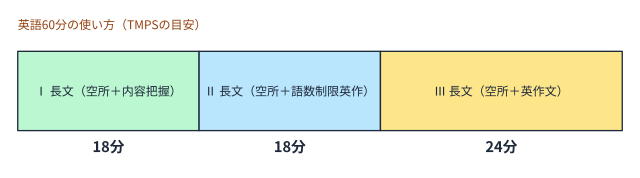
🧭 おすすめの解く順番
Ⅰ → Ⅱ → Ⅲ(Ⅲの空所を先に済ませて、英作文の時間を確保)
Ⅲの空所は文法・語法が中心で短時間で取れます。Ⅰ・Ⅱで迷った空所には印をつけ、最後にまとめて見直します。
大問Ⅰ ── 医学史:インスリンの発見(語彙の空所補充+内容把握)
現場戦略試験会場でのリアルな立ち回り(大問Ⅰ)
⏱ 目標時間 & 死守ライン目標18分。空所A〜Fに7分、内容把握2〜5に9分。
⚠️ 損切り・警戒ライン空所で1つの語に3分以上使わない。印をつけて、内容把握に進む。
💡 初手の思考トリガー空所は、直前の形容詞・動詞との対比や因果を見る。内容把握は、設問の語句を本文で探して、その前後の段落だけを読む。
📝 どういう問題か?
19〜20世紀の糖尿病研究の歴史を、10段落で追う長文。昔の誤解、犬の実験、膵臓の細胞の研究、バンティングらの技術、功績をめぐる人間関係、そして大量生産までの流れが書かれている。「偶然の大発見」と「多くの人の積み重ね」の対比で始まる。
- 問1:空所A〜Fに入る語を、リストの4つ(番号1〜4)から1つずつ選ぶ(語彙・語法)
- 問2:糖尿病が腎臓の病気だと考えられた最初の理由(4択)
- 問3:膵臓に病気を防ぐ物質があると確かめた方法(4択)
- 問4:ランゲルハンス島だけから物質を得た方法(4択)
- 問5:コリップの貢献(4択)
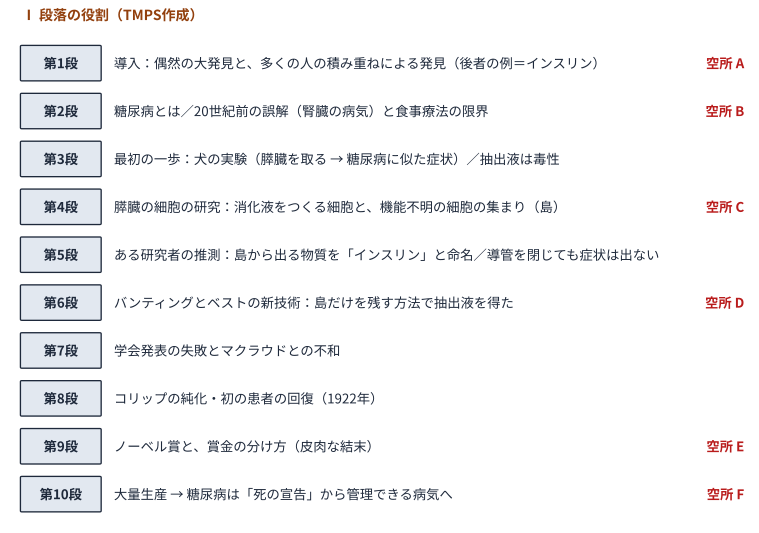
(B):4 prolong。食事療法は患者の命を「数年だけ〜する」。延命にとどまった(治せなかった)という文脈なので「延ばす」です。increase / expand は「命」とは相性が悪く、survive は後ろに目的語をとれません。
(C):2 suspended。<span class="todo-flag">要確認</span>「機能不明の細胞の集まりが、膵臓の中に〜状態で見つかった」。膵臓の組織の中に散らばっている様子で、found + 過去分詞の形になるのは suspended(浮かんで、散らばって)が自然。dead は不自然、uncovered は found と意味が重なり、placed は「置かれた」で不自然です。
(D):3 remains。<span class="todo-flag">要確認</span>新しい方法で腺房細胞を死なせ、島だけを残して液を得た。「健康な犬の膵臓の残ったものから」得たという流れなので remains。
(E):4 reacted。バンティングが賞を助手と分けると発表し、マクラウドは「〜することで反応した」。目的語なしで「by 〜ing」が続くので、自動詞の reacted です。provoked・angered・confronted は目的語(誰を)が必要です。
(F):1 commercial。<span class="todo-flag">要確認</span>製薬会社が大量に生産した「市販の」インスリン。他の選択肢は、名詞 insulin の前に置く形容詞として不自然です(commodity は名詞)。
問2:4。第2段落に、患者が頻繁に排尿し、尿が甘かったとあります。「尿の状態が変わった」ので腎臓の病気と考えた、が正解です。選択肢1は「甘いものをよく食べた」という別の話です。
問3:4。犬の膵臓を取り去ると糖尿病に似た症状が出たが、導管を閉じただけでは症状が出なかった(第5段落)。つまり、消化液の通り道ではなく、膵臓の中の別の物質が病気を防いでいる、と確かめられました。
問4:2。腺房細胞を死なせて、島だけを残す技術(第6段落)。選択肢2「島以外のすべての細胞を殺す方法を見つけた」が一致します。選択肢4は「腺房細胞を封じて維持した」で、逆の内容です。
問5:3。第8段落:マクラウドとコリップは、バンティングの方法を使って、ウシの膵臓から、より純度の高いインスリンを抽出した。選択肢3が直接の言い換えです。選択肢4は、「コリップの努力で抽出量が増えた」という結果と、原因を取り違えた内容です。選択肢1(少年の血糖値を戻した)は、コリップ個人の貢献ではなく、2(製薬会社を助けた)は本文にありません。
Mio先生の整理
空所の根拠
| 空所 | 答え | 根拠(本文のどこを見るか) |
|---|---|---|
| A | 2 unexpected | 「偶然の幸運」と「積み重ね」の対比 |
| B | 4 prolong | 食事療法は延命にとどまる |
| C | 2 suspended | 膵臓の組織中に散らばる細胞(要確認) |
| D | 3 remains | 島を残した後の「残り」(要確認) |
| E | 4 reacted | 自動詞+by 〜ing |
| F | 1 commercial | 市販のインスリン(要確認) |
⚠️ 空所(E)は、意味だけで angered などを選ばない。後ろに目的語がなく by 〜ing が続くので自動詞です。内容把握は、選択肢の一部だけが本文に一致する「ひっかけ」に注意(問2の1、問4の4、問5の4)。
Yuiちゃん
(E) は、angered でも意味は通りそうで迷いました。Mio先生
意味だけで選ぶと危ないのよ。angered は「〜を怒らせた」で、目的語が必要。ここは目的語がなくて by 〜ing につながるから、自動詞の reacted だけが入るの。ニックニ先生
品詞と語法の確認は、空所補充で一番確実に点になる部分だよ。TMPSコーチング診断
🩺【自己診断】大問Ⅰで手が止まった人への処方箋
- 空所2つで迷う → 後ろに目的語があるか、品詞は何かを先に確認
- 内容把握選べない → 設問の語句を本文で探し、その前後の段落だけを読んで、一致する選択肢を探す
- 時間空所に時間をかけすぎる → 3分で見切りをつけ、印をつけて次へ
大問Ⅱ ── 「信念が身体に影響する」ことの実例(句の空所補充+英作)
現場戦略試験会場でのリアルな立ち回り(大問Ⅱ)
⏱ 目標時間 & 死守ライン目標18分。A〜Fに12分、Xに6分。
⚠️ 損切り・警戒ライン空所は句(フレーズ)を選ぶので、選択肢を読む前に「主語は誰か・時制は何か」を確認する。
💡 初手の思考トリガー時間の流れを追う(過去の逸話)。空所の直前・直後の動詞で、品詞と時制から絞る。
📝 どういう問題か?
信念が身体に影響することを示す実話の長文。従来の医学モデルを信じていた医師が、患者が「病気だと信じて」病気になる例に出会い、最後に、呪いをかけられて死にかけた患者を、医師が「呪いは解けた」と信じさせて救う、という逸話が語られる。
- A〜F:文の空所に入る最も適切な句を、4つの選択肢(番号1〜4)から選ぶ
- X:文章の最後の空所に、7語未満の英語を入れて、文脈に合う文を完成させる
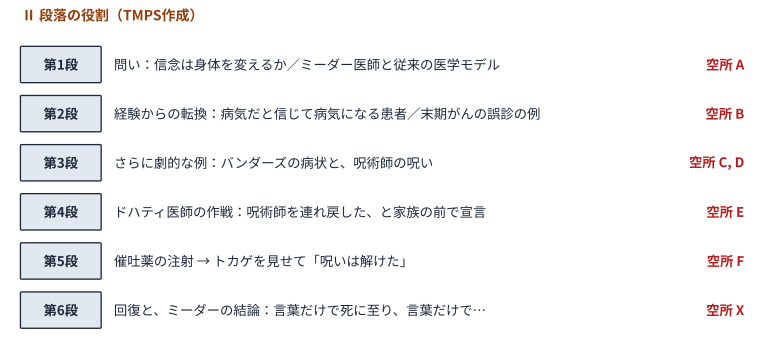
A:3 cure the symptoms。従来のモデルは「身体の問題が症状を起こし、核心の問題を治療すれば症状は〜」。治るはずだ、という内容。1(治せない)・2(うまく治療できない)は、「核心を治せば〜」という流れに合いません。4(問題を解決してしまった)は、症状の話になりません。
B:1 had got it wrong。死後の検査で医師たちは〜だった、と続き、直後に「その患者はがんではなかった」。診断を誤った、です。
C:2 reveal what the problem was。検査のたびに〜できなかった。原因を明らかにできなかった、が自然です。
D:1 staggered home in shock。呪いの言葉を聞いて、ショックで帰宅し、それ以来何も食べていない、という流れ。直前の呪いの場面と、後ろの「食べていない」につながる唯一の選択肢です。
E:4 they hatched out。呪術師が「トカゲの卵を皮膚にすり込み、胃に入ったものがある」と言う場面。胃の中で卵が「かえった」、が内容に合います。
F:2 injected what was in fact。<span class="todo-flag">要確認</span>看護師が強い催吐薬を「注射した」。文の構造は、as he ( F ) a strong emetic into Vance's arm。injected what was in fact は、「実は強い催吐薬であるものを注射した」という形で、a strong emetic が続きます。他は、後ろの a strong emetic とつながる形になりません。
X:解答例 undo the curse and save him(6語)。<span class="todo-flag">要確認</span>直前の「言葉だけで、死に至らせることができた」の対になる内容を入れます。「言葉だけで、実際に〜できた」=呪いを解いて命を救えた、という意味です。7語未満の条件を守るため、動詞+目的語で簡潔にまとめます(他の表現も可)。
Mio先生の整理
空所の根拠
| 空所 | 答え | 根拠(本文のどこを見るか) |
|---|---|---|
| A | 3 cure the symptoms | 従来のモデル:核心を治せば症状は治る |
| B | 1 had got it wrong | 直後に「がんではなかった」 |
| C | 2 reveal what the problem was | 検査で原因が分からなかった |
| D | 1 staggered home in shock | 呪いの直後・「食べていない」へつながる |
| E | 4 they hatched out | 卵が胃の中でかえった |
| F | 2 injected what was in fact | 催吐薬を注射した(要確認) |
⚠️ 空所補充の句は、選択肢の語に引っ張られて意味だけで選ばないこと。主語・動詞・時制を確認してから選ぶ。Xは語数(7語未満)を必ず数え直す。
Yuiちゃん
Xは何を書けばいいのか分からなくて、手が止まりました。Mio先生
まず直前の文を見て。「言葉だけで死に至らせた」でしょう? だから最後は「言葉だけで救えた」。これを7語未満で書けばいいの。ニックニ先生
書いたら、必ず指で数えてね。6語以内なら安心だよ。TMPSコーチング診断
🩺【自己診断】大問Ⅱで手が止まった人への処方箋
- A〜F句の選択で迷う → 空所の前後の動詞・時制・主語を確認し、文として成り立たないものを消す
- X何を書くか分からない → 直前の文の「対」を考える(言葉で死に → 言葉で救えた)
- 時間長文が読みきれない → 逸話の時間の流れ(症状→呪い→作戦→回復)を追う
大問Ⅲ ── 頻度錯覚(空所補充A〜E+指定書き出しの英作文)
現場戦略試験会場でのリアルな立ち回り(大問Ⅲ)
⏱ 目標時間 & 死守ライン目標24分。空所A〜Eに8分、英作文に16分(構想3分+執筆10分+見直し3分)。
⚠️ 損切り・警戒ライン空所は文法・語法で決まる。迷えば印をつけて、必ず英作文の時間を残す。
💡 初手の思考トリガー英作文は、本文の要点 → 重要な理由 → 具体例 → 結論の順に、本文の語句を使って書く。
📝 どういう問題か?
「新しいことを知った後、急にあちこちで目にする」という現象(頻度錯覚)の説明文。理由として、選択的注意と確証バイアスが挙げられ、広告での利用、言語学習での良い面、診断での悪い面が述べられる。最後に、結論の段落を書く。
- A〜E:文法・語法の空所補充(4択)
- 英作文:文章の最後に示された書き出し(Therefore, it is important to be aware of …)に続けて、結論を英語で書く。解答欄は約16.5cm×1行と約19.7cm×7行(解答用紙の想定)
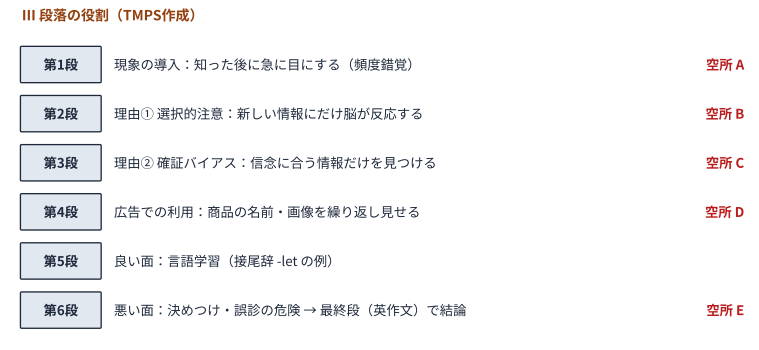
A:4 being walked。seeing + 目的語(Chihuahuas)+ 〜ing / 過去分詞。犬は「散歩させられる」側なので受け身の being walked。
B:4 deem。「重要で関連があると〜しないもの」は無視する。deem + O + C(OをCとみなす)の形で、significant が補語。weigh(量る)や prove は補語をとる形に合いません。
C:3 contradicts。確証バイアス=信念を確かめる情報には注目し、信念と「矛盾する」情報は無視する。contradict は他動詞で、them を目的語にとります。
D:3 in its category。広告は、商品が「そのカテゴリーの中で」最良・最も人気に見えるようにする。最上級の範囲を示す in。
E:4 close enough。症状が新しい病気の症状に「十分近い」場合、その病気と診断しやすい。形容詞 + enough + to 不定詞(to those of …)の形。
Mio先生の整理
空所の根拠
| 空所 | 答え | 根拠(本文のどこを見るか) |
|---|---|---|
| A | 4 being walked | seeing + O + 受け身の進行形 |
| B | 4 deem | deem + O + C |
| C | 3 contradicts | 信念と矛盾する情報を無視 |
| D | 3 in its category | 最上級の範囲を示す in |
| E | 4 close enough | 形容詞 + enough + to 〜 |
英作文(Therefore, it is important to be aware of … に続ける):解答例と型。<span class="todo-flag">要確認</span>指定の書き出しを正確に写し、本文のまとめ(頻度錯覚が起こる理由)→ 悪い面(医師の診断)→ 対策、の順で書きます。以下は83語の解答例です。
Therefore, it is important to be aware of the frequency illusion in our daily lives. Because our brains notice what we have just learned and ignore what contradicts our beliefs, we may wrongly think that something has become more common or more likely. This is especially true for doctors, who must not rush to diagnose a new disorder simply because it is fresh in their minds. By considering other possibilities and checking the evidence carefully, we can avoid misdiagnosis and make better decisions.
型:①指定の書き出し(なぜ「意識すべき」か)→ ②本文の理由を言い直す(選択的注意・確証バイアス)→ ③特に医師で危険(誤診)→ ④対策(他の可能性・証拠の確認)。1文ずつ短く、本文の語句を活かすと、文法ミスが減ります。
⚠️ 書き出しの「Therefore, it is important to be aware of」は1行目に正確に写す(ピリオドや語の抜けに注意)。文は「aware of +名詞」になるので、名詞(句)で終わらせてから、続きの文で理由を書く。
Yuiちゃん
書き出しのあと、何から書けばいいですか?Mio先生
まず「aware of」のあとに、この文章のテーマ(頻度錯覚)を入れて、1文目を完成させて。次の文で「なぜ」を、本文の語句で説明するのよ。ニックニ先生
時間は、構想3分・執筆10分・見直し3分。見直しは、主語と動詞の一致と、冠詞を確認しよう。TMPSコーチング診断
🩺【自己診断】大問Ⅲで手が止まった人への処方箋
- 空所文法で迷う → 空所の前後の品詞と、直前の動詞の語法(deem + O + C など)を確認
- 英作文何を書くか分からない → 「テーマ → 理由 → 具体例(医師)→ 対策」の4文で組み立てる
- 時間空所に時間をかけすぎる → 8分で切り上げ、必ず英作文に16分を残す
本番の答え一覧(採点用)
解説を読み終えた後の採点用です。番号の範囲と語数はpythonで確かめ、意味で判断が割れうるものは「要確認」、英作文は「解答例」としています。
大問Ⅰ
問1 A 2 / B 4 / C 2(要確認)/ D 3(要確認)/ E 4 / F 1(要確認)問2 4問3 4問4 2問5 3
大問Ⅱ
A 3 / B 1 / C 2 / D 1 / E 4 / F 2(要確認)X(解答例)undo the curse and save him(6語)
大問Ⅲ
A 4 / B 4 / C 3 / D 3 / E 4英作文:解答例は大問Ⅲの解説(83語)
⚠️ 要確認:大問Ⅰ 問1の C・D・F、大問Ⅱの F・X、大問Ⅲの英作文は、意味や表現で判断が割れうるため、断定していません。選択肢の番号・並びは問題冊子で確かめてください。
※ 検算:選択肢の番号が1〜4の範囲にあること、Xが7語未満であること、英作文の書き出しと語数を、pythonで確かめました。
採点したら → 30秒の得点診断へ
TMPS ORIGINAL
慈恵医大2026型 そっくり類題セット
慈恵医大2026型 そっくり類題セット
(全3題・解答解説つき)
2026年度の本番と同じ3題・同じ型(空所補充A〜F+内容把握、空所補充A〜F+語数制限つき英作、空所補充A〜E+英作文)で、英文をTMPSがオリジナルで書いた問題です。人物・団体・地名はすべて架空です。語彙の空所、句の空所、文法・語法の空所、英作文を一通り練習できます。
試験時間の目安 60分医学史・逸話・認知バイアス
📄 本番形式の問題冊子PDFをダウンロード(全7ページ)
印刷して、本番と同じように60分で解けます。解答・解説はこのページの下に掲載しています。
※ 東京慈恵会医科大学の入試問題ではありません。本文・設問・人物・団体(架空)はすべてTMPS医学館が作成したオリジナルで、出典のある引用ではありません。
類題 Ⅰ 長文(空所補充 A〜F+内容把握 2〜5)
- 本問題の英文は,TMPS医学館が作成したオリジナルです。人物・団体・地名はすべて架空です。
- 各問いの答えは,解答用紙(想定)に番号で記入すること(Ⅲの英作文を除く)。
Read the following passage and answer the questions that follow.
Some of the most important discoveries in medicine were the result of an A, fortunate mistake by a single researcher. Many others, however, came from the slow work of many people, each adding a little to what had been learned before. Such was the case with one of the great public health successes of the 19th century, the discovery of how tidewater fever spreads.
Tidewater fever is an infection that causes a high temperature, pain in the joints, and a deep tiredness that can last for weeks. Before the 1880s, doctors in the port town of Carrow believed that it was caused by bad air rising from the harbor mud, because every year the outbreaks began in midsummer, when the tide flats dried out in the heat. The standard advice was to keep the windows shut at night. This advice could only B residents' discomfort a little, and the disease returned every summer.
The first step towards the truth came in 1884, when a physician named Anselm Kroll noticed that sailors sleeping on ships anchored far from the shore rarely became ill, while fishermen living by the water often did. He collected water from the tide flats and found tiny living things in it. When he injected the water into guinea pigs, however, they died within hours of other causes, so the water could not be used to show anything about the disease.
At that time, the part played by insects in spreading disease was hardly understood. Ten years earlier, a naturalist named Ines Varga had described a small biting fly that lived only in the salt marshes around Carrow. Large numbers of the flies were found C in the mud of the marsh during the day, and they came out to feed at dusk. Varga suggested in her report that the fly might carry a disease, but few doctors read it.
Kroll came across her report by chance and wondered whether the fly was the missing link. He asked a young colleague, Tobias Lind, to make fine nets and hang them over the beds of families in the harbor district. In houses where the nets were used, no new cases appeared that summer, while neighboring houses without nets suffered as before. The fly, not the air, was spreading the fever.
In 1891, the city council gave Kroll a gold medal for his work, but Varga's name did not appear on the certificate. Kroll was embarrassed, so he announced that he would give half of the prize money to her. Lind D by announcing that he would share his own small reward with the nurses who had hung the nets. So, ironically, because the doctors were so eager to be fair to one another, the credit for the discovery ended up spread among many more people than anyone had expected.
By 1895, the city had begun producing enough E netting for every home in the harbor district, and the number of cases F sharply within a few years. Later improvements in drainage and in the design of houses made the protection even stronger. Thus, the discovery turned a yearly threat into a disease that most people in Carrow no longer feared.
1 Choose the best word from the list to fill in blanks ( A )〜( F ) and write the number in the space on the answer sheet.
A1. unplanned2. unforgiving3. unreasonable4. unclear
B1. lessen2. ignore3. deserve4. cause
C1. hidden2. interested3. arrived4. needed
D1. provoked2. offended3. confronted4. responded
E1. protective2. protection3. protects4. protected
F1. fell2. was fallen3. falling4. had fall
2 Choose the best answer for each question according to the text and write the number in the space on the answer sheet. What originally led doctors in Carrow to believe that tidewater fever came from the air?
1. Many patients lived beside the harbor mud.2. The outbreaks started in midsummer, when the tide flats dried out.3. Sailors on anchored ships rarely became ill.4. The disease was worse when the windows were shut.
3 Why could Kroll not use the water from the tide flats to show what caused the disease?
1. It contained no living things.2. The guinea pigs that received it died of other causes.3. It was too dirty to be collected safely.4. Sailors refused to drink it.
4 How did Lind's nets help to test Varga's idea?
1. The flies were caught and counted every evening.2. Families with nets moved away from the marsh.3. No new cases appeared in the houses that used the nets.4. The nets showed that the flies carried guinea pigs.
5 What was Varga's contribution to the discovery?
1. She cured the first patients with tidewater fever.2. She made the nets that were hung over the beds.3. She described a fly that lived only in the salt marshes and suggested it might carry a disease.4. She won the city's gold medal in 1891.
▶ Ⅰ の答えと解説を見る
Ⅰ 長文(空所補充 A〜F+内容把握 2〜5) の答えと解説
1 (A)
1 unplanned
- "a( n ) ___, fortunate mistake" は「偶然の,幸運な間違い」。後ろの a lucky mistake に合うのは unplanned(計画されていない)。
- unforgiving(容赦ない)・unreasonable(理不尽な)・unclear(はっきりしない)は,fortunate と並べて意味が通らない。
1 (B)
1 lessen
- could only ( B ) residents' discomfort a little =「住民の不快感を少しだけ〜できるだけ」。直後に the disease returned とあるので,効果は小さい → lessen(和らげる)。
- cause(引き起こす)は逆の意味。ignore・deserve は目的語 discomfort と合わない。
1 (C)
1 hidden
- were found ( C ) in the mud = 泥の中に〜な状態で見つかった。found + 過去分詞。hidden(隠れて)だけが自然。
- interested・arrived・needed は,found の後ろに置いても意味が通らない(found interested など)。
1 (D)
4 responded
- Lind ( D ) by announcing ... = Lind は〜することで…した。目的語がないので,自動詞の responded(応じた)が入る。
- provoked・offended・confronted は他動詞で,目的語(誰を)が必要。ここには目的語がない。
1 (E)
1 protective
- enough ( E ) netting = 名詞 netting を修飾する形容詞が必要。「保護用の網」= protective。
- protection は名詞,protects は動詞の形。protected(保護された)は,網が保護される意味になり,文脈に合わない。
1 (F)
1 fell
- the number of cases ( F ) sharply = 主語 the number of cases に対する述語動詞が必要。「減った」= fell(過去形)。
- fall は自動詞なので受動態 was fallen は不可。falling は動詞の形ではなく,had fall は形が誤り。
2
2
- 第2段落:毎年,潮が引いた干潟が暑さで乾く真夏に流行が始まる → 港の泥から悪い空気が出ると考えた。→ 2。
- 3は第3段落(Kroll が気づいた事実)で,空気説の根拠ではない。1・4は本文にない。
3
2
- 第3段落:水をモルモットに注射すると,数時間以内に別の原因で死んだ → 病気について何も示せなかった。→ 2。
- 1は,水の中に小さな生き物を見つけたという本文と逆。
4
3
- 第5段落:網を使った家では,その夏に新しい患者が出なかった。網のない近所の家では従来どおり患者が出た → ハエが原因という考えを支持。→ 3。
5
3
- 第4段落:Varga は,塩性湿地にだけ住む小さな吸血バエを記述し,病気を運ぶかもしれないと報告で述べた。→ 3。
- 2は Lind の役割,4は Kroll(Varga の名は証書にさえなかった)。
類題 Ⅱ 長文(空所補充 A〜F+語数制限つき英作 X)
Read the following passage and answer the questions that follow.
Our expectations shape not only what we notice but also how we feel. Can the mere expectation of harm really make a person ill? Many doctors now say yes. Dr. Lucia Ferreira trained in medicine in 1962 and spent decades working in small hospitals in the north of the country. In her early years, she accepted without question the standard view that every sickness had a physical cause, and that finding and treating that cause would A.
However, her experience with many patients slowly persuaded her that this view was too narrow. Again and again she met people who became sick because they expected to be sick, even though nothing was physically wrong with them. She recalls one man who was told that his headaches were the first sign of a serious brain disease. He lost weight, stopped sleeping, and grew steadily weaker; yet when he was examined later, it turned out that his doctors B: there was no disease at all. His fear alone had been making him ill.
She tells an even stranger story about a farmer named Walter Penn, a patient of her teacher, Dr. Harold Quill. In the autumn of 1951, Quill was asked to visit the farm of a fifty-year-old man who had not eaten for days and could barely stand. Illness was suspected, but every test failed to C. At last, when Penn seemed close to death, his daughter told Quill that, a week earlier, an old woman in the village, who was said to have special powers, had pointed at him and said, "Before the harvest is over, you will be gone." Walter D and had not eaten since.
Quill thought carefully about what to do. The next morning he asked the whole family to come to the bedroom, and then he spoke in the most serious voice he could manage. He said that he had visited the old woman during the night and had made her admit that she had only wanted to frighten the farmer, and that the curse had never been real. "But to be safe," he added, "I will remove what she has put inside you." He sent for his assistant, who E a clear liquid into Penn's arm; it was, in fact, only a mild medicine to settle the stomach.
Within the hour, Penn was sitting up. By evening he was asking for soup, and the next day he walked to the barn by himself. He F for another fifteen years. "It is very clear," writes Ferreira, "that Walter believed, in the deepest part of his mind, that his days were numbered." Words alone had been enough to bring him to the edge of death, and in the end, words alone had also been able to X.
A Choose the best phrase to fit blank ( A ).
1. make no difference2. remove the illness3. create new problems4. be a waste of time
B Choose the best phrase to fit blank ( B ).
1. had made a mistake2. were telling the truth3. knew about it4. had worried too much
C Choose the best phrase to fit blank ( C ).
1. find the patient's home2. show what was wrong3. cure the patient4. help the farmer eat
D Choose the best phrase to fit blank ( D ).
1. went home in fear2. was glad to hear it3. came home from the market4. laughed at her words
E Choose the best phrase to fit blank ( E ).
1. injected2. was injected3. had injection4. made inject
F Choose the best phrase to fit blank ( F ).
1. lived2. has lived3. will live4. lives
X Finish the sentence by filling in blank [ X ] with fewer than seven words to best fit the context of the passage.
[ X ] : ______________
▶ Ⅱ の答えと解説を見る
Ⅱ 長文(空所補充 A〜F+語数制限つき英作 X) の答えと解説
A
2
- 「すべての病気には身体的な原因があり,その原因を見つけて治療すれば…」→ その病気は治る(remove the illness)。
- 直後の However 以降で,この考え方は狭すぎると変わる。つまり前の文は「従来の考えでは治療すれば治る」という内容。
B
1
- 「診察してみると,医師たちは(B):病気はまったくなかった」。診断(重い病気)が間違っていた → had made a mistake。
- 2は,医師が言ったことが正しかったことになり,直後の there was no disease と矛盾。
C
2
- 「どの検査も(C)に至らなかった」=原因を示せなかった(show what was wrong)。
- cure や help は「検査」の働きとして不自然。
D
1
- 「Walter は(D)し,それ以来何も食べていない」。呪いの言葉を聞いて家に帰り,恐怖で食事ができなくなった → went home in fear。
- 2・4は,その後 not eaten since につながらない。
E
1
- who ( E ) a clear liquid into Penn's arm = 関係代名詞 who の述語動詞。主語は his assistant で,過去の出来事なので他動詞 injected(注射した)。
- was injected は受動態で,主語(助手)と意味が合わない。had injection・made inject は形が誤り。
F
1
- He ( F ) for another fifteen years. = すでに亡くなった人の過去の話(次の文の writes Ferreira は引用の導入)。過去形 lived。
- has lived・lives・will live は,いまも生きている,またはこれから先の話になる。
X
(解答例)undo the curse and save him
- 直前:Words alone had been enough to bring him to the edge of death(言葉だけで死の淵まで追い込まれた)。
- and in the end, words alone had also been able to ... → 同じく言葉だけで,呪いを解いて救った,という内容を7語未満で。
- 解答例:undo the curse and save him(6語)。
- 要確認(自由英作文のため,他の表現も可)。
類題 Ⅲ 長文(空所補充 A〜E+英作文)
Read the following passage and answer the questions that follow.
Almost all of you have probably had this experience: a song that sounded strange the first time you heard it slowly becomes one of your favorites. For example, you might hear a new song A in the shops and cafés you visit during one week. After a few days, you find yourself humming it, even though you did not like it at first. This is known as the mere-exposure effect. Several reasons can be given to explain this phenomenon.
The first reason is familiarity. Your brain has to deal with an enormous amount of new information every day, and unfamiliar things require extra effort. Your brain, therefore, is happy to ignore anything that it does not B harmful. When you meet something for the second or third time without any bad result, your brain relaxes and marks it as safe, and this feeling of safety slowly turns into a feeling of liking.
The other reason is ease of processing. Things you have seen or heard before are processed more quickly, and this smoothness feels pleasant. You may believe that you like something for its own qualities, but your brain is often simply enjoying how easy it is to recognize. In the same way, people tend to doubt or ignore information that C their existing preferences.
The mere-exposure effect is commonly used by advertisers. By showing you the name and the face of a product again and again, they make sure that you recognize it the next time you go shopping. It also makes that product seem to be the safest or most reliable one D.
The effect is not just an amusing phenomenon but can have various effects on your mind. On the positive side, it can help you with learning a language. You might see a new word several times in different books, and the repeated exposure makes the word feel familiar, so you can remember it more easily.
On the negative side, though, the effect can influence how you make decisions. When you have met a treatment many times, you tend to trust it and to overlook other possibilities. For doctors, especially, this can be dangerous because it might lead to the continued use of an old treatment when a better one exists. A doctor may be more likely to keep using a familiar drug even if the evidence for a new drug is E to change the choice.
(A)〜(E) Choose the best option from the list to fill in blanks ( A )〜( E ) and write the number in the space on the answer sheet.
A1. were played2. to play3. have played4. being played
B1. find2. ask3. either4. rather
C1. supports2. resembles3. challenges4. repeats
D1. on its category2. of its category3. in its category4. for its category
E1. enough strong2. strong enough3. strongly enough4. strong as
Writing Question Finish the concluding paragraph for this passage. Start your answer by writing: Therefore, it is important to be aware of ... on the first line of the space given on the answer sheet, and continue your answer in English.
(解答欄)約16.5cm×1行,約19.7cm×7行
Therefore, it is important to be aware of …
▶ Ⅲ の答えと解説を見る
Ⅲ 長文(空所補充 A〜E+英作文) の答えと解説
(A)〜(E) (A)
4 being played
- hear + 目的語 + 〜ing/過去分詞。a new song は「演奏される」側なので,受け身の進行形 being played(店で流されている)。
- were played は節になってしまい,hear の後で文が成り立たない。to play・have played は a new song との関係が合わない。
(A)〜(E) (B)
1 find
- ignore anything that it does not ( B ) harmful = 「有害だと〜しないものは無視する」。find + O + C(OがCだとわかる)の形で find。
- ask・either・rather は,harmful(形容詞)を補語にとる形を作れない。
(A)〜(E) (C)
3 challenges
- ignore information that ( C ) their existing preferences = 既存の好みを「疑わしくする」情報は無視。challenges(異議を唱える)。
- supports(支持する)なら無視する理由がない。resembles・repeats は文脈に合わない。
(A)〜(E) (D)
3 in its category
- the safest or most reliable one ( D ) = 「そのカテゴリーの中で」最も安全な/信頼できる商品 → in its category。
- 他の前置詞では「カテゴリー内での最上位」という意味にならない。
(A)〜(E) (E)
2 strong enough
- enough は形容詞を後ろから修飾する:形容詞 + enough + to 不定詞 = 「〜するのに十分なほど強い」。
- enough strong は語順が逆,strongly enough は副詞(be の補語になれない),strong as は形が誤り。
Writing Question
(解答例)Therefore, it is important to be aware of the mere-exposure effect in our daily lives. Because our brains tend to prefer what is familiar, we may trust a product or a treatment only because we have met it often, not because it is truly better. This is especially important for doctors, who must not keep using a familiar treatment without comparing it with new evidence. By checking the evidence carefully and considering other possibilities, we can make better decisions.
- 型:①指定の書き出しを正確に書く → ②この文章の要点(なじみがあるものを好む/信頼する)を言い直す → ③悪い面(医師が古い治療に固執する危険)に触れる → ④対策(証拠を確かめ,他の選択肢も考える)で締める。
- 本文の語句を使いまわしてよいが,1〜2文ごとに「なぜ重要か」が分かるように書く。解答欄は約19.7cm×7行(約90語が目安)。
- 自由英作文のため,上は解答例(要確認)。
※ 類題は、本番の出題の型(空所補充・内容把握・語数制限つき英作・英作文)を残しつつ、題材・本文をすべて新しく書いています。選択肢の番号の範囲、語数制限、英作文の書き出しは、pythonで確かめています。意味で判断が割れうる選択問題が無いよう作っていますが、英作文は解答例です。
30秒 得点診断
本番の過去問、またはそっくり類題セットを60分で解いた結果を選んでください。次にやるべきことを表示します。
保護者の方へ:慈恵医大の英語で知っておきたい3つのこと
① 60分で長文3題。時間配分が勝負
長文が3題で、最後に英作文があります。読む速さだけでなく、「空所は短時間で取り、英作文の時間を残す」配分の練習が点につながります。② 空所補充は文法・語法で絞れる
語彙・句・文法の空所は、前後の品詞・語法・文の構造で選択肢を絞れます。単語を覚えるだけでなく、「なぜその形になるか」を説明できる練習が有効です。③ 英作文は「添削」で伸びる
英作文は、自分では誤りに気づきにくい部分です。第三者に直してもらうと最短で伸びます。よくある質問
Q. 東京慈恵会医科大学 医学部の英語2026年度は、どの順番で解くのがよいですか?
60分で長文3題です。TMPSのおすすめは、Ⅰに18分、Ⅱに18分、Ⅲに24分(英作文の時間を確保)です。空所補充は、文法・語法で決まるものを先に取り、迷う語は印をつけて後回しにします。
Q. 英文の本文が載っていなくても、どんな問題か分かりますか?
分かります。著作権に配慮して英文と設問文は掲載していませんが、各大問の「どういう文章か」を段落ごとの役割で説明し、各空所・設問が何を問うか、どこを根拠に答えを決めるかを書いています。
Q. 答えは、どうやって確かめていますか?
選択肢の番号の範囲、語数制限、英作文の書き出しと語数はpythonで確かめています。一方、空所補充の意味的な妥当性や、英作文の内容は機械では確かめられないので、判断が割れうる問題は「要確認」、英作文・自由記述は「解答例」と明記しています。
Q. 英作文は、どう書けばいいですか?
指定された書き出しを正確に写し、「本文の要点 → なぜ重要か → 具体例 → 結論」の型で、本文の語句を使って書きます。このページには、7行の解答欄に収まる語数の解答例と型を載せています。
Q. そっくり類題セットとは何ですか?
2026年度と同じ3題の構成(空所補充A〜F+内容把握、空所補充A〜F+語数制限つき英作、空所補充A〜E+英作文)で、英文をTMPSがオリジナルで書いた問題です。人物・団体・地名はすべて架空です。全問の答え・解説をこのページに掲載し、問題冊子PDFも無料で配布しています。
Q. 解説に誤りを見つけたらどうすればいいですか?
公式LINEからお知らせください。確認のうえ修正し、更新日を記載します。
安心安全・継続更新システム
問題等で誤りを発見された場合、修正しますので、TMPS医学館までLINEを下さい。
受験生・指導者の皆様からのご指摘を真摯に受け止め、最も信頼できる過去問解説・類題ライブラリーとして随時アップデートいたします。
🔥 次に読むならこちら
慈恵医大の英語を、
あなたの答案で攻略する
「どこで時間を失ったか」「英作文でどこが減点されそうか」を、Mio先生があなたの答案から直接診断します。