tick は時計の「カチカチ」の動詞ですが、主語は人間の体です。体が24時間のリズムで「動いている」→ works。
📌 このページの使い方
- 過去問集をお持ちの方:本番と同じ80分で解き、答え一覧で採点してから解説へ
- お持ちでない方:各設問の「どういう問題か」を読めば、問題の中身がそのまま分かります
- 最後にそっくり類題セット(PDF版あり)を80分で解き、初見でも同じ解き方ができるか確かめる
※ 著作権に配慮し、入試問題の本文・図は掲載していません。大問・問・選択肢の番号は、本番の問題との対応を示すためのものです。※ 過去問集の解答編に載っているのは大問Ⅰの答えと全訳だけです。大問Ⅱ〜Ⅳの答えは、TMPSが紙面の英文から自力で導きました(公開された解答は見つけられていません)。判断が割れうる設問には「要確認」、自由英作文には「解答例」と付けています。
⚠️ 問題等で誤りを発見された場合、修正しますので、TMPS医学館までLINEを下さい。(迅速に確認・更新いたします)
LINEで誤りを連絡3分で分かる 2025年度の順天堂大の英語
- ✅ 試験時間80分。大問Ⅰ〜Ⅳが長文の選択式(各10問・計40問)、大問Ⅴが自由英作文(19.8cm×22行)です。問題冊子の冒頭に「最後の自由英作文に注意して時間配分を」と明記されています。
- ✅ 題材はインタビュー記事(体内時計)、動物の研究記事(チンパンジーの思春期)、科学記事(手書きノートと脳)、解説記事(ビタミン)。どれも医学・生物に近く、専門知識は要りませんが、読む量は多めです。
- ✅ 各大問の問1は「語の言い換え」(5問×4大問=20問)。下線部の語に最も近い意味を選ぶ問題で、本文を全部読まなくても語義と文脈で取れます。ここを速く取るのが時間づくりの要です。
- ✅ 問2以降は内容の理解・推論。「第◯段落によると」「何が含意されるか」「どんな題名が最適か」と、根拠の段落が示されます。大問Ⅲには、空所に語句を補う問題(問3)もあります。
- ✅ 差がつくのは、英作文に20分を残せるか。最後の大問Ⅴで、遺伝子編集と「デザイナーベビー」の是非を、道徳・社会・健康の観点から論じます。

Yuiちゃん
長文が4つもあって、そのうえ英作文…。全部読んだら間に合わなさそうです。
Mio先生
そこがポイントよ。各大問の問1は語の言い換えだから、本文を読む前でも半分は取れるの。取れる問題を先に取って、読む時間を作ろう!
ニックニ先生
英作文は最後に回しても、20分は絶対に確保してください。長文が終わらなくても、英作文を白紙にするほうが痛いです。80分の立ち回りマップ
時間はTMPSの目安です。解く順番と「捨てどころ」をセットで覚えておきましょう。
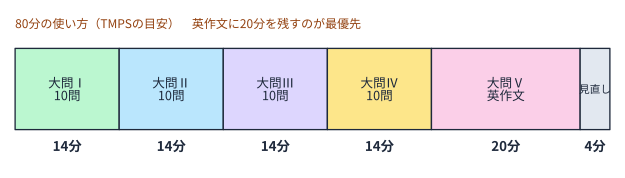
大問Ⅰ インタビュー(10問)
問1を先に
14分
大問Ⅱ 研究記事(10問)
段落を指定される
14分
大問Ⅲ 科学記事(10問)
空所A・B
14分
大問Ⅳ 解説記事(10問)
時間切れ警戒
14分
大問Ⅴ 自由英作文
20分死守
20分
🧭 おすすめの解く順番
大問Ⅰ → Ⅱ → Ⅲ → Ⅳ(ここまで56分)→ 大問Ⅴ(20分)→ 見直し4分
各大問は「問1(語の言い換え)→ 設問を読んで根拠の段落を探す → 内容問題」の順。56分を過ぎたら、解けていない設問に印をつけて大問Ⅴへ進みます。余った時間で戻りましょう。
大問Ⅰ インタビュー記事(体内時計の科学者)── 問1は語の言い換え、問2は発言を順に追う
概日リズム(24時間周期の体内時計)を研究する英国の神経科学者への、一問一答のインタビュー記事です。話題は「体内時計とは」「研究に入ったきっかけ」「現代社会の害」「朝型・夜型」「睡眠をよくする方法」と進みます。
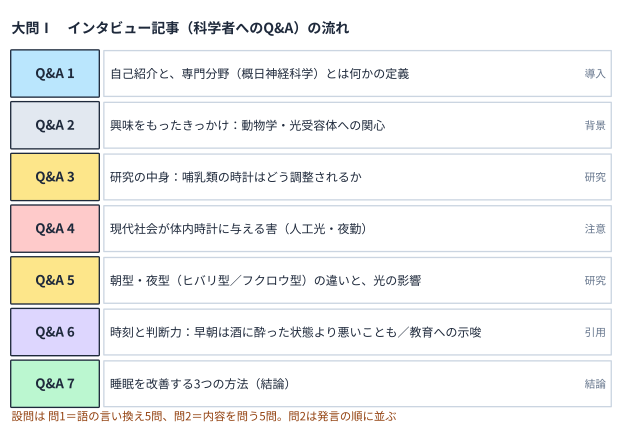
現場戦略試験会場でのリアルな立ち回り(大問Ⅰ)
⏱ 目標時間 & 死守ライン目標14分。問1は5問で約3分、問2は設問の根拠を発言から探して約8分、残りは見直し。
⚠️ 損切り・警戒ライン問2の1問で2分以上かけない。本文の全訳は求められておらず、設問が聞く発言を探すだけでよい。
💡 初手の思考トリガー問1は下線部の前後だけ読んで、本来の意味から選ぶ。問2は「(1)はどこの発言か」を先に推測して探す。
Yuiちゃん
インタビューって、話があちこちに飛んで読みにくいです…。Mio先生
大丈夫、質問が見出し代わりになっているわ。Interviewerの質問を拾えば、各設問がどの発言の話かすぐ分かるよ。ニックニ先生
問1は5問で3分。知らない語は、反対の意味や形(un-、-ate など)から絞ります。問1(1)ticks ── 「時を刻む」の比喩
📝 どういう問題か?
「私たちの生物学的な仕組みは24時間周期で ticks する」という文の ticks に、最も近い意味の語を4つから選ぶ。
🎯 問1(1) の答え
4 works(機能する・動く)
⚠️ ⚠️ sounds は tick の「音」の連想に引っ張られた罠。decays(朽ちる)・expands(広がる)は文意に合わない。
問1(2)regulated ── 医学英語の中心動詞
📝 どういう問題か?
「哺乳類の体内時計はどのように regulated されるのか」という問いの regulated に最も近い語を選ぶ。
regulate は「規則どおりに調整する」。体温・血圧・ホルモンの調節に使う医学英語の基本動詞で、言い換えは controlled。
🎯 問1(2) の答え
2 controlled(制御される)
⚠️ ⚠️ contained(抑え込まれた)は「制御」と近く見えるが、意味は「中に収められた」。
問1(3)unfettered ── 接頭辞 un- + 語幹
📝 どういう問題か?
「私たちは自分の生物学に unfettered ではない」という文の unfettered に最も近い語を選ぶ。
fetter は「足かせ」。un- がついて「足かせがない」=縛られていない。選択肢では、bind の過去分詞 bound に un- をつけた unbound。
🎯 問1(3) の答え
3 unbound(束縛されない)
⚠️ ⚠️ unspoken・undone・unmasked は un- で始まる形が似ているだけ。形ではなく、語幹の意味で選ぶ。
問1(4)nudge ── 名詞・動詞の転用
📝 どういう問題か?
24時間の体内時計は、少しなら前後に nudge できる、という文の nudge に最も近い語を選ぶ。
nudge は「ひじで軽く突く」→「少し動かす」。体内時計を少しずらす、なので adjust(調整する)。
🎯 問1(4) の答え
1 adjust(少し動かす・調整する)
⚠️ ⚠️ delete・save・explain は動きの意味がない。
問1(5)negate ── 否定の動詞
📝 どういう問題か?
朝の光で時計を前にずらせるが、フクロウ型の人の傾向を完全には negate できない、という文の negate に最も近い語を選ぶ。
negate は negative の動詞形で「打ち消す・無効にする」。完全には「消し去れない」ので erase。
🎯 問1(5) の答え
3 erase(打ち消す)
⚠️ ⚠️ open・trap・understand は、否定の意味を持たない。
問2(1)主題を問う
📝 どういう問題か?
概日神経科学の「主な焦点」は何か、を4択から選ぶ。
冒頭の定義の部分を探します。専門家は「24時間周期の生物学的な仕組みがどう働くか」を根本から理解することだと答えています。選択肢2「24時間の生物学的過程を調べること」と同じ内容です。
🎯 問2(1) の答え
2
⚠️ ⚠️ 1(加齢と脳の構造)・3(遺伝子とタンパク質)・4(種ごとの行動)は、定義の説明の一部に出てくる語を使っただけの選択肢。
問2(2)きっかけを問う
📝 どういう問題か?
教授が概日リズムの研究に興味をもった最初のきっかけは何か、を4択から選ぶ。
「どうして興味をもったか」という質問への答えの発言を読みます。最初のきっかけは光受容体(光を感じる細胞)で、動物ごとの光受容体の違いに関心を持ったことが出発点でした。4と一致します。
🎯 問2(2) の答え
4
⚠️ ⚠️ 3「ブリストル大学で生物学を取った」は本文の事実と一致するが、「きっかけ」ではない。事実が合うだけで選ばない。
問2(3)原因の組み合わせ
📝 どういう問題か?
「ヒバリ型」「フクロウ型」かどうかに影響する要因は何か、を4択から選ぶ。
朝型・夜型の質問への答えの発言を読みます。時計遺伝子の微妙な違いと、光を見るタイミング(朝の光は時計を進め、夕方の光は遅らせる)の2つが挙がっています。両方を含むのは1。
🎯 問2(3) の答え
1
⚠️ ⚠️ 2・4は、本文に出る語(性別・年齢)の一部だけが合う、半分正しい選択肢。2つの要因の両方が合うものを選ぶ。
問2(4)原因・理由を問う
📝 どういう問題か?
朝早く起きていることが、酒に酔っているときより悪い場合があるのはなぜか、を4択から選ぶ。
決断力は時刻で変わる、という発言を読みます。オーストラリアの研究で、朝4時の認知機能の低下は飲酒より大きいことが示され、「朝早くは考える力が弱い」という趣旨でした。3。
🎯 問2(4) の答え
3
⚠️ ⚠️ 1「運転中に見えにくい」は、運転の話が出ることに引っ張られた罠。見えにくさではなく、考える力の話。
問2(5)列挙を問う
📝 どういう問題か?
睡眠をよくするための、3つの簡単なことは何か、を4択から選ぶ。
最後の質問への答えです。ストレス・不安を減らす、朝の光を浴びる、寝室を快適に整える、の3つ。選択肢2「ストレスを減らす・朝の光・快適な空間をつくる」と一致します。
🎯 問2(5) の答え
2
⚠️ ⚠️ 3(カフェイン・電子機器)や4(日中の睡眠)は、睡眠の「敵」を並べた逆の内容。
ニックニ先生の総整理表
大問Ⅰ:設問タイプ別の着眼点
| 設問 | 型 | 着眼点 |
|---|---|---|
| 問1(1)〜(5) | 語の言い換え | 下線の前後と語の成り立ち(un-、-ate、転用義)。形が似た選択肢は罠 |
| 問2(1) | 主題 | 冒頭の定義の発言。語が出ても「主眼」でなければ✕ |
| 問2(2)(3) | きっかけ・要因 | 質問への答えの発言だけを読む。半分だけ合う選択肢に注意 |
| 問2(4)(5) | 理由・列挙 | 数字や固有名詞より、発言の主旨。逆の内容の選択肢に注意 |
TMPSコーチング診断
🩺【自己診断】大問Ⅰで手が止まった人への処方箋
- 問1語が分からない → 語の成り立ち(接頭辞・語幹)と、文のプラス・マイナスから絞る
- 問2(1)主題を外す → 冒頭の定義の発言だけを読み、本文に出る語の寄せ集めに引っ張られない
- 問2(2)(3)半分正しい選択肢で迷う → 2つの要素のうち、片方だけが合うものを消す
- 問2(4)(5)時間が足りない → 質問(Interviewerの発言)を見出し代わりに拾い、答えの発言を直接読む
大問Ⅱ 研究紹介記事(チンパンジーの思春期)── 段落番号を手がかりに根拠を探す
人間の10代に似た「思春期」が、チンパンジーにもあることを示した研究の紹介記事です。保護区にいる40頭を対象に、2つの課題(ギャンブル課題と、待てば得をする課題)を行い、衝動性や待つ力を人間と比べています。
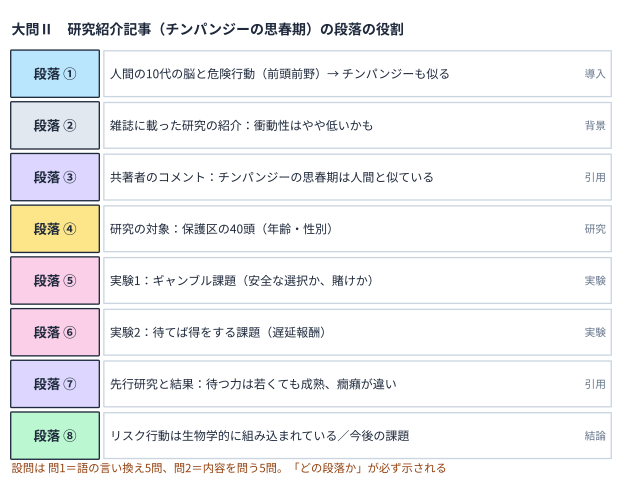
現場戦略試験会場でのリアルな立ち回り(大問Ⅱ)
⏱ 目標時間 & 死守ライン目標14分。問1は約3分。問2は「第◯段落」と指定されるので、その段落だけを読んで約8分。
⚠️ 損切り・警戒ライン1問で1分半かけたら印をつけて先へ。実験1と実験2の取り違えが多いので、迷ったらどちらの実験の話かを確かめる。
💡 初手の思考トリガー設問の「paragraph ◯」を先に見て、その段落の1〜2文に答えを探す。実験の設定(誰が・何を選ぶか)を整理しながら読む。
Yuiちゃん
実験が2つ出てきて、どっちの話か混ざります…。Mio先生
段落⑤が実験1(ギャンブル)、段落⑥が実験2(待てば得)。設問が「実験2」と言ったら⑥だけを読めばいいの。ニックニ先生
人間の10代との比較が、実は答えのカギです。「チンパンジーは待てる、人間の10代は待てない」という対比を覚えておくと、逆の選択肢が消せます。問1(1)engage in ── 熟語(動詞+前置詞)
📝 どういう問題か?
「危険な行動に engage in する」という文の engage in に最も近い意味を選ぶ。
engage in は「〜に従事する・〜を行う」。undertake(引き受けて行う)が近い。
🎯 問1(1) の答え
3 undertake(〜に従事する)
⚠️ ⚠️ engage には「婚約する」の意味があるので、marry に引っ張られないこと。promote(促進する)も「行う」ではない。
問1(2)counterparts ── 名詞の言い換え
📝 どういう問題か?
「人間の counterparts」という語で、チンパンジーの思春期と比べる相手を指している。counterparts に最も近い語を選ぶ。
counterpart は「相当するもの・対応するもの」。人間の10代に「相当する」存在、なので equivalents。
🎯 問1(2) の答え
2 equivalents(相当するもの)
⚠️ ⚠️ enemies・champions・children は、文脈に合わない。counter- の字面(反対)に引っ張られると enemies を選んでしまう。
問1(3)coveted ── 形容詞の言い換え
📝 どういう問題か?
「coveted banana(バナナ)」の coveted に最も近い語を選ぶ。
covet は「欲しがる」。coveted は「誰もが欲しがる」という意味で、desired。賭けに勝てば手に入る、好物の報酬のこと。
🎯 問1(3) の答え
1 desired(欲しがられる)
⚠️ ⚠️ dangerous は、リスクのある選択と混ざった罠。報酬の性質を答える問題。
問1(4)prior ── 形容詞の言い換え
📝 どういう問題か?
「prior research」の prior に最も近い語を選ぶ。
prior は「前の・以前の」。prior research は「先行研究」で、previous。
🎯 問1(4) の答え
3 previous(以前の)
⚠️ ⚠️ supporting・solid・practical は、prior の語形に引っ張られない。
問1(5)capacities ── 名詞の多義語
📝 どういう問題か?
「自己制御の capacities」の capacities に最も近い語を選ぶ。
capacity は「容量」のほかに「能力・可能性」の意味があり、ここは認知能力の話。選択肢で近いのは potential(潜在的な力)。
🎯 問1(5) の答え
4 potential(潜在的な能力)
⚠️ ⚠️ volumes(容量・量)は capacity の「容量」の意味。文脈が認知能力なので、物理的な意味は不適。
問2(1)含意を問う(段落①)
📝 どういう問題か?
段落①から、思春期のチンパンジーについて何が含意されるか、を4択から選ぶ。
段落①は、人間の10代の脳の「ブレーキ」役の部位(vmPFC)が、危険な行動を抑えるのに関わるとし、チンパンジーも同様だと述べます。つまり、危険を抑える部分がまだ十分に発達していないことが含意されます。4。
🎯 問2(1) の答え
4
⚠️ ⚠️ 3「vmPFCが攻撃的な行動を増やす」は逆。vmPFCは抑える側。1「人間の10代より危険な行動が多い」は、段落②で「衝動性はやや低いかも」とされる点と合わない。
問2(2)心理面の類似(段落③)
📝 どういう問題か?
段落③によると、思春期のチンパンジーは人間の10代と心理的にどう似ているか、を4択から選ぶ。
段落③に、ホルモンの急激な変化、仲間と新しい絆を作ること、攻撃性がやや高まること、地位をめぐって争うこと、が並んでいます。選択肢では1「攻撃性が高まる」が段落③の内容と一致します。
🎯 問2(2) の答え
1
⚠️ ⚠️ 2「寿命が同じ」は違う(チンパンジーは50年)。3「ホルモンが安定」は逆。4「関係を作るのが苦手」も、新しい絆を作ると書かれていて逆。
問2(3)推論(段落⑤)
📝 どういう問題か?
段落⑤から、成体のチンパンジーは思春期のチンパンジーと比べてどうだと推論できるか、を4択から選ぶ。
実験1で、思春期は危険な選択(きゅうりの当たりのあるほう)を大人より多く選びました。つまり大人は安全な選択(ピーナッツのほう)をより選ぶ、と言い換えられます。2。
🎯 問2(3) の答え
2
⚠️ ⚠️ 4「大人のほうがきゅうりに否定的な反応」は、本文は「どちらも否定的な反応を示した」と書く。違いは選択のほう。
問2(4)実験2の結論
📝 どういう問題か?
実験2から、思春期のチンパンジーが満足を遅らせる(待つ)能力について何が分かったか、を4択から選ぶ。
段落⑥⑦をつなげます。思春期も大人も、待つと3倍もらえる状況で待てました。研究者は、待つ力はかなり若い段階でもう成熟しており、人間と違うと述べます。4。
🎯 問2(4) の答え
4
⚠️ ⚠️ 2「人間の10代より未発達」は逆。人間の10代のほうが衝動的で、すぐ得られる報酬を選びやすいという対比。
問2(5)内容一致(段落⑧)
📝 どういう問題か?
段落⑧によると、思春期のチンパンジーについて正しいものは何か、を4択から選ぶ。
段落⑧に、リスクを取る行動は、人間もチンパンジーも生物学的に「組み込まれている」ように見える、とあります。選択肢3「遺伝的に根ざしているようだ」が言い換え。3。
🎯 問2(5) の答え
3
⚠️ ⚠️ 1「男性のほうが衝動的」は、男女差は今後の研究で調べる、とされる点。4「人間より衝動を抑えにくい」は、実験2の結論と逆。
ニックニ先生の総整理表
大問Ⅱ:設問タイプ別の着眼点
| 設問 | 型 | 着眼点 |
|---|---|---|
| 問1(1)〜(5) | 語の言い換え | 熟語・多義語(engage in・capacity)は文脈の領域で意味を決める |
| 問2(1) | 含意 | 本文に書かれていないが言える内容。逆の関係の選択肢に注意 |
| 問2(2)(5) | 段落の内容一致 | 指定された段落の言い換え。男女差・寿命など、他の話の混入に注意 |
| 問2(3)(4) | 実験の読み取り | 実験1と実験2を取り違えない。人間の10代との対比で逆を消す |
TMPSコーチング診断
🩺【自己診断】大問Ⅱで手が止まった人への処方箋
- 問1多義語で迷う → 文脈の領域(ここは認知能力)で意味を決め、物理的な意味は消す
- 問2(1)含意問題で本文に答えが無い → 本文の主張の「言い換え」か「逆の関係」かを確かめる
- 問2(3)(4)実験1・2を取り違える → 設問の「test number」から段落⑤/⑥を決めてから読む
- 問2(5)他の段落の情報に引っ張られる → 段落番号の指定を守り、その段落だけを読む
大問Ⅲ 科学記事(手書きノートと脳)── 空所A・Bは直前直後の言い換えで決める
授業のノートは手書きとタイピングのどちらが学びに良いか、を脳活動の実験から論じた科学記事です。電極のついたヘアネットで学生の脳活動を測り、手書きのほうが脳の広い範囲がつながって働いたことを紹介します。
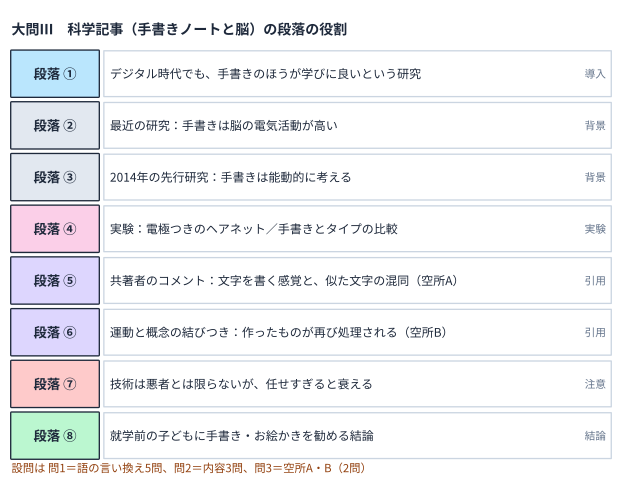
現場戦略試験会場でのリアルな立ち回り(大問Ⅲ)
⏱ 目標時間 & 死守ライン目標14分。問1は約3分、問2は約5分、問3の空所A・Bは約3分、残りは見直し。
⚠️ 損切り・警戒ライン問3は空所の前後の文だけで決める。選べないときは、他の設問を先に解いてから戻る。
💡 初手の思考トリガー空所A・Bは、直後の具体例(b と d など)や、直前直後の言い換えから、何を表す語かを先に決める。
Yuiちゃん
空所に語句を入れる問題は、本文を全部読まないと解けませんよね?Mio先生
実は空所の1〜2文だけで決まることが多いの。「Aの具体例が何か」を見れば、答えがほぼ見えるよ。ニックニ先生
問2(3)の「題名」は最後に。本文全体の趣旨を問われるので、他の設問を解いたあとのほうが当てやすいです。問1(1)grasp ── 動詞の言い換え
📝 どういう問題か?
「新しい概念を grasp する」という文の grasp に最も近い語を選ぶ。
grasp は「つかむ」→「理解する」。新しい概念をつかむ、は understand。
🎯 問1(1) の答え
1 understand(理解する)
⚠️ ⚠️ grant・govern は g- で始まる形が似ているだけ。underestimate(過小評価する)も「理解」ではない。
問1(2)spanning ── 分詞の言い換え
📝 どういう問題か?
「視覚領域を含む広い脳のつながりが spanning する」という文の spanning に最も近い語を選ぶ。
span は「橋が川にまたがる」ように、範囲に「及ぶ」。ここは視覚領域・運動皮質などの複数の領域に及ぶ、つまり「〜を含む」の意味で、including。
🎯 問1(2) の答え
3 including((範囲に)及ぶ・含む)
⚠️ ⚠️ spinning(回転する)は形が似ているだけ。
問1(3)off-loading ── 動詞の言い換え
📝 どういう問題か?
認知的な作業をデジタル機器に off-loading する、という文の off-loading に最も近い語を選ぶ。
off-load は「荷を降ろす」→「作業を機器に任せる」。delegating(任せる)が近い。
🎯 問1(3) の答え
2 delegating(任せる)
⚠️ ⚠️ eliminating(取り除く)は、作業をなくすのでなく機器に任せる点が違う。
問1(4)deteriorate ── 動詞の言い換え
📝 どういう問題か?
使わなければ記憶や運動能力は時間とともに deteriorate する、という文の deteriorate に最も近い語を選ぶ。
deteriorate は「悪化する・衰える」。worsen。直前の「使わなければ」から、良い方向でないと分かる。
🎯 問1(4) の答え
4 worsen(悪化する)
⚠️ ⚠️ deepen(深まる)は形・音が近いが、悪化の意味ではない。prevent・repair は逆の方向。
問1(5)ultimately ── 副詞の言い換え
📝 どういう問題か?
段落の頭の Ultimately(結論を述べる文)に最も近い語を選ぶ。
ultimately は「最終的に・結局」。結論を導く副詞で、finally。
🎯 問1(5) の答え
1 finally(結局)
⚠️ ⚠️ currently(現在は)・fortunately(幸運にも)は、結論を導く語ではない。
問2(1)内容一致(段落④)
📝 どういう問題か?
段落④によると、正しい記述はどれか、を4択から選ぶ。
段落④は、手書きのときセンサーが、視覚の領域と運動皮質にわたる広いつながりをとらえ、タイピングではほとんど活動がなかった、と述べます。選択肢4「手書きは運動と視覚の脳領域を刺激する」が一致。4。
🎯 問2(1) の答え
4
⚠️ ⚠️ 2「タイピングのほうが脳の電気活動が多い」は逆。3「体の動きを減らすと脳の機能が上がる」は、本文に根拠がない。
問2(2)含意(段落⑦⑧)
📝 どういう問題か?
段落⑦と⑧から、何が含意されるか、を4択から選ぶ。
⑦は、技術は欠点ばかりではないが、認知作業を機器に任せすぎると、記憶や運動能力が衰えると述べます。⑧は、就学前に手書き・お絵かきを勧めます。つまり「技術への頼りすぎは学びに有害」。2。
🎯 問2(2) の答え
2
⚠️ ⚠️ 1「就学前に技術をもっと使う」は⑧と逆。4「技術を使う学生は不公平に有利」は、⑦が機器は公平なアクセスをもたらすとする点と逆。
問2(3)題名を問う
📝 どういう問題か?
本文に最もふさわしい題名は何か、を4択から選ぶ。
全体の趣旨は、手書きには学びの利点がある、ということ。選択肢1「手書きには学習上の利点が伴う」が全体を覆います。1。
🎯 問2(3) の答え
1 要確認
⚠️ ⚠️ 3(言葉と絵はつながる)・4(スタイラスとタブレット)は、一部の段落の話。2も細部。題名は全体を覆うものを選ぶ。
問3(A)空所A ── 似た文字の例から決める
📝 どういう問題か?
段落⑤で、デジタルタブレットで読み書きを学んだ子は、文字が互いに「( A )」で見分けにくい、という文の空所Aに入る語句を選ぶ。
直後に、具体例として b と d が挙がっています。この2つは、左右を反転させると重なる関係で、英語では mirror images(鏡像)です。
🎯 問3(A) の答え
1 mirror images(鏡像)
⚠️ ⚠️ upside-down letters(上下逆の文字)は、b と q のような関係。b と d は上下ではなく左右の反転。
問3(B)空所B ── 作ったものがどこへ戻るか
📝 どういう問題か?
段落⑥で、字や絵を描く行為で作ったものが「( B )」に戻され、そこで再び処理される、という文の空所Bに入る語句を選ぶ。
描いたものは目で見て確かめるので、戻る先は視覚の処理を担う場所です。選択肢では visual system(視覚系)。「運動系で作る → 視覚系に戻る」という循環が、行為とイメージの結びつきを強める、という説明です。
🎯 問3(B) の答え
4 visual system(視覚系)
⚠️ ⚠️ motor system は「作る」側。電極のヘアネットは実験の道具で、処理される場所ではない。
ニックニ先生の総整理表
大問Ⅲ:設問タイプ別の着眼点
| 設問 | 型 | 着眼点 |
|---|---|---|
| 問1(1)〜(5) | 語の言い換え | 前後の文のプラス・マイナスで意味を絞る。形が似た語は罠 |
| 問2(1) | 段落の内容一致 | 逆の選択肢(タイピングのほうが活発)に注意 |
| 問2(2) | 含意 | 2つの段落をつなげて、趣旨を言い換える |
| 問2(3) | 題名 | 全体を覆うものを選ぶ。一部の段落の話は✕ |
| 問3(A)(B) | 空所補充 | 直後の具体例、直前直後の言い換えから、語の働きを決める |
TMPSコーチング診断
🩺【自己診断】大問Ⅲで手が止まった人への処方箋
- 問1形が似た語に引っ張られる → 前後の文のプラス・マイナスと、語の本来の意味で決める
- 問2(1)(2)逆の選択肢を選ぶ → 本文の主張と「逆向き」の選択肢(タイピングが優位など)を先に消す
- 問2(3)題名が決まらない → 全段落の共通の趣旨を1文で言ってから、選択肢を見る
- 問3空所が選べない → 空所の直後の具体例(b と d など)や、前後の言い換えに戻る
大問Ⅳ 解説記事(ビタミン)── 定義と歴史の対比を整理する
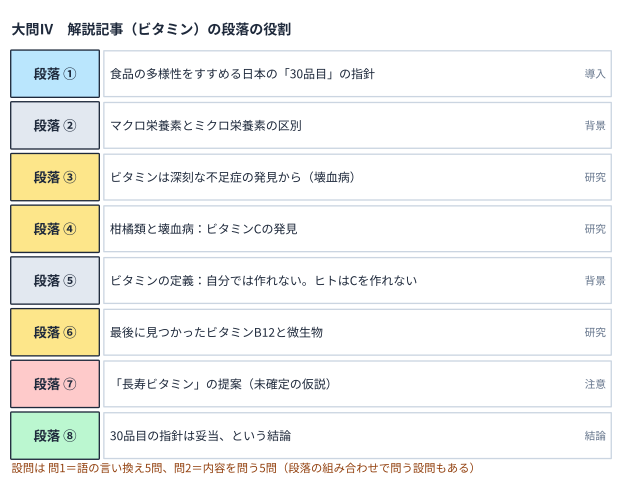
ビタミンとは何か、どのように発見されてきたかを、壊血病やビタミンCを例に説明した記事です。最後に、まだ見つかっていない「長寿ビタミン」の仮説と、日本の「1日30品目」の指針を結びつけて終わります。
現場戦略試験会場でのリアルな立ち回り(大問Ⅳ)
⏱ 目標時間 & 死守ライン目標14分。問1は約3分、問2は約8分。ここで時間が余らなければ、英作文のために残りを切り上げる。
⚠️ 損切り・警戒ライン大問Ⅳは最後の長文なので、56分を過ぎたら印をつけて大問Ⅴへ進む。
💡 初手の思考トリガー「ビタミンCを作れる動物・作れない動物」「B12は微生物が作る」のように、誰が作れるかの対比を整理して読む。
Yuiちゃん
壊血病とかビタミンとか、医学部の知識がないと解けませんか?Mio先生
知識は要らないの。本文に書いてあることだけで決まるわ。ただし「作れる/作れない」の主語を取り違えないようにね。ニックニ先生
残り時間が少ないときは、問2の(1)(2)のように段落が絞られた設問から取りましょう。題名の問題は最後です。問1(1)arbitrary ── 形容詞の言い換え
📝 どういう問題か?
「30品目という数は arbitrary な妥協だ」という文の arbitrary に最も近い語を選ぶ。
arbitrary は「恣意的な・理由なく決められた」。数字の根拠が決定的でない、ということなので random(でたらめな・任意の)。
🎯 問1(1) の答え
3 random(恣意的な)
⚠️ ⚠️ precise(正確な)は逆。improbable(ありそうにない)は random と似て見えるが、「起こる確率」の話ではない。
問1(2)carries ── 多義語(動詞)
📝 どういう問題か?
「ドラッグストアは今日、多様なビタミンを carries している」という文の carries に最も近い語を選ぶ。
carry の基本義は「運ぶ」ですが、店が主語のときは「商品を置いている」。選択肢では stocks(在庫として置く)が近い。
🎯 問1(2) の答え
1 stocks((店が)置いている) 要確認
⚠️ ⚠️ conveys(運ぶ・伝える)は carry の基本義に引かれた罠。店の品揃えの話なので、運搬の意味は不適。
問1(3)issues ── 多義語(名詞)
📝 どういう問題か?
「深刻な医学的 issues から発見された」という文の issues に最も近い語を選ぶ。
issue には「発行・版」「問題」「論点」などの意味があります。ここは病気にかかわる「深刻な問題」で、problems。
🎯 問1(3) の答え
1 problems(問題)
⚠️ ⚠️ editions(版)は issue の別の意味。controversies・questions は、症状や病気を指す語ではない。
問1(4)dubbed ── 動詞の言い換え
📝 どういう問題か?
「長寿ビタミンと dubbed された物質のグループ」の dubbed に最も近い語を選ぶ。
dub は「〜と呼ぶ・あだ名をつける」。named。「(そのグループを)〜と名づけた」の形。
🎯 問1(4) の答え
3 named(〜と名づけた)
⚠️ ⚠️ translated(翻訳された)・combined・painted は、呼び名をつける意味ではない。
問1(5)vigorous ── 形容詞の言い換え
📝 どういう問題か?
「a vigorous microbiome(腸内細菌の集まり)」の vigorous に最も近い語を選ぶ。
vigorous は「活発な・力強い」。健全な腸内細菌叢は、元気で強い、なので strong。
🎯 問1(5) の答え
4 strong(力強い)
⚠️ ⚠️ shallow(浅い)・surface(表面)は、形・音の連想の罠。safe は意味が少しずれる。
問2(1)違いを問う(段落②)
📝 どういう問題か?
段落②によると、マクロ栄養素とミクロ栄養素の違いは何か、を4択から選ぶ。
段落②は、前者は主にエネルギー(カロリー)をまかない、後者はミネラルやビタミンなど、ごく少量が必要なものだと述べます。選択肢2「マクロ栄養素はエネルギーを与え、ミクロ栄養素はそのほかの必要を満たす」。2。
🎯 問2(1) の答え
2
⚠️ ⚠️ 1「マクロは小さいことが多い」は、macro/micro を字面で大小と取った罠。栄養の「量」の話で、粒の大きさではない。
問2(2)含意(段落③④)
📝 どういう問題か?
段落③と④から、何が示されているか、を4択から選ぶ。
③は、ビタミンが、ビタミン不足から起きた深刻な医学的問題から発見された、と述べます。選択肢2「健康上の懸念がビタミンの発見につながった」と一致。2。
🎯 問2(2) の答え
2
⚠️ ⚠️ 1「果汁が有効成分」は、④で有効成分は後にアスコルビン酸と判明した、という点と違う。4「負傷しなければあざはできない」は、不足があるとあざができる点と逆。
問2(3)推論(段落⑤⑥)
📝 どういう問題か?
段落⑤と⑥から、何が推論できるか、を4択から選ぶ。
人間はビタミンCを自分で作れず、B12は腸内の微生物が作るものの、吸収する場所は作る場所より手前の小腸で配置が「逆向き」、という複雑な関係が描かれます。選択肢3「人間はB12と複雑な関係にある」。3。
🎯 問2(3) の答え
3 要確認
⚠️ ⚠️ 1「ほとんどの動物はCを摂る必要がある」は逆(多くの動物は自分で作れる)。4「B12不足ですぐ病気」は、肝臓に数年分の蓄えがあるという点と逆。
問2(4)内容一致(段落⑦)
📝 どういう問題か?
段落⑦によると、正しいものはどれか、を4択から選ぶ。
「長寿ビタミン」は短期的な生存・繁殖には必須ではない、とされます。選択肢1「『長寿ビタミン』が足りなくても、すぐに深刻な問題は起きない」。1。
🎯 問2(4) の答え
1
⚠️ ⚠️ 2「高齢者に特に勧める」は書かれていない。3「キノコ(エルゴチオネイン)が老化を早める」は逆の方向。
問2(5)題名を問う
📝 どういう問題か?
本文に最もふさわしい題名は何か、を4択から選ぶ。
全体は、ビタミンはどう発見され、まだ見つかっていないものはないか、と問う流れです。選択肢2「ビタミン:完全なリストはあるのか?」が全体と最終段落の問いを覆います。2。
🎯 問2(5) の答え
2 要確認
⚠️ ⚠️ 1(limeys)は④の一部の話、3(ビタミンを忘れずに)は筆者の主張と合わない、4(長寿のためのビタミン)は⑦だけの話。
ニックニ先生の総整理表
大問Ⅳ:設問タイプ別の着眼点
| 設問 | 型 | 着眼点 |
|---|---|---|
| 問1(1)〜(5) | 語の言い換え | 多義語(carries・issues)は、主語と文脈から意味を決める |
| 問2(1) | 違いを問う | macro/micro を字面で大小と取らない |
| 問2(2)(3) | 含意・推論 | 2つの段落をつなげる。「作れる/作れない」の主語に注意 |
| 問2(4) | 段落の内容一致 | 「必須ではない」という否定の言い換えに気づく |
| 問2(5) | 題名 | 全体を覆うものを選ぶ。一部の段落の話は✕ |
TMPSコーチング診断
🩺【自己診断】大問Ⅳで手が止まった人への処方箋
- 問1多義語で迷う → 主語(店・病気)から意味を決め、基本義(運ぶ)を疑う
- 問2(1)字面で大小と取る → 段落②の定義を、「何をまかなうか」の言い換えで読む
- 問2(2)(3)逆の選択肢を選ぶ → 「作れる動物/作れない動物」の対比を表にして整理する
- 問2(4)(5)時間が足りない → 段落が指定された設問を先に取り、題名の設問を最後にする
大問Ⅴ 自由英作文(遺伝子編集と「デザイナーベビー」)── 型を決めてから書く
合否を分けるのは、ここに20分を残せるかどうかです。
大問Ⅴ遺伝子編集の是非を論じる自由英作文
📝 どういう問題か?
英語で自分の考えを述べる自由英作文が1題です。賛成・反対のどちらでもよく、理由が具体的で、構成が整っているかが問われます。
- 科学者は遺伝子を編集でき、親が将来の子どもの特性を選べるようになるかもしれない、という設定。
- 「選べるとしたら、子どもを遺伝的にデザインすることは許されると思うか」と問い、道徳的・社会的・健康上の影響を考えて、遺伝子工学の良い結果・悪い結果を論じる。
- 指示:導入・本論・結論を含む1つの完結したエッセイを書く。問題文を読んでいない人に向けて書く。量と質の両方、そして問いに答えているかが評価される。
- 解答欄は19.8cm×22行。書体は活字体でも筆記体でもよい。
現場戦略試験会場でのリアルな立ち回り(大問Ⅴ)
⏱ 目標時間 & 死守ライン目標20分。立場と構成を決めるのに3分、書くのに14分、見直しに3分。
⚠️ 損切り・警戒ライン15分たっても書き出せない場合は、立場を「条件つきの賛成」に決めて、導入の1文だけでも書く。
💡 初手の思考トリガー最初の1文で問題文を知らない人にも通じるようにテーマを言い直し、立場を示す。
Yuiちゃん
賛成か反対か、決められなくて書き出せません…。Mio先生
どちらでもいいの。採点は「問いに答えているか」「構成」「具体性」。決めきれなければ、治療には賛成、能力の増強には反対のような条件つきの立場が書きやすいよ。ニックニ先生
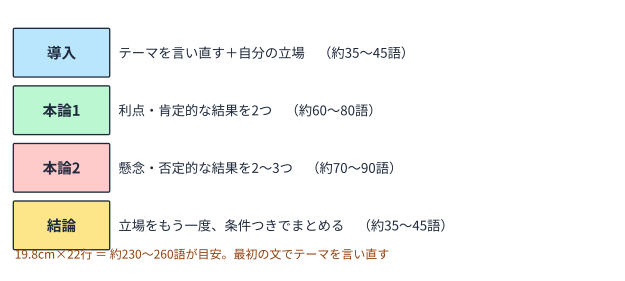
語数は19.8cm×22行で230〜260語が目安です。長すぎて枠をはみ出すのも減点なので、本論は「利点2つ・懸念2〜3つ」までにしましょう。答案の型(4ブロック)
① 導入:テーマを言い直し(遺伝子編集で子どもの特性を選べるようになる)、自分の立場を1文で示す。
② 本論1:利点。遺伝性の重い病気を防げる、将来の世代の苦しみを減らせる、など。
③ 本論2:懸念。意図しない遺伝子の変化による健康リスク、経済力による格差、人の価値観や障害のある人への差別、など。
④ 結論:立場をもう一度。「医療目的に限り、厳しい規制のもとで」のように、条件をつけてまとめる。
✍️ TMPSの解答例 解答例 (234語)
Scientists can now edit human genes, and in the future parents may be able to choose some features of their children. I believe that this technology should be used to prevent serious diseases, but I do not think it is acceptable to design a child for non-medical reasons.
The greatest benefit is the prevention of suffering. Many inherited diseases, such as Huntington's disease and cystic fibrosis, cause severe pain and shorten lives. If correcting a single faulty gene could spare a child from such a fate, refusing to use the technology would be difficult to justify morally. In addition, treating a disease before birth might reduce the long-term burden on families and on health care systems.
However, going beyond treatment carries serious risks. First, the technology is still imperfect: unintended changes in other genes could harm not only the child but also later generations, who cannot give their consent. Second, if only wealthy families could afford to choose height, intelligence or appearance, social inequality might become biological inequality. Third, designing children may teach society that human worth depends on being improved, which could lead to discrimination against people who live with disabilities.
In conclusion, genetic engineering should be accepted only as a medical tool for serious illness, under strict regulation and international oversight. Parents' wish for a healthy child is understandable, but a child should never be treated as a product to be customised.
▶ 解答例の日本語訳と、使える表現
日本語訳(TMPS)
科学者は今や人の遺伝子を編集でき、将来は親が子どもの特徴のいくつかを選べるようになるかもしれない。私は、この技術は重い病気を防ぐために使うべきだと考えるが、医療以外の理由で子どもをデザインすることは許されないと思う。
最大の利点は、苦しみを防げることだ。ハンチントン病や嚢胞性線維症のような多くの遺伝性疾患は、強い痛みをもたらし、寿命を縮める。ひとつの欠陥のある遺伝子を直すことで子どもをそうした運命から救えるなら、この技術を使うことを拒むのは、道徳的に正当化しにくい。さらに、生まれる前に病気を治療できれば、家族や医療制度の長期的な負担も減るかもしれない。
しかし、治療を超えることには重大な危険がある。第一に、技術はまだ不完全で、意図しない別の遺伝子の変化は、子どもだけでなく、同意できない後の世代にも害を及ぼしうる。第二に、裕福な家庭だけが身長・知能・容姿を選べるなら、社会の不平等は生物学的な不平等になるかもしれない。第三に、子どもをデザインすることは、人間の価値は「改良されていること」で決まるという考えを社会に広め、障害とともに生きる人々への差別につながりかねない。
結論として、遺伝子工学は、重い病気に対する医療の道具としてのみ、厳しい規制と国際的な監督のもとで認められるべきだ。健康な子どもを望む親の気持ちは理解できるが、子どもは、思いどおりに作り変える製品として扱われてはならない。
使える表現
- 立場:I believe that ... should be used only for ...(〜は…のためだけに使うべきだ)
- 譲歩・対比:Although ..., I do not think ... / However, ...
- 列挙:First, ... Second, ... Third, ...
- 結論:In conclusion, ... should be accepted only as ..., under strict regulation.
⚠️ ⚠️ 「感情論だけ」「どちらにも賛成・反対と書く」は避ける。立場を1つ決め、理由を具体例で支えること。「問題文を読んでいない人向け」なので、最初の文で「遺伝子編集」「子どもの特性を選ぶ」を言い直すのを忘れない。
ニックニ先生の総整理表
大問Ⅴ:答案の型と減点を避ける点
| 項目 | やること | 減点を避けるには |
|---|---|---|
| 導入 | テーマを言い直す+立場を1文 | 問題文を写さず、自分の言葉で書く |
| 本論1(利点) | 具体例つきで2つ | 「良い」だけで終わらせず、何がどう良いかを書く |
| 本論2(懸念) | 2〜3つ(健康・社会・道徳) | 問題文の3観点に触れる |
| 結論 | 条件つきの立場でまとめる | 新しい論点を足さない |
| 分量 | 230〜260語(19.8cm×22行) | 枠をはみ出さず、白い行も残さない |
TMPSコーチング診断
🩺【自己診断】大問Ⅴで手が止まった人への処方箋
- 書き出し立場が決まらない → 「治療は賛成、能力の増強は反対」の条件つき賛成で書く
- 構成話があちこちに飛ぶ → 導入・利点・懸念・結論の4ブロックを、先に1行ずつメモする
- 語彙英語が出てこない → 難しい語より、短い文を正確につなぐ(First, Second, However)
- 時間20分で書けない → 本論を「利点2つ・懸念2つ」に絞り、結論を必ず書く
本番の答え一覧(採点用)
解説を読んだあとの最終確認用です。選択肢の番号は本番どおり1〜4です。大問Ⅰは過去問集の解答編と一致を確認しました。大問Ⅱ〜ⅣはTMPSが紙面から導いた答えで、判断が割れうるものには「要確認」を付けています。
大問Ⅰ 問1(語の言い換え)
(1) 4(2) 2(3) 3(4) 1(5) 3
大問Ⅰ 問2
(1) 2(2) 4(3) 1(4) 3(5) 2
大問Ⅱ 問1
(1) 3(2) 2(3) 1(4) 3(5) 4
大問Ⅱ 問2
(1) 4(2) 1(3) 2(4) 4(5) 3
大問Ⅲ 問1
(1) 1(2) 3(3) 2(4) 4(5) 1
大問Ⅲ 問2
(1) 4(2) 2(3) 1 要確認
大問Ⅲ 問3(空所)
(A) 1(B) 4
大問Ⅳ 問1
(1) 3(2) 1 要確認(3) 1(4) 3(5) 4
大問Ⅳ 問2
(1) 2(2) 2(3) 3 要確認(4) 1(5) 2 要確認
大問Ⅴ 自由英作文
解答例あり(唯一の正解はありません)
※ 大問Ⅱ〜Ⅳの答えは、過去問集の解答編に載っていないため、TMPSが本文から独立に導きました。公開された解答は見つけられていません。大問Ⅳ 問1(2)は、carry の意味が複数あり、他の解答例と食い違う可能性があるため要確認としています。意味の判断は機械では確かめられないので、根拠は解説に書いています。
採点したら → 30秒の得点診断へ
TMPS ORIGINAL
順天堂大2025型 そっくり類題セット
順天堂大2025型 そっくり類題セット
(全5大問・解答解説つき)
2025年度の本番と同じ5大問・同じ設問構成(大問Ⅰ〜Ⅳは各10問の選択式、大問Ⅴは自由英作文)で、題材と設定を変えたTMPSオリジナル問題です。問1の語の言い換えと、段落を手がかりに根拠を探す読み方、英作文の型の練習に使ってください。
試験時間の目安 80分長文4題(選択式40問)+自由英作文
📄 本番形式の問題冊子PDFをダウンロード(全11ページ)
印刷して本番と同じように80分で解けます(英作文の解答用紙つき)。解答・解説はこのページの下に掲載しています。
※ 順天堂大学の入試問題ではありません。本文・設問・人物・団体(架空)はすべてTMPS医学館が作成したオリジナルで、出典のある引用ではありません。
類題 大問Ⅰ
次のインタビュー記事を読み、以下の設問に答えなさい。(インタビュー記事。本文はTMPSオリジナル。人物・研究所は架空です)
Interviewer: Marcus Hale grew up on the Cornish coast and is now a professor of marine ecology and the director of the Harlow Institute for Reef Studies. (...) So, what do reef ecologists actually study?
Marcus Hale: At the simplest level, we study how coral colonies live, grow and die. But it is bigger than that. A reef is a city built by animals: it covers less than one per cent of the sea floor, yet it is home to roughly a quarter of all marine species. Reefs thrive(a) only where the water is clear, warm and fairly stable, so they act like a thermometer for the whole ocean.
Interviewer: How did you first get interested in corals?
Marcus Hale: By accident, really. As a student I took a summer job on a dive boat, and one morning I saw a stretch of reef that had turned completely white. The older divers told me it had been full of colour only a few weeks earlier. I could not stop wondering what had happened, so for my PhD I tried to understand why heat makes corals lose the tiny algae that live inside them. At the time, many of my colleagues believed the cause was local pollution. Our data suggested otherwise.
Interviewer: Is bleaching always fatal?
Marcus Hale: No, and that is the hopeful part. Corals can tolerate(b) a hot spell of a few weeks if the water cools again, and some colonies recover within a year. But if the heat returns before they have recovered, their numbers dwindle(c) very quickly. Recovery also depends on whether fish that eat seaweed are still present, because they keep the reef clean and make room for young coral. Protecting those fish is one of the cheapest ways to bolster(d) a reef's defences.
Interviewer: What can ordinary people do to help?
Marcus Hale: Three things matter. First, cut emissions, because warming is the main driver. Second, choose seafood from sustainable sources. Third, support local monitoring: volunteer divers have been pivotal(e) in our work, because they send us photographs from places that no research ship could ever visit.
問1 英文の内容に合うように、(a)〜(e)の各文の空所を補うものとして最も適したものを、それぞれ選択肢1〜4の中から一つ選びなさい。
The word/phrase thrive(a) is closest in meaning to .
- 1. shrink
- 2. flourish
- 3. migrate
- 4. hide
The word/phrase tolerate(b) is closest in meaning to .
- 1. produce
- 2. predict
- 3. avoid
- 4. endure
The word/phrase dwindle(c) is closest in meaning to .
- 1. increase
- 2. settle
- 3. shrink
- 4. reflect
The word/phrase bolster(d) is closest in meaning to .
- 1. strengthen
- 2. measure
- 3. replace
- 4. inspect
The word/phrase pivotal(e) is closest in meaning to .
- 1. temporary
- 2. crucial
- 3. harmless
- 4. familiar
問2 英文の内容に合うように、(1)〜(5)の質問に対する答えとして最も適したものを、それぞれ選択肢1〜4の中から一つ選びなさい。
(1) According to Hale, what is the main focus of reef ecology?
- 1. Designing safer equipment for divers
- 2. Mapping the deep sea floor
- 3. Understanding how coral colonies live, grow and die
- 4. Counting the fish sold in markets
(2) What first sparked Hale's interest in corals?
- 1. A university lecture about algae made him curious.
- 2. A government report on pollution made him curious.
- 3. A teacher's talk about fishing made him curious.
- 4. Seeing a white reef during a summer job made him curious.
(3) According to Hale, what influences whether a bleached reef recovers?
- 1. Whether the heat returns before recovery, and whether seaweed-eating fish remain
- 2. The number of volunteer divers and the season
- 3. The colour of the algae and the depth of the water
- 4. The age of the reef and the amount of pollution
(4) What did many of Hale's colleagues believe about bleaching when he was a student?
- 1. It was a natural yearly cycle.
- 2. It was caused by local pollution.
- 3. It was caused by too many fish.
- 4. It was harmless to the reef.
(5) According to Hale, what are three simple things ordinary people can do to help reefs?
- 1. Dive more often, buy coral souvenirs, feed the fish
- 2. Avoid beaches, eat less seafood, move inland
- 3. Reduce emissions, choose sustainable seafood, support local monitoring
- 4. Plant seaweed, study algae, join research ships
▶ 類題 大問Ⅰの答えと解説
- 問1 (a) 2(flourish)…thrive=栄える。反対の shrink(縮む)と混同しない。
- 問1 (b) 4(endure)…tolerate=耐える。後ろの「数週間の暑さ」に耐える、が文意に合う。avoid(避ける)は「耐える」ではない。
- 問1 (c) 3(shrink)…dwindle=だんだん減る。直後が very quickly なので「数が急に減る」。increase の反対。
- 問1 (d) 1(strengthen)…bolster=強める。「守りを強める最も安い方法」という文意。
- 問1 (e) 2(crucial)…pivotal=決定的に重要な。ボランティアダイバーの写真が「欠かせない」。
- 問2 (1) 3(Understanding how coral colonies live, grow and die)…冒頭の答えで、研究の中心は「サンゴの群体がどう生き、育ち、死ぬか」。
- 問2 (2) 4(Seeing a white reef during a summer job made him curious.)…きっかけは、ダイビングボートの仕事で真っ白な礁を見たこと。汚染の報告は同僚の考えとして出るだけ。
- 問2 (3) 1(Whether the heat returns before recovery, and whether seaweed-eating fish remain)…回復を左右するのは、回復前に再び高温になるかと、海藻を食べる魚が残っているか。
- 問2 (4) 2(It was caused by local pollution.)…当時の同僚の多くは、原因を地元の汚染だと考えていた。
- 問2 (5) 3(Reduce emissions, choose sustainable seafood, support local monitoring)…3つ=排出削減、持続可能な魚介の選択、地元の監視への協力。
類題 大問Ⅱ
次の英文を読み、下記の設問に答えなさい。①〜⑧は段落番号を表す。(研究を紹介する記事。本文はTMPSオリジナル。人物・大学・研究・保護施設は架空です)
①Teenagers are not known for their caution. The part of the brain that helps people stop and think matures later than the parts that respond to rewards, and this gap leaves adolescents prone to(a) impulsive choices, from speeding in cars to accepting dangerous dares.
②A study published on March 4 in the Journal of Comparative Cognition suggests that young crows may behave in a similar way. Adolescent crows seem to be bold when they meet unfamiliar things, yet the researchers found that they can be quite patient when they have to wait for a reward.
③“Adolescent crows are, in some ways, facing the same dilemma that human teenagers face,” said lead author Priya Raman, a senior lecturer in animal behaviour at Northfield University, in a statement. “Our findings show that several features of adolescent psychology are not unique to humans.” Crows can live for more than 15 years in the wild, and their adolescence lasts from about the end of their first winter until the age of three. During this time, young crows leave their parents, form loose groups with other young birds, and compete for food in a way that is akin to(b) the rivalry among human teenagers.
④In the study, the team ran two tests with 36 wild-caught crows at the Marlow Bird Sanctuary in Kent, England. The group included 20 males and 16 females between one and nine years old, with an average age of four.
⑤During test one, each bird was placed in a large cage with a familiar feeding dish and a novel(c) object, a bright plastic toy on a string. The team measured how quickly each crow approached the toy and recorded its calls and body movements. Adolescent crows approached the toy sooner than adults, but both groups gave loud warning calls when the toy suddenly made a noise.
⑥Test two was modelled on a famous experiment with human children that measures how well people can wait for a reward. A crow could take one piece of cheese at once or wait 45 seconds to receive three pieces. Adults and adolescents both chose to wait in most trials. In the same situation, human teenagers tend to be more impulsive than adults and would more often choose the instant reward.
⑦“Earlier research indicates that crows are patient compared with many other birds, and our study shows that this self-control is already mature at a young age,” said Raman. What set the adolescent crows apart from the adults was how they behaved after the scare: adults tended to retain(d) their caution for a long time, whereas adolescents recovered their nerve within minutes and went back to the toy.
⑧According to Raman, bold behaviour in young crows appears to be partly inherited, but learning from other birds may also matter. “We are now looking at several other mental capabilities(e) in crows, including memory and the ability to plan ahead, and at how social skills help young birds build and keep friendships,” she told Wildlife Weekly in an email.
問1 英文の内容に合うように、(a)〜(e)の各文の空所を補うものとして最も適したものを、それぞれ選択肢1〜4の中から一つ選びなさい。
The word/phrase prone to(a) is closest in meaning to .
- 1. able to
- 2. afraid of
- 3. inclined to
- 4. forced to
The word/phrase akin to(b) is closest in meaning to .
- 1. similar to
- 2. opposed to
- 3. older than
- 4. aware of
The word/phrase novel(c) is closest in meaning to .
- 1. expensive
- 2. dangerous
- 3. familiar
- 4. new
The word/phrase retain(d) is closest in meaning to .
- 1. lose
- 2. keep
- 3. share
- 4. repeat
The word/phrase capabilities(e) is closest in meaning to .
- 1. habits
- 2. limits
- 3. abilities
- 4. needs
問2 英文の内容に合うように、(1)〜(5)の質問に対する答えとして最も適したものを、それぞれ選択肢1〜4の中から一つ選びなさい。
(1) What is implied about adolescent humans in paragraph ①?
- 1. They think more carefully than adults.
- 2. They avoid dangerous dares.
- 3. The part of their brain that helps them stop and think is not yet fully developed.
- 4. Their reward systems mature later than their control systems.
(2) According to paragraph ③, how are adolescent crows psychologically similar to adolescent humans?
- 1. They stay with their parents until adulthood.
- 2. They compete with other young birds.
- 3. They have stable hormone levels.
- 4. They avoid forming groups.
(3) What can be inferred about adult crows compared to adolescent crows from paragraph ⑤?
- 1. They are more cautious about unfamiliar objects.
- 2. They prefer plastic toys to cheese.
- 3. They never give warning calls.
- 4. They approach the toy faster than adolescents.
(4) What did test number two reveal about adolescent crows' ability to wait for a reward?
- 1. It improves steadily as crows age.
- 2. It is less developed than in adolescent humans.
- 3. It varies a lot among individual crows.
- 4. It is already well developed in adolescent crows.
(5) According to paragraph ⑧, which of the following is true about adolescent crows?
- 1. Their bold behaviour is more common in males.
- 2. Their social skills develop only through learning.
- 3. Their bold behaviour seems to be partly inherited.
- 4. Their ability to plan ahead is greater than that of humans.
▶ 類題 大問Ⅱの答えと解説
- 問1 (a) 3(inclined to)…prone to=〜しがち(inclined to)。
- 問1 (b) 1(similar to)…akin to=〜に似た(similar to)。
- 問1 (c) 4(new)…novel=目新しい。familiar(なじみの)と対の語として本文に出る。
- 問1 (d) 2(keep)…retain=保つ。lose の反対。
- 問1 (e) 3(abilities)…capabilities=能力。
- 問2 (1) 3(The part of their brain that helps them stop and think is not yet fully developed.)…「止まって考える部分が遅れて成熟する」ので、その部分はまだ十分に発達していない。4は成熟の順序が逆。
- 問2 (2) 2(They compete with other young birds.)…③は群れを作り、若い鳥どうしで食べ物を競うと書く。
- 問2 (3) 1(They are more cautious about unfamiliar objects.)…⑤で、若い個体のほうが見慣れない物に早く近づく。つまり大人のほうが慎重。
- 問2 (4) 4(It is already well developed in adolescent crows.)…実験2で、思春期のカラスも待てる。人間の10代より待てる点が対比。
- 問2 (5) 3(Their bold behaviour seems to be partly inherited.)…⑧は、大胆さは部分的に遺伝的らしいと述べる。性差や計画能力の優劣は書かれていない。
類題 大問Ⅲ
次の英文を読み、下記の設問に答えなさい。①〜⑧は段落番号を表す。(科学ニュースの記事。本文はTMPSオリジナル。人物・大学・雑誌・研究は架空です)
①Music lessons might seem like a luxury in schools where budgets are shrinking. But a growing body of research suggests that learning to play an instrument is one of the best ways for children to absorb(a) new information and to build self-control, especially in the early years.
②In a study published recently in the Journal of Child Brain Science, researchers monitored the brain activity of schoolchildren and found that those who played a real keyboard showed higher levels of activity across many connected brain regions. The result adds to a body of evidence that supports teaching children to play, and not merely to listen to, music.
③The new work builds on an earlier study from 2016, which suggested that reading music from a page is slow and makes learners pay close attention to each note, whereas tapping along to a recording requires little thought. This active effort of linking symbols to sounds may make it easier for students to stay focused and remember new pieces.
④To compare two ways of practising, the authors fitted 64 sensors to a soft cap and placed it on 40 children. The sensors recorded each child's brain activity while the child played a short tune on a keyboard or pressed a single key again and again. When the children played the tune, the sensors picked up robust(b) brain connections linking auditory regions, which handle sound, and the motor cortex, which controls movement. Pressing a single key, by contrast, produced only minimal activity in these regions.
⑤“When you press one key, your finger makes the same small movement every time, but when you play a tune, your hand has to reach, stretch and change position for each note,” says co-author Lena Moritz, a neuroscientist at Northfield University. She notes that children who have learned only on touch-screen apps often struggle to judge the ( A ) between notes, such as the gap between a low C and a high G.
⑥Across many contexts, studies have shown that children learn better when they use their hands and ears together. Educational neuroscientist Tomas Berg says the new findings highlight the clear tie between movement and sound: “As you play a phrase, you listen to what you have produced and use your hands to correct it. That sound is then fed back into the ( B ), where it is processed again, strengthening the connection between an action and the sound it makes.” Too much reliance on screens, he adds, can hinder(c) this loop.
⑦Moritz notes that the findings do not mean technology is always a disadvantage. Apps and recordings can give children from poorer families access to teaching that they might not otherwise have. But skills fade when they are not used, says Aiko Sato, who studies learning and memory at a music school in Osaka. “If we never practise by ear, then our listening skills are going to diminish(d) over time, whether it is memory or coordination.”
⑧“Children who start early eventually(e) play better, and they also concentrate better in other lessons,” Berg says. “I think there is a very strong case for giving young children real instruments in preschool and kindergarten, when they first learn what sounds are. There is something about engaging the hands and ears that really helps learning.”
問1 英文の内容に合うように、(a)〜(e)の各文の空所を補うものとして最も適したものを、それぞれ選択肢1〜4の中から一つ選びなさい。
The word/phrase absorb(a) is closest in meaning to .
- 1. reject
- 2. emphasise
- 3. take in
- 4. give up
The word/phrase robust(b) is closest in meaning to .
- 1. weak
- 2. strong
- 3. slow
- 4. rare
The word/phrase hinder(c) is closest in meaning to .
- 1. reveal
- 2. reward
- 3. follow
- 4. obstruct
The word/phrase diminish(d) is closest in meaning to .
- 1. lessen
- 2. widen
- 3. repair
- 4. confirm
The word/phrase eventually(e) is closest in meaning to .
- 1. suddenly
- 2. in the end
- 3. by chance
- 4. fortunately
問2 英文の内容に合うように、(1)〜(3)の質問に対する答えとして最も適したものを、それぞれ選択肢1〜4の中から一つ選びなさい。
(1) According to paragraph ④, which of the following statements is true?
- 1. Pressing a single key produced stronger activity than playing a tune.
- 2. The children wore the sensor caps for two years.
- 3. The motor cortex is responsible for hearing.
- 4. Playing a tune involved activity linking auditory and motor regions.
(2) According to paragraphs ⑦ and ⑧, which of the following can be implied?
- 1. Tablets should replace instruments in classrooms.
- 2. Music apps are harmful and should be banned.
- 3. Depending too much on apps can be harmful to learning.
- 4. Piano lessons are useful only for older children.
(3) What is the best title of the passage?
- 1. Why Children Should Stop Using Tablets
- 2. Real Instruments Give Young Brains a Workout
- 3. How to Choose a Piano Teacher
- 4. The History of the Brain Scanner
問3 英文の内容に合うように、( A )と( B )にあてはまる語句として最も適したものを、それぞれ選択肢1〜4の中から選びなさい。
( A )
- 1. colour
- 2. distance
- 3. volume
- 4. weight
( B )
- 1. sensor cap
- 2. school curriculum
- 3. auditory system
- 4. piano keyboard
▶ 類題 大問Ⅲの答えと解説
- 問1 (a) 3(take in)…absorb=取り込む(take in)。
- 問1 (b) 2(strong)…robust=力強い。minimal(わずか)と対比されている。
- 問1 (c) 4(obstruct)…hinder=妨げる(obstruct)。
- 問1 (d) 1(lessen)…diminish=減る(lessen)。
- 問1 (e) 2(in the end)…eventually=結局・最終的に(in the end)。
- 問2 (1) 4(Playing a tune involved activity linking auditory and motor regions.)…④は、曲を弾くとき聴覚と運動の領域をつなぐ活動が強く、1つの鍵盤を押すだけでは弱かった、と述べる。
- 問2 (2) 3(Depending too much on apps can be harmful to learning.)…⑦は技術を全否定しないが、頼りすぎると力が衰える。1・2・4は本文と合わない。
- 問2 (3) 2(Real Instruments Give Young Brains a Workout)…全体は、本物の楽器を弾くことが幼い脳の学びを助ける、という趣旨。
- 問3 (A) 2(distance)…「低いCと高いGの間の gap」と言い換えられているので、distance(音の隔たり)。
- 問3 (B) 3(auditory system)…自分が出した音を聞き返して処理し直すので、auditory system(聴覚系)。
類題 大問Ⅳ
次の英文を読み、下記の設問に答えなさい。①〜⑧は段落番号を表す。(食と健康を扱う解説記事。本文はTMPSオリジナル。研究者・論文は架空です)
①Salt is ubiquitous(a) in the modern diet. It is added to bread, soup, snacks and sauces so routinely that many people eat far more than they realise. Most health agencies advise adults to take in no more than about five grams a day. While that number is a practical compromise rather than a sharp scientific boundary, the advice to eat less salt fits well with what doctors know about blood pressure.
②The body needs sodium, the main element in salt, to send nerve signals, to move muscles, and to keep the right amount of water inside cells. The amounts involved are tiny, however: an adult could manage on less than one gram a day. In other words, a mineral that is essential in small doses becomes harmful in large ones, a pattern that is common in nutrition.
③For most of history, salt was a prize rather than a worry. In inland regions far from the sea it was scarce(b), and rulers taxed the mines and coastal pans that yielded(c) it. Caravans carried it across deserts, and in some places a block of salt could be exchanged for a considerable amount of grain.
④Salt also made long journeys possible. Before refrigerators existed, fish and meat were packed in salt to stop them from rotting, so sailors and travellers could carry food for months. Without this simple method, many voyages of exploration would have been impossible, and cities far from the coast would have eaten fresh fish only rarely.
⑤The trouble began when salt became cheap. In the twentieth century, doctors noticed that in regions where people ate very salty diets, such as parts of northern Japan, high blood pressure and strokes were common. Later studies showed that cutting salt lowered blood pressure in many patients. Some people's blood pressure rises sharply when they eat salt, and researchers coined(d) the term “salt-sensitive” to describe them.
⑥It would be wrong, however, to conclude that less is always better. Athletes who sweat heavily and drink only plain water can dilute the sodium in their blood, which may cause headaches, confusion and, in extreme cases, collapse. Older people who follow very strict low-salt diets can face similar risks. In short, both too much and too little salt can cause problems.
⑦Whether five grams is the ideal limit for everyone is still debated. Ellen Frost, a nutrition scientist, argued in a recent review that advice should be personalised: people with high blood pressure should cut their intake strictly, while healthy young adults who exercise a lot need not worry about small amounts. Her proposal is attractive, but it has not yet been confirmed by large long-term trials, so most agencies have kept the single figure.
⑧Whichever view proves correct, a profound(e) change can come from simple habits. Cooking at home lets people control how much salt goes into a meal, and herbs, lemon juice or the savoury flavour of a good stock can replace much of it. Taste buds adapt within a few weeks, and after that, foods that once seemed normal often taste far too salty.
問1 英文の内容に合うように、(a)〜(e)の各文の空所を補うものとして最も適したものを、それぞれ選択肢1〜4の中から一つ選びなさい。
The word/phrase ubiquitous(a) is closest in meaning to .
- 1. hidden
- 2. widespread
- 3. poisonous
- 4. delicious
The word/phrase scarce(b) is closest in meaning to .
- 1. plentiful
- 2. heavy
- 3. rare
- 4. pure
The word/phrase yielded(c) is closest in meaning to .
- 1. produced
- 2. stored
- 3. hid
- 4. bought
The word/phrase coined(d) is closest in meaning to .
- 1. repeated
- 2. banned
- 3. translated
- 4. invented
The word/phrase profound(e) is closest in meaning to .
- 1. brief
- 2. deep
- 3. dull
- 4. sudden
問2 英文の内容に合うように、(1)〜(5)の質問に対する答えとして最も適したものを、それぞれ選択肢1〜4の中から一つ選びなさい。
(1) According to paragraph ②, which of the following is true about sodium?
- 1. The body needs only small amounts of it.
- 2. It is produced by nerve cells.
- 3. It is harmful in any amount.
- 4. Adults need at least five grams of it a day.
(2) What is indicated in paragraphs ③ and ④?
- 1. Salt was cheaper inland than on the coast.
- 2. Sailors disliked salted food.
- 3. Refrigerators were invented to replace salt mines.
- 4. Salt was valuable in the past for both trade and food storage.
(3) What can be inferred from paragraphs ⑤ and ⑥?
- 1. Everyone’s blood pressure rises when they eat salt.
- 2. Low-salt diets are best for everyone.
- 3. Both too much and too little salt can cause problems.
- 4. Athletes should avoid drinking water.
(4) According to paragraph ⑦, which of the following is true?
- 1. Frost's proposal has been proven by large trials.
- 2. Frost suggests that advice on salt should differ between individuals.
- 3. Most health agencies have already adopted personalised limits.
- 4. Healthy young adults must eat at least five grams of salt.
(5) Which of the following would be the best title for this article?
- 1. How Sailors Kept Fish Fresh
- 2. Salt: Why Both Too Much and Too Little Matter
- 3. The Case Against All Seasoning
- 4. Mining Salt in Deserts
▶ 類題 大問Ⅳの答えと解説
- 問1 (a) 2(widespread)…ubiquitous=至るところにある(widespread)。
- 問1 (b) 3(rare)…scarce=乏しい(rare)。plentiful の反対。
- 問1 (c) 1(produced)…yield=産する(produce)。
- 問1 (d) 4(invented)…coin a term=新語を作る。invented。
- 問1 (e) 2(deep)…profound=深い。
- 問2 (1) 1(The body needs only small amounts of it.)…②は、ごく少量で足りる、と述べる。
- 問2 (2) 4(Salt was valuable in the past for both trade and food storage.)…③は交易・課税、④は保存で長旅を可能にした、という昔の価値。
- 問2 (3) 3(Both too much and too little salt can cause problems.)…⑤は多すぎる害、⑥は少なすぎる害。
- 問2 (4) 2(Frost suggests that advice on salt should differ between individuals.)…Frostは個人に合わせた助言を提案したが、大規模試験では未確認。
- 問2 (5) 2(Salt: Why Both Too Much and Too Little Matter)…全体の趣旨は、塩は多すぎても少なすぎても問題になる、ということ。
類題 大問Ⅴ
自由英作文問題
下記テーマについて、英語で自分の考えを述べなさい。書体は活字体でも筆記体でもよいが、解答は所定の範囲内に収めること。
The writing will be evaluated from the viewpoint of both quantity and quality. The evaluation will also consider whether what you write responds to the question.
You are expected to write one complete essay. Your essay should include an introduction, main text, AND conclusion. Please write as if you are writing for someone who has not read the topic question.
Artificial intelligence (AI) systems can now read medical images and suggest diagnoses with a high level of accuracy. While there may be many benefits, there may also be concerns. If given the choice, do you believe that hospitals should allow AI to make the final decision about a patient's diagnosis? Considering the medical, ethical, and social implications, discuss the potential positive and/or negative outcomes of using AI in medical diagnosis.
[解答欄]19.8cm × 22行(PDFに解答用紙つき)
▶ 類題 大問Ⅴの解答例と書き方
自由英作文には唯一の正解はありません。次はTMPSの解答例です(語数は検算スクリプトで数えています)。
Artificial intelligence can now detect some diseases in medical images as well as experienced doctors can. Although AI is a powerful tool, I do not believe that hospitals should let it make the final decision about a patient's diagnosis. A doctor should always remain responsible for that decision.
The benefits of AI are clear. First, it never gets tired, so it can check thousands of images quickly and may notice small signs that a busy doctor could miss. Second, it could bring high-quality diagnosis to rural areas where specialists are scarce, which would reduce regional inequality in health care. Such a second pair of eyes would be especially valuable in emergency departments, where decisions must be made quickly.
However, there are serious concerns. AI learns from past data, so if that data mostly comes from one group of people, its judgments may be less accurate for others. Moreover, many systems cannot explain why they reach a conclusion, and a patient has the right to understand the reasons behind a diagnosis. If an AI makes a mistake, it is also unclear who should take responsibility: the hospital, the developer or the doctor.
For these reasons, I believe AI should be used as a second opinion that supports doctors, not as a replacement for them. By combining the speed of AI with human judgment and compassion, hospitals can improve both the accuracy and the humanity of medical care.
書き方:①最初の文でテーマを言い直す(読み手は問題文を読んでいない前提)→ 自分の立場を示す、②利点を2つ、③懸念を2〜3つ、④結論で立場をもう一度。
30秒 得点診断
本番の過去問、またはそっくり類題セットを80分で解いた結果を選んでください。次にやるべきことを表示します。
保護者の方へ:順天堂大の英語で知っておきたい3つのこと
① 差がつくのは「時間配分」
長文4題のあとに自由英作文があり、80分では全部を丁寧に読む余裕がありません。各大問の「語の言い換え」を速く取り、英作文に時間を残せるかが得点を分けます。② 自由英作文は「型」で書く
医療倫理のテーマを、導入・本論・結論の型で論じる練習が効きます。感情論ではなく、利点と懸念を具体的に挙げる力は、面接や小論文にも役立ちます。③ 秋からは「答案を見てもらう」
英作文は、自分では良し悪しが分かりにくい科目です。書いた答案を第三者に見てもらい、構成・具体性・語数を直すと、最短で伸びます。よくある質問
Q. 順天堂大学 医学部の英語2025年度は、どの大問から解くべきですか?
TMPSのおすすめは、大問Ⅰ→Ⅱ→Ⅲ→Ⅳの順に各14分、そして大問Ⅴの自由英作文に20分を残し、最後に4分で見直す配分です。長文を4題とも全部読み込むと英作文を書く時間がなくなるので、各大問は「問1の語の言い換え」を先に取り、内容問題は設問の根拠だけを本文で探します。
Q. 問題文が載っていなくても、どんな問題か分かりますか?
分かります。著作権に配慮して問題本文・図は掲載していませんが、各設問の最初に「どういう問題か」として、題材・何を答えるか・答え方をTMPSの言葉で説明しています。
Q. 大問Ⅱ〜Ⅴの答えに「要確認」が付いているのはなぜですか?
過去問集の解答編には、大問Ⅰの答えと全訳しか載っていません。大問Ⅱ〜Ⅳは、TMPSが紙面の英文から自力で答えを導きました。公開された解答は見つけられなかったので、判断が割れうる設問には「要確認」を付けています。自由英作文には正解が1つに決まらないため、「解答例」と明示しています。
Q. 自由英作文はどう書けばいいですか?
問題の指示には「導入・本論・結論」を入れ、「問題を読んでいない人に向けて書く」とあります。最初の文でテーマを言い直し、利点と懸念をそれぞれ具体的に挙げ、条件つきの立場で結論を書く型を、解説ページの大問Ⅴで説明しています。
Q. そっくり類題セットとは何ですか?
2025年度と同じ5大問・同じ設問構成(大問Ⅰ〜Ⅳは各10問の選択式、大問Ⅴは自由英作文)で、題材を変えたTMPSオリジナル問題です。本文・設問はすべて新しく作ったもので、全問の解答・解説と英作文の解答例をこのページに掲載し、本番形式の問題冊子PDF(解答用紙つき)も無料で配布しています。
Q. 英語の外部試験のスコアは使えますか?
過去問集の備考によると、A方式では出願時に大学の定める基準を満たす英語外部試験(TOEFL iBT、IELTS、英検など)のスコアを利用すると、英語の得点に最高25点が加点されると書かれています。年度で変わりうるので、必ず最新の募集要項で確認してください。
Q. 解説に誤りを見つけたらどうすればいいですか?
公式LINEからお知らせください。確認のうえ修正し、更新日を記載します。
安心安全・継続更新システム
問題等で誤りを発見された場合、修正しますので、TMPS医学館までLINEを下さい。
受験生・指導者の皆様からのご指摘を真摯に受け止め、最も信頼できる過去問解説・類題ライブラリーとして随時アップデートいたします。
🔥 次に読むならこちら
順天堂大の英語を、
あなたの答案で攻略する
「どこで時間を失ったか」「英作文の構成のどこを直すか」を、Mio先生があなたの答案から直接診断します。