〈on no account〉=「決して〜ない」。否定の副詞句が文頭に出るので、後ろが疑問文の語順(should 〜 の倒置)になっているのが手がかり。in / for / with では熟語にならない。
📌 このページの使い方
- 過去問集をお持ちの方:本番と同じ60分で解き、答え一覧で採点してから解説へ
- お持ちでない方:各設問の「どういう問題か」を読めば、問題の中身がそのまま分かります
- 最後にそっくり類題セット(PDF版あり)を60分で解き、初見でも同じ解き方ができるか確かめましょう
※ 著作権に配慮し、入試問題の本文・設問文は掲載していません。設問番号・選択肢の記号(ア〜オ)は、本番の解答欄との対応を示すためのものです。※ 答えはTMPSが本文から独立に導いたものです。判断が割れうる設問には「要確認」を付けています。設問(20)は過去問集で「設問省略」のため、扱っていません。
⚠️ 問題等で誤りを発見された場合、修正しますので、TMPS医学館までLINEを下さい。(迅速に確認・更新いたします)
LINEで誤りを連絡3分で分かる 2024年度の近畿大の英語
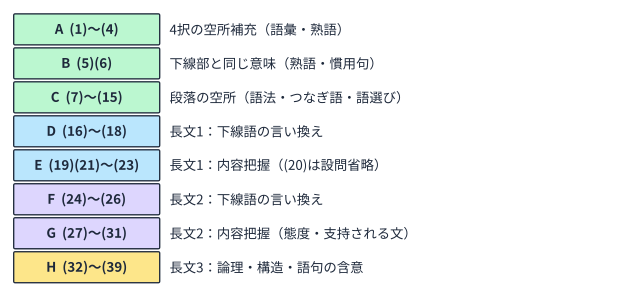
- ✅ 全8大問・設問は(1)〜(39)((20)は省略)の38問、試験時間は60分。すべてマークシートで、記述(和訳・英作文)はありません。
- ✅ (A)〜(C)は語彙・熟語・語法の15問。短い空所補充(A)、下線部と同じ意味(B)、段落中の空所(C)。ここを8分前後で終えるのが目標です。
- ✅ (D)〜(H)の長文3題が23問。(D)(F)は下線語の言い換え、(E)(G)は内容把握。最後の(H)は段落の構造・フレーズの働き・語句の含意まで問う、論理読みの大問です。
- ✅ 英文は科学・時事の記事。歴史上の人物の健康を調べる研究、人工知能チャットボットと教育現場、思春期の脳についての評論。専門知識は要りませんが、語彙の幅が点数を分けます。

Yuiちゃん
60分で38問、記述もあるのかと思っていました…。
Mio先生
全部マークだよ。語彙の15問を速く終えれば、長文に時間が回る。まず60分の使い方を決めよう!
ニックニ先生
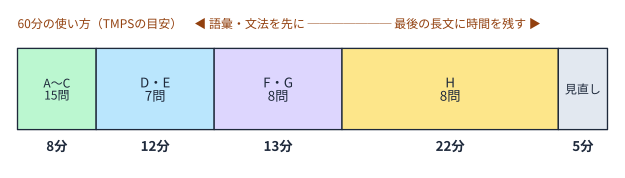
(A)〜(C)は1問30秒が目安です。知らない熟語に粘らず、印をつけて先へ。長文のほうが取り返せる点数は大きいです。60分の立ち回りマップ
時間はTMPSの目安です。解く順番と「捨てどころ」をセットで覚えておきましょう。
各大問の中身(設問番号と、問われる力)はこの図のとおりです。
🧭 おすすめの解く順番
(A)(B)(C) → (D)(E) → (F)(G) → (H) → 見直し
長文では、先に下線語の言い換え(D・F)を取り、そのあと内容把握(E・G)へ。(H)は構造や語句の働きを問うので、22分を確保しておきましょう。
(A)〜(C) 語彙・熟語・語法 ── 1問30秒、根拠は空所の前後だけ
(A)は短い1文の空所補充(4問)、(B)は下線部と同じ意味を選ぶ問題(2問)、(C)は長めの段落の空所補充(9問)。選択肢はすべてア〜エの4つです。
現場戦略試験会場でのリアルな立ち回り((A)〜(C))
⏱ 目標時間 & 死守ライン目標8分((A)(B)で3分、(C)で5分)。知っているかどうかで決まる問題が多いので、30秒悩んで決まらなければ印をつけて先へ。
⚠️ 損切り・警戒ライン(C)は段落全体の意味から決める問題が混ざります。前後の文の流れ(順接か逆接か)を先に押さえると速くなります。
💡 初手の思考トリガー選択肢を見たら、まず品詞と形(前置詞を伴う句か、他動詞か)を確認。意味はそのあとで確かめる。
Yuiちゃん
熟語は知らないと解けなくて、固まってしまいます…。Mio先生
まず形で絞ろう。たとえば「あとに前置詞が来る動詞か」「目的語が人か物か」。それで半分は消えるよ。ニックニ先生
知らない問題に粘らない。ここで1問落としても致命傷ではなく、悩んだ時間のほうが痛いです。(A)(B) 短い空所補充と同義語
(1)熟語(前置詞)
📝 どういう問題か?
「どんな事情があっても〜してはいけない」という強い禁止の文。文頭の空所に入る前置詞を、ア〜エの4択から選ぶ。
🎯 (1) の答え
イ(On)
(2)句動詞(受け身)
📝 どういう問題か?
授業中に私語をして、先生に注意を受けた、という文。空所に入る語を選ぶ。
〈tell 人 off〉=「(人を)叱る」。受け身で was told off =「叱られた」。gone / showed は off と組んでも「叱られた」という意味にならない。
🎯 (2) の答え
ア(told)
(3)慣用表現
📝 どういう問題か?
「曇ってきた。雨が降ったらどうする?傘を持っていったほうがいい」という会話。空所に入る語を選ぶ。
〈What if + 文?〉=「もし〜したらどうする?」。from / about / for では文が続かない。
🎯 (3) の答え
ア(if)
(4)語法(同格の that)
📝 どういう問題か?
「リナは次の試合に勝つことは疑いない」という文。空所に入る語を選ぶ。
〈There is no doubt that + 文〉=「〜は疑いない」。whether は「〜かどうか」で、no doubt の後ろでは〈that〉が基本。
🎯 (4) の答え
イ(that)
(5)下線部の同義(take advantage of)
📝 どういう問題か?
このグローバルなチームの一員として、現在の経済成長を「活用したい」という文。下線部と意味が最も近いものを選ぶ。
〈take advantage of ~〉=「~を利用する、活用する」。capitalize on =「~を(資本として)活用する」が同義。compliment on(ほめる)、concentrate on(集中する)は意味が違う。
🎯 (5) の答え
イ(capitalize on)
(6)下線部の同義(desire)
📝 どういう問題か?
世界はますます平和と調和を「望んでいる」という文。下線部と意味が最も近いものを選ぶ。
〈desire〉=「強く望む」。long for =「~を切望する」が近い。wait for(待つ)は「望む」ではない。fight for(~のために戦う)、stand for(~を表す)は別の意味。
🎯 (6) の答え
ア(longs for)
(C) 段落の空所補充((7)〜(10)・(11)〜(13)・(14)(15)の3つの段落)
本文は3つの短い段落で、順に航空と気候変動(7〜10)、雲を白くするプランクトン(11〜13)、移民規則をめぐる法案(14・15)です。段落ごとに前後の流れをつかんでから選びます。
(7)名詞(語選び)
📝 どういう問題か?
航空機が環境への影響から評判を落としている、という文の中の「評判」を表す名詞。ア〜エの4語から選ぶ。
〈get good press〉=「好意的に報道される」。ここでは否定形で「評判がよくない」。path / plague / payment は〈good ~〉と組んで「評判」の意味にならない。
🎯 (7) の答え
イ(press)
(8)句動詞(account for)
📝 どういう問題か?
航空は世界の二酸化炭素排出のうち約2%「を占めている」という文。
〈account for ~〉=「(割合を)占める」。アの adopts / イの allows / ウの adjusts は、後ろに「約2%」の割合を置いても意味が通らない。数字とセットで覚える。
🎯 (8) の答え
エ(accounts)
(9)名詞(語選び)
📝 どういう問題か?
未来の飛行機は、より少ない「〜燃料」を使い、より多くの代替エネルギーを使う必要がある、という文。
〈fossil fuel〉=「化石燃料」。直後に「持続可能な航空燃料(SAF)」=代替、とあるので、減らす対象は fossil。biomass / nuclear / hydrogen は「代替」側。
🎯 (9) の答え
ア(fossil)
(10)名詞(語選び)
📝 どういう問題か?
SAFの普及の「主な〜」は価格だ、という文。
〈a major obstacle to ~〉=「~への大きな障害」。直後の to と組む。option / outcome / obligation は to の相手として意味が合わない。
🎯 (10) の答え
ウ(obstacle)
(11)分詞(語選び)
📝 どういう問題か?
白い雲は、太陽光を宇宙へ「反射する」ことで地球を冷やす、という文。
直前に「太陽光が雲に当たって宇宙に跳ね返る」と述べている。〈the better it is at reflecting sunlight〉=「日光を反射するのが得意」。absorbing(吸収)は逆。
🎯 (11) の答え
エ(reflecting)
(12)句の意味(play a role)
📝 どういう問題か?
植物プランクトンが雲を白くするうえで大きな「役割を果たす」、という文。
〈play a big role in ~〉=「~で大きな役割を果たす」。define / function は a role と組めない。
🎯 (12) の答え
ア(play)
(13)名詞(語選び)
📝 どういう問題か?
プランクトンが出す物質は、「大気中」のガスと反応して小さな粒子になる、という文。
ガスと反応するのは〈in the atmosphere(大気中)〉。ocean(海)にあるのは生物のほうで、ガスと反応する場所としては不自然。
🎯 (13) の答え
エ(atmosphere)
(14)名詞(語選び)
📝 どういう問題か?
移民規則を見直し、長期収容に歯止めをかける、物議をかもす「〜」(法案)が上院の委員会を通過した、という文。
〈a controversial bill〉=「物議をかもす法案」。bill=法案。due / check / invoice は「法案」の意味ではない。
🎯 (14) の答え
イ(bill)
(15)句動詞の-ing
📝 どういう問題か?
採決の前に、その承認への「道を整えた」、という文。
〈pave the way for ~〉=「~への道を整える」。paving が入る。closing the way は「道を閉ざす」で、承認の話と逆になる。
🎯 (15) の答え
ア(paving)
ニックニ先生の総整理表
(A)〜(C):設問タイプ別の着眼点
| 型 | 設問 | 着眼点 |
|---|---|---|
| 熟語・句動詞 | (1)(2)(8)(15) | 前置詞・副詞とのかたまりで覚える(on no account / tell off / account for / pave the way) |
| 語彙(名詞) | (7)(9)(10)(13)(14) | 直前直後の語との組み合わせ(good press / fossil fuel / obstacle to / atmosphere / bill) |
| 同義語 | (5)(6) | 熟語を日本語で言い換えてから選択肢を見る(take advantage of =活用する) |
| 慣用・語法 | (3)(4)(11)(12) | What if / no doubt that / play a role など、形ごと覚える |
TMPSコーチング診断
🩺【自己診断】(A)〜(C)で手が止まった人への処方箋
- (1)(2)(8)(15)句動詞が出てこない → 動詞と前置詞を「かたまり」で音読して覚える
- (7)(9)(10)(13)(14)名詞が決まらない → 直前直後の語との相性(〜 fuel、obstacle to、bill)を先に見る
- (5)(6)同義語で迷う → 熟語を日本語に直してから選択肢を見る。選択肢の英語を見て決めない
- (11)(12)段落の意味から決める問題 → 前の文の言い換えが空所の近くにないか探す
(D)(E) 長文1(髪の毛のDNAと作曲家)── 下線語を先に、内容把握は第4段落から
歴史上の人物の健康を、保存された髪のDNAから調べた研究の記事です。設問は下線語の言い換え3問(D)と、内容把握4問(E)((20)は省略)。本文は4段落で、設問の根拠は第3・4段落に集中します。
現場戦略試験会場でのリアルな立ち回り((D)(E))
⏱ 目標時間 & 死守ライン目標12分。(D)の3問を先に3分で。(E)は設問を先に読み、第4段落から根拠を探す。
⚠️ 損切り・警戒ライン(E)で選択肢が組み合わせ型の問題((21))は、本文の3要素を先にメモしてから選ぶ。決まらなければ印をつけて先へ。
💡 初手の思考トリガー(D)は下線語の前後の語句が答えのヒントです。
Yuiちゃん
歴史の人物の医学の話は、知らない用語が多くて身構えてしまいます。Mio先生
専門用語は設問で問われないことが多いよ。段落ごとに「何の話か」を一言でまとめれば、設問の根拠はすぐ見つかる。ニックニ先生
組み合わせ型は、まず本文から要素を3つ書き出します。選択肢の組み合わせを先に読むと、混ざります。本文の要点(長文1):作曲家ベートーヴェンの死因や病気を、保存された髪の毛のDNAから調べた研究の記事。①生涯の健康問題と、聴力低下の原因が謎だったこと(P1)、②研究チームが髪から得たDNAで肝臓病の素因とB型肝炎を見つけた(P2)、③保存された髪のうち5本が同一人物のもので、本人のものと確認された(P3)、④難聴や消化器症状の遺伝的な説明は見つからず、肝臓病のリスク要因(遺伝子の型・大量の飲酒・B型肝炎)が重なったとみられる(P4)。
(16)下線語の言い換え(mystified)
📝 どういう問題か?
第1段落で、聴力低下の原因が専門家を「〜させた」という動詞の過去分詞。同じ意味の語を、ア〜オの5択から選ぶ。
〈mystify〉=「(人を)当惑させる」。原因が分からず困惑した、という流れ。baffled(当惑した)が同義。amazed(驚いた)は「驚嘆」で、原因不明の困惑とずれる。
🎯 (16) の答え
ア(baffled)
(17)下線句の言い換え(leading up to)
📝 どういう問題か?
第2段落の「死に至る数か月間」にあたる句。〈in the months ~ his death〉の ~ に入る意味の語を選ぶ。
〈lead up to ~〉=「~に先立つ、~へとつながる」。〈the months leading up to his death〉=「死の直前の数か月」。preceding(先立つ)が同義。
🎯 (17) の答え
イ(preceding)
(18)下線語の言い換え(patterns)
📝 どういう問題か?
第3段落で、髪のDNAに見られた損傷の「〜」。サンプルに予想される損傷の様子を表す名詞。
〈damage patterns〉=「損傷の様子・パターン」。選択肢で「模様・跡」を表すのは markings。regions(部位)や portions(部分)は「どこが」であって、損傷の「あり方」ではない。
🎯 (18) の答え
エ(markings)
(19)内容把握(研究の結論)
📝 どういう問題か?
DNA研究から、研究者たちは「聴力低下」について何を結論したか。
第4段落:髪のDNAからは、聴力低下や消化器症状を説明する遺伝的な証拠は見つからなかった。→「遺伝的な解析では判断できなかった」。ア(遺伝子の型が原因)・イ(肝炎への弱さが原因)は聴力低下には結びつけられていない。
🎯 (19) の答え
ウ(遺伝子解析では判断できなかった)
(21)内容把握(肝臓病リスクを重ねた要因)
📝 どういう問題か?
ベートーヴェンの肝臓病のリスクを重ねた要因の組み合わせを選ぶ。
第4段落:①リスクを3倍にする遺伝子の型、②大量の飲酒(歴史的記録)、③B型肝炎。→この3つの組み合わせ。「ユダヤ系の祖先」は第3段落で別のサンプルの話。「消化器症状」は肝臓病の要因ではなく、別の症状として扱われている。
🎯 (21) の答え
ウ(大量の飲酒・遺伝子の型・B型肝炎)
(22)内容把握(NOT・当てはまる症状)
📝 どういう問題か?
複数の消化器症状のうち、本文によると、ベートーヴェンが経験した症状はどれか。
第4段落:長引く下痢に苦しんだと記録がある。乳糖不耐症・セリアック病は「ほぼ除外」、過敏性腸症候群は「原因とは考えにくい」とされる。便秘は本文に出てこない。
🎯 (22) の答え
ア(下痢)
(23)内容把握(新しい発見)
📝 どういう問題か?
本文によると、研究者の「新しい発見」は何か。
第4段落の終わり:B型肝炎にかかっていたという新たな発見が、肝臓病の証拠をさらに積み上げる。ア(リスクが3倍)は遺伝子の型の話で、発見そのものではない。
🎯 (23) の答え
イ(ベートーヴェンはB型肝炎にかかり、肝臓病になりやすかった)
ニックニ先生の総整理表
(D)(E):設問タイプ別の着眼点
| 型 | 設問 | 着眼点 |
|---|---|---|
| 下線語の言い換え | (16)〜(18) | 直前直後の語句で意味を決める(mystify=当惑させる、lead up to=先立つ) |
| 研究の結論 | (19) | 「何が分かって、何が分からなかったか」を分けて読む |
| 要因の組み合わせ | (21) | 本文から要素を書き出し、別のサンプルの話(P3)と混ぜない |
| 当てはまる・新発見 | (22)(23) | ほぼ除外された選択肢を消去。「新しい発見」は文末の方の新情報 |
TMPSコーチング診断
🩺【自己診断】(D)(E)で手が止まった人への処方箋
- (16)〜(18)下線語が分からない → 直前直後の語句から意味を決め、選択肢を日本語にして比べる
- (19)(23)結論・発見で迷う → 「分かったこと」と「分からなかったこと」を分けて書く
- (21)(22)組み合わせ・症状 → 本文の列挙に○をつけ、「ほぼ除外」の語を消去
(F)(G) 長文2(教育現場とAI)── 「言い換え」は動詞・名詞の取り違えに注意、「本文にない」の選択肢もある
生成AIのチャットボットが教育現場に広がり、各所が対応を進めている、という記事です。設問は下線語の言い換え3問(F)と、内容把握5問(G)。「誰が」「どんな対策か」「なぜか」と、本文の事実を探します。
現場戦略試験会場でのリアルな立ち回り((F)(G))
⏱ 目標時間 & 死守ライン目標13分。(F)の3問は4分で。(G)は設問のキーワード(誰・対策・理由)を先に見て、該当する段落を探す。
⚠️ 損切り・警戒ライン(G)の(27)のような「感情・姿勢」を問う問題は選択肢が断定的で迷うので、印をつけて後回し。
💡 初手の思考トリガー(30)のように選択肢に「本文に書かれていない」がある問題は、本文に出てこない対策を一つずつ確かめる。
Yuiちゃん
言い換えの選択肢に、知っている意味の語が入っていて迷います。Mio先生
それが引っかけだよ。stir の動詞の意味(混ぜる)を選ばせる、みたいに。必ず、文の中での品詞と意味を確かめよう。ニックニ先生
「本文にない」を選ぶ問題は、他の4つを一つずつ消して、残った1つが答えです。本文の要点(長文2):生成AIのチャットボット(ChatGPT)が教育現場に広がり、大学や文部科学省が対応を進めている、という記事。①新学期を前に大学・教育省が動き出した(P1)、②九州大学がワーキンググループを設置、読書感想文コンクールも不正に注意(P2)、③文科省が参考資料を早く作成、専門家は「誤情報を子どもが信じる恐れ」を指摘(P3)、④海外でも対策が始まり、調査では学生の17%が使用経験あり。NYの公立校は原則禁止、オックスフォード大も課題への使用を認めない(P4)。
(24)下線語の言い換え(stir)
📝 どういう問題か?
第1段落の「教育界に〜を巻き起こしている」にあたる名詞。同じ意味の語を、ア〜オの5択から選ぶ。
〈cause a stir〉=「騒ぎ・波紋を巻き起こす」。commotion(騒ぎ、動揺)が同義。mixing(混ぜること)は stir の動詞の意味で、名詞の「騒ぎ」ではない。ここが引っかけ。
🎯 (24) の答え
イ(commotion)
(25)下線語の言い換え(accusation)
📝 どういう問題か?
第3段落の、「誤ってAIを使ったと疑われた」子どもが身の潔白を証明できない、その「疑い」にあたる名詞。
〈accusation〉=「非難・告発」。charge(嫌疑、告発)が近い。liability(責任)や obligation(義務)は「責める」意味を持たない。
🎯 (25) の答え
ア(charge)
(26)下線語の言い換え(grounds)
📝 どういう問題か?
第4段落の「〜という根拠で(on the grounds that)」の根拠にあたる名詞。
〈on the grounds that ~〉=「~という理由で」。grounds=理由・根拠。選択肢では premise(前提)が最も近い。campus(キャンパス)は「場所」の意味にとらわれた引っかけ。
🎯 (26) の答え
イ(premise)
(27)内容把握(教育者の姿勢)
📝 どういう問題か?
本文で示された、授業での利用に対する教育者の姿勢を最もよく表すものはどれか。
第2〜4段落:レポートなどでAIが使われるのを心配する一方、使用自体は広がっている。TMPSは、「小・中・高校生を含め、使われうる」という事実の記述に近いウを選んだ。ただし「教育者の感情」を問う問題で、選択肢はどれも断定的なため、判断が割れる。
🎯 (27) の答え
ウ(小・中・高校生に使われうる) 要確認
(28)内容把握(将来の責任)
📝 どういう問題か?
今後、授業でのChatGPTの利用を管理する責任を負うのは誰か。
第3段落:文科省は参考資料を作るが、各学校が自分で判断する。→学校(schools)。NII(国立情報学研究所)の教授はコメントしただけ。
🎯 (28) の答え
ウ(学校)
(29)内容把握(本文から支持される文)
📝 どういう問題か?
本文の情報から最も支持される文を選ぶ。
第4段落:学生新聞の調査で「17%が使った」と答えた。つまり多数の学生は「使った」と述べていない。→オ。ア(他国では問題ない)は逆、ウ(退学)は本文にない、エ(教育者の意見が分かれる)は本文に明示がない。
🎯 (29) の答え
オ(多数の学生は使用経験を述べていない) 要確認
(30)内容把握(大学の対策)
📝 どういう問題か?
大学がChatGPTの宿題使用を防ぐために実施した対策は何か。
第4段落:試験前に電子機器やかばんを回収、オックスフォードは課題での使用を禁止。選択肢のAI対策ボット・監視員・盗用チェッカー・退学処分は、本文に出てこない。→「本文に書かれていない」。
🎯 (30) の答え
オ(本文に書かれていない)
(31)内容把握(学校での使用が不適切な理由)
📝 どういう問題か?
本文の情報によると、学校の課題にChatGPTを使うのはなぜ不適切か。
第4段落:NYの公立校は、問題解決力や批判的思考力を育てないという理由で原則禁止。→ウ。ほかの理由(教科に合わない・費用)は本文にない。
🎯 (31) の答え
ウ(重要な力を育てる妨げになる)
ニックニ先生の総整理表
(F)(G):設問タイプ別の着眼点
| 型 | 設問 | 着眼点 |
|---|---|---|
| 下線語の言い換え | (24)〜(26) | 文中の品詞と意味を確認。よく知る別の意味(stir=混ぜる、grounds=場所)の引っかけに注意 |
| 誰が・どんな対策 | (28)(30) | 設問のキーワードで該当段落を探す。「本文にない」の選択肢を意識 |
| 支持される文 | (29) | 数字(17%)から言い換える。言い切りの強い選択肢は疑う |
| 姿勢・理由 | (27)(31) | 「教育者の感情」は判断が割れるので後回し。理由は「〜という理由で」の文を探す |
TMPSコーチング診断
🩺【自己診断】(F)(G)で手が止まった人への処方箋
- (24)〜(26)言い換えが選べない → 文中の品詞と意味を確かめ、よく知る別の意味に引っかからない
- (28)(30)(31)誰が・対策・理由 → 設問のキーワードで段落を絞り、本文の言い換えを探す
- (27)(29)姿勢・支持文で迷う → 数字を言い換え、断定的な選択肢は疑う
(H) 長文3(思春期の脳)── 段落の構造とフレーズの働きで解く
「思春期の脳は未熟だから危険な行動をする」という通説に反論する評論です。設問は8問すべて内容把握で、段落の要点・段落の構造・疑いを示すフレーズ・最大の問題点・語句の意味・要約・概念・筆者の見方、と論理を読む力が試されます。
⚠️ (38)(39)は判断が割れうる問題です。(38)は「高齢者の思考力の低下」と「若い成人の認知力の低下」の区別、(39)は「正直な失敗」と「経験不足による知恵の欠如」のどちらが筆者の主眼か、で迷います。TMPSの答えは根拠を示したうえで「要確認」としています。
現場戦略試験会場でのリアルな立ち回り((H))
⏱ 目標時間 & 死守ライン目標22分。本文9段落を約9分で読み、設問8問に約11分。見直し2分。
⚠️ 損切り・警戒ライン(38)(39)のように、選択肢が似ていて迷う問題は印をつけて、他の問題を先に取る。
💡 初手の思考トリガー段落ごとに役割を一言(主張・反論・紹介・欠点・例外・補足・結論)でメモする。
Yuiちゃん
9段落もあって、読むだけで時間が足りなくなりそうです。Mio先生
全部を訳さなくていいよ。段落の最初と最後の1文から、役割を一言でメモする。設問が聞くのは、ほぼその役割だから。ニックニ先生
「構造」や「フレーズの働き」の問題は、段落の最初・途中・最後の文に役割を書けば解けます。時間がかかるので、最後に回して構いません。本文の要点(長文3):「思春期の脳は未熟で、だから危険な行動をする」という通説を疑う評論。①危険な行動の原因は脳の欠陥ではなく、経験の不足と探索への意欲(P1)、②筆者は研究責任者として、文献を調べた結果、通説とは別の解釈を支持する証拠を得た(P2)、③脳の発達の不均衡という説の紹介(P3)、④その説は「危険な行動」の種類の違いを混同している点が最大の欠点(P4)、⑤探索は衝動的とは限らない、リスクが分かっていれば思春期は慎重(P5)、⑥衝動性の強い一部の子は実際にリスクが高い(P6)、⑦それは一部であって大多数ではない(P7)、⑧「知恵」は経験で積まれる。思春期は学習の時期(P8)、⑨失敗は経験不足による正直な失敗で、制御の欠如ではない(P9)。
(32)段落の要点(P1)
📝 どういう問題か?
第1段落の主な主張は何か。
第1段落:脳の欠陥が原因とされてきたが、本当の要因は経験の不足と、世界を探索したい意欲。→「思春期の行動の動機は、長く誤解されてきたのかもしれない」。「欠陥」を言い切るア・ウ・オは誤り。
🎯 (32) の答え
エ(行動の動機が長く誤解されてきたかもしれない)
(33)段落の構造(P2)
📝 どういう問題か?
第2段落の基本的な構造として正しい順序を選ぶ。
第2段落の流れ:①「私は公共政策センターの研究責任者として…」=権威づけ、②「私たちは10年分の文献を調べ…」=調査結果の記述、③「リスク行動は脳の制御の欠如の結果ではない」=従来の考えへの反論。→この順。
🎯 (33) の答え
イ(権威づけ→結果の記述→従来の考えへの反論)
(34)フレーズの働き(P3)
📝 どういう問題か?
第3段落で、筆者が通説に疑いを投げかけるために使っている句はどれか。
第3段落の最後:「…or so the theory goes(~ということになっている)」。「本当かは疑わしい」と、距離を置く表現。ア(More recently)は時間の副詞、エ(According to this theory)は紹介の導入で、疑いの表明ではない。
🎯 (34) の答え
イ(…so the theory goes.)
(35)最大の問題点(P4)
📝 どういう問題か?
第4段落で、筆者が従来の「思春期の脳」の考えの最大の問題と考えているのは何か。
第4段落:「最も目立つ失敗は、異なる種類のリスク行動の重要な違いを混同していること」。→あらゆる大胆な行動を一括して否定的にとらえる、という一般化。
🎯 (35) の答え
エ(あらゆる大胆な行動を否定的に一般化していること)
(36)語句の意味(falling prey to)
📝 どういう問題か?
第5段落の「stereotypes にとらわれる(falling prey to)」にあたる句を選ぶ。
〈fall prey to ~〉=「~の餌食になる、~に引きずられる」。stereotypes に影響されてしまう、の意味。→being influenced by。
🎯 (36) の答え
イ(being influenced by)
(37)段落の要約(P7)
📝 どういう問題か?
第7段落の正確な要約を選ぶ。
第7段落:危険な行動は子どもより思春期に多いが、決して一般的ではない。大多数は事故死・自殺・重い抑うつなどを経験しない。→「悪い結果は一般的でなく、一部の10代だけ」。ア(広く一般的)・ウ(大半が飲酒運転・薬物)は逆。
🎯 (37) の答え
エ(悪い結果は一般的ではなく、一部だけ)
(38)概念(wisdom paradox)
📝 どういう問題か?
本文の「知恵のパラドックス」の一因となるのはどれか。
第8段落:思春期後期〜若い成人は、多くの高齢者より衝動を抑える力が高い。一方で、高齢者は認知能力が30代の頃から衰えはじめ、知恵に頼る。→パラドックスの一因は「高齢者の思考力の低下」。ウ(若い成人の認知力の低下)は本文と逆。
🎯 (38) の答え
オ(高齢者の思考力の低下) 要確認
(39)筆者の見方(全体)
📝 どういう問題か?
思春期の行動と意思決定についての、筆者の見方を最もよく表すものはどれか。
第9段落:思春期の若者に欠けているのは制御する能力ではなく、経験によって得られる知恵。→「経験不足による知恵の欠如が、失敗を招く」。ア(正直な失敗)も本文の語を使うが、主眼は「経験・知恵の不足」。TMPSはイを選んだが、アとの比較で判断が割れる。
🎯 (39) の答え
イ(経験不足による知恵の欠如が失敗を招く) 要確認
ニックニ先生の総整理表
(H):設問タイプ別の着眼点
| 型 | 設問 | 着眼点 |
|---|---|---|
| 段落の要点・要約 | (32)(37) | 最初・最後の文から主張を決め、言い切りの強い選択肢は疑う |
| 段落の構造 | (33) | 文ごとの役割(権威づけ・結果・反論)を並べる |
| 疑いのフレーズ | (34) | or so the theory goes など、距離を置く表現を探す |
| 最大の問題・筆者の見方 | (35)(39) | 「最も」を示す文(most striking failure / what students lack)を探す |
| 語句・概念 | (36)(38) | 文脈から意味を決める。概念は定義の文の前後を見る |
TMPSコーチング診断
🩺【自己診断】(H)で手が止まった人への処方箋
- (32)(37)主張・要約が選べない → 段落の最初と最後の文を探し、「言い切り」の入った選択肢は疑う
- (33)(34)構造・フレーズ → 文ごとの役割を書き出し、距離を置く表現を探す
- (35)(39)最大の問題・見方 → 「最も」にあたる文を探し、本文の言い換えと比べる
- (36)(38)語句・概念 → 文中の意味から決め、前後の文で確かめる
本番の答え一覧(採点用)
解説を読んだあとの最終確認用です。判断が割れうるものには「要確認」を付けています。(20)は設問省略のため載せていません。
(A)(B)(C) 語彙・熟語・語法
(1) イ(2) ア(3) ア(4) イ(5) イ(6) ア(7) イ(8) エ(9) ア(10) ウ(11) エ(12) ア(13) エ(14) イ(15) ア
(D)(E) 長文1(髪のDNAと作曲家)
(16) ア(17) イ(18) エ(19) ウ(21) ウ(22) ア(23) イ
(F)(G) 長文2(教育現場とAI)
(24) イ(25) ア(26) イ(27) ウ 要確認(28) ウ(29) オ 要確認(30) オ(31) ウ
(H) 長文3(思春期の脳)
(32) エ(33) イ(34) イ(35) エ(36) イ(37) エ(38) オ 要確認(39) イ 要確認
※ 答えはTMPSが本文から独立に導き、解説に書いた根拠で成り立つことを確認したものです。意味の近い選択肢が並ぶ(27)(29)(38)(39)は判断が割れうるため、断定を避けています。
採点したら → 30秒の得点診断へ
TMPS ORIGINAL
近畿大2024型 そっくり類題セット
近畿大2024型 そっくり類題セット
(A〜H・全39問・解答解説つき)
2024年度の本番と同じA〜Hの構成(設問(1)〜(39)。本番で省略された(20)も類題では出題)で、題材と設定を変えたTMPSオリジナル問題です。語彙の即答力と、長文で根拠を探す読み方を、本番どおり60分で確かめられます。
試験時間の目安 60分語彙・同義語・段落の空所・長文3題
📄 本番形式の問題冊子PDFをダウンロード(全10ページ)
印刷して本番と同じように60分で解けます。解答・解説はこのページの下に掲載しています。
※ 国際医療福祉大学の入試問題ではありません。本文・設問・人物・団体(架空)はすべてTMPS医学館が作成したオリジナルで、出典のある引用ではありません。
類題 (A)
(A) Complete the following sentences with the best word.
空所に入る最も適切な語を、ア〜エから一つ選べ。
(1) 1 no circumstances should visitors enter the laboratory without a badge.
- ア By
- イ Over
- ウ Under
- エ Of
(2) The driver was 2 off with a warning for parking in the wrong place.
- ア let
- イ held
- ウ taken
- エ gone
(3) How 3 taking a short break before we start the next task?
- ア if
- イ about
- ウ with
- エ for
(4) There is no question 4 the new bridge will reduce traffic in the town.
- ア that
- イ how
- ウ what
- エ whose
▶ 類題 (A) の答えと解説
- (1) ウ(Under)…〈Under no circumstances〉=「どんな事情があっても〜ない」。否定語が文頭に出るので、後ろは疑問文の語順(should visitors enter)になる。
- (2) ア(let)…〈let 人 off〉=「(人を)罰せずに許す」。受け身で was let off with a warning(警告だけで済んだ)。
- (3) イ(about)…〈How about + -ing〉=「~してはどうですか」。How if は文として成り立たない。
- (4) ア(that)…〈There is no question that ~〉=「~は疑いない」。直後は完全な文なので、同格の that が入る。
類題 (B)
(B) Choose the answer that is closest in meaning to the underlined word or phrase.
下線部と意味が最も近いものを、ア〜エから一つ選べ。
(5) We should make the most of this chance to meet the researcher.
- ア take full advantage of
- イ look down on
- ウ run out of
- エ give up on
(6) The mayor strives for a cleaner river and a quieter town.
- ア waits patiently for
- イ pays no attention to
- ウ cares little for
- エ works hard for
▶ 類題 (B) の答えと解説
- (5) ア(take full advantage of)…〈make the most of ~〉=「~を最大限に活用する」。take full advantage of が最も近い。
- (6) エ(works hard for)…〈strive for ~〉=「~を目指して努力する」。works hard for が近い。waits(待つ)は努力の意味がない。
類題 (C)
(C) Complete the following paragraphs with the best word.
次の3つの段落の空所(7)〜(15)に入る最も適切な語を、ア〜エから一つずつ選べ。
P1: In many cities, summer heat is becoming a serious 7 to public health. Concrete and asphalt absorb sunlight and release it slowly at night, which keeps city centers several degrees warmer than the nearby countryside. Planting trees is one of the most effective ways to 8 the problem, because leaves cool the air as they release water vapor. Planners also paint roofs white so that they 9 sunlight instead of storing it. The difficulty is cost: many city governments cannot 10 such projects without outside help.
P2: Bees do far more than make honey. As they move from flower to flower, they carry pollen, which helps plants 11. Roughly one-third of the food we eat depends on this service. Yet bee numbers have been falling in recent decades, partly because of the widespread use of 12 and partly because of the loss of wildflower meadows. Some farmers have therefore started to leave strips of wild land beside their fields, a simple step that has 13 in a surprising increase in local bee populations.
P3: A proposal to ban cars from the city center was 14 by the council on Monday, despite fierce protest from shop owners, who fear that customers will 15 elsewhere.
(7)
- ア bonus
- イ threat
- ウ mission
- エ custom
(8)
- ア raise
- イ ease
- ウ praise
- エ erase
(9)
- ア reflect
- イ collect
- ウ inspect
- エ neglect
(10)
- ア argue
- イ allow
- ウ afford
- エ alter
(11)
- ア reproduce
- イ rescue
- ウ retreat
- エ resign
(12)
- ア pastimes
- イ proteins
- ウ pesticides
- エ portions
(13)
- ア resulted
- イ insisted
- ウ arisen
- エ consisted
(14)
- ア appealed
- イ approved
- ウ applied
- エ approached
(15)
- ア make
- イ take
- ウ go
- エ pass
▶ 類題 (C) の答えと解説
- (7) イ(threat)…〈a threat to ~〉=「~への脅威」。暑さが健康にとって「脅威」になる、という文脈。
- (8) イ(ease)…木を植えると問題が「和らぐ」。ease the problem =問題を和らげる。raise は問題を「引き起こす・持ち出す」で逆。
- (9) ア(reflect)…白い屋根は日光を「反射する」。〈instead of storing it(蓄える代わりに)〉との対比で reflect。
- (10) ウ(afford)…〈cannot afford ~〉=「~をする余裕がない」。直前の「費用が問題」という流れに合う。
- (11) ア(reproduce)…花粉を運ぶと、植物が「繁殖する」。reproduce =繁殖する。
- (12) ウ(pesticides)…蜂が減った理由として、広く使われる「農薬」。pesticides が文脈に合う。
- (13) ア(resulted)…直後が in なので〈result in ~〉(~という結果になる)。a step that has resulted in an increase。
- (14) イ(approved)…提案が議会で「承認された」。despite(~にもかかわらず)の対比も手がかり。
- (15) ウ(go)…〈go elsewhere〉=「よそへ行く」。直後に目的語がない形なので、自動詞の go だけが入る。
類題 (D)
(D) Find the underlined words in the passage and choose the best substitute.
本文(長文1)の下線部(16)〜(18)に最も近い意味のものを、ア〜オから一つずつ選べ。
P1: In 1998, workers digging a drain beneath the old market square of Ravenholt uncovered a sealed clay jar. Inside was the account book of a seventeenth-century baker named Tomas Hale. For years historians paid it little attention. The handwriting was cramped and the entries seemed ordinary, but one thing puzzled 16 them: Hale recorded loaves sold on every day except Sundays, yet his household bought medicine almost every week.
P2: Now a team at Eastfield University has examined the book with imaging software that can recover faded ink. They found that in the weeks running up to 17 the town's great fire of 1672, Hale had almost stopped recording sales. The later pages were written in thinner ink and a shakier hand, a telltale 18 sign that he was writing in a hurry or under strain.
P3: To understand why, the researchers compared the book with parish records. The records show that Hale's daughter fell seriously ill in the summer of 1672 and died the following spring, and that after the fire Hale lost the lease on his shop. Hale's own entries also show a debt to a miller, which had tripled within a single year.
P4: The team found no evidence that the missing sales were caused by a poor harvest or by a ban on selling bread: grain prices stayed stable, and the town council never issued a ban. Illness in the family, the debt, and the loss of the shop together explain the pressure on Hale much better. And the new finding that the medicine entries were mostly for his daughter, not for Hale himself, adds to the evidence.
(16) Which choice is closest in meaning to puzzled in paragraph 1 (P1)?
- ア pressed
- イ delighted
- ウ repaid
- エ prepared
- オ confused
(17) Which choice is closest in meaning to running up to in paragraph 2 (P2)?
- ア following
- イ preceding
- ウ avoiding
- エ celebrating
- オ rebuilding
(18) Which choice is closest in meaning to telltale in paragraph 2 (P2)?
- ア false
- イ rare
- ウ revealing
- エ hidden
- オ decorative
▶ 類題 (D) の答えと解説
- (16) オ(confused)…puzzle=当惑させる。confused(戸惑った)が最も近い。「ふつうの記録なのに、薬の購入だけが不可解」という文脈。
- (17) イ(preceding)…〈the weeks running up to ~〉=「~の直前の数週間」。preceding(先立つ)が近い。following は逆の向き。
- (18) ウ(revealing)…telltale=(隠れた事情を)示す。「急いでいた・負担を受けていたことを示すしるし」なので revealing。hidden(隠れた)は逆に近い。
類題 (E)
(E) Choose the best answer to the following:
本文(長文1)の内容に関する設問(19)〜(23)に答えよ。ア〜オから一つ選べ。
(19) According to the passage, what did the researchers conclude about Hale's missing sales?
- ア not mentioned in the passage
- イ They could not be explained by any record.
- ウ They could be linked to family illness, a debt, and the loss of the shop.
- エ They were caused by a ban on selling bread.
- オ They were caused by a poor harvest.
(20) According to the passage, which factors added to the pressure on Hale?
- ア family illness, a debt to a miller, and the loss of his lease
- イ family illness, a poor harvest, and the loss of his lease
- ウ a debt to a miller, a poor harvest, and a ban on bread
- エ a poor harvest, a debt to a miller, and a ban on bread
- オ a ban on bread, family illness, and the loss of his lease
(21) Which of the following did the passage say Hale did NOT have to deal with?
- ア a rise in the price of grain
- イ a growing debt
- ウ the death of his daughter
- エ the loss of his shop
- オ a fire in the town
(22) According to the passage, for whom was most of the medicine probably bought?
- ア his apprentice
- イ his daughter
- ウ the town council
- エ the miller
- オ Hale himself
(23) According to the passage, what novel discovery was made by the researchers?
- ア Bread had been banned in Ravenholt.
- イ Hale was the first baker in the town.
- ウ The fire of 1672 began in Hale's shop.
- エ Faded entries in the book could be recovered with imaging software.
- オ Grain prices tripled in 1672.
▶ 類題 (E) の答えと解説
- (19) ウ(They could be linked to family illness, a debt, and the loss of the shop.)…P4:病気・借金・店の喪失が合わせて説明する、と述べる。「ban」「poor harvest」は P4 で否定されている。
- (20) ア(family illness, a debt to a miller, and the loss of his lease)…P3・P4で、病気(娘)・借金(製粉業者)・店の賃借権の喪失の3つが挙げられる。poor harvest と ban は否定された要因。
- (21) ア(a rise in the price of grain)…P4:grain prices stayed stable(穀物価格は安定していた)。ほかの4つは本文に出てくる。
- (22) イ(his daughter)…P4:the medicine entries were mostly for his daughter。本文の言い換えをそのまま探す問題。
- (23) エ(Faded entries in the book could be recovered with imaging software.)…P2:imaging software で消えかけた記録を読み取れた、が新しい点。ほかの選択肢は本文にないか、本文と逆。
類題 (F)
(F) Find the underlined words or phrase in the passage and choose the best substitute.
本文(長文2)の下線部(24)〜(26)に最も近い意味のものを、ア〜オから一つずつ選べ。
P1: Smartphones have become a source of friction 24 in Japanese classrooms. As the new term begins, several city boards of education are reviewing their rules on phones at school, and parents, teachers and students are all being heard.
P2: In March, the Hirano City Board of Education set up a panel to study the issue. "Teachers spend too much time telling students to put their phones away, and we worry that learning is being interrupted," said the panel chair, Ayumi Kondo. A national association of parents has meanwhile released a statement: "Phones should not be banned outright, because many families rely on them to contact their children after school."
P3: The Ministry of Education says it will compile a guide as quickly as possible, but each school will make the final decision on its own rules. Professor Daisuke Mori, an education researcher, said: "A blanket 25 ban may be easy to explain, but it does not teach children when and how to use a phone."
P4: According to a survey of 1,200 students conducted by the board last autumn, 62 percent said they check their phones during lessons at least once a day. Some schools now collect phones in lockers at the start of the day. A few schools have chosen to do away with 26 their rules altogether, arguing that students must learn self-control for themselves.
(24) Which choice is closest in meaning to friction in paragraph 1 (P1)?
- ア profit
- イ weight
- ウ silence
- エ fashion
- オ conflict
(25) Which choice is closest in meaning to blanket in paragraph 3 (P3)?
- ア thin
- イ plain
- ウ sweeping
- エ warm
- オ soft
(26) Which choice is closest in meaning to do away with in paragraph 4 (P4)?
- ア abolish
- イ publish
- ウ delay
- エ repeat
- オ improve
▶ 類題 (F) の答えと解説
- (24) オ(conflict)…friction=摩擦、対立。「ルールをめぐって親・教師・生徒が意見を出している」という文脈から conflict。
- (25) ウ(sweeping)…blanket=全面的な(例外のない)。「全員に一律に当てはめる禁止」なので sweeping が近い。
- (26) ア(abolish)…〈do away with ~〉=「~をなくす」。abolish が近い。「ルールを一切つくらない」という文脈。
類題 (G)
(G) Choose the best answer to the following:
本文(長文2)の内容に関する設問(27)〜(31)に答えよ。ア〜オから一つ選べ。
(27) Which statement best describes the attitude of the panel chair toward phones in class?
- ア Phones interrupt lessons, so rules are needed.
- イ Phones should be encouraged for taking notes.
- ウ Phones are unfair because not every student owns one.
- エ Phones should be banned from all schools at once.
- オ Phones are harmless in every situation.
(28) According to the passage, who will make the final decision on the rules?
- ア the parents' association
- イ the students
- ウ each school
- エ the Ministry of Education
- オ the panel
(29) Which of the following statements is best supported by the passage?
- ア Teachers rarely mention phones to students.
- イ All schools in the country have banned phones.
- ウ Most students in the survey check their phones during lessons.
- エ Rural schools have fewer phones than city schools.
- オ Parents unanimously support a ban.
(30) According to the passage, which countermeasure has been adopted by some schools?
- ア fining parents
- イ using phone-detecting software
- ウ installing signal blockers
- エ collecting phones in lockers
- オ expelling students
(31) According to the sources in the passage, why does the parents' association oppose an outright ban?
- ア The Ministry has already approved phones.
- イ Phones are cheaper than textbooks.
- ウ Families use phones to contact their children after school.
- エ Teachers prefer phones to books.
- オ Phones make students study harder.
▶ 類題 (G) の答えと解説
- (27) ア(Phones interrupt lessons, so rules are needed.)…P2:Kondo は授業が中断されることを心配している。→「ルールが必要」。全面禁止とまでは言っていない。
- (28) ウ(each school)…P3:each school will make the final decision。国は guide をつくるだけ。
- (29) ウ(Most students in the survey check their phones during lessons.)…P4:62%(過半数)が授業中に少なくとも1日1回は確認する。ほかの選択肢は本文にないか、言い切りが強すぎる。
- (30) エ(collecting phones in lockers)…P4:collect phones in lockers。ほかは本文に出ない。
- (31) ウ(Families use phones to contact their children after school.)…P2:保護者団体の声明。「下校後に子どもと連絡をとる家庭が多い」から全面禁止に反対。
類題 (H)
(H) Choose the best answer to the following:
本文(長文3)の内容に関する設問(32)〜(39)に答えよ。ア〜オから一つ選べ。
P1: For decades, teachers have been told to match lessons to students' "learning styles"—visual, auditory, or hands-on. A closer look at the evidence suggests that this popular idea may have long been mistaken: what helps students learn is variety and effort, not a style that fits.
P2: As director of research at an education policy center, I have spent years reviewing experiments on teaching methods. Recently, my colleagues and I examined sixty studies. The popular belief is not supported by the evidence. In our review, students taught in their "preferred" style did no better than those taught in another way.
P3: We often describe students as "visual people" or "hands-on people." This belief became popular in some teacher-training circles after questionnaires showed that students were willing to describe themselves in this way. According to this view, a visual learner given a spoken lecture simply cannot absorb it—or so the story goes.
P4: The idea has gained currency to the point that publishers label textbooks by style and parents ask schools to "identify" their children's styles. In my view, the most serious failure of the style theory is that it treats every difference between students as fixed, when most of them—in interest, background, and prior knowledge—change quickly. What clearly helps all students is a mix of methods: pictures, words, practice, and discussion.
P5: Sorting students by style is not harmless. A teacher who labels a child a "listener" may stop offering diagrams, and a student who accepts the label may avoid tasks that "do not suit" her. Both fall prey to a simple stereotype, and the label becomes a limit rather than a description.
P6: In studies that mimic real classrooms, students who studied with a mix of formats did slightly better than those who received only their "preferred" format, and the difference was steady across ages. Differences between individual students were large, but they were differences in prior knowledge, not in style.
P7: It is important to realize that real exceptions exist, though they are few. A student with poor eyesight needs large print, and a student with a hearing difficulty needs captions. These are needs, not styles. The great majority of students gain far more from a well-made lesson that uses several formats than from any matching exercise.
P8: Considerable research suggests that testing oneself on what one has learned, rather than rereading, is the most reliable way to remember. The irony is that students often find self-testing harder and therefore rate it as less useful, a result some have called the "difficulty paradox." Learners must rely on evidence, not on how a method feels, to choose how they study.
P9: A calm review of existing research suggests that what students lack is not a matched style but a repertoire of study habits. This takes time and, without guidance, students will make mistakes. But these are honest mistakes, and they do not show that a style was ignored. We should not let the label color our interpretation of what students are doing. They are just learning how to learn, and this inevitably involves trial and error.
(32) The primary idea in paragraph 1 (P1) is that
- ア most students are visual learners.
- イ a popular belief about learning may have long been mistaken.
- ウ teachers have never used style-based lessons.
- エ lessons are better today than they used to be.
- オ matching lessons to styles clearly raises test scores.
(33) What is the basic structure of paragraph 2 (P2)?
- ア make a statement of findings, establish authority, disagree with past ideas
- イ establish authority, disagree with past ideas, make a statement of findings
- ウ disagree with past ideas, make a statement of findings, establish authority
- エ disagree with past ideas, establish authority, make a statement of findings
- オ establish authority, make a statement of findings, disagree with past ideas
(34) In paragraph 3 (P3), what phrase is used by the author to cast doubt on a widely held belief about how students learn?
- ア "...were willing to describe themselves..."
- イ "...became popular in some teacher-training circles..."
- ウ "According to this view,..."
- エ "We often describe..."
- オ "...or so the story goes."
(35) In paragraph 4 (P4), what does the author suggest is the biggest problem with the style theory?
- ア It prevents teachers from using discussion.
- イ It was developed by parents, not teachers.
- ウ It ignores the role of pictures in lessons.
- エ It treats changeable differences between students as fixed.
- オ It makes textbooks too expensive.
(36) What phrase below is closest in meaning to "fall prey to" as it is used in paragraph 5 (P5)?
- ア taking care of
- イ being misled by
- ウ making use of
- エ getting rid of
- オ becoming tired of
(37) Which sentence below is an accurate summary of paragraph 7 (P7)?
- ア Lessons that use several formats are harmful to most students.
- イ Matching exercises help students with poor eyesight more than anyone else.
- ウ Captions are useful only for students with a preferred style.
- エ A few students have real needs, but most gain more from lessons that use several formats.
- オ Most students have real needs that must be met one by one.
(38) Which of the concepts below contributes to the "difficulty paradox" mentioned in the passage?
- ア rereading a text many times
- イ studying in a quiet room
- ウ matching lessons to preferred styles
- エ self-testing that feels hard but works well
- オ studying in one long session
(39) Which of the following best captures the author's view about students' study habits?
- ア Students' difficulties come mainly from not yet having effective habits, not from ignored styles.
- イ Students' mistakes show a lack of effort.
- ウ Students should be sorted by style as early as possible.
- エ Students make mistakes because their teachers ignore their styles.
- オ Students cannot improve without individual style tests.
▶ 類題 (H) の答えと解説
- (32) イ(a popular belief about learning may have long been mistaken.)…P1の主張は第2文:popular idea may have long been mistaken。「いつも・clearly」と言い切る選択肢は誤り。
- (33) イ(establish authority, disagree with past ideas, make a statement of findings)…P2は、①As director…(肩書き=権威づけ)→ ②The popular belief is not supported(従来の考えへの反論)→ ③In our review…(調査結果の記述)の順。
- (34) オ("...or so the story goes.")…〈or so the story goes〉=「~ということになっている(が本当かは疑わしい)」。自分は信じていない、と距離を置く言い回し。
- (35) エ(It treats changeable differences between students as fixed.)…P4:most serious failure … treats every difference as fixed。「最も重大な欠陥」を探す問題。
- (36) イ(being misled by)…〈fall prey to ~〉=「~の餌食になる、~にだまされる」。stereotype(固定観念)に引きずられる、の意味。
- (37) エ(A few students have real needs, but most gain more from lessons that use several formats.)…P7:例外は「few」。多数は複数の形式を使う授業から得るもののほうが大きい。「most」と「few」の取り違えに注意。
- (38) エ(self-testing that feels hard but works well)…P8:自己テストは「難しく感じる」ので、役に立たないと評価されがち。実際には最も確実、という皮肉が paradox。
- (39) ア(Students' difficulties come mainly from not yet having effective habits, not from ignored styles.)…P9:lack a repertoire of study habits / honest mistakes。「スタイル」でなく「習慣の不足」が原因、が筆者の見方。
30秒 得点診断
本番の過去問、またはそっくり類題セットを60分で解いた結果を選んでください。次にやるべきことを表示します。
保護者の方へ:近畿大の英語で知っておきたい3つのこと
① 差がつくのは「語彙の幅」
15問が語彙・熟語・語法で、知らないと解けない問題が多くを占めます。日頃から熟語を「かたまり」で覚える習慣が効きます。② 長文は「段落の役割」で解く
長い本文を全部理解しようとするより、段落ごとの役割(主張・反論・調査・結論)を一言でつかむ練習が効きます。(H)は論理を問う設問が中心です。③ 秋からは「答案を見てもらう」
60分で38問を終える配分は、独学では直しにくい部分です。どこで時間を失ったか、第三者の目で見ると最短で伸びます。よくある質問
Q. 近畿大学 医学部の英語2024年度は、どこから解くべきですか?
TMPSのおすすめは(A)〜(C)の語彙・文法15問を8分で終え、(D)(E)・(F)(G)の長文を計25分、最後の(H)に約22分を残す順です。60分で38問なので1問あたり約1.6分。(H)は設問が論理・構造まで踏み込むので、時間を先に確保します。
Q. 問題文が載っていなくても、どんな問題か分かりますか?
分かります。著作権に配慮して英文・設問文は掲載していませんが、各設問ごとに「どういう問題か」「何を根拠に選ぶか」をTMPSの言葉で説明しています。
Q. 設問(20)の解説がないのはなぜですか?
過去問集では(20)が「設問省略」となっており、問題が掲載されていないためです。このページの解説は掲載されている38問((1)〜(19)、(21)〜(39))です。
Q. 答えに「要確認」が付いているのはなぜですか?
TMPSが本文から独立に答えを導き、判断が割れうる(27)(29)(38)(39)には「要確認」を付けています。答えを断定せず、どこで迷うかを解説に書いています。
Q. そっくり類題セットとは何ですか?
2024年度と同じ大問構成(A〜H)で、題材を変えたTMPSオリジナル問題です。本文・設問は新しく作ったもので、全問((20)を含む39問)の解答・解説をこのページに掲載し、問題冊子PDFも無料でダウンロードできます。
安心安全・継続更新システム
問題等で誤りを発見された場合、修正しますので、TMPS医学館までLINEを下さい。
受験生・指導者の皆様からのご指摘を真摯に受け止め、最も信頼できる過去問解説・類題ライブラリーとして随時アップデートいたします。
🔥 次に読むならこちら
近畿大の英語を、
あなたの答案で攻略する
「どこで時間を失ったか」「どの問題を後回しにすべきだったか」「長文のどこで迷うか」を、Mio先生があなたの答案から直接診断します。