TMPS英語道場 近畿大 英語2025
2025年度 一般前期 全39問・マーク式60分そっくり類題セット

近畿大学
医学部 英語
2025年度 解答・解説

問題文は掲載できませんが、
解説を読むだけでどんな問題かもわかる!

さらに、そっくり類題PDFを見れば、実際の問題イメージもわかるよ!

長文3題とA〜Cの語彙・文法を、段落の役割と設問の型から解説。最後に、本番と同じ設問数のオリジナルそっくり類題セット(全39問・全問解答つき)で、2025年度を丸ごと演習できます。

Mio先生
解説:Mio先生・ニックニ先生(TMPS医学館) / 更新:2026.11.08 / 読了 約30分

📌 このページの使い方

  1. 過去問集をお持ちの方:本番と同じ60分で解き、各大問の解説で根拠を確かめる。答え一覧は本編の後ろにあります
  2. お持ちでない方:各大問の「どういう問題か」と「段落の役割」を読めば、英文の流れと設問の型が分かります
  3. 最後にそっくり類題セット(PDF版あり)を60分で解き、初見でも同じ解き方ができるか確かめる

※ 著作権に配慮し、英文・設問文は掲載していません(引用は短い語句まで)。※ 赤本に載っている答えは(1)〜(6)だけです。それ以外はTMPSが本文から導いた答えで、判断が割れる設問には「要確認」を付けています。

⚠️ 問題等で誤りを発見された場合、修正しますので、TMPS医学館までLINEを下さい。(迅速に確認・更新いたします)

LINEで誤りを連絡
SUMMARY

3分で分かる 2025年度の近畿大の英語

Yuiちゃん
Yuiちゃん
長文が3つもあって、60分で終わるか不安です…。
Mio先生
Mio先生
大丈夫。A〜Cを12分で終えて、長文は1つ13〜15分を目安にしましょう。ポイントは、本文を読む前に設問をざっと見て、何を探すか決めておくことです。
ニックニ先生
ニックニ先生
時計は11分、25分、40分、55分で見る。この4回の確認だけ決めておくと、焦らないぞ。
STRATEGY MAP

60分の立ち回りマップ

試験時間は60分。時間はTMPSの目安です。

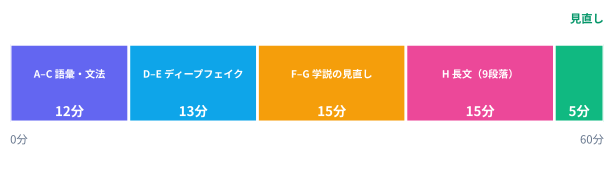
60分の時間配分。A〜C 12分、D〜E 13分、F〜G 15分、H 15分、見直し5分
図A 60分の使い方(TMPS作成)
🧭 おすすめの解く順番
A〜C → D〜E → H → F〜G(見直しは最後の5分)
F〜Gは抽象度が高く迷いやすいので最後に回し、本文が長くても内容が具体的なHを先に取る、という順番もおすすめです。自分の得意な順で構いませんが、マークの番号がずれないよう、1題ごとに確認しましょう。
A〜C / 目標:12分

A〜C 語彙・文法((1)〜(15))

前置詞や動詞の語法(A)、下線部の言い換え(B)、短い3つの文章の空所補充(C)の計15問です。知っているかどうかで決まる設問が多く、考え込まずに速く取るのがコツです。

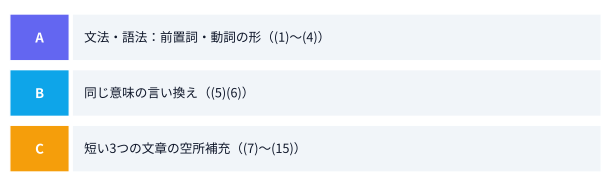
A〜Cの構成。Aは語法の4問、Bは言い換えの2問、Cは3つの文章の9問
図B A〜Cの構成(TMPS作成)
現場戦略試験会場でのリアルな立ち回り(A〜C)
⏱ 目標時間 & 死守ライン目標12分(1問平均48秒)。A・Bの6問は3分、Cの9問は9分。
⚠️ 損切り・警戒ライン30秒で決まらない設問は印をつけて飛ばし、最後に戻る。(7)は文脈の判断なので後回しでよい。
💡 初手の思考トリガー最初の一手は空所の前後の語(前置詞・目的語)を見ること。語法の設問は、前後だけで決まることが多い。

A語法の空所補充((1)〜(4))

📝 どういう問題か?

4つの短い文で、空所に入る語(前置詞・副詞・動詞)をア〜エから選ぶ。熟語・語法の知識で決まる。

  • (1):「わざわざ〜する」という熟語に入る前置詞
  • (2):「もたらす」という意味の句動詞に入る副詞
  • (3):人に仕事を「任せる」の形に合う動詞
  • (4):成功の原因を〜に帰す、の形に合う動詞

(1) イ go out of one’s way で「わざわざ〜する」。on・to・with では熟語にならない。

(2) エ bring about で「(結果を)もたらす」。up・down・to はこの意味にならない。

(3) イ 「A(人)にB(仕事)を任せる」は entrust A with B。assign は assign B to A の形(with は続かない)、allocate・transfer は意味が合わない。 要確認(assign/entrust の使い分け)

(4) エ attribute A to B で「AをBのおかげ(せい)とする」。空所の直後の to がヒント。

🎯 (1)〜(4) の答え
(1) イ(2) エ(3) イ(4) エ

赤本の解答編に載っている答えと、TMPSが独立に導いた答えが一致しました。

B下線部の言い換え((5)(6))

📝 どういう問題か?

下線部と意味がもっとも近い語句を、4つの選択肢から選ぶ。

  • (5):「〜を犠牲にして」を表す下線の句に最も近いもの
  • (6):「(チームに)話しかけた」を表す下線の動詞に最も近いもの

(5) ウ by sacrificing(〜を犠牲にして)は at the expense of(〜を犠牲にして)と同じ意味。at the mercy of(〜のなすがまま)と混同しない。

(6) ア address には「(人に)話しかける」の意味があり、spoke to が近い。brought up(話題に出した)・pointed out(指摘した)は対象が「人」でないと合わない。

🎯 (5)(6) の答え
(5) ウ(6) ア

C短い3つの文章の空所補充((7)〜(15))

📝 どういう問題か?

科学・環境の話題の短い3つの文章。語彙(名詞・形容詞・動詞)と、熟語(take over、account for など)を、文脈から選ぶ。

  • 第1の文章:トウモロコシと文化・多様性・進化((7)〜(9))
  • 第2の文章:絶滅後の哺乳類の生き残り((10)〜(13))
  • 第3の文章:水素エネルギーと日本の姿勢((14)(15))

(7) イ 「この農業の( )」と、トウモロコシの存在がもたらした遺産・宝を言い換える語が入る。名詞の意味から asset(財産・価値あるもの)を選ぶ。soil(土)は「農業」と結びつくがつながりが弱い。 要確認(文脈で asset(soil との迷い))

(8) ア the most genetically diverse(遺伝的にもっとも多様な)が、後ろの「59の固有品種」とつながる。

(9) イ has evolved through millennia of domestication(長年の栽培を経て進化してきた)。「現代のトウモロコシ」に至る流れ。

(10) ウ took over(優勢になった、とって代わった)。文脈は「恐竜が絶滅し、哺乳類が生き残って支配した」という通説。

(11) イ 「絶滅を( )した哺乳類」で、endured(耐えた、くぐり抜けた)。caused・prevented・facilitated は意味が逆または合わない。

(12) エ endured the extinction and persevered during the next 10 million years(絶滅をくぐり抜け、その後1000万年を耐え抜いた)。preserved(保存した)は人が主語でないと合わない。 要確認(persevered と preserved の迷い)

(13) ウ 「現在も( )している6000以上の種」で、thrive(繁栄する)。

(14) エ Japan’s commitment to developing ...(〜への取り組み)。commitment to ~ing の形。

(15) ウ account for ~(〜を占める)。割合を表すときの熟語。

🎯 (7)〜(15) の答え
(7) イ(8) ア(9) イ(10) ウ(11) イ(12) エ(13) ウ(14) エ(15) ウ

(7)(12) のように意味の判断が分かれうる設問は、機械では確かめられません。TMPSの導出です。

⚠️ Cは文の意味が通るかだけでなく、品詞と語法が合うかも確かめること。(8)(11)(12)(13) のように、意味が近い選択肢が並ぶ設問は、直前直後の語との組み合わせで切り捨てます。
Yuiちゃん
Yuiちゃん
Cで選択肢が全部もっともらしく見えます…。
Mio先生
Mio先生
そんなときは、動詞なら主語と目的語の組み合わせを見ます。「endured the extinction」は自然ですが、「prevented the extinction」だと意味が逆になりますよね。
ニックニ先生
ニックニ先生
判断に迷ったら一度仮のマークをして次の設問へ進みましょう。時間を多く消費する難問であっても、1問あたりの配点は他の設問と変わりませんからね。
Mio先生の総整理表

A〜Cの設問タイプ

設問タイプ着眼点
(1)〜(4)語法空所の前後の語(前置詞・目的語)から熟語を決める
(5)(6)言い換え下線の語の意味と、文脈上の意味を確かめる
(7)〜(9)名詞・形容詞・動詞直前直後の語と文全体の流れ
(10)〜(13)動詞・熟語主語と目的語の組み合わせ、自動詞か他動詞か
(14)(15)名詞・前置詞commitment to ~ing、account for ~
TMPSコーチング診断

🩺【自己診断】A〜Cで手が止まった人への処方箋

  • (1)〜(4)熟語が浮かばない → 動詞+前置詞の熟語を、意味ごとに音読して覚える(go out of one’s way、attribute A to B など)
  • (5)(6)言い換えが選べない → 下線の語の「文中での意味」を日本語にしてから選択肢を見る
  • (7)〜(15)迷って時間が溶ける → 品詞と語法で2つに絞り、30秒で決めて次へ
D〜E / 目標:13分

D〜E 長文(ディープフェイク)(16)〜(23)

AI技術でつくる偽の画像・動画・音声(ディープフェイク)についての5段落の説明文です。定義→仕組み→悪用→前向きな使い道→教育・医療という流れで、同義語3問(D)と内容理解5問(E)が出ます。

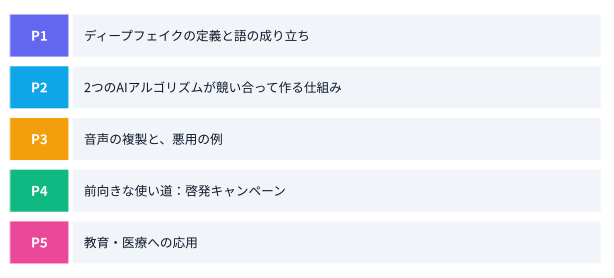
D〜Eの本文の構成。P1定義、P2仕組み、P3悪用、P4前向きな使い道、P5教育・医療
図C D〜Eの段落の役割(TMPS作成)
現場戦略試験会場でのリアルな立ち回り(D〜E)
⏱ 目標時間 & 死守ライン目標13分。本文を3分で通読し、Dの3問を2分、Eの5問を8分。
⚠️ 損切り・警戒ライン内容理解は、設問に出る語(アルゴリズム、悪用、教育など)を本文で探して、その近くだけを読み直す。
💡 初手の思考トリガー最初の一手は段落ごとに「何の説明か」を1行でメモすること。設問の根拠の段落が、すぐ見つかる。

(16)〜(18)同義語(D)

📝 どういう問題か?

下線の語が、文中でどんな意味で使われているかを考え、5つの選択肢から最も近いものを選ぶ。

  • (16):P1の下線の語「( )に作られた」の意味に近いもの
  • (17):P3の下線の動詞「(人を)おとしめる」に近いもの
  • (18):P4の下線の動詞「現れた」に近いもの

(16) エ P1は、人工的につくられた(実在しない)メディアの説明。synthetic は「合成の・人工的な」で、simulated(本物に似せてつくられた)が文脈に合う。non-existent(存在しない)は意味が強すぎる。

(17) オ demean は「品位を落とす、おとしめる」。後ろに intimidate(脅す)・harass(嫌がらせをする)が並ぶので、悪い意味の動詞。humiliate(恥をかかせる)が最も近い。

(18) オ emerge は「現れる、出てくる」。materialized(実現した、形になって現れた)が近い。uncovered(暴かれた)は「隠れていたものを発見された」という意味で違う。

🎯 (16)〜(18) の答え
(16) エ(17) オ(18) オ

(19)〜(23)内容理解(E)

📝 どういう問題か?

本文の各段落に、設問の根拠がある。選択肢は、本文に書かれていることと、もっともらしいだけのものが混ざっている。

  • (19):ディープフェイクの制作の中心になる技術の組み合わせ
  • (20):2つ目のアルゴリズムの「フィードバック」が、制作過程にどう影響するか
  • (21):ディープフェイクが引き起こしうる害として挙げられていること
  • (22):教育での活用の仕方
  • (23):MRI画像の診断に、どう役立つか

(19) ア P2:偽物を最もそれらしく作るAIと、それが偽物かどうかを検出するAIの2つ。「image generation and detection」。

(20) エ P2:2つ目の検出側からのフィードバックを受けて、1つ目が画像を調整し、より本物らしくする。検出されなくなるまで繰り返す。→ 本物に見えるまで微調整する。

(21) イ P3:人をおとしめたり、脅したり、嫌がらせをしたりするのに使われてきた。→ 個人を傷つけたり迫害したりすることに使われうる。

(22) イ P5:教育者が、歴史上の演説をディープフェイクで再現して、臨場感のある授業にできる。→ 歴史的な出来事の現実味ある体験。

(23) ウ P5:ディープフェイク画像を使うと、AIにより多くの異常の例を学習させられ、MRI画像での腫瘍の発見の精度が上がる。→ AIの訓練のための画像をつくる。

🎯 (19)〜(23) の答え
(19) ア(20) エ(21) イ(22) イ(23) ウ

同義語・内容理解の答えは、本文と選択肢の意味から導いたTMPSの判断で、機械では確かめられません。ただし、本文の根拠が明確な設問が中心です。

⚠️ (21)(22)の選択肢には、本文の語を一部使った引っかけがあります(例:医学での「偶然の使用」、教育での「物理的な教科書の廃止」)。本文にその内容そのものが書かれているかを確かめること。
Yuiちゃん
Yuiちゃん
(20)は、フィードバックって聞いて「保存する」かなと思ってしまいました。
Mio先生
Mio先生
「archives」は一見それらしいですが、本文は「検出されなくなるまで繰り返す」と言っています。繰り返しの目的は、保存ではなく、本物らしくすることですよね。
ニックニ先生
ニックニ先生
本文中の単語をそのまま使った選択肢ほど引っ掛けの罠になりやすいです。意味が正しく「言い換え(パラフレーズ)」されているかを冷静に見極めましょう。
Mio先生の総整理表

D〜Eの設問タイプ

設問タイプ着眼点
(16)〜(18)同義語文中での意味(直後・直前の語がヒント)
(19)(20)仕組みの理解P2の「2つのアルゴリズム」と、繰り返しの目的
(21)悪い面P3の動詞の並び(おとしめる・脅す・嫌がらせ)
(22)(23)良い面P5:教育(歴史)と医療(AIの訓練)
TMPSコーチング診断

🩺【自己診断】D〜Eで手が止まった人への処方箋

  • (16)〜(18)同義語で迷う → 下線の語を文から抜いて「 」に入れ、日本語で言い換えてから選択肢を見る
  • (19)〜(23)選択肢が決まらない → 設問の語を本文で探し、その段落の文だけを読み直す
  • 全体本文が頭に入らない → 段落ごとに「定義・仕組み・悪用・良い使い道・応用」の1行メモ
F〜G / 目標:15分

F〜G 長文(進化学説の見直し)(24)〜(31)

進化の理論は遺伝子だけで説明できるのかと問い、生物の発生や環境との関わりを取り込んだ「拡張進化的総合説(EES)」を提案する、研究者による4段落の主張です。従来説への疑問→新しい枠組みの提案→賛同者→反発の流れを追います。

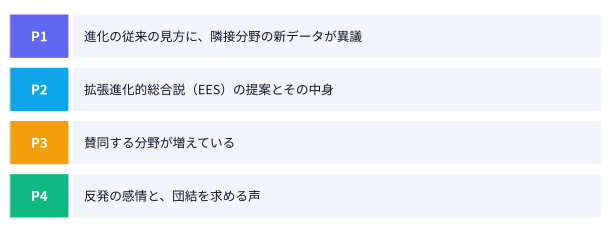
F〜Gの本文の構成。P1従来の見方への疑問、P2EESの提案、P3賛同、P4反発
図D F〜Gの段落の役割(TMPS作成)
現場戦略試験会場でのリアルな立ち回り(F〜G)
⏱ 目標時間 & 死守ライン目標15分。本文の通読に4分、Fの3問に2分、Gの5問に8分。
⚠️ 損切り・警戒ライン抽象的な語が続いて意味が取れなくなったら、設問の根拠になる段落(P1・P2)だけをまず読む。
💡 初手の思考トリガー最初の一手は筆者が「何に反対し、何を提案しているか」を1行にすること(遺伝子だけ → 発生・環境も含める)。

(24)〜(26)同義語(F)

📝 どういう問題か?

下線の名詞が、この文章の中でどんな意味かを考えて、選択肢から選ぶ。同じ語でも、文脈で意味が変わる。

  • (24):P1の「隣接する( )」の意味に近いもの
  • (25):P2の「進化の重要な( )」に近いもの
  • (26):P3の「私たちの( )を支えるデータ」に近いもの

(24) オ fields は「畑」ではなく「分野」。adjacent fields=隣接する研究分野。disciplines(学問分野)が最も近い。

(25) ア drivers は「運転手」ではなく「推進する要因」。進化を推し進める要素なので factors。

(26) ウ 「position」は「立場・主張」の意味。「私たちの主張を支えるデータ」と読める belief が最も近い。role(役割)・standing(地位)は文脈に合わない。 要確認(position の語義(belief))

🎯 (24)〜(26) の答え
(24) オ(25) ア(26) ウ

(27)〜(31)内容理解(G)

📝 どういう問題か?

主張文なので、筆者の立場(従来説の何を問題にし、何を足すのか)を押さえると、選択肢を切れる。

  • (27):EESを打ち立てた目的
  • (28):本文の情報から最も支持される記述
  • (29):進化生物学の現在の考えを改める必要がある理由
  • (30):EESの位置づけ(従来説との関係)
  • (31):「生物は発生の中でつくられ、遺伝子に『プログラム』されるだけではない」の意味

(27) エ P2:学際的なチームで、より広い枠組み(EES)を築いた。遺伝子の変化だけでなく、環境や発生の働きも進化に関わることを示すことが目的と読める。ただし「協力の促進(イ)」との迷いが残る。 要確認(EES を設立した目的(イとエの迷い))

(28) エ P2の「EESは進化がどう働くかに新しい光を当てると信じる」と一致。ア(ダーウィンが提案)・イ(全員が受け入れる)・オ(主流の理論として定着)は本文と合わない。

(29) ア P1:現在の主流の理論は、遺伝子に焦点を絞りすぎている(狭い立場)。→ 限られた視点に基づいている。

(30) オ P2:遺伝子に還元できない重要な要因を理論に織り込む。→ 従来の前提を検討し、追加の要因で補う。

(31) ウ P2:生物は発生の中でつくられる。進化は遺伝子の「プログラム」だけで決まるわけではない。

🎯 (27)〜(31) の答え
(27) エ(28) エ(29) ア(30) オ(31) ウ

(27) は趣旨の判断が分かれうる設問で、機械では確かめられません。TMPSの導出です。

⚠️ 選択肢の「solely(〜だけ)」「all(すべて)」「never(決して〜ない)」のような強い語は、本文より言い過ぎていないかを疑います。(28)(30)の引っかけに多い型です。
Yuiちゃん
Yuiちゃん
主張が抽象的で、何を言っているのか分からなくなります。
Mio先生
Mio先生
筆者は「遺伝子だけでは説明できない」と言っているので、「だけ」を否定している文を探しましょう。(29)も(31)も、「だけではない」が答えの形です。
ニックニ先生
ニックニ先生
すべてを一語一句精読する必要はありません。P1とP2の冒頭2文に最も重要な根拠が示されていますから、そこを軸に読み進めましょう。
Mio先生の総整理表

F〜Gの設問タイプ

設問タイプ着眼点
(24)〜(26)同義語(多義語)fields・drivers・position は日常の意味ではなく、学術的な文脈の意味
(27)目的P2の「より広い枠組み」と、その中身
(28)支持される記述本文に書かれたことだけを選ぶ(言い過ぎの選択肢を切る)
(29)〜(31)主張の理解「遺伝子だけ」ではない、という筆者の立場
TMPSコーチング診断

🩺【自己診断】F〜Gで手が止まった人への処方箋

  • (24)〜(26)同義語が選べない → 多義語は「日常の意味」を捨て、文の中での意味を日本語にする
  • (27)〜(31)主張が追えない → 「従来説:遺伝子だけ」「筆者:発生と環境も」の対比を書き出す
  • 全体抽象語で止まる → 具体例(P2の「生物は環境をつくり変える」)だけでも拾う
H / 目標:15分

H 長文(宇宙太陽光発電)(32)〜(39)

宇宙で太陽光発電をして、電気を地上に送るという構想の可能性を、実演・技術・費用・安全性の面から検討する、9段落の記事です。設問は8問で、段落の指定がある設問(P2、P3、P4・P5、P7、P8、P9)が多いのが特徴です。

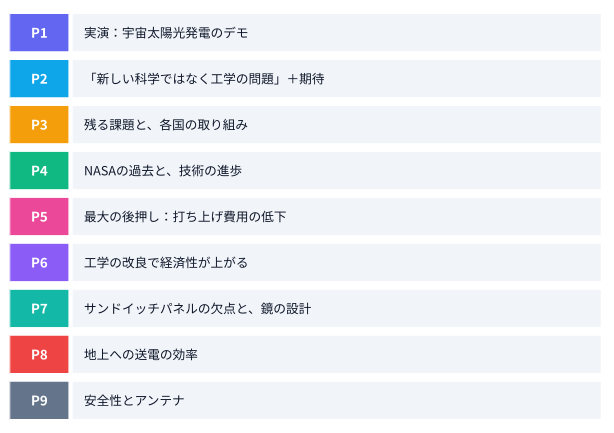
Hの本文の構成。P1実演、P2工学の問題、P3課題、P4過去と進歩、P5費用、P6経済性、P7パネルと鏡、P8送電効率、P9安全性
図E Hの段落の役割(TMPS作成)
現場戦略試験会場でのリアルな立ち回り(H)
⏱ 目標時間 & 死守ライン目標15分。本文の通読に5分、設問8問に9分、見直し1分。
⚠️ 損切り・警戒ライン段落の指定がある設問は、その段落だけを読んで答える。(37)のような「修辞的な目的」は迷いやすいので、後回しにする。
💡 初手の思考トリガー最初の一手は設問の指定の段落番号に印をつけ、順に答えること。9段落を全部精読しなくても、設問ごとに根拠が絞れる。

(32)〜(34)実演・段落の主題・安全上の懸念

📝 どういう問題か?

P1〜P3は、構想の紹介・専門家のコメント・残る課題の説明にあたる。

  • (32):欧州の航空宇宙企業が実演した技術
  • (33):P2で扱われている2つの概念
  • (34):P3で触れられる、地上への送電に関する安全上の懸念

(32) ア P1:太陽光を集め、マイクロ波に変換し、格納庫の向こうへ送り、再び電気に戻した。→ 太陽光から変換したエネルギーの送信(beaming)。

(33) イ P2:「新しい科学ではなく、工学の問題」という発言から、old science と problems in engineering の組み合わせ。ただし、clean energy と technological approaches(ウ)にも読めるため、迷いが残る。 要確認(P2 の「2つの概念」(イとウの迷い))

(34) イ P3:何ギガワットもの電力を送る際に、鳥や、場合によっては人に害が出ないかが問われている。→ マイクロ波への有害な曝露のリスク。

🎯 (32)〜(34) の答え
(32) ア(33) イ(34) イ

(35)〜(37)過去の課題・利点・段落の役割

📝 どういう問題か?

P4・P5は費用・打ち上げ、P7はパネルの欠点と鏡による解決。(36)は本文の冒頭近くに根拠がある。

  • (35):P4・P5から読み取れる、これまでの実用上の主な課題
  • (36):地上の太陽光発電に対する、宇宙太陽光発電の利点
  • (37):P7の修辞的な役割(段落が果たしている働き)

(35) イ P4:1兆ドルもかかる計画で棚上げされた。P5:巨大な発電所には数百回の打ち上げと軌道上の大規模建設が必要。→ 工学的な複雑さと高い費用。ただし「建設と輸送の難しさ(オ)」との迷いが残る。 要確認(P4・P5 の課題(イとオの迷い))

(36) エ P1:高軌道は雲や夜がなく、24時間発電できる。→ 継続的に発電できること。

(37) イ P7:パネルの欠点(太陽に面さないことがある)を述べ、それを鏡で補う設計を紹介している。→ 光の反射で太陽光パネルの働きを高める方法の説明。「サンドイッチパネルの利点の説明(オ)」との迷いが残る。 要確認(P7 の修辞的な役割(イとオの迷い))

🎯 (35)〜(37) の答え
(35) イ(36) エ(37) イ

(38)(39)現在の限界・安全性

📝 どういう問題か?

P8は送電の効率、P9は安全性と、受信アンテナの特徴の説明。

  • (38):P8で述べられている、宇宙からの送電に関する現在の限界
  • (39):P9で、受信用の装置について述べられている点

(38) オ P8:現在の送信機と受信機は、入力の電力の半分を失う。→ 約50%の電力の損失。

(39) エ P9:受信アンテナは安く建てられるが広い土地が必要で、その下で作物を育てられるなど、農業とも両立できる。→ 農業の場として使える。ただし選択肢の言い回しに癖があり、他の選択肢(危険・高コスト)を本文で切って選ぶ設問。 要確認(P9 のアンテナの要点)

🎯 (38)(39) の答え
(38) オ(39) エ

Hの答えは、本文と選択肢の意味から導いたTMPSの判断で、機械では確かめられません。(33)(35)(37)(39) のように選択肢の判断が分かれうるものは「要確認」としています。

⚠️ (35)(37)は、設問が指定する段落(P4・P5、P7)の内容そのものを答えます。本文の別の段落に書かれた話題(P6の経済性、P1の実演)に引きずられないこと。
Yuiちゃん
Yuiちゃん
9段落もあると、設問に使う段落を探すだけで時間がかかります…。
Mio先生
Mio先生
設問に「P7」「P8」と指定があるので、その段落だけを読めばいいですよ。(37)のような「役割」を問う設問は、段落の最初と最後の文を見ると分かります。
ニックニ先生
ニックニ先生
長いパッセージほど、本文を読む前にまず設問に目を通しましょう。読み始める段階で「探すべき情報8つ」を頭の中に設定しておくと読解効率が格段に上がりますよ。
Mio先生の総整理表

Hの設問タイプ

設問タイプ着眼点
(32)何の技術かP1の実演の流れ(集める→変換→送る→電気に戻す)
(33)段落の主題P2の「新しい科学ではなく工学の問題」
(34)懸念P3:鳥・人への害(マイクロ波)
(35)(36)課題・利点費用と建設(P4・P5)、24時間の発電(P1)
(37)修辞的な役割P7:欠点→鏡による解決
(38)(39)限界・要点電力の損失の割合(P8)、アンテナと土地・農業(P9)
TMPSコーチング診断

🩺【自己診断】Hで手が止まった人への処方箋

  • (32)〜(34)根拠が見つからない → 設問の指定の段落だけを読み、固有の語(beaming、frying birds など)を探す
  • (35)〜(37)選択肢が決められない → 指定の段落の「最初の文」と「最後の文」で段落の働きをつかむ
  • (38)(39)数字・事実の設問 → 本文の数字(50%)や名詞を、選択肢と1対1で照らす
ANSWERS

本番の答え一覧(採点用)

解説を読んだあとの採点用です。赤本に載っている答えは(1)〜(6)だけで、それ以外はTMPSが本文から導いたものです。

A〜C((1)〜(15))

(1) イ(2) エ(3) イ(4) エ(5) ウ(6) ア(7) イ(8) ア(9) イ(10) ウ(11) イ(12) エ(13) ウ(14) エ(15) ウ

D〜E((16)〜(23))

(16) エ(17) オ(18) オ(19) ア(20) エ(21) イ(22) イ(23) ウ

F〜G((24)〜(31))

(24) オ(25) ア(26) ウ(27) エ(28) エ(29) ア(30) オ(31) ウ

H((32)〜(39))

(32) ア(33) イ(34) イ(35) イ(36) エ(37) イ(38) オ(39) エ
⚠️ 要確認:(3・7・12・26・27・33・35・37・39) は選択肢の判断が分かれうる設問です((3)assign/entrust の使い分け、(7)文脈で asset(soil との迷い)、(12)persevered と preserved の迷い、(26)position の語義(belief)、(27)EES を設立した目的(イとエの迷い)、(33)P2 の「2つの概念」(イとウの迷い)、(35)P4・P5 の課題(イとオの迷い)、(37)P7 の修辞的な役割(イとオの迷い)、(39)P9 のアンテナの要点)。赤本の解答編の答えは(1)〜(6)だけで、TMPSの答えと一致していることをスクリプトで確かめました。それ以外の答えは、機械では確かめられない意味の判断で、手元の解答と食い違う場合はお知らせください。

※ 検算:全39問の答えが選択肢の範囲内であること、(1)〜(6)が赤本の解答編と一致することを実行して確認しました。

採点したら → 30秒の得点診断へ
TMPS ORIGINAL

近畿大2025型 そっくり類題セット
(全39問・解答解説つき)

2025年度の本番と同じ設問数・同じ設問の型(空所補充15問、同義語6問、内容理解18問)で、題材を変えたTMPSオリジナルの英文と設問です。60分の立ち回りを確かめられます。入試問題ではありません。

試験時間の目安 60分マーク式 全39問長文:デジタルツイン・免疫学の見直し・垂直農法
📄 本番形式の問題冊子PDFをダウンロード(全7ページ)

印刷して本番と同じように60分で解けます。解答・解説はこのページの下に掲載しています。

※ 近畿大学の入試問題ではありません。本文・設問・人物・団体(架空)はすべてTMPS医学館が作成したオリジナルで、出典のある引用ではありません。

類題 Ⅰ Sections A–C(空所補充・同義語・文脈)

Follow instructions in sections A–C and answer the following items. Ensure that your choices correspond to the correct number on the marksheet.

(A) Complete the following sentences with the best word.

(1)After weeks of discussion, the team finally came up ( 1 ) a workable solution.

ア on
イ over
ウ in
エ with

(2)A: “Why was the match cancelled?” B: “Heavy snow ( 2 ) the field unusable.”

ア rendered
イ proposed
ウ resolved
エ declared

(3)The professor ( 3 ) his students to submit the report by Friday.

ア insisted
イ urged
ウ suggested
エ hoped

(4)She ( 4 ) her quick recovery to regular exercise and good sleep.

ア prefers
イ introduces
ウ owes
エ assumes

(B) Choose the answer that is closest in meaning to the underlined word or phrase.

(5)The team finished the project ahead of schedule.

ア behind the plan
イ without any plan
ウ earlier than planned
エ according to the plan

(6)The panel dismissed the proposal as unrealistic.

ア discussed
イ delayed
ウ revised
エ rejected

(C) Complete the following paragraphs with the best word.

Bees are often described as the unsung ( 7 ) of agriculture. A single hive can pollinate millions of flowers in a day, and roughly one third of the crops that feed humans ( 8 ) on this service. As wild bee populations ( 9 ), farmers have begun to rent managed hives.

In 1998, a farmer in northern France ( 10 ) a small wooden chest buried beneath his barn. Inside lay a manuscript that had ( 11 ) hidden for nearly 600 years. Scholars were astonished that the ink had ( 12 ) so well, as most documents of that age have faded ( 13 ) recognition.

Scientists remain ( 14 ) about the results, as the trial was small, but officials insist ( 15 ) releasing the data next month.

(7)

ア heroes
イ victims
ウ rivals
エ tenants

(8)

ア insist
イ conclude
ウ approve
エ depend

(9)

ア flourish
イ multiply
ウ decline
エ celebrate

(10)

ア undertook
イ underlined
ウ unleashed
エ unearthed

(11)

ア pretended
イ prevented
ウ remained
エ released

(12)

ア survived
イ persuaded
ウ preserved
エ perceived

(13)

ア beyond
イ into
ウ toward
エ within

(14)

ア casual
イ capable
ウ curious
エ cautious

(15)

ア in
イ at
ウ to
エ on
▶ Ⅰ の答えと解説を見る

Ⅰ Sections A–C(空所補充・同義語・文脈) の答えと解説

(1) エ(2) ア(3) イ(4) ウ(5) ウ(6) エ(7) ア(8) エ(9) ウ(10) エ(11) ウ(12) ア(13) ア(14) エ(15) エ
  • (1) エ come up with ~で「~を思いつく」。on・over・in では熟語にならない。
  • (2) ア render A B「AをBの状態にする」。主語は雪(人ではない)なので declared(宣言した)は合わない。
  • (3) イ urge 人 to do「人にするよう強く促す」。insist・suggest は〈人 to do〉の形をとらない。
  • (4) ウ owe A to B「AはBのおかげである」。
  • (5) ウ ahead of schedule=予定より早く。
  • (6) エ dismiss=(案などを)退ける。reject が最も近い。
  • (7) ア 「縁の下の力持ちの(unsung)ヒーロー」。受粉を担うという文脈から heroes。
  • (8) エ depend on ~に頼る。直後の on がヒント。
  • (9) ウ 野生のハチが減るから、人が管理する巣箱を借りる、という因果。
  • (10) エ 地中に埋まった箱を「掘り出した」=unearth。
  • (11) ウ remain hidden=隠れたままだった。
  • (12) ア 自動詞として「(インクが)もちこたえた」=survive。preserve は受け身でないと使えない。
  • (13) ア beyond recognition=見分けがつかないほど。
  • (14) エ 試験の規模が小さいので「慎重な」。
  • (15) エ insist on ~ing=~すると言い張る。
類題 Ⅱ Sections D–E(長文・デジタルツイン)

Read the passage below and follow instructions in sections D and E. Ensure that your choices correspond to the correct number on the marksheet.

P1: A “digital twin” is a (16)virtual copy of a physical object, building, or system that is kept up to date with data from its real-world counterpart. The term joins “digital,” meaning computer-based, and “twin,” which signals that the copy mirrors something that actually exists. Unlike a simple drawing, a digital twin changes as the original changes.

P2: Digital twins rely on two components working together. The first is a network of sensors attached to the real object, which measure things such as temperature, vibration, and pressure and send the readings to a computer. The second is a simulation model that uses those readings to predict what the object will do next. When the prediction differs from what the sensors later report, engineers correct the model, and the cycle repeats. Over time, the model’s forecasts become more reliable.

P3: Factories were the first to use the technology, but it is now used to (17)scrutinize far more than machinery. City planners test traffic patterns on virtual streets before changing a single traffic light, and airline engineers monitor the condition of a jet engine in mid-flight. Such uses can save money, because problems are found before the real equipment breaks down.

P4: Hospitals have recently (18)adopted the idea. By combining a patient’s scans, blood tests, and heart-rate data, doctors can build a personal model and try a treatment on it before giving it to the patient. Some researchers hope this will reduce side effects. Others warn that the models contain sensitive personal data, which must be protected from hackers and misuse.

P5: Teachers are also exploring digital twins. A medical student, for instance, can practise a surgical procedure on a virtual organ as often as needed without any risk to a living person. Because the model reacts to every mistake, the student receives immediate feedback and can improve steadily. Experts agree, however, that a virtual organ can never fully replace real clinical experience.

(D) Find the underlined words in the passage and choose the best substitute.

(16)Which choice is closest in meaning to virtual in paragraph 1 (P1)?

ア permanent
イ simplified
ウ identical
エ historical
オ computer-made

(17)Which choice is closest in meaning to scrutinize in paragraph 3 (P3)?

ア replace
イ inspect
ウ invent
エ delay
オ praise

(18)Which choice is closest in meaning to adopted in paragraph 4 (P4)?

ア turned down
イ handed over
ウ looked after
エ made up
オ taken up

(E) Choose the best answer to the following:

(19)According to the passage, which combination of components is central to a digital twin?

ア sensors and a simulation model
イ cameras and a printer
ウ speakers and a microphone
エ a battery and a motor
オ a keyboard and a screen

(20)In what way does the correction of the model by engineers affect the digital twin, according to the passage?

ア It stops the sensors from sending data.
イ It gradually makes the forecasts more reliable.
ウ It turns the model into a physical object.
エ It removes the need for any simulation.
オ It makes the real object change its shape.

(21)According to the passage, what concern is raised about the use of digital twins in hospitals?

ア They cost more than any surgery.
イ They cannot be used on adults.
ウ Sensitive personal data may be misused.
エ They always increase side effects.
オ They replace all doctors.

(22)According to the passage, how might digital twins benefit education?

ア by removing the need for exams
イ by allowing students to practise procedures without risk to patients
ウ by teaching students to repair sensors
エ by replacing teachers with virtual assistants
オ by printing textbooks automatically

(23)According to the passage, how can digital twins improve treatment?

ア by choosing a hospital automatically
イ by lowering the price of medicine
ウ by shortening the time doctors spend with patients
エ by letting doctors try a treatment on a personal model first
オ by removing scans and blood tests
▶ Ⅱ の答えと解説を見る

Ⅱ Sections D–E(長文・デジタルツイン) の答えと解説

(16) オ(17) イ(18) オ(19) ア(20) イ(21) ウ(22) イ(23) エ
  • (16) オ 「コンピュータ上でつくられた」。本文の直後にある meaning computer-based の説明と対応。
  • (17) イ scrutinize=細かく調べる。交通の流れを試す・エンジンの状態を監視する、という例が続く。
  • (18) オ adopt=(考えなどを)取り入れる。take up が近い。
  • (19) ア P2の2つの構成要素:実物に付けるセンサーと、予測する(シミュレーション)モデル。
  • (20) イ P2:予測とセンサーの報告がずれたらモデルを直し、これを繰り返すと予測の信頼性が増す。
  • (21) ウ P4:個人の機微なデータを含むので、ハッキングや悪用から守る必要がある。
  • (22) イ P5:仮想の臓器で、患者に危険を及ぼさず何度も手技を練習できる。
  • (23) エ P4:患者の検査データから個人用モデルをつくり、実際に投与する前に試せる。
類題 Ⅲ Sections F–G(長文・免疫学の見直し)

Read the passage below and follow instructions in sections F and G. Ensure that your choices correspond to the correct number on the marksheet.

P1: For decades, the dominant view in immunology has been that the immune system exists mainly to defend the body against invading microbes. Yet new findings arriving from neighbouring (24)strands of research, including microbiology and neuroscience, are beginning to challenge this narrow picture. An alternative view is taking shape, in which the immune system is also understood as a partner that helps to maintain the communities of microbes living inside us.

P2: We are a group of researchers who first met five years ago to discuss these discoveries. Since then we have worked to build a broader framework, which we call the cooperative immunity approach, and to set out its assumptions and predictions. At its core, the approach holds that key (25)pillars of health, ones that cannot be explained by defence alone, must be built into the theory. We believe that this approach will clarify how the body stays healthy. We argue that the immune system is shaped by the microbes it lives with, not simply “switched on” by infection. Microbes and immune cells adjust to each other, and in doing so they change the environment of the gut.

P3: The number of scientists asking for change is growing quickly. Strong encouragement comes from related disciplines, in particular nutrition science, but also genetics, psychology, and medicine. We contend that immunology will benefit fully only if it takes in lessons from these fields. The evidence behind our (26)stance grows stronger every year.

P4: Even so, merely mentioning the approach often provokes a heated, sometimes hostile, response from established immunologists. Discussions too often turn into argument, with accusations of confusion or misrepresentation. Some fear that grants will be lost if outsiders enter the field. Yet we believe that a shared effort, not a defensive wall, is the best way to serve patients.

(F) Find the underlined words in the passage and choose the best substitute.

(24)Which choice is closest in meaning to strands in paragraph 1 (P1)?

ア ropes
イ hairs
ウ branches
エ colonies
オ wires

(25)Which choice is closest in meaning to pillars in paragraph 2 (P2)?

ア elements
イ rules
ウ symbols
エ gates
オ stones

(26)Which choice is closest in meaning to stance in paragraph 3 (P3)?

ア posture
イ speed
ウ distance
エ footing
オ viewpoint

(G) Choose the best answer to the following:

(27)According to the passage, what was the purpose of establishing the cooperative immunity approach?

ア to show that infection never causes disease
イ to defend the traditional view of immunology
ウ to build a broader framework in which the immune system is shaped by its microbial partners
エ to persuade hospitals to buy new equipment
オ to reduce funding for microbiology

(28)Which of the following statements is best supported by the information provided in the passage?

ア The approach is accepted by all immunologists.
イ The approach was proposed more than twenty years ago.
ウ Immunology has stopped studying infection.
エ The approach is likely to clarify how the body stays healthy.
オ Nutrition scientists oppose the approach.

(29)According to the passage, why does the current thinking in immunology need to be revised?

ア Because infections have disappeared.
イ Because the present view treats the immune system too narrowly, as only a defence.
ウ Because doctors no longer use microscopes.
エ Because every theory must change every five years.
オ Because microbes have stopped living in the gut.

(30)According to the passage, what is the relative importance of the cooperative immunity approach?

ア It guarantees funding for immunologists.
イ It ends all arguments between scientists.
ウ It replaces the study of the gut with the study of the brain.
エ It builds on the defence view and adds the role of microbial partners.
オ It proves that nutrition has no effect on health.

(31)What does the author mean by “not simply ‘switched on’ by infection” in paragraph 2 (P2)?

ア The immune system works only when an infection occurs.
イ The immune system is also influenced by the microbes it lives with.
ウ Infections can never be avoided.
エ The immune system can be turned on by electricity.
オ Microbes have no effect on the body.
▶ Ⅲ の答えと解説を見る

Ⅲ Sections F–G(長文・免疫学の見直し) の答えと解説

(24) ウ(25) ア(26) オ(27) ウ(28) エ(29) イ(30) エ(31) イ
  • (24) ウ 「研究の strand」=研究の分野・枝。
  • (25) ア 「健康を支える柱」=構成要素。
  • (26) オ 「our stance を裏づける証拠」=立場・見解。物理的な posture は文脈に合わない。
  • (27) ウ P2:より広い枠組みをつくり、防御だけでは説明できない要素を理論に組み込むため。
  • (28) エ P2:「この枠組みが、体が健康を保つ仕組みを明らかにすると信じる」。ほかの選択肢は本文と合わない(P4で反発もある/5年前に集まった/など)。
  • (29) イ P1:「免疫は微生物から守るだけ」という狭い見方に、新しい知見が異議を唱えている。
  • (30) エ P1・P2:防御という従来の見方を土台に、微生物との協力関係という要素を加える。
  • (31) イ 感染で「スイッチが入る」だけでなく、共に暮らす微生物からも影響を受けて形づくられる、という意味。
類題 Ⅳ Section H(長文・垂直農法)

Read the article below and follow instructions in section H. Ensure that your choices correspond to the correct number on the marksheet.

P1: In a warehouse outside Rotterdam, a start-up called GreenStack showed off what might be the future of food. Rows of lettuce grew on shelves stacked eight levels high, lit by purple LEDs and fed by a mist of nutrient-rich water. The demonstration farm produced as much lettuce as a field fifty times its size, which raises a serious question: is it time to bring farming indoors and build tall farms in the middle of cities?

P2: “It isn’t new science, it’s a logistics problem,” says GreenStack engineer Marta Visser. “Everyone knows plants can grow under lamps. Doing it cheaply is the challenge.” The need for food closer to consumers, falling energy prices, and better lighting technology could, supporters believe, finally make the model work. “Once a big supermarket chain signs a contract, the sector will take off,” says investor Daniel Okoro.

P3: Major obstacles remain, including whether crops other than leafy greens can be grown profitably, and whether staff can stay healthy working long shifts under artificial light and in humid air. But the idea is moving from small trials to larger commercial projects. The Dutch government, which sponsored the Rotterdam demonstration, will next year propose a national plan of pilot farms to test the concept. Japan, Singapore, and the UAE already have several operating farms.

P4: Interest in growing food indoors first surged in the 1960s, when researchers imagined sealed greenhouses for polar stations. But early prototypes were too expensive to run: the electricity bill alone could have exceeded the value of the harvest. The idea was shelved and, according to analyst Hana Kimura, remains a niche curiosity for many agricultural scientists. Today, lighting technology has changed beyond recognition. Kimura says the efficiency of LED lamps has risen by 40 percent over the past decade, while their prices have fallen sharply. Sensors for water and nutrients are cheap, and robots now sow and harvest trays without human hands.

P5: But the biggest obstacle has been the cost of construction. A farm tall enough to feed a mid-sized city needs thousands of shelves, pipes, and lamps fitted by hand, demanding years of building work. “It would require a huge up-front investment,” says Visser. Cheaper LEDs have made the notion seem less far-fetched. “It’s changing the equation,” Kimura says. “Economics is everything.”

P6: Better engineering could make those economics more favourable. Visser says GreenStack’s farm is only 30 percent efficient overall, comparing the energy stored in the plants with the electricity consumed. Fields in sunny regions do better, but only during the growing season. If indoor farms can reach 50 percent efficiency, recent studies say, they could compete with field vegetables on price. And unlike a field, an indoor farm can harvest every week of the year, whatever the weather. Lighter shelving will also improve the calculation. “Stackable trays,” pizza-box-sized units with lamps on top and water channels below, could help. Link hundreds of these together and they form the basis of a tower farm without a lot of heavy framework.

P7: The drawback of stackable trays is that heat from the lamps builds up between the layers, so the upper shelves become warmer than the lower ones. To keep the temperature even, a farm needs fans that move air through every level, with the added benefit that moving air can also strengthen the plant stems. A 2021 study by Kimura put forward a design in which a central duct with thousands of tiny vents sends cool air to each tray.

P8: If an indoor farm ever does go commercial, the water it uses will need to be recycled efficiently. In a recent pilot, Teresa Lund’s team at a Danish university recycled 90 percent of the water in a 500-square-metre farm, and teams in Japan and Singapore report similar results. But current pumps and filters lose about a fifth of the electricity they take in. For indoor farming, Lund says, pumping needs 90 percent efficiency, “ideally 95.”

P9: The hygiene of tall farms also needs testing. Most designs aim to keep the air so clean that any worker or visitor who enters brings in only a tiny, hopefully harmless, number of spores. Cleanroom entrances are cheap to build, but they “need a lot of space,” Visser says, although she adds that you could place them in a basement or on the roof.

(H) Choose the best answer to the following:

(32)What technology did the GreenStack engineers demonstrate in Rotterdam that could shape the future of food?

ア growing lettuce in open fields using purple lamps
イ building greenhouses on the roofs of supermarkets
ウ transporting lettuce by refrigerated trucks
エ growing crops on stacked shelves lit by LEDs and fed by a nutrient mist
オ harvesting crops with the help of weather forecasts

(33)What are two main concepts discussed in paragraph 2 (P2)?

ア established science and a practical problem of cost
イ old farmers and young investors
ウ clean energy and fashionable lamps
エ modern art and large harvests
オ traditional fields and indoor sports

(34)According to paragraph 3 (P3), what concern is associated with working on a tall indoor farm?

ア too much noise from the robots
イ the risk of falling from the shelves
ウ the health of staff working under artificial light and humid air
エ the loss of customers to supermarkets
オ the danger of fire from the lamps

(35)According to paragraphs 4 (P4) and 5 (P5), what have been the primary practical challenges of indoor farming?

ア the arrival of cheaper LEDs
イ lack of interest from farmers
ウ inability to grow any crop indoors
エ high operating and construction costs
オ difficulty in finding customers

(36)According to the article, what advantage does an indoor farm have over a field?

ア lower electricity costs
イ ability to harvest crops throughout the year regardless of weather
ウ no need for any water
エ fewer workers in sunny regions
オ a larger area of land

(37)What is the rhetorical purpose of paragraph 7 (P7)?

ア to explain how the layers of a farm produce their own electricity
イ to explain how a design can solve a heat problem of stackable trays
ウ to explain why plants prefer warm air
エ to describe a study on manually cooled trays
オ to explain the particular advantages of lighter shelving

(38)What is one current limitation of recycling water in indoor farms, as mentioned in paragraph 8 (P8)?

ア recycling only 50 percent of the water
イ competition among universities
ウ the small size of the farms
エ doubt whether farms can be built in Japan
オ loss of about a fifth of the electricity by pumps and filters

(39)What point is made in paragraph 9 (P9) regarding the entrances used to keep farms clean?

ア They are cheap to build but need a lot of space.
イ They are highly dangerous to workers.
ウ They can only be built in basements.
エ They are too expensive for any farm.
オ They are made of living plants.

▶ Ⅳ の答えと解説を見る

Ⅳ Section H(長文・垂直農法) の答えと解説

(32) エ(33) ア(34) ウ(35) エ(36) イ(37) イ(38) オ(39) ア
  • (32) エ P1:8段に積んだ棚で、LEDの光と栄養を含む霧で育てる屋内農場。
  • (33) ア P2:「新しい科学ではない」(実証済みの科学)+「安くやるのが課題」(実務上の問題)。
  • (34) ウ P3:長時間、人工光と湿った空気の中で働く職員の健康。
  • (35) エ P4:電気代が収穫の価値を上回りうる。P5:最大の障害は建設費。どちらも費用。
  • (36) イ P6:畑と違い、天候に関係なく年間を通して毎週収穫できる。
  • (37) イ P7は「欠点(熱)→ 換気で解決する設計」という流れ。
  • (38) オ P8:現在のポンプとフィルターは入力電力の約5分の1を失う。
  • (39) ア P9:建設は安いが、広い場所が要る(地下や屋上に置ける)。

※ 類題は、本番の設問の型を残しつつ、題材・本文・選択肢をすべて新しく書いています(本番の長文:ディープフェイク/進化学説/宇宙太陽光発電 → 類題:デジタルツイン/免疫学の見直し/垂直農法)。人物・団体は架空です。設問の数・選択肢の数・空所と下線の番号は、スクリプトで確かめています。

CHECK

30秒 得点診断

本番の過去問、またはそっくり類題セットを60分で解いた結果を選んでください。次にやるべきことを表示します。

A〜C(語彙・文法)
D〜E(ディープフェイク)
F〜G(進化学説)
H(宇宙太陽光発電)
FOR PARENTS

保護者の方へ:近畿大の英語で知っておきたい3つのこと

① マーク式・全39問
記述はなく、選択肢から選ぶ形式です。語彙・熟語の知識と、本文に根拠を求める読み方の両方が必要で、どちらかが弱いと得点が伸びません。
② 60分で長文3題
科学・技術の題材が毎回続きます。時間配分と、設問から先に読む手順を決めておくことで、慌てずに取り切れます。
③ 秋からは「根拠の探し方」を見てもらう
正解でも根拠が曖昧だと、次に同じ型で間違えます。第三者に「なぜその選択肢か」を説明して確かめると、最短で伸びます。
FAQ

よくある質問

Q. 近畿大学 医学部の英語2025年度(一般前期)は、どの順番で解くのがよいですか?

TMPSのおすすめは、A〜C(語彙・文法15問)を約12分、D〜E(ディープフェイクの長文)を約13分、F〜G(進化学説の長文)を約15分、H(宇宙太陽光発電の長文)を約15分、見直し5分の合計60分です。A〜Cで取れる点を先に確保し、長文は設問から先に読んで本文で根拠を探します。

Q. 英文が載っていなくても、どんな問題か分かりますか?

分かります。著作権に配慮して英文・設問文は掲載していませんが、各大問で「段落の役割」と「設問の型」を日本語で説明し、根拠にした箇所は段落番号と短い語句だけで示しています。

Q. 答えは、どうやって確かめていますか?

A〜Bの(1)〜(6)は、赤本の解答編に載っている答えとTMPSが本文から独立に導いた答えが一致することを、スクリプトで確かめました。それ以外の設問の答えは、本文と選択肢の意味から導いたTMPSの判断で、機械では確かめられないため、迷う設問には「要確認」を付けています。

Q. そっくり類題セットとは何ですか?

2025年度と同じ設問の数・型(空所補充15問、語の言い換え6問、内容理解18問)で、題材を変えたTMPSオリジナルの英文と設問(全39問)です。全問の答え・解説をこのページに載せ、本番形式の問題冊子PDF(7ページ)も無料で配布しています。

Q. 解説に誤りを見つけたらどうすればいいですか?

公式LINEからお知らせください。確認のうえ修正し、更新日を記載します。

安心安全・継続更新システム

問題等で誤りを発見された場合、修正しますので、TMPS医学館までLINEを下さい。

受験生・指導者の皆様からのご指摘を真摯に受け止め、最も信頼できる過去問解説・類題ライブラリーとして随時アップデートいたします。

LINEで誤りを報告・相談する

一緒に医学部を目指す友達にシェア 📣

🔥 次に読むならこちら

毎月先着3名・無料

近畿大の英語を、
あなたの答案で攻略する

「どこで時間を失ったか」「どの設問を後回しにすべきだったか」「選択肢の切り方の癖」を、Mio先生とニックニ先生があなたの答案から直接診断します。