[I]The Marlow River fever outbreak is remembered for its tragic toll, yet few people know how the disease was first identified. In 1983, Dr. Lena Brandt of Switzerland and her colleagues were the first people to recognize the virus behind it.
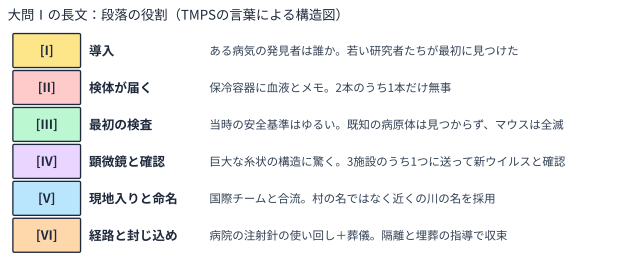
[II]In 1983, 28-year-old Dr. Brandt had just finished her doctorate and was working as a junior virologist*¹ at a university hospital in Basel. One morning she received a battered metal cooler containing two sealed tubes of serum*² and a little melted ice. Inside was also a handwritten note from a Swiss nurse based in Ruvia (presently the Republic of Karvonia). The note explained that the serum (1) a local teacher who, together with sixty others in a mountain district, had fallen gravely ill with an unknown disease. The cooler had been flown on an ordinary passenger flight, packed inside a traveler’s backpack! When Brandt and her colleagues opened it, they found a puddle of ice water and serum. (2) tubes, only one had survived the trip, while the other had cracked on the way.
[III]Brandt’s team suspected the unknown illness was a severe form of typhus*³. The hospital was well qualified to handle typhus. (3) that the still unnamed Marlow virus was waiting inside the tubes. In those days, (9) biosafety protocols were far less strict than they are today. Wearing only thin cotton gloves, the researchers took a small amount of serum from the undamaged tube and ran standard tests. The serum was screened for known germs, typhus, and several hemorrhagic*⁴ fever viruses. None of them was found. Brandt also injected hamsters with the serum. Within five days, every one of the hamsters was dead.
[IV]When the team examined the serum under an electron microscope, they were astonished (4). “We saw a long, thread-like structure — enormous by viral standards,” says Brandt. Only one other known virus had a similar shape: the Kell virus, first seen in 1961 when twenty hospital cleaners fell ill after handling infected goats. In 1983, only three laboratories outside the Eastern bloc were equipped to deal with deadly viruses safely: one in Lyon, one near Oxford, and what is now the National Reference Laboratory (NRL) in Ottawa. The health ministry told the Swiss team to send the remaining serum to the NRL, the world’s reference center for thread-shaped viruses. After analysis, the NRL confirmed that the serum held a brand-new virus. Brandt says she felt “a rush of disbelief” at the discovery.
[V]Soon after the NRL’s confirmation, Brandt and several Swiss colleagues were on their way to Ruvia. She traveled to the center of the outbreak in the mountains, (5) an international team of scientists. “I was not afraid,” says Brandt. “The thrill of discovery and the wish to stop the outbreak drove everything.” The team decided it needed a name for the virus. Some suggested Karsa, after the village where the first case appeared. However, they feared that naming a deadly virus after a place would attach a (10) stigma to it. Instead, they studied a map and named the virus after the river that runs closest to Karsa, the Marlow River. The name has stuck ever since.
[VI]In the mountains, the scientists’ first task was to work out (6) between people. They asked questions and mapped where the patients lived. The data showed that the cases clustered around the district clinic and that more women than men had fallen ill, mostly pregnant women between 20 and 35. Because expectant mothers often visited the clinic for checkups, they were more likely to meet contaminated equipment. It turned out that the clinic had been reusing dirty needles and tubing, which in turn spread the virus through the villages. In addition, the team found that people caught the virus by touching the bodies of the dead at funerals. Once the route of infection was clear, the next mission was to halt the spread. The scientists (7) village to village, isolating the sick. Those who had been in contact with a patient were also isolated, and families were taught how to bury their dead safely. The scientists’ (11) containment efforts were successful. The outbreak ended, (8) the death of 150 people.
Notes: *¹virologist「ウイルス学者」 *²serum「血清」 *³typhus「発疹チフス」 *⁴hemorrhagic「出血性の」
(9) The phrase “biosafety protocols”, as used in paragraph III, is closest in meaning to ________. 解答番号 9
(10) The phrase “stigma”, as used in paragraph V, is closest in meaning to ________. 解答番号 10
(11) The phrase “containment efforts”, as used in paragraph VI, is closest in meaning to ________. 解答番号 11
(13) According to the passage, how did the virus spread, and why were there more female patients? 解答番号 13
(14) Which of the following details or descriptions of the passage is NOT correct? 解答番号 14