Mio先生の医学部英語道場 北里大 英語2026
2026年度 一般選抜 全6大問・解答番号1〜46要確認を正直に表示そっくり類題セット

北里大学
医学部 英語
2026年度 解答・解説

問題文は掲載できませんが、
解説を読むだけでどんな問題かもわかる!

さらに、そっくり類題PDFを見れば、実際の問題イメージもわかるよ!

各設問を「どういう問題か」から説明し、考え方を1行も飛ばさずに解説。最後に、本番と同じ6大問の構成で作ったそっくり類題セット(全問解答つき)で、2026年度を丸ごと演習できます。

Mio先生
解説:Mio先生・ニックニ先生(TMPS医学館) / 更新:2026.10.20 / 読了 約35分

📌 このページの使い方

  1. 過去問集をお持ちの方:本番と同じ70分で解き、答え一覧で採点してから解説へ
  2. お持ちでない方:各設問の「どういう問題か」を読めば、問題の中身がそのまま分かります
  3. 最後にそっくり類題セット(PDF版あり)を70分で解き、初見でも同じ解き方ができるか確かめる

※ 著作権に配慮し、入試問題の英文・設問文は掲載していません(引用は短い語句まで)。問番号・解答番号は、本番の解答欄との対応を示すためのものです。※ 英語は意味と語法で答えを決める設問が中心で、機械では確かめられません。判断が割れうる設問には「要確認」を付けています。

⚠️ 問題等で誤りを発見された場合、修正しますので、TMPS医学館までLINEを下さい。(迅速に確認・更新いたします)

LINEで誤りを連絡
SUMMARY

3分で分かる 2026年度の北里大の英語

Yuiちゃん
Yuiちゃん
英語はすべてマークなんですね。でも、紛らわしい選択肢が多そうで不安です…
Mio先生
Mio先生
そう、だからこそ選択肢を「消す理由」を言葉にする練習が大事!「形が合わない」「意味が逆」「言い過ぎ」を言えるようにしよう。
ニックニ先生
ニックニ先生
時間配分は第1問の長文に20分前後。ほかは1問1分ずつ。迷ったら印をつけて先へ進めます。
STRATEGY MAP

70分の立ち回りマップ

時間はTMPSの目安です。解く順番と「捨てどころ」をセットで覚えておきましょう。

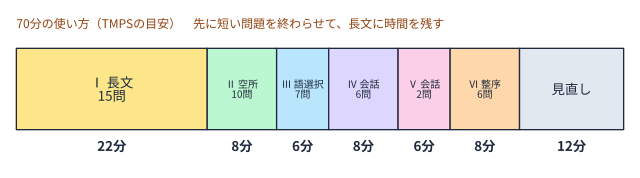
70分の時間配分。第Ⅰ問22分、第Ⅱ問8分、第Ⅲ問6分、第Ⅳ問8分、第Ⅴ問6分、第Ⅵ問8分、見直し12分
図A 70分の使い方(TMPS作成)
🧭 おすすめの解く順番
第Ⅱ問 → 第Ⅲ問 → 第Ⅵ問(短い問題で22分)→ 第Ⅳ問 → 第Ⅴ問 → 第Ⅰ問 → 見直し12分
長文は「設問を先に読んでから本文」。時間が読みにくい人は、本番の並び順で解いても構いません。大事なのは、1問に粘らず、印をつけて先に進むことです。
第Ⅰ問 / 目標:22分(15問・解答番号1〜15)

第Ⅰ問 長文(気候に関する国際報告書)── 設問を先に、根拠は1〜2文で見つける

2023年に公表された気候変動に関する国際報告書の内容を、新聞記事の形で紹介した長い英文(全10段落)です。設問は問1:空所補充6問(1〜6)/問2:下線部の意味4問(7〜10)/問3:語句の並べ替え2問(11・12)/問4:内容把握3問(13〜15)の15問で、すべて5択です。

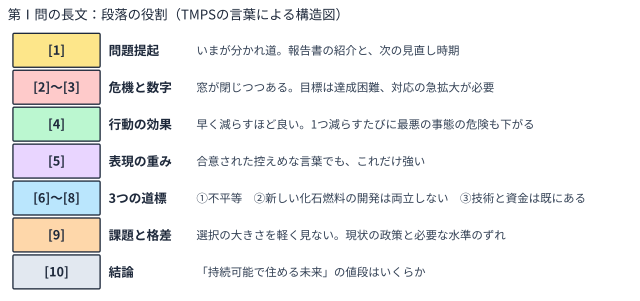
第Ⅰ問の長文の段落ごとの役割
図B 段落の役割(TMPSの言葉による構造図)
現場戦略試験会場でのリアルな立ち回り(第Ⅰ問)
⏱ 目標時間 & 死守ライン目標22分。まず設問に目を通す(2分)→本文を読みながら問1・問2を解く(12分)→問3・問4(8分)。
⚠️ 損切り・警戒ライン迷う選択肢は印をつけて先へ。問4の(13)(15)は選択肢が長く、1問に3分以上かけない。
💡 初手の思考トリガー空所補充は5択の「形」(前置詞で終わる/名詞が続く/動詞の形)を見て、空所の前後と合うものに絞る。
Yuiちゃん
Yuiちゃん
本文が長くて、最後まで読む時間があるか心配です…
Mio先生
Mio先生
全部を同じ濃さで読まなくていいよ。空所と下線部のある段落だけ丁寧に、あとは段落の役割をつかむつもりで流そう。
ニックニ先生
ニックニ先生
内容把握の問題(13)〜(15)は最後に。先に問1・問2・問3で確実に点を取ります。

問1空所補充(1)〜(6)=解答番号1〜6

📝 どういう問題か?

前置詞や句動詞の組み合わせを、前後の文脈で選ぶ問題。

  • 本文中の6か所の空所に、5つの語句(2〜3語)から最も適切なものを選ぶ。
  • (1)(2)(3)は第2〜4段落、(4)は第6段落、(5)(6)は第9段落にある。

(1)=1:⑤ taking away。空所のあとが「命と暮らし(lives and livelihoods)」。気候危機はすでに命や生活を「奪っている」という意味にしたいので taking away。setting up(設立する)や bringing up(育てる)は意味が合わない。

(2)=2:③ followed by。「遅くとも2025年より前にピークを迎え、そのあと深い削減が続く」という時間の流れ。前に出た動作を後ろに続ける followed by が合う。

(3)=3:① risk of。排出を1トン防ぐたびに、「本当の大惨事の危険」が減る。reduce the risk of 〜の形。

(4)=4:② set out in。「何千ページもの資料に示された多くの複雑な詳細のうち」。details set out in the documents という形。found by(〜によって見つけられる)では、資料が見つける側になってしまう。

(5)=5:④ avoid discussing。「報告書は、選択がどれほど大きく難しいかを論じることを避けていない」。直後の引用が「規模は前例がなく、前払いの投資が高額」と難しさをそのまま述べているので、does not avoid discussing の形が合う。simplify too much(単純化しすぎる)とも読めて迷うが、「大きさ・難しさを語る」流れには avoid discussing が自然。

(6)=6:③ between what。「政策の隔たり、実際にあるものと必要なものとの間の」。gap, between what is in place and what is needed の形。

🎯 問1 の答え
1:⑤2:③3:①4:②5:④6:③
⚠️ (5)は、「simplify too much」と「avoid discussing」で迷いやすい所です。直後の引用が「規模は前例がなく、前払いの投資が高額」と、難しさをそのまま語っているので、「避けていない」と読める avoid discussing を選びました(simplify too much は「単純化しすぎない」で、近い意味にも読めます)。判断が割れる場合は印をつけて後回しにしましょう 要確認

問2下線部の意味(7)〜(10)=解答番号7〜10

📝 どういう問題か?

語句の意味を、英語の説明文から選ぶ問題。

  • (7)=第1段落の landmark report
  • (8)=第3段落の irreversible
  • (9)=第3段落の a big increase in efforts
  • (10)=第5段落の harsh words
  • 各5択から、本文中の意味に最も近い説明を選ぶ。

(7)=7:②「歴史的・社会経済的に重要な、重要な情報の集まり」。landmark は「画期的な」の意味で、landmark report は「画期的な報告書」。①④⑤は「目印・境界」という物理的な意味、③は建物・物の意味で、いずれも report(報告書)の説明にならない。ただし、②の英文は「歴史的・社会経済的」と範囲を広げており、報告書の説明として少し不自然です 要確認。「報告書=情報の集まり」で②を選ぶのが最も無理がありません。

(8)=8:④「元の状態に戻すことができない」。irreversible=reverse(元に戻す)できない。①②は「元の状態に影響される・元に戻せる」、③は意味が違う、⑤は「別の状態に変えられる」で、いずれも逆または無関係。

(9)=9:③「必要で関連のある作業の、水準と量の急な増加」。a big increase in efforts=努力の大幅な増加。①②④⑤はすべて「坂道・傾斜」の意味で解釈した誤り(ramp の連想)。

(10)=10:①「無視できない、非常に強い言葉と言及」。harsh words=厳しい言葉。第5段落は「各国合意の妥協された言葉でも、これほど強い」という流れなので、「強く否定しがたい表現」が合う。④の「不十分に厳しい表現(緊迫感の欠如を伝える)」は、文脈と逆。

🎯 問2 の答え
7:② 要確認8:④9:③10:①
⚠️ (7)は、選択肢がどれも報告書の説明としてしっくりこない「消去法の問題」です。②以外は「目印」「境界線」など、landmark の別の意味(目印)に引っ張られた誤答です。意味がずれた選択肢を消して残った②を選びます。

問3語句の並べ替え(11)(12)=解答番号11・12

📝 どういう問題か?

文の骨格(cuts in A and B are C ones)を作り、5つの語句を一度ずつ使う整序。

  • 第8段落の下線部の空欄[ A ]に入る部分を、①〜⑤の語句(of / halting the destruction / the key / methane emissions / forests)で完成させる。
  • (11)と(12)に入るものの番号を選ぶ。各選択肢は一度しか使えない。

文頭の「Solar and wind power, energy efficiency, cuts in [ ... ] are ( ) ones」から、骨格は〈cuts in A and B〉+〈are the key ones〉。

・「are( )ones」に入るのは the key(鍵となるもの)→ (12)=③。

・A=methane emissions(メタンの排出)。B=halting the destruction of forests(森林破壊を止めること)。of の後ろに forests が続く。

・並び:( ④ methane emissions ) and ( ② halting the destruction )( ① of )( ⑤ forests ) → 3番目の空欄(11)=① of。

完成文:cuts in methane emissions and halting the destruction of forests are the key ones
🎯 問3 の答え
11:①12:③
⚠️ 名詞句 the destruction は後ろに of +名詞を取る。halting the destruction forests とはならず、of が必ず必要、という点がヒントです。

問4内容把握(13)〜(15)=解答番号13〜15

📝 どういう問題か?

本文全体の理解を問う設問。

  • (13):本文に書かれていないものを選ぶ(NOT問題)。
  • (14):報告書の全体のメッセージとして最も適切なものを選ぶ。
  • (15):本文の範囲・文脈・調子に最もよく合う考えを選ぶ。

(13)=13:⑤。⑤は「高い排出シナリオのもとでも、気温上昇1.5℃に抑える道を達成することは可能」と述べるが、本文は「非常に低い排出シナリオでも1.5℃を超える可能性が高い」と述べており、本文と逆。①〜④は本文にある(①2030年までに最も重要な選択、③既存の化石燃料事業が炭素予算を超える、④前例のない規模の変化)。

②は「9割の世帯の排出は55〜66%」と述べる。本文は「上位10%が34〜45%」と述べており、100から引けば55〜66%になるので、本文から算術で導ける内容。ただし数値の出し方(「のみ」と述べる点)が本文の言い方と違うため、本文にない内容という見方もできる。⑤は本文と逆の内容なので、より明確に「書かれていない」と言える⑤を選びました 要確認。

(14)=14:②。全体のメッセージは「破滅的な結果を避けるために、世界は直ちに決然と行動し、前例のない努力と投資で温暖化を抑え、持続可能で住める未来を確保すべき」。①は「すでに不可逆」「資金不足で不可能」と述べており悲観的に偏る。③技術だけで十分、④途上国が先導、⑤さらに科学的な議論が必要、はいずれも本文にない。

(15)=15:⑤。⑤は「世界の一流気候科学者のメッセージは、通常のやり方が生存可能な世界を危うくするほど背筋が凍る」という趣旨で、本文の調子(chilling、dire warnings)に合う。②は「CO₂排出を直ちに止めても…惑星の系の変化は避けられない」と述べるが、語が interplanetary(惑星間の)となっており、「気候系」の誤りで文意が成り立たない。①③④は本文が否定する内容(技術ですべて解決、何もできない、すべて無駄)。要確認

🎯 問4 の答え
13:⑤ 要確認14:②15:⑤ 要確認
⚠️ NOT問題で、「選択肢の内容が本文にある(正しい)か」ではなく「本文に書かれていない・本文と逆か」を探す。(13)は⑤が本文と逆、②は算術で導けるため、二択で迷いやすい問題です。
ニックニ先生の総整理表

第Ⅰ問:設問タイプ別の着眼点

設問型着眼点
1〜6空所補充(句)前後の形(前置詞・名詞・動詞)と文脈。熟語の知識+消去法
7〜10語句の意味語の本来の意味→選択肢の説明。「物理的な意味」に引っ張られた誤答に注意
11・12語句の並べ替え骨格(cuts in A and B are C)を決め、of+名詞のかたまりを作る
13〜15内容把握NOT問題は「本文と逆」を探す。全体のメッセージは「今すぐ大規模に動け」
TMPSコーチング診断

🩺【自己診断】第Ⅰ問で手が止まった人への処方箋

  • 1〜6句の知識で迷う → 前置詞で終わる句(set out in / taking away / followed by)を、動詞+前置詞のかたまりで音読して覚える
  • 7〜10説明文の英語が重い → 先に語の和訳を決めてから、選択肢の説明を読む。「物理的な意味」に引っ張られた選択肢は消す
  • 11・12並べ替えが組めない → 先に主語と動詞、次に of+名詞のかたまりを作り、残りを入れる
  • 13〜15内容把握で時間切れ → 設問を先に読み、本文の根拠の1〜2文を探す。本文と逆の選択肢から消す
第Ⅱ問 / 目標:8分(10問・解答番号16〜25)

第Ⅱ問 文法・語法の空所補充 ── 1問50秒、形から先に決める

短い1文の空所に、5つの語句から最も適切なものを選ぶ問題が10問。語句の形(品詞・語法)と意味の両方で絞る問題です。

現場戦略試験会場でのリアルな立ち回り(第Ⅱ問)
⏱ 目標時間 & 死守ライン目標8分(1問あたり約50秒)。10問のうち、30秒で決まらないものは印をつけて先へ。
⚠️ 損切り・警戒ライン5択のうち2つに絞れても決まらない問題は、印をつけて飛ばす。第Ⅱ問で12分以上かけると、長文の時間が削れる。
💡 初手の思考トリガー選択肢を見たら、まず形(品詞・語順・前置詞の有無)で消す。意味はそのあとで確かめる。
Yuiちゃん
Yuiちゃん
5つもあると、どれも正しそうに見えてしまいます…
Mio先生
Mio先生
正しそうに見える選択肢は、形の誤り(relative unaffected のような形)か意味のずれのどちらか。一つずつ「なぜ✕か」を言おう。
ニックニ先生
ニックニ先生
分からなければ飛ばします。この大問は1問も「悩まない」が基本です。

(16)解答番号16

📝 どういう問題か?

「古代遺跡が、自然災害や近代開発にほとんど影響されずに保存された」という文。5択から、by の前に入る語句を選ぶ。

    ⑤ relatively untouched。「〜に影響されなかった」は relatively untouched by。① relative unaffected は副詞であるべき所が形容詞で誤り。③ overlook for the most part は意味が違う。

    🎯 (16) の答え
    ⑤

    (17)解答番号17

    📝 どういう問題か?

    「数か月の研究のあと、科学者は、より速く安価なウイルス検出法を思いついた」という文。

      ④ came up with。「考えつく」は come up with。subsided(静まる)、postponed(延期した)、gave up on(見切りをつけた)は、後ろの novel method と合わない。

      🎯 (17) の答え
      ④

      (18)解答番号18

      📝 どういう問題か?

      「マネージャーは、チームに、年次会議までに多数の提案を見直すように指示した」という文。

        ② look over。「ざっと目を通す・見直す」は look over。③ completely examine into は、examine が他動詞なので into は不要で誤り。④ careful examination は名詞で、動詞の働きをしない。

        🎯 (18) の答え
        ②

        (19)解答番号19

        📝 どういう問題か?

        「その会社は、市場の機会を生かしたあとに急成長した」という文。

          ④ took advantage of。「(機会を)利用する」は take advantage of。made gain to / had belief into / had insights by は、熟語として成り立たない。

          🎯 (19) の答え
          ④

          (20)解答番号20

          📝 どういう問題か?

          「過去1年、患者は健康のために砂糖を減らすよう繰り返し助言されたが、状態は安定しなかった」という文。

            ① advised to cut down on。was advised to cut down on sugar(砂糖を減らすよう助言された)。② resistant to listen to は形が誤り、③④⑤は後ろの sugar と文法的につながらない。

            🎯 (20) の答え
            ①

            (21)解答番号21

            📝 どういう問題か?

            「嵐の警告にもかかわらず、登山者たちは日程の都合で危険な計画を強行した」という文。

              ③ went ahead with。「(計画を)進める・強行する」は go ahead with。felt they had to go to は後ろの their plan とつながらない。

              🎯 (21) の答え
              ③

              (22)解答番号22

              📝 どういう問題か?

              「先生は、その経験が大学出願書類を強くすると強調して、生徒の大半に科学イベントに参加するよう説得した」という文。

                ④ to take part in。〈persuade 人 to do〉の形。① being part of は動名詞で、persuade の後ろには置けない。

                🎯 (22) の答え
                ④

                (23)解答番号23

                📝 どういう問題か?

                「彼女の長く詳細な説明は、追加の質問なしに部屋の全員が理解できるほど十分に明確だった」という文。

                  ⑤ eventually clear enough。〈形容詞+enough for 人 to do〉の形を保つのは⑤のみ。他は文法的に成り立たない(the fairly explained など)。ただし eventually(最終的に)はやや不自然で、④ the fairly explained / ② almost totally thoughtful なども意味が合わないため、消去で⑤を選ぶ問題です 要確認。

                  🎯 (23) の答え
                  ⑤ 要確認

                  (24)解答番号24

                  📝 どういう問題か?

                  「印刷機の発明は、知識の共有の仕方に革命をもたらし、やがてルネサンスにつながった」という文。

                    ② led to。「(結果を)もたらす」は lead to。caused into / brought with / created from / made where は、語法として成り立たない。

                    🎯 (24) の答え
                    ②

                    (25)解答番号25

                    📝 どういう問題か?

                    「専門家の多くは、子供時代の経験、特に強い経験が、大人の行動に大きな影響を与えうると考える」という文。

                      ④ can have a profound impact on。have an impact on(〜に影響する)。① can make deeply affected は形が誤り、③ had は時制が合わない、⑤ might cause heavy reactions within は意味がずれる。

                      🎯 (25) の答え
                      ④
                      ニックニ先生の総整理表

                      第Ⅱ問:設問タイプ別の着眼点

                      型設問着眼点
                      句動詞・熟語17・18・21come up with / look over / go ahead with。かたまりで覚える
                      動詞の語法20・22・24〈advise 人 to do〉〈persuade 人 to do〉〈lead to〉
                      形の誤り16・23副詞と形容詞の取り違え、enough の位置
                      名詞・熟語19・25take advantage of / have an impact on
                      TMPSコーチング診断

                      🩺【自己診断】第Ⅱ問で手が止まった人への処方箋

                      • 句動詞熟語が出てこない → 動詞+前置詞のかたまりで音読し、意味を日本語で確かめる
                      • 形形が分からない → 品詞(動詞か名詞か)を先に確認し、形が合わない選択肢を消す
                      • 時間1問に1分以上かかった → 印をつけて先へ。見直しの12分で戻る
                      第Ⅲ問 / 目標:6分(7問・解答番号26〜32)

                      第Ⅲ問 語選択 ── 確実な空所から決め、残りを消去法で

                      人工知能(AI)が医療をどう変えているかを紹介する短い英文。7つの空所に、7つの語から1回ずつ選びます(①〜⑦の語を使い切る)。

                      現場戦略試験会場でのリアルな立ち回り(第Ⅲ問)
                      ⏱ 目標時間 & 死守ライン目標6分(7問)。品詞を手がかりに、確実に決まる空所から先に決める。
                      ⚠️ 損切り・警戒ライン最後の2語が決まらないときは、残った語を空所に当てはめて文意を確かめる。1問で粘らない。
                      💡 初手の思考トリガー空所の前後を見て、品詞(形容詞か名詞か動詞の -ing か)を先に決めると、7語が絞れる。
                      Yuiちゃん
                      Yuiちゃん
                      7つの語が全部使われるなら、最後の1つは自動的に決まりますか?
                      Mio先生
                      Mio先生
                      その通り!だから確実なものから決めて、消去法で残りを埋めよう。ただし、残った語が文意に合うかは最後に確かめてね。
                      ニックニ先生
                      ニックニ先生
                      品詞が分かれば、半分は一瞬で決まります。

                      26〜32空所補充(7語を一度ずつ)

                      📝 どういう問題か?

                      7つの語を、文脈と品詞で7つの空所に1回ずつ当てはめる。

                      • 語の一覧:① chronic ② makeup ③ alerting ④ virtual ⑤ bias ⑥ experienced ⑦ diagnosis
                      • (26)は「( )目」の形容詞、(27)は Beyond の後ろの名詞、(28)は「遺伝的( )」の名詞、(29)(30)は health assistants / conditions を修飾、(31)は「医師に( )」の動詞、(32)は「データの計算における( )」の名詞。

                      (26)=⑥ experienced。「最も経験豊富な目でも見逃すパターン」。形容詞で eyes を修飾。

                      (27)=⑦ diagnosis。「診断を超えて、AIは治療の計画の仕方も変えている」。Beyond の後ろに名詞が来る。前の段落が診断の話だったので文意とも合う。

                      (28)=② makeup。「患者個人の遺伝的な特徴(遺伝的構成)に基づく」。genetic makeup で一つのかたまり。

                      (29)=④ virtual。「仮想の健康アシスタントやチャットボット」。virtual assistant の形。

                      (30)=① chronic。「糖尿病や高血圧のような慢性の病気」。chronic conditions の形。

                      (31)=③ alerting。「緊急のときには医師に知らせる」。動名詞(-ing)で、reminders / answering と並ぶ。

                      (32)=⑤ bias。「データの計算における偏り」。名詞で、privacy / need と並ぶ列挙。

                      🎯 26〜32 の答え
                      26:⑥27:⑦28:②29:④30:①31:③32:⑤
                      ⚠️ (26)(30)は形容詞の chronic / experienced で迷いやすい。(26)は「目(eyes)」に合う experienced、(30)は「慢性の病気」の chronic。品詞だけでなく、名詞との組み合わせ(genetic makeup / virtual assistant)で決める。
                      ニックニ先生の総整理表

                      第Ⅲ問:設問タイプ別の着眼点

                      型設問着眼点
                      形容詞26・29・30experienced eyes / virtual assistants / chronic conditions
                      名詞27・28・32Beyond diagnosis / genetic makeup / bias in data
                      動名詞31reminders・answering と並ぶ alerting
                      TMPSコーチング診断

                      🩺【自己診断】第Ⅲ問で手が止まった人への処方箋

                      • 品詞語が決まらない → 空所の前後から品詞を先に決める
                      • 組み合わせ形容詞+名詞で迷う → genetic makeup / chronic conditions などの定番の組み合わせを覚える
                      • 消去最後の1語が合わない → 先に決めた空所の誤りを疑い、見直す
                      第Ⅳ問 / 目標:8分(6問・解答番号33〜38)

                      第Ⅳ問 会話 ── 前後の発言のつながりで選ぶ

                      ネット上の情報規制について、FredとJanetが話す会話文。問1:5つの空所(33〜37)に5つの発言を1回ずつ入れ、問2:最後に二人が同意しそうな内容(38)を選びます。

                      現場戦略試験会場でのリアルな立ち回り(第Ⅳ問)
                      ⏱ 目標時間 & 死守ライン目標8分。空所の前後の発言を見て、直前の話題を受けるものを選ぶ。
                      ⚠️ 損切り・警戒ライン5つの発言から選ぶ問題。確実な空所から決めて、残りを消去法で。
                      💡 初手の思考トリガー各選択肢が「事実の説明」「例」「疑問」「反論」のどれかを先に分類すると、空所に当てはめやすい。

                      問1空所補充(33)〜(37)=解答番号33〜37

                      📝 どういう問題か?

                      会話の流れに合う発言を、前後のつながりで選ぶ問題。

                      • ①〜⑤の5つの発言を、5つの空所に1回ずつ入れる。
                      • 話題:ネット上のコンテンツ規制の強化と、表現の自由・誤情報。

                      (33)=④:Fredの「規制の動きが増えている」を、具体的な動き(プラットフォームが投稿を削除している)で補強する。

                      (34)=①:Janetの「例は妥当」の理由として、フェイクニュースが多く人々を混乱させるので、介入の論理も理解できる、と続ける。

                      (35)=⑤:Fredの「行き過ぎでは」を、「投稿の削除・意見のブロックは、表現の自由を制限しすぎでは?」という疑問で具体化する。

                      (36)=②:Janetの「表現の自由は、すべてのコンテンツが役立つ・安全という意味ではない」の例として、健康・科学の誤情報が現実の問題を起こす、と続ける。

                      (37)=③:Fredの「少数派の意見が誤情報とされる危険」を、「あとで正しいと証明された意見を誰かが共有したら?」と問い返す。

                      🎯 問1 の答え
                      33:④34:①35:⑤36:②37:③
                      ⚠️ 「意見の対立」を軸に、Fred(慎重・懸念)とJanet(規制に理解)の立場を分けて読むと、発言の役割(懸念/理由/例)が見えます。

                      問2二人が同意しそうな内容=解答番号38

                      📝 どういう問題か?

                      会話全体の結論を問う設問。

                      • 会話の最後に、二人が同意しそうな内容を5択から選ぶ。
                      • 選択肢は、「情報を対立する見解と並べて消費者に判断させる」「完全な不干渉」「解決策なし」「対抗投稿を大量に流す」「読者を信用できない」など。

                      38=①。二人は最後に、投稿を削除するのではなく、「ラベルやファクトチェックで反対の見解を示す」「メディアリテラシーを教える」方向で一致している。①「疑わしい情報は、対立する見解と並べて、読者が自分で判断できるようにするのが最良」がこれに合う。

                      ②「完全な不干渉」は、ラベルや補足を認めた二人の発言と矛盾。③「解決策がない」は、二人が合意点を見つけているので不適。④「大量の投稿で置き換える」は、二人が批判している方向。⑤「読者は信用できない」は、二人が「ツールを与える」と述べているので逆。

                      🎯 問2 の答え
                      38:①
                      ニックニ先生の総整理表

                      第Ⅳ問:設問タイプ別の着眼点

                      設問型着眼点
                      33〜37発言の補充直前の発言の「理由・例・疑問・反論」を受けているか
                      38結論の選択会話の最後に二人が合意した方向。極端な選択肢は消す
                      TMPSコーチング診断

                      🩺【自己診断】第Ⅳ問で手が止まった人への処方箋

                      • 33〜37発言が決まらない → 選択肢を「事実/例/疑問/反論」に分類し、空所の前後の役割に合わせる
                      • 38結論で迷う → 会話の最後の3〜4発言を読み返し、二人が合意した内容を探す
                      第Ⅴ問 / 目標:6分(2問・解答番号39・40)

                      第Ⅴ問 会話(教授と学生)── 教授の主張を一文で言う

                      統計の授業で、学生の個人的な観察と、統計データの違いを教授が説明する会話。(39)教授が賛成しそうな文/(40)学生の個人的な経験についての文を選ぶ、2問です。

                      現場戦略試験会場でのリアルな立ち回り(第Ⅴ問)
                      ⏱ 目標時間 & 死守ライン目標6分。まず教授の主張を一文でまとめる(「個人の観察は妥当だが、標本が小さく、全体の傾向を反映しない」)。
                      ⚠️ 損切り・警戒ライン選択肢に「absolutely」「essential」「impossible」などの強い語があれば疑う。
                      💡 初手の思考トリガー教授の最後の発言を、各選択肢と照らし合わせる。

                      (39)教授が賛成しそうな文

                      📝 どういう問題か?

                      教授の主張を正しく言い換えた文を選ぶ問題。

                      • 5つの文から、教授が同意しそうなものを選ぶ。

                      (39)=②。教授は「個人的な観察は個人の経験として妥当だが、より広い統計的な傾向を反映するとは限らない」と述べている。②「体系的でない個人的観察から得た証拠は、より広い統計的な傾向を反映する場合も、しない場合もある」がこれに合う。

                      ①「6回のコイン投げで、表が5回・裏が1回は絶対に不可能」は、教授が「5回続けて表も起こりうる」と述べているので誤り。③「学生の質問は講義の主題から外れた邪魔」は、教授が「great question」と評価しているので誤り。④「個人的経験は統計データの妥当性の確認に不可欠」は、教授の主張と逆。⑤「大きな標本はばらつきが多くて誤解させる」は、教授が大きな標本を信頼する立場なので逆。

                      🎯 (39) の答え
                      39:②

                      (40)学生の個人的な経験について

                      📝 どういう問題か?

                      会話の中での、学生の経験の位置づけを選ぶ問題。

                      • 「In this discussion, the student’s personal experience ______.」の下線部に入る文を5択から選ぶ。

                      (40)=⑤ 要確認。教授は学生の経験を「個人の経験としては妥当(valid)」と認めつつ、標本が小さいと説明している。⑤「話し合っている主題に関連し、教授に認められた」が、この「認められた」という点に合う。

                      他の選択肢は、①「関連するデータ源から取ったものなら妥当だった」(データ源の話は出ていない)、②「適切な大きさだったが一貫性に欠けた」(大きさが不足していたという話)、③「より狭い期間に限るべきだった」(期間を短くする話は出ていない)、④「範囲が広すぎて現実を反映しなかった」(広すぎではなく狭すぎ)で、いずれも会話の内容と合わない。

                      🎯 (40) の答え
                      40:⑤ 要確認
                      ⚠️ (40)は、教授の指摘「標本が小さい」にぴったり合う選択肢が見当たらず、消去法で残る⑤を選ぶ問題です。「範囲が広すぎる(④)」は、教授の指摘と逆(広すぎではなく小さすぎ)なので消せます。
                      TMPSコーチング診断

                      🩺【自己診断】第Ⅴ問で手が止まった人への処方箋

                      • (39)選択肢が似ていて迷う → 教授の主張を日本語の一文にしてから、選択肢と照らし合わせる
                      • (40)決め手がない → 「言われていないこと」を述べる選択肢を消去する(データ源・期間・範囲)
                      第Ⅵ問 / 目標:8分(6問・解答番号41〜46)

                      第Ⅵ問 整序(日本語に合わせて10個の語句を並べる)── 骨格から作る

                      日本語の文の意味を表す英文の空欄に、10個の語句を1回ずつ入れて完成させる問題が2つ((A)(B))。番号がついた3か所((A)41〜43、(B)44〜46)だけを答えます。

                      現場戦略試験会場でのリアルな立ち回り(第Ⅵ問)
                      ⏱ 目標時間 & 死守ライン目標8分。(A)と(B)に4分ずつ。まず日本語を2つに区切って骨格をつかむ。
                      ⚠️ 損切り・警戒ライン10個すべてを並べようとして時間を使わない。番号がついた3か所が決まれば足りる。
                      💡 初手の思考トリガー動詞(will / are / is)と、その主語になる名詞のかたまりを先に決める。

                      (A)自動運転と雇用(解答番号41〜43)

                      📝 どういう問題か?

                      10個の語句(eventual adoption / concerned about / result in / professional drivers / will be an / as to whether / uncertain future / is a lot of / almost certainly / self-driving cars and trucks)を、1回ずつ入れる。

                      • 日本語:自動運転の車やトラックの導入が雇用の純増・純減のどちらにつながるか議論と懸念があり、安全性はほぼ確実に向上するが、職業ドライバーは仕事の先行きに不安。
                      • 英文の骨格:There ( ) debate and worry ( 41 ) the ( ) of ( ) will ( 42 ) a net increase or decrease in jobs. ( ), there ( 43 ) increase in safety, but ( ) are ( ) an ( ) for their profession.

                      骨格:There ⑧ is a lot of debate and worry ⑥ as to whether the ① eventual adoption of ⑩ self-driving cars and trucks will ③ result in a net increase or decrease in jobs.

                      後半:⑨ Almost certainly, there ⑤ will be an increase in safety, but ④ professional drivers are ② concerned about an ⑦ uncertain future for their profession.

                      41=⑥ as to whether。debate and worry の後ろに「〜かどうか」の疑問を導く。42=③ result in。will の後ろに原形で「〜という結果になる」。43=⑤ will be an。there の後ろ、increase の前に入る動詞+冠詞で、「安全性の向上がある」。

                      🎯 (A) の答え
                      41:⑥42:③43:⑤

                      (B)高齢化とロボット・AI(解答番号44〜46)

                      📝 どういう問題か?

                      10個の語句(useful to / most industrialized nations / performing everyday tasks / in light of / over time / conversational companion / aging populations / helping with / by serving / hoped that)を、1回ずつ入れる。

                      • 日本語:先進諸国の人口減少と高齢化を考えると、ロボットが日常的な作業を手伝ったり行ったりすることや、AIが進歩するにつれて話し相手になることで、高齢者の支援に役立つことが期待されている。
                      • 英文の骨格:( ) declining and ( 44 ) among ( ), it’s ( ) robots will be ( ) aid seniors by ( ) or ( 45 ), and ( ) as a ( ) as AI improves ( 46 ).

                      骨格:④ In light of declining and ⑦ aging populations among ② most industrialized nations, it’s ⑩ hoped that robots will be ① useful to aid seniors by ⑧ helping with or ③ performing everyday tasks, and ⑨ by serving as a ⑥ conversational companion as AI improves ⑤ over time.

                      44=⑦ aging populations。declining and の後ろで、「減少し、高齢化する」とつなぐ名詞句。45=③ performing everyday tasks。by ⑧ helping with or ③ performing everyday tasks の or の後ろ(helping with と並ぶ -ing 形)。46=⑤ over time。as AI improves の後ろに「時間とともに」。

                      🎯 (B) の答え
                      44:⑦45:③46:⑤
                      ⚠️ (B)の「by ( ) or ( 45 )」は、helping with と performing everyday tasks のどちらも前置詞 by の後ろの -ing 形で、並べ方が入れ替わっても文法上は成り立ちます。「helping with +名詞」と「performing +名詞」の組み合わせと、直後の「everyday tasks」の位置から決めます 要確認
                      ニックニ先生の総整理表

                      第Ⅵ問:設問タイプ別の着眼点

                      型設問着眼点
                      疑問を導く句41debate and worry as to whether ...
                      動詞の句42・43will result in / there will be an increase
                      名詞句の並び44declining and aging populations
                      -ing の並列45by helping with or performing ...
                      副詞句46as AI improves over time
                      TMPSコーチング診断

                      🩺【自己診断】第Ⅵ問で手が止まった人への処方箋

                      • 骨格10語句を並べられない → 日本語を2つに区切り、主語・動詞を先に決める
                      • 接続as to whether / by serving などが分からない → 語句を見て、前後にどんな品詞が必要かを考える
                      • 時間8分で終わらない → 番号がついた3か所だけに絞って決める
                      ANSWERS

                      本番の答え一覧(採点用)

                      解説を読んだあとの最終確認用です。判断が割れうる設問には「要確認」を付けています。

                      第Ⅰ問(長文)

                      1:⑤2:③3:①4:②5:④6:③7:②(要確認)8:④9:③10:①11:①12:③13:⑤(要確認)14:②15:⑤(要確認)

                      第Ⅱ問(空所補充)

                      16:⑤17:④18:②19:④20:①21:③22:④23:⑤(要確認)24:②25:④

                      第Ⅲ問(語選択)

                      26:⑥27:⑦28:②29:④30:①31:③32:⑤

                      第Ⅳ問(会話)

                      33:④34:①35:⑤36:②37:③38:①

                      第Ⅴ問(会話)

                      39:②40:⑤(要確認)

                      第Ⅵ問(整序)

                      41:⑥42:③43:⑤44:⑦45:③46:⑤
                      ⚠️ 要確認:(7) 画期的な報告書の意味(②が最も無理がないが、選択肢が不自然)/(13) NOT問題(⑤と②で迷う)/(15) 本文の調子に合う考え(⑤、②は語の誤りを含む)/(23) 空所補充(⑤、消去法)/(40) 学生の経験(⑤、決め手が弱い)。この5問は、赤本の解答と必ず照合してください。

                      ※ 答えはTMPSが自力で導いたものです。第Ⅲ問の7語の使い切り、第Ⅳ問の5発言の使い切り、第Ⅵ問の整序の完成文と解答番号の対応は、検算スクリプトで確認しました(意味・語法の正しさは機械では確かめられません)。

                      採点したら → 30秒の得点診断へ
                      TMPS ORIGINAL

                      北里大2026型 そっくり類題セット
                      (全6大問・解答解説つき)

                      2026年度の本番と同じ6大問・同じ設問構成(解答番号1〜46)で、題材と設定を変えたTMPSオリジナル問題です。長文で根拠を探す読み方と、短い問題を速く取り切る力の練習に使ってください。

                      試験時間の目安 70分長文・空所補充・語選択・会話・整序
                      📄 本番形式の問題冊子PDFをダウンロード(全9ページ)

                      印刷して本番と同じように70分で解けます。解答・解説はこのページの下に掲載しています。

                      ※ 北里大学の入試問題ではありません。本文・設問・人物・団体(架空)はすべてTMPS医学館が作成したオリジナルで、出典のある引用ではありません。

                      類題 第1問

                      次の英文を読み、下記の設問に答えよ。(本文は架空の報告書についてのTMPSオリジナルです)

                      [1]After decades of warnings, medicine has reached a crossroads: what hospitals and governments do in the next few years will decide whether common infections stay treatable. That choice is set out in the landmark report published on Tuesday, 3 June 2031, by the Global Panel on Antimicrobial Futures (GPAF), assembled by leading microbiologists and endorsed by every member state. The next review will come around 2036 — by then, the most important decisions will have been made.

                      [2]The report is (7) a stark warning: “The window for keeping routine surgery safe is closing fast. Decisions taken in this decade will affect patients for generations,” it says. Drug-resistant infections are already (1) thousands of lives each week, and the report adds that the future will be worse than expected: “For almost every major pathogen, resistance is spreading faster than previously estimated.”

                      [3]“Without new drugs, many strains will become (8) untreatable within a generation,” it says. To stay on the safest path — holding antibiotic use per person below its 2025 level — countries must cut unnecessary prescriptions “by 2028 at the latest,” (2) “steady annual reductions.” Yet in 2030, global sales rose again to a record. The target now looks almost out of reach, and the panel says: “Resistance is more likely than not to keep rising in the near term, even under a strong stewardship scenario.” (9) A surge in spending on hospital hygiene and new drugs will therefore be needed. For example, infections that affected one patient in a thousand in 2020 will affect one in a hundred by 2040 in half of all monitored regions.

                      [4]However, the faster prescriptions are cut, the better: “Every avoided course of antibiotics slows the spread of resistance.” Each prescription avoided also reduces the (3) untreatable disease: “Once a strain resists every available drug, it may stay that way permanently.”

                      [5]The report presents the choice in (10) plain language, made all the more sobering by the fact that this is compromise wording agreed by every member state — many would go further if speaking alone. But it also presents the signposts to the path the world should take.

                      [6]Among the many details (4) the 400 pages of supporting documents, three signposts stand out. First, resistance is a crisis of inequality: “The 10% of patients with the greatest access to specialist care receive 40-60% of newly approved drugs, while the poorest 50% receive 5-8%.” The crisis cannot be ended without addressing unequal access to medicine, for the simple reason that “public trust” is required for “behavioural change.”

                      [7]The second signpost is that cheap, unregulated antibiotic sales are utterly incompatible with the goal of safe care. “Projected resistance from current farm and pharmacy practice without additional controls would exceed the safe level for 2040,” the report says. Put plainly, the drugs sold freely today will weaken our chance of keeping them effective, unless sales are controlled early or replaced by rapid testing that is yet to be proven at scale.

                      [8]The third signpost points to the tools and money we need: “Practical, effective, low-cost options for prevention and treatment are already available.” Rapid testing, vaccines, and cuts in [ A ] are 12 ones.

                      [9]The report does not (5) how big and difficult the choices are: “The change required is unprecedented in scale, and near-term action involves high up-front investment.” The money is key, but the panel says “there is enough global capital to close the funding gaps” if barriers are removed. Furthermore, it states that the costs of action are clearly lower than the harm that inaction will cause. But there is also a wide policy gap, (6) is in place and what is needed: “Without stronger policies, resistance will cause ten million deaths a year by 2050.” That is the “road to a post-antibiotic age.”

                      [10]Thirty years of warnings, mostly unheeded, have brought us here. Perhaps the plainest way to put the choice before political and medical leaders is this: what is the price of safe care for everyone?

                      問1 本文中の(1)〜(6)の各空欄に入る最も適切なものを、それぞれ①〜⑤の中から一つずつ選べ。

                      (1) 解答番号 1

                      1. ① carrying out
                      2. ② making up
                      3. ③ cutting short
                      4. ④ setting down
                      5. ⑤ holding off

                      (2) 解答番号 2

                      1. ① owing to
                      2. ② set against
                      3. ③ ahead of
                      4. ④ short of
                      5. ⑤ followed by

                      (3) 解答番号 3

                      1. ① risk of
                      2. ② chance to
                      3. ③ reversal in
                      4. ④ end of
                      5. ⑤ hidden from

                      (4) 解答番号 4

                      1. ① cut off by
                      2. ② made up for
                      3. ③ run out of
                      4. ④ set out in
                      5. ⑤ put off by

                      (5) 解答番号 5

                      1. ① hide from
                      2. ② play down
                      3. ③ look up to
                      4. ④ give up on
                      5. ⑤ make up for

                      (6) 解答番号 6

                      1. ① as for
                      2. ② despite
                      3. ③ among which
                      4. ④ more than
                      5. ⑤ between what

                      問2 次の(7)〜(10)の英語に続く下線部に入るものを、それぞれ①〜⑤の中から一つずつ選べ。(下線部は本文中の語句の本文中での意味に最も近いもの)

                      (7) The phrase “a stark warning,” as used in the passage, is closest in meaning to ________. 解答番号 7

                      1. ① an unusually bright signal that can be seen from far away
                      2. ② a plainly worded and harsh message about a danger
                      3. ③ a rough drawing that shows only the outline of a plan
                      4. ④ a sudden announcement that is made without any evidence
                      5. ⑤ a friendly reminder that is given early to avoid trouble

                      (8) The phrase “untreatable,” as used in the passage, is closest in meaning to ________. 解答番号 8

                      1. ① able to be cured by drugs already in use
                      2. ② not yet tested in any hospital
                      3. ③ able to be treated only with surgery
                      4. ④ not able to be cured by any available medicine
                      5. ⑤ not noticed until the patient dies

                      (9) The phrase “A surge in spending,” as used in the passage, is closest in meaning to ________. 解答番号 9

                      1. ① a sudden and large increase in the money used
                      2. ② a slow fall in the amount of money saved
                      3. ③ a wave of water that spreads over low land
                      4. ④ a careful plan for how money should be kept
                      5. ⑤ a sharp rise in the price of goods

                      (10) The phrase “plain language,” as used in the passage, is closest in meaning to ________. 解答番号 10

                      1. ① words that are very simple and so avoid all technical terms
                      2. ② unusual phrases that are only found in older reports
                      3. ③ wording that is direct and clear and cannot be misunderstood
                      4. ④ humble words that are used to make readers feel calm
                      5. ⑤ a flat and dull style that hides the real message

                      問3 本文8段落目の空欄[ A ]に入る部分を完成するため、①〜⑤の語(句)を最も意味の通るように並べ替えたとき、(11)と(12)に入るものの番号を一つずつ選べ。ただし、各選択肢は一度しか使えない。

                      Rapid testing, vaccines, and cuts in [ ( ) and ( 11 )( )( ) ] are ( 12 ) ones.

                      1. ① of
                      2. ② stopping the sale
                      3. ③ the cheapest
                      4. ④ hospital infections
                      5. ⑤ weak drugs

                      問4 次の(13)〜(15)の英語の質問の答えとして最も適切なものを、それぞれ①〜⑤の中から一つずつ選べ。

                      (13) Which of the following details is NOT found in the passage? 解答番号 13

                      1. ① The most important decisions will have been made by around 2036.
                      2. ② The poorest half of patients receive only a small share of newly approved drugs.
                      3. ③ Under a strong stewardship scenario, resistance is certain to fall in the near term.
                      4. ④ Rapid testing is described as a possible replacement for uncontrolled sales, though not yet proven at scale.
                      5. ⑤ Safe care for everyone requires change on an unprecedented scale and high up-front investment.

                      (14) What is the overall message of the report, as presented in the passage? 解答番号 14

                      1. ① Resistance is already beyond control, so the world can only wait for new drugs.
                      2. ② New drugs alone will solve the problem if they are launched by 2040.
                      3. ③ Low-income countries should lead the cuts because they are the most affected.
                      4. ④ To keep common infections treatable, the world must act now, with large efforts and investment, to cut antibiotic use and widen access to medicine.
                      5. ⑤ More studies are needed before any practical action can be taken.

                      (15) Which of the following ideas would fit best within the scope, context, and tone of the passage? 解答番号 15

                      1. ① The message from the world’s leading microbiologists is sobering: carrying on as we do now puts the treatability of common infections at risk.
                      2. ② We can keep prescribing as freely as before because new drugs will certainly arrive in time.
                      3. ③ There is nothing anyone can do, so sales of antibiotics should be left uncontrolled.
                      4. ④ Thirty years of warnings prove that every effort from now on will be useless.
                      5. ⑤ Even if all prescriptions stopped today, every resistant strain would disappear at once.

                      ▶ 類題 第1問の答えと解説
                      • (1) ③(cutting short)…「毎週何千人もの命を( )」。lives を目的語にして意味が通るのは cutting short(途中で断ち切る)。他は lives と結びつかない。
                      • (2) ⑤(followed by)…「2028年までに削減し、( )毎年の着実な削減」。時間の流れで前の動作に続く内容を置くのは followed by。
                      • (3) ①(risk of)…処方を1回避けると、治療できない病気の( )が減る。reduce the risk of 〜(〜の危険を減らす)が自然。
                      • (4) ④(set out in)…「400ページの資料の中に( )示されている詳細」。details set out in 〜 で「〜に述べられた詳細」。
                      • (5) ②(play down)…「選択がどれほど大きく難しいかを( )ない」。play down(軽く扱う)なら「軽視していない」で文意が通る。
                      • (6) ⑤(between what)…「現状と必要なものとの間の政策のずれ」。gap, between what is in place and what is needed の形。
                      • (7) ②(a plainly worded and harsh message about a danger)…stark=あからさまに厳しい。「窓が急速に閉じつつある」と危険をはっきり述べる文なので②。
                      • (8) ④(not able to be cured by any available medicine)…un-+treat+-able。「新薬がなければ多くの菌株が( )になる」=利用できる薬では治せない。
                      • (9) ①(a sudden and large increase in the money used)…surge=急増。spending=支出。直後の「必要になる」と合い、①。
                      • (10) ③(wording that is direct and clear and cannot be misunderstood)…plain=率直ではっきりした。「各国合意の妥協表現でも、なおぞっとする」という流れなので②。
                      • (11) ②、(12) ③…完成文:Rapid testing, vaccines, and cuts in hospital infections and stopping the sale of weak drugs are the cheapest ones.
                        cuts in [hospital infections and stopping the sale of weak drugs] are the cheapest ones。cuts in A and B の A・B を並べ、sale of +名詞、are the cheapest ones で締める。
                      • (13) ③…③は第3段落と正反対(「強い対策のもとでも、耐性は今後も上がり続ける可能性が高い」)。他は本文にある。
                      • (14) ④…全体の主張は「今すぐ大規模に動け」。①は諦め、②は新薬だけ、③は書かれていない、⑤は先延ばしで、いずれも本文と逆。
                      • (15) ①…「現状のままだと治療可能性が危うい」が本文の調子に合う。②〜⑤は本文が否定している、または言い過ぎ。
                      類題 第2問

                      次の(16)〜(25)の英文の空欄に入る最も適切なものを、それぞれ①〜⑤の中から一つずつ選べ。

                      (16) The coastal village was spared serious damage because it lay in an area that was 16 by the storm surge.

                      1. ① hardly affecting
                      2. ② nearly protective
                      3. ③ virtually untouching
                      4. ④ largely unaffected
                      5. ⑤ much prevented

                      (17) After weeks of testing, the engineers 17 a simple fix that was both cheaper and more reliable.

                      1. ① gave up on
                      2. ② came up with
                      3. ③ ran out of
                      4. ④ put up with
                      5. ⑤ got away with

                      (18) The editor asked the writers to take their time and 18 every figure in the report before the deadline.

                      1. ① look at into
                      2. ② go for
                      3. ③ run across
                      4. ④ careful checking
                      5. ⑤ check over

                      (19) The start-up grew quickly after it 19 the chance to sell directly to customers.

                      1. ① made the most of
                      2. ② took the best of
                      3. ③ had much from
                      4. ④ got more of
                      5. ⑤ gave a lot to

                      (20) The coach 20 the players to warm up properly, but several of them skipped it.

                      1. ① insisted
                      2. ② demanded to
                      3. ③ urged
                      4. ④ said
                      5. ⑤ wanted for

                      (21) Despite warnings from the weather service, the sailors 21 their plan to cross the strait that night.

                      1. ① fell back with
                      2. ② stuck to
                      3. ③ turned down for
                      4. ④ gave out
                      5. ⑤ put aside to

                      (22) The teacher persuaded most of her students 22 the science fair by pointing out that it would strengthen their applications.

                      1. ① taking part in
                      2. ② for taking part in
                      3. ③ to taking part in
                      4. ④ that they take part
                      5. ⑤ to take part in

                      (23) Her explanation of the complicated topic was 23 for everyone in the room to follow without further questions.

                      1. ① enough clear
                      2. ② so clear that
                      3. ③ clear enough
                      4. ④ too clear
                      5. ⑤ clearly more

                      (24) The invention of the telescope 24 a revolution in the way people understood the sky, eventually leading to modern astronomy.

                      1. ① led to
                      2. ② resulted from
                      3. ③ ended up
                      4. ④ turned out at
                      5. ⑤ gave in

                      (25) Researchers agree that sleep, especially in the early teens, 25 memory and mood in adult life.

                      1. ① can make deeply affected
                      2. ② had insight into
                      3. ③ will leave much result in
                      4. ④ can have a lasting effect on
                      5. ⑤ might cause heavy reaction within
                      ▶ 類題 第2問の答えと解説
                      • (16) ④(largely unaffected)…受け身の by + 原因。was largely unaffected by 〜(〜にほとんど影響されなかった)。affecting / untouching は能動の形で by と合わない。
                      • (17) ②(came up with)…「解決策を思いついた」は come up with。give up on(見切りをつける)、put up with(我慢する)などは意味が合わない。
                      • (18) ⑤(check over)…「数字を見直す」は check over。look at into は形が誤り、careful checking は動詞の働きがない。
                      • (19) ①(made the most of)…「機会を最大限に生かす」は make the most of。他は chance と結びつく熟語にならない。
                      • (20) ③(urged)…〈urge 人 to do〉(人に〜するよう促す)。insist / say は 人 to do の形をとれず、demanded to / wanted for は形が誤り。
                      • (21) ②(stuck to)…「計画を貫く」は stick to one’s plan。「警告にもかかわらず」という逆接とも合う。
                      • (22) ⑤(to take part in)…〈persuade 人 to do〉。「科学フェアに参加するよう説得した」で to take part in。
                      • (23) ③(clear enough)…〈形容詞+enough for 人 to do〉。enough は形容詞の後ろに置く(enough clear は誤り)。
                      • (24) ①(led to)…「発明が革命をもたらした」は lead to。resulted from は原因と結果が逆。
                      • (25) ④(can have a lasting effect on)…〈have an effect on 〜〉(〜に影響する)。他は語と語のつながりが成り立たない。
                      類題 第3問

                      次の英文を読み、(26)〜(32)の空欄に入るものとして最も適切なものを、①〜⑦の中から一つずつ選べ。ただし、選択肢は一度しか使えない。

                      Farming is changing quickly as artificial intelligence (AI) enters the field. Sensors and drones help growers spot problems earlier than even the most 26 farmers can. For example, AI systems can analyze images of leaves to detect early signs of disease, drought stress, or insect damage with impressive accuracy.

                      Beyond 27, AI is also changing how farmers plan their work. Software can study thousands of past harvests and suggest planting dates based on a field’s specific soil 28. This level of precision was not possible just a few years ago.

                      Another development is the use of 29 machines such as tractors and irrigation systems. These tools help farms cut 30 of water and fertilizer by working only where it is needed, and even 31 farmers when a storm is approaching.

                      Despite its promise, AI is not without challenges. Questions about data ownership, 32 in crop predictions, and the need for human judgment remain important. AI is a tool — not a replacement for farmers — but it can make agriculture more efficient and sustainable.

                      ① waste② seasoned③ errors④ warning⑤ autonomous⑥ profile⑦ monitoring
                      ▶ 類題 第3問の答えと解説
                      • (26) ②(seasoned)…the most ( ) farmers=最も経験を積んだ農家。seasoned(熟練の)。
                      • (27) ⑦(monitoring)…Beyond ( ), AI is also changing ...=「〜を超えて、AIは計画も変えている」。直前の話題(見つける=監視)を受けて monitoring。
                      • (28) ⑥(profile)…soil ( )=土壌の特性。profile(土壌の特徴を一覧にしたもの)。
                      • (29) ⑤(autonomous)…( ) machines such as tractors=自動運転の機械。autonomous。
                      • (30) ①(waste)…cut ( ) of water and fertilizer=水や肥料の無駄を減らす。waste。
                      • (31) ④(warning)…and even ( ) farmers when a storm is approaching=嵐が来るときに農家に警告する。warning。
                      • (32) ③(errors)…( ) in crop predictions=収穫予測の誤り。errors。
                      類題 第4問

                      次の会話文を読んで、下記の設問に答えよ。

                      Kenji: Hi Rosa, did you hear that more schools are moving to ban phones during class? There’s much more action being taken lately. 33

                      Rosa: I did. I think the cases I’ve read about seem sensible in most cases. 34

                      Kenji: That’s true, but I wonder if we risk overdoing it. 35

                      Rosa: I agree it can be a risk in that sense. But having a phone doesn’t mean it is always helping students learn. 36

                      Kenji: Sure, but some students rely on phones for real needs, even basic ones. 37

                      Rosa: That’s exactly why it’s so complicated. In hindsight*¹, some bans went too far. I think that instead of locking phones away, maybe the focus should be on clear rules for when they can be used.

                      Kenji: That sounds more balanced. Give students guidelines rather than just taking things away.

                      Rosa: Right. It’s also about teaching self-control and how to manage notifications.

                      Kenji: I totally agree. In a way, discipline works best when students understand why the rules exist.

                      Rosa: Exactly. So maybe the goal shouldn’t be control*², but habits and better tools for students.

                      Notes: *¹hindsight「あと知恵」 *²control「統制」

                      問1 会話が論理的に意味が通るように(33)〜(37)の空欄に入るものとして最も適切なものを、①〜⑤の中から一つずつ選べ。ただし、選択肢はそれぞれ一度しか使えない。

                      1. ① Constant notifications, for example, can wreck a student’s focus for the rest of the lesson.
                      2. ② Students are easily distracted, so I can understand the logic behind a ban.
                      3. ③ And what if a student needs the phone for a medical alert or to call home?
                      4. ④ More and more schools are now collecting phones at the door.
                      5. ⑤ If schools lock up every phone, isn’t that taking too much independence from students?

                      問2 次の(38)の英語の質問の答えとして最も適切なものを、①〜⑤の中から一つ選べ。

                      (38) Which of the following statements would both speakers most likely agree with by the end of this conversation? 解答番号 38

                      1. ① Strict bans with no exceptions are the only policy that can protect students’ attention.
                      2. ② Parents, not schools, should decide when students may use their phones.
                      3. ③ Clear, explained rules about when phones may be used, together with teaching self-control, are better than a total ban.
                      4. ④ Phones should be allowed at all times because students cannot learn without them.
                      5. ⑤ There is no policy that could ever work, so schools should give up trying.
                      ▶ 類題 第4問の答えと解説
                      • (33) ④…直前の「学校の対応が増えている」を受けて、具体的な動きを述べる④。
                      • (34) ②…「例は妥当に思える」の理由として、規制の論理を理解できると述べる②。
                      • (35) ⑤…「やりすぎでは」という懸念を、疑問の形で具体化する⑤。
                      • (36) ①…「スマホがあれば常に役立つとは限らない」の例として、通知による集中の乱れを挙げる①。
                      • (37) ③…「必要に頼る生徒もいる」を受けて、「必要としていたら?」と問い返す③。
                      • (38) ③…最後に二人が合意しているのは「統制ではなく習慣と道具」=明確で理由の分かる規則と自己管理の指導。③。
                      類題 第5問

                      次の会話文を読んで、下記の設問に答えよ。

                      Professor: OK, so that outlines the basics of the trial for this project. Are there any questions?

                      Student: Yes, Professor. You mentioned that the chance of full recovery within one week is only 10%, which is quite low. However, in my own experience, I’ve mostly, actually only, seen quick recoveries. I hope you don’t mind me asking, but are you confident the 10% figure is accurate?

                      Professor: That’s a great question, and it highlights an important point. How many patients would you say you’ve followed, and over what period?

                      Student: Oh, I’d say three patients over the last two months. So, in my experience, it’s been 100% quick recovery and no slow ones at all.

                      Professor: I see. Well, that’s a good example of the difference between anecdotal* evidence based on a few personal observations, and statistical data drawn from large samples. Think of rolling a die. Over thousands of rolls, we expect each number about one time in six. But if you roll just six times, it is entirely possible, though not very likely, that you’ll never see a six. That doesn’t mean sixes are impossible, it just means the sample was too small to reflect the true probability. The same applies to your three patients. Your observations are valid as personal experience, but they don’t yet reflect the broader pattern.

                      Student: OK, I get it. So my experience doesn’t contradict the 10% figure, I simply haven’t observed enough cases for the pattern to emerge.

                      Professor: Exactly. In statistics, we rely on large, representative data sets to estimate probabilities with confidence. Small samples can sometimes mislead us if we’re not careful.

                      Notes: *anecdotal「個人の事例に基づく」

                      問 次の(39)の英語の質問の答えとして最も適切なものと、(40)の下線部に入るものを、それぞれ①〜⑤の中から一つずつ選べ。

                      (39) Which statement would the professor most likely agree with? 解答番号 39

                      1. ① In six rolls of a die, it would be absolutely impossible never to see a six.
                      2. ② The student’s question is a distraction from the original lecture topic.
                      3. ③ Personal observations are absolutely essential for confirming the statistical validity of a data set.
                      4. ④ A few personal cases can look convincing without showing the true overall rate.
                      5. ⑤ Large sample sets are likely to mislead researchers because the data varies too much.

                      (40) In this discussion, the student’s personal experience ________. 解答番号 40

                      1. ① showed that the stated 10% figure must be wrong
                      2. ② was valid as a personal account but too limited to show the overall pattern
                      3. ③ needed to be spread over a shorter period of time
                      4. ④ was rejected by the professor as irrelevant to the lecture
                      5. ⑤ was large enough but lacked consistency
                      ▶ 類題 第5問の答えと解説
                      • (39) ④…教授の主張は「少数の個人的観察は妥当でも、全体の傾向は反映しない」。④。①は「不可能ではない」と言っており逆、②は良い質問と評価、③⑤は逆。
                      • (40) ②…教授は「個人の経験としては妥当だが、全体の傾向を示すには少ない」と述べている。②。
                      類題 第6問

                      次の(A)と(B)の日本語の文の意味を表すように、それぞれ①〜⑩の語句を各空欄に一つずつ入れて英文を完成させ、(41)〜(46)の空欄に入るものを選べ。ただし、各選択肢は一度しか使えない。また、文頭に来る語も小文字の書き出しになっている。

                      (A) 都市部でのドローン配送が広く普及することが、仕事全体で見て純増になるのか純減になるのかについては、多くの議論と不安がある。配達時間が大幅に短縮されることは間違いないが、配達員たちは自分たちの仕事の不透明な将来を案じている。

                      There (   ) debate and worry (41) the (   ) of (   ) will (42) a net gain or loss in jobs. (   ), delivery times (43) much shorter, but (   ) are (   ) the (   ) of their trade.

                      1. ① couriers
                      2. ② delivery drones
                      3. ③ uncertain future
                      4. ④ as to whether
                      5. ⑤ will be
                      6. ⑥ anxious about
                      7. ⑦ is a great deal of
                      8. ⑧ lead to
                      9. ⑨ widespread use
                      10. ⑩ Without doubt

                      (B) 山間部の過疎化と高齢化を考えると、ロボットが日常の買い物を代行したり重い荷物を運んだりして高齢の住民を支えること、そしてAIが進歩するにつれて話し相手にもなることが期待されている。

                      (   ) shrinking and (44) in (   ), it is (   ) robots will (45) older residents by (   ) or (   ), and (   ) as a (   ) as AI (46).

                      1. ① doing their shopping
                      2. ② conversational partner
                      3. ③ mountain villages
                      4. ④ In view of
                      5. ⑤ gets better
                      6. ⑥ support
                      7. ⑦ by serving
                      8. ⑧ aging populations
                      9. ⑨ carrying heavy loads
                      10. ⑩ widely hoped that
                      ▶ 類題 第6問の答えと解説
                      • (A) 完成文:There is a great deal of debate and worry as to whether the widespread use of delivery drones will lead to a net gain or loss in jobs. Without doubt, delivery times will be much shorter, but couriers are anxious about the uncertain future of their trade.
                        41 ④(as to whether)…There is a great deal of debate and worry の後ろに疑問の中身を導く as to whether。
                        42 ⑧(lead to)…the widespread use of delivery drones will ( ) a net gain or loss = lead to(〜をもたらす)。
                        43 ⑤(will be)…「配達時間はほぼ確実に( )短くなる」。主語 delivery times の動詞は will be。
                      • (B) 完成文:In view of shrinking and aging populations in mountain villages, it is widely hoped that robots will support older residents by doing their shopping or carrying heavy loads, and by serving as a conversational partner as AI gets better.
                        44 ⑧(aging populations)…In view of shrinking and aging populations(過疎化と高齢化を考えると)。shrinking と並ぶのは aging populations。
                        45 ⑥(support)…robots will support older residents(高齢の住民を支える)。助動詞 will の後ろは原形の support。
                        46 ⑤(gets better)…as AI gets better(AIが進歩するにつれて)。as 節の動詞として gets better。
                      CHECK

                      30秒 得点診断

                      本番の過去問、またはそっくり類題セットを70分で解いた結果を選んでください。次にやるべきことを表示します。

                      第Ⅰ問(長文・15問)
                      第Ⅱ・Ⅲ問(知識・17問)
                      第Ⅳ・Ⅴ問(会話・8問)
                      第Ⅵ問(整序・6問)
                      FOR PARENTS

                      保護者の方へ:北里大の英語で知っておきたい3つのこと

                      ① 差がつくのは「時間配分」
                      記述がなく、すべてマーク式です。短い問題を速く終え、長文に時間を回せるかが、得点を分けます。
                      ② 長文は「設問の型」で解く
                      長い本文を全部理解しようとするより、設問ごとの根拠の1〜2文を探す練習が効きます。空所・語句の意味・内容把握・並べ替えの型を知っているかが分かれ目です。
                      ③ 秋からは「答案を見てもらう」
                      70分で6大問を終える配分は、独学では直しにくい部分です。どこで時間を失ったか、第三者の目で見ると最短で伸びます。
                      FAQ

                      よくある質問

                      Q. 北里大学 医学部の英語2026年度は、どの大問から解くべきですか?

                      TMPSのおすすめは、短い問題から順に、第Ⅱ問(空所補充)→第Ⅲ問(語選択)→第Ⅵ問(整序)を先に済ませ、そのあと第Ⅰ問の長文と会話(第Ⅳ・Ⅴ問)に進む方法です。ただし本番の並び順どおりに解いても構いません。大事なのは、70分のうち長文に20分以上を残すことと、迷う問題に印をつけて先へ進むことです。

                      Q. 問題文が載っていなくても、どんな問題か分かりますか?

                      分かります。著作権に配慮して問題本文・設問文は掲載していませんが、各設問の最初に「どういう問題か」として、設定・何を答えるか・答え方をTMPSの言葉で説明しています。

                      Q. 「要確認」が付いているのはなぜですか?

                      英語は意味と語法で答えを決める設問が中心で、機械で確かめられるのは番号の範囲・語句の使い切り・整序の完成文までです。そのため、複数の選択肢が成り立ちうる設問(第Ⅰ問(7)(13)(15)、第Ⅱ問(23)、第Ⅴ問(40))は、断定せず「要確認」と明示しています。

                      Q. そっくり類題セットとは何ですか?

                      2026年度と同じ6大問・同じ設問構成(解答番号1〜46)で、題材と設定を変えたTMPSオリジナル問題です。本文・設問はすべて新しく作ったもので、全問の解答・解説をこのページに掲載し、本番形式の問題冊子PDFも無料で配布しています。入試問題そのものではありません。

                      Q. 解説に誤りを見つけたらどうすればいいですか?

                      公式LINEからお知らせください。確認のうえ修正し、更新日を記載します。

                      安心安全・継続更新システム

                      問題等で誤りを発見された場合、修正しますので、TMPS医学館までLINEを下さい。

                      受験生・指導者の皆様からのご指摘を真摯に受け止め、最も信頼できる過去問解説・類題ライブラリーとして随時アップデートいたします。

                      LINEで誤りを報告・相談する

                      一緒に医学部を目指す友達にシェア 📣

                      🔥 次に読むならこちら

                      毎月先着3名・無料

                      北里大の英語を、
                      あなたの答案で攻略する

                      「どこで時間を失ったか」「どの問題を後回しにすべきだったか」「長文のどこで迷うか」を、Mio先生があなたの答案から直接診断します。