空所1つにつき、① 直前直後の形(have + 過去分詞、過去形、to+原形が続く、など)と、② 前後の意味のつながりの2段階で絞ります。形で合わない選択肢を先に消せば、意味で迷うのは2つ程度に減ります。
📌 このページの使い方
- 過去問集をお持ちの方:80分で解き、各大問の解説で根拠を確認。答え一覧は本編の後ろにあります(先に見てしまわないように)
- お持ちでない方:各大問の「どういう問題か」を読めば、問題の中身がそのまま分かります
- 最後にそっくり類題セット(PDF版あり)を80分で解き、初見でも同じ解き方ができるか確かめる
※ 著作権に配慮し、英文・設問文は掲載していません(引用は短い語句のみ)。設問番号(1〜48)・選択肢の記号(a〜r など)・空所の記号((E)〜(K) など)は、本番の解答欄との対応を示すためのものです。※ 選択問題で判断が割れるものは「要確認」、記述問題は「解答例」と明記しています。
⚠️ 問題等で誤りを発見された場合、修正しますので、TMPS医学館までLINEを下さい。(迅速に確認・更新いたします)
LINEで誤りを連絡3分で分かる 2026年度の関西医科大の英語
- ✅ 全3大問・80分(設問番号は1〜48)。大問Ⅰ・Ⅱが長文、大問Ⅲが英文の誤り訂正です。
- ✅ 大問Ⅰは「幸せ」をめぐる研究のレビュー記事(約900語)。空所補充(選択肢18個から12個、1回ずつ)が最大の山。直前直後の形(have + 過去分詞か、過去形か)と意味の両方で絞るのがコツです。同義語・語選択・内容一致(正しいものをすべて選ぶ)が続きます。
- ✅ 大問Ⅱは読書と心の健康を扱う記事(約750語)。真偽5問、語義5問、6択の空所補充、句の意味2問に加え、記述(職業を4つ、代名詞の指示内容、整序、動詞の形、類義の句、1語補充)が出ます。
- ✅ 大問Ⅲは誤り訂正。約230語の英文に、品詞・数・時制・冠詞の誤りが複数あります。「文体の好み」で直してはいけない指示が付くので、文法的に誤りと言えるものだけを直します。

Yuiちゃん
長文が2つもあって、80分で読み切れるか不安です…。
Mio先生
まず設問の種類を見よう。空所補充や語彙は、本文を全部読まなくても答えが出る問題が多いの。長文は「何を探すか」を決めてから読むと、速さが全然変わるよ。
ニックニ先生
時間配分もあらかじめ決めておくと安心ですね。Ⅰに28分、Ⅱに32分、Ⅲに12分、見直しに8分が目安です。Ⅲは語彙・文法の知識で即断できる設問が多いため、最初にⅢから片付けてリズムを作る戦略も有効ですよ。Yuiちゃん
先にⅢを解いてもいいんですか?ニックニ先生
まったく問題ありませんよ。解答用紙は大問ごとに独立して構成されていますから、ご自身の解きやすい得意な大問から順番に着実に得点を積み上げていきましょう。英語80分の立ち回りマップ
TMPSの目安です。解く順番と「捨てどころ」をセットで覚えておきましょう。
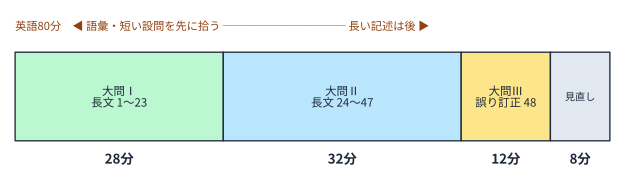
🧭 おすすめの解く順番
大問Ⅲ → 大問Ⅰ → 大問Ⅱ → 見直し8分(Ⅲを先に解くかは、得意・不得意で決めてよい)
長文は、設問の種類(語彙・真偽・記述)を先に見渡してから読みます。語彙問題は本文の該当箇所だけを読めば解けるので、本文通読の前に片づけると、通読中に「ここは空所補充の答えに使える」と気づけます。
大問Ⅰ 「幸せ」の研究レビュー ── 「空所は形と意味の二段構え」「内容一致は全選択肢を本文で裏づける」
📝 どういう問題か?
心理学の研究を振り返る記事。幸せになる方法(笑顔・感謝・社交性・親切・瞑想など)が、新しい厳しい研究のやり方(計画の事前公表)で確かめ直されたら、どれが生き残ったか、という流れ。
- 1〜12:選択肢a〜r(18個)から、12個の空所に1回ずつ当てはめる(フレーズ)
- 13〜17:下線部(A)〜(E)の語に最も近い意味の語を、4択から選ぶ
- 18〜22:空所[a]〜[e]に入る語を、5択から選ぶ
- 23:本文の内容に合うものを、a〜fからすべて選ぶ
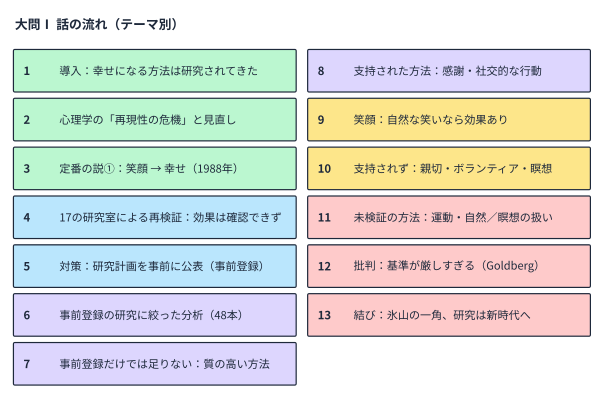
現場戦略試験会場でのリアルな立ち回り(大問Ⅰ)
⏱ 目標時間 & 死守ライン目標28分(空所補充1〜12に10分、13〜22に6分、23に5分、通読に7分)。13〜22は本文を通読しなくても取れる。
⚠️ 損切り・警戒ライン12個のうち2〜3個がどうしても決まらなければ、残った選択肢から消去して先へ。23は、本文で確認できない選択肢を保留にして、確実な3つだけでも答える。
💡 初手の思考トリガー最初の一手は選択肢18個を「過去形/過去分詞でそのまま使える」「to不定詞が続く」「前置詞で終わる」に3分類しておくこと。空所の直前が have か過去形かで、候補が半分になる。
1〜12空所補充(フレーズ選択)
| 空所 | 答え | 入る語句 | 決め手 |
|---|---|---|---|
| 1 | q | tried to figure out | 「幸せになる方法をどう〜してきたか」。have + 過去分詞で、「解き明かそうとしてきた」が自然。 |
| 2 | m | pointed to a variety of | 調査・実験が「さまざまな方法を示してきた」。直後の“from A to B to C”の列挙とも合う。adopted(採用する)は、調査が主語だと不自然。 |
| 3 | g | led to a closer scrutiny of | 研究の再現性への気づきが、研究手法への注目を高めた。That(前の内容)を受けて、結果を表す。 |
| 4 | h | looked at four examples of | 実験の参加者が、漫画を見て面白さを評価する場面。「(漫画を)見る」という動作に合うのはこれ。 |
| 5 | e | failed to hold up | 17の研究室による再検証で、前の説が支持されなかった。同じ表現が冒頭近くの hold up と対応している。 |
| 6 | f | homed in on | 「事前登録された研究に的を絞った」結果、分野が48本に絞られた。narrowed とつながる。 |
| 7 | a | adopted a lot of | 「この分野は、新しい厳密さを高める習慣を、たくさん取り入れている」。has + 過去分詞。 |
| 8 | o | resulted in more | 感謝を表現することが、より良い気分につながった、という因果。 |
| 9 | r | worked together to | 約2ダースの研究室が「協力して」検証した。主語が複数の研究室であることに注目。 |
| 10 | l | measured up to | 他の方法は、研究者の基準に「達していない」。直後の“at least not yet”とも整合。 |
| 11 | j | made no difference to | 親切にしても、4週間では幸福感に「変化がなかった」。直前の「明確な証拠なし」の言い換え。 |
| 12 | b | covered the tip of | 「このレビューは氷山の一角にしか触れていない」。iceberg との結びつきで決まる。 |
🎯 1〜12 の答え
1 q2 m3 g4 h5 e6 f7 a8 o9 r10 l11 j12 b
使わない選択肢は c, d, i, k, n, p の6個(c「encouraged them to」、d「entrusted them with」、i「lured away from」、k「manipulated them into」、n「read too much into」、p「tended to hold on to」)。いずれも、前後の語の形か意味が合いません。要確認 2番は、「a(adopted a lot of)」との区別が意味判断になります。調査・実験が主語であることから m としましたが、赤本の解答でご確認ください。
⚠️ 形だけで決めない。4番は動詞の形だけなら複数が残る。「何をしている場面か」を一文で言い換えてから選ぶ。2番と7番の adopted は、どちらの主語が「採用する」側かで振り分ける。
13〜22同義語と語選択
13〜17(同義語):下線部の語を、その文脈での意味に置き換える問題。字面が似ている選択肢は引っかけです。
- 13 (A):grin(にっこり笑い)→ smile(d)。grimace は「顔をしかめること」で逆。cheer(歓声・励まし)は字面・意味とも離れる。
- 14 (B):upheaval(大変動)→ turmoil(d)(混乱・動乱)。calamity(大災害)は被害が主で、研究の見直しという文脈には強すぎる。
- 15 (C):sound methods の sound は「確かな・堅実な」→ solid(d)。loud(音が大きい)や probe(探査)は、音の意味や別の語との取り違え。
- 16 (D):mimic(まねる)→ imitate(c)。
- 17 (E):renaissance(再生・復興)→ revival(d)。
18〜22(語選択):空所に入る語を5択から選びます。
- 18 [a]:「昔からある〜は、笑顔が幸せにする、というものだ」→ hypothesis(仮説)(c)。後で検証される対象だから。
- 19 [b]:「心理学の〜の危機」。再現できなかった、という流れなので reproducibility(再現性)(b)。
- 20 [c]:「新しい〜を高める習慣」。事前登録は、研究の厳密さを高めるので rigor(d)。vigor(活力)との綴りの取り違えに注意。
- 21 [d]:「感謝の手紙を〜する」→ pen(c)(動詞:書く)。scrawl(殴り書きする)は、わざわざ手紙を書く場面にそぐわない。要確認
- 22 [e]:「事前登録された〜が今のところ…」。preregistered landscape(現状の全体像)→ landscape(c)。
🎯 13〜22 の答え
13 d14 d15 d16 c17 d18 c19 b20 d21 c22 c
⚠️ 同義語は辞書の第一義ではなく、その文での意味で選ぶ。15の sound は「音」ではなく「確かな」。字面の近い選択肢(calamity、loud、vigor)ほど危ない。
23内容一致(正しいものをすべて選ぶ)
📝 どういう問題か?
選択肢は本文の内容をそのまま、または少し変えて述べたもの。数字・比較の向き・「できた/できなかった」が変えられていないかを1つずつ本文と照らす。
- 23:本文の内容に合うものを、a〜fの6つからすべて選ぶ(答えは複数)
- a:×。顕微鏡(microscope)は「より厳密に調べる」という比喩なのに、「顕微鏡の性能が上がったおかげで」と、文字どおりの話に変えている。
- b:○。1988年の実験で、歯でペンをくわえた(笑顔の形になる)グループのほうが、唇でくわえたグループより漫画をわずかに面白いと評価した。
- c:×。矢を射る話は、分析をやり直せる問題を説明するたとえ。実験の説明ではない。
- d:○。事前に計画を登録した研究を48本、厳密に調べた(「数ダース」と言える数)。
- e:○。社交的に振る舞う条件(71人)と、控えめに振る舞う条件(76人)で、合わせて147人。社交的な条件のほうが気分が良かったと報告された。
- f:○。Goldberg は、基準が厳しすぎるために、瞑想の効果を示す研究の多くが分析から外れた、と批判している。
🎯 23 の答え
b, d, e, f
要確認 d の「rigorously reviewed several dozen articles」の「rigorously」は、本文の「事前登録を条件にした」ことを指すと読めますが、厳密に調べたかどうかの読みが分かれる可能性があります。ほかの5つは判断が割れにくい選択肢です。
⚠️ 比喩を事実にすり替える選択肢(a・c)が2つ入っている。本文に“like”や“a bit like”があれば比喩、と見抜く。
Yuiちゃん
a と c は、本文を読んだ時は「たとえ話だな」と思ったのに、選択肢で見ると本当のことのように見えました。Mio先生
それが罠なの。出題者は、本文の比喩を「事実の文」に書き換えてくるでしょう? 選択肢を読むときは、その文が本文のどの文に対応するかを探して、対応する文が比喩かどうかを見るといいよ。ニックニ先生
時間がないときは、1つずつ○×をつけて、○が確実な3つだけでも先に答える。残りは見直しで。Mio先生の総整理表
大問Ⅰ:設問タイプ別の整理
| 設問 | 型 | 着眼点 |
|---|---|---|
| 1〜12 | 空所補充(フレーズ) | 形(have+過去分詞か過去形か、to不定詞か)→意味。使わない選択肢が6個ある |
| 13〜17 | 同義語 | 文脈での意味。字面が近い選択肢(grimace、calamity、loud)は引っかけ |
| 18〜22 | 語選択 | 品詞と前後の語との結びつき(rigor-enhancing、replication crisis など) |
| 23 | 内容一致(複数) | 比喩の事実化、数字、比較の向きに注意。確実な選択肢から答える |
TMPSコーチング診断
🩺【自己診断】大問Ⅰで手が止まった人への処方箋
- 1〜12決まらない空所 → 形で選択肢を半分に。それでも迷えば、先に他の空所を埋めて消去
- 13〜17意味が分からない語 → 前後の文から「良い/悪い」「大きい/小さい」だけでも判定
- 18〜22語が出ない → 品詞と連語(〜 crisis、〜-enhancing)で絞る
- 23○×が決まらない → 該当する本文の一文に印をつけ、比喩かどうかを見る
大問Ⅱ 読書は心のセラピー ── 「真偽は本文の言い換えを探す」「記述は本文から拾う」
📝 どういう問題か?
筆者が、読書を「心の健康法」として紹介する記事。専門家(ソーシャルワーカー)の話を引きながら、本が感情・自己理解・ものの見方・孤独感にどう働くか、本の選び方、読書量の目標を立てないこと、セラピストが本を処方する理由、と進む。
- 24〜28:本文に合っているか(a=true/b=false)
- 29〜33:下線部(A)(B)(C)(N)(Q)の語句の意味を、4択から選ぶ
- 34〜39:空所(E)(F)(G)(H)(J)(K)に、6つの語句を1回ずつ当てはめる
- 40・41:下線の句(L)(O)の意味を、4択から選ぶ
- 42〜47:記述(職業を4つ、代名詞が指すもの、並べ替え、動詞の形、類義の句、1語補充)
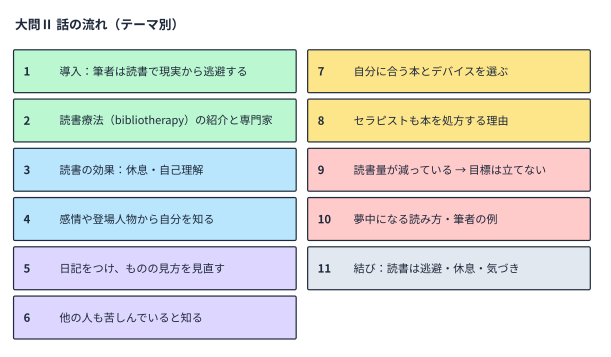
現場戦略試験会場でのリアルな立ち回り(大問Ⅱ)
⏱ 目標時間 & 死守ライン目標32分(通読に10分、24〜33に8分、34〜41に6分、42〜47に8分)。29〜33・40・41は下線部の周辺だけで取れる。
⚠️ 損切り・警戒ライン42(職業を4つ)は本文から拾うだけなので落とさない。44(整序)が20秒で組めなければ後回し。
💡 初手の思考トリガー最初の一手は真偽の5問の主語と数字に印をつけてから読むこと。本文のどの段落が根拠になるかを、読みながら番号でメモする。
24〜28真偽
- 24:b(false)。筆者が現実から離れる場所は、本の中の舞台。休暇を取って実際に旅行したわけではない。
- 25:b(false)。読書に使う機器は個人の好みで選べばよく、大切なのは本人が楽しめること。「本の内容の楽しさによって、適した機器が決まる」とは言っていない。要確認
- 26:a(true)。従来の対話型の治療はつらく感じることがあるが、登場人物の視点を通すと、つらい記憶も話しやすくなる、と述べている。
- 27:b(false)。1週間・1年あたりの冊数の目標は立てないほうがよい、という助言。
- 28:b(false)。本文では、ある小説を読んで「芸術の力」を思い出し、娘を美術館に連れて行った。ただし娘たちが見入ったのは古代エジプトの遺物で、小説の内容そのものとの関連は書かれていない。「その本に感動して」「本の内容に関連する展示」の2点をどう読むかで a・b が割れうるため、TMPSは b としたが要確認。
🎯 24〜28 の答え
24 b25 b26 a27 b28 b
⚠️ 25と28は、本文の2つの事実を「因果」や「関連」でつなぎ直した文。本文にない関係づけは false。
29〜33語句の意味
- 29 (A) juggling:仕事と家庭の両方の要求を同時にやりくりする → balancing(a)。
- 30 (B) badly:needed badly = 強く必要としている → very much(c)。「悪く」の意味ではない。
- 31 (C) spell:a rough spell = つらい期間 → a certain period of time(a)。「呪文」「綴り」の意味に引きずられない。
- 32 (N) impacted:社会問題に「影響を受けている」→ affected(b)。effected は「もたらされた」で意味が違う(字面の引っかけ)。
- 33 (Q) engaging:本の内容に「関わっている・参加している」→ taking part in some activity(d)。「雇う」「婚約」「契約」は別の意味。
🎯 29〜33 の答え
29 a30 c31 a32 b33 d
34〜41空所補充と句の意味
34〜39は、6つの語句(angry、down and turn inward、down what they learn、personal insights、published in April、your beliefs)から、空所の直前の語との結びつきで決めます。
- 34(E):slow + down and turn inward(b)(速度を落として内面を見つめる)。
- 35(F):a book to be + published in April(e)(近刊の本)。
- 36(G):a way to gain + personal insights(d)。
- 37(H):causing them to get + angry(a)(涙を流す・怒るなど、感情が動く文脈)。
- 38(J):journals on hand to write + down what they learn(c)(write down)。
- 39(K):reconsider + your beliefs(f)。
- 40 (L):in black-and-white terms = 白か黒かで考える → either completely good or completely bad(a)。
- 41 (O):who you are as a reader = どんな読者か。直後の「歴史小説・SF・伝記・恋愛などのファンか」がヒント → what genre of books you like(c)。
🎯 34〜41 の答え
34 b35 e36 d37 a38 c39 f40 a41 c
42〜47記述(解答例)
📝 どういう問題か?
記述問題は、本文から拾う(42・43・46)、文法で組み立てる(44・45)、文脈から補う(47)の3種類。42・43・46は本文の該当箇所を探すだけなので、時間を使わず確実に取る。
- 42:本文から職業を4つ抜き出す
- 43:下線の代名詞(D)が指す語を、本文から1語で
- 44:★の括弧内の8語を並べ替えて文を完成させる
- 45:(I)に入る、動詞 keep の適切な形
- 46:下線の語(M)と似た意味の句を本文から抜き出す
- 47:空所(P)に入る1語
解答例です。記述には別解がありえます。
- 42:clinical social worker/college professor/librarian/therapist(本文にある職業から4つ。author なども可と考えられる)。
- 43:bibliotherapy(直前の文で紹介された療法を、it が受けている)。
- 44:what's making them have the reactions they're experiencing(間接疑問の形。「何が彼らにその反応をさせているのか」)。
- 45:keep(またはto keep)。設問は「動詞 to keep の適切な形」。recommend + 人 + to do の形なので to keep と書くのが本文の流れに最も素直だが、to を含めるか原形だけかは採点基準が分からない。要確認
- 46:points of view(perspective の言い換え。同じ段落内に出てくる)。
- 47:less(students read less now than ~。直前の「読書量が減っている」の流れ)。
🎯 42〜47 の答え(解答例)
42 social worker / professor / librarian / therapist43 bibliotherapy44 what's making them have the reactions they're experiencing45 keep46 points of view47 less
⚠️ 44はwhat's が文頭の疑問詞で、主語になる。「making them have ~」の形(make + 人 + 原形)を先に作ってから、残りの語をはめる。45は、本文の語順に合わせて to keep の形を意識する。
Yuiちゃん
42の職業は、何を選べば正解になりますか?Mio先生
本文に出てくる職業ならOK。だから、「本文のどこにも出てこない職業」を書かないことが一番大事。自信がある4つを選ぼう。ニックニ先生
記述問題では英単語のスペルミスも減点対象になります。もし綴りに少しでも不安がある場合は、問題文中に登場している単語を正確に参照して記述するのが最も安全確実ですね。Mio先生の総整理表
大問Ⅱ:設問タイプ別の整理
| 設問 | 型 | 着眼点 |
|---|---|---|
| 24〜28 | 真偽 | 本文にない関係づけ(因果・関連)は false |
| 29〜33 | 語句の意味 | 多義語(spell、badly)は文脈で。字面が似た語(effected)は引っかけ |
| 34〜39 | 空所補充(6択) | 直前の語との結びつき(slow down、published in など) |
| 40・41 | 句の意味 | 直後の言い換えがヒント |
| 42〜47 | 記述 | 本文から拾う/文法で組む/文脈で補う。スペルに注意 |
TMPSコーチング診断
🩺【自己診断】大問Ⅱで手が止まった人への処方箋
- 24〜28○×が決まらない → 主語と数字に印をつけ、本文の対応する文に番号を振る
- 29〜33語の意味が出ない → 下線部を含む一文を、日本語に言い換えてから選ぶ
- 34〜39決まらない → 空所の直前の語との結びつき(slow down など)から選ぶ
- 42〜47時間が足りない → 42・43・46(本文から拾う)を先に取る
大問Ⅲ 誤り訂正 ── 「文体ではなく文法の誤りだけ」「品詞・数・時制・冠詞を順番に見る」
📝 どういう問題か?
例示(forget → forgot、umbrella → an umbrella)のように、語の形を直す/語を足す形で訂正する。
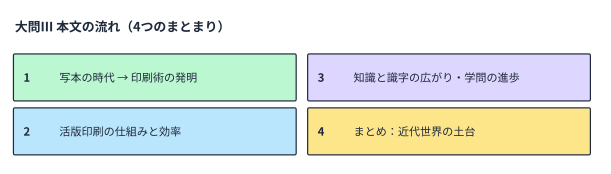
- 48:約230語の英文(印刷術の発明を扱う4つのまとまり)に含まれる英語の誤りを、すべて見つけて訂正する。誤りだけを直し、文体の好みで書き換えてはいけない。解答欄には本文が印刷されていて、そこに直接書き込む
現場戦略試験会場でのリアルな立ち回り(大問Ⅲ)
⏱ 目標時間 & 死守ライン目標12分。1段落あたり3分。確実な誤りを先に拾い、迷う箇所は後で。
⚠️ 損切り・警戒ライン「ここは誤りかもしれない」程度の箇所に3分以上かけない。すでに見つけた誤りの数と、自信のあるものを優先する。
💡 初手の思考トリガー最初の一手は各文を「主語と動詞が数で合っているか」「名詞に冠詞か複数形が必要か」「品詞(形容詞・副詞・名詞)が正しいか」の順に見ること。
以下は、TMPSが「誤りと言い切れる」と判断した11か所です。
- 「copied with hand」→ by hand(手段の by)。
- 「Those process of manually copying」→ That / The process(process は単数)。
- 「only the wealthy or powerful was able」→ were(the wealthy は複数扱い)。
- 「allowed individual letter to be arranged」→ letters(複数の文字を並べ替える)。
- 「multiple copies … could produce quickly」→ could be produced(copies は作られる側=受け身)。
- 「Ordinarily people」→ Ordinary(名詞を修飾する形容詞)。
- 「encouraged education and lead to」→ led(encouraged と並ぶ過去形)。
- 「astronomy, medical, and mathematics」→ medicine(学問分野の名詞)。
- 「making information accessibility」→ accessible(making + O + C の C は形容詞)。
- 「where knowledge is sharing freely」→ shared(知識は共有される側=受け身)。
- 「more widely available as ever before」→ than(比較級 + than ever before)。
要確認 次の3か所は、冠詞・コンマの誤りかどうかが判断の分かれる候補です:
・「Before mid-15th century」→ the mid-15th century(時期を表す名詞句に冠詞が要るか)
・「The impact of printing press」→ the printing press(文中の他の箇所では the printing press と言っている)
・「Ordinarily people, who previously had little access」のコンマ(限定か非限定かで意味が変わる)
赤本の解答に含まれているかは確認できていません。確実な11か所を先に直し、候補は時間があれば追加します(「直しすぎ」で減点されるかどうかは、採点基準が公表されていないため不明)。
🎯 48 の答え(誤り訂正)
with hand → by handThose → That/Thewas → wereletter → lettersproduce → be producedOrdinarily → Ordinarylead → ledmedical → medicineaccessibility → accessiblesharing → sharedas → than
⚠️ 書き換えすぎ。「因果表現が不自然」「語が硬い」など、好みの修正は誤りではない。指示は「誤りだけを直す」。確信のない箇所を直して、正しい箇所を壊さない。
Yuiちゃん
誤りの数は全部で何か所なんでしょうか? 見落としが怖いです。ニックニ先生
数は書いていない。だから「見つけた数」にこだわるより、確実な誤りを漏らさないこと。段落ごとに「主語と動詞の数」「名詞の複数形・冠詞」「品詞」を順番に見て、1周で終わらせる。Mio先生
本当は直す必要のない箇所を直してしまうのが一番もったいない。冠詞のように「どちらも文法的にありうる」箇所は、他で確実な誤りを拾ったあとで、時間があれば検討しよう。Mio先生の総整理表
大問Ⅲ:誤りの型の整理
| 型 | 例 | チェックのしかた |
|---|---|---|
| 数の一致 | the wealthy was → were | 主語を探し、単数か複数か |
| 受け身・能動 | could produce → be produced | 主語が「する側」か「される側」か |
| 品詞 | Ordinarily/accessibility/sharing | 修飾する相手(動詞か名詞か)と、補語の位置 |
| 語形・時制 | lead → led/letter → letters | 並列の形をそろえる・複数形が要るか |
| 前置詞・比較 | with hand → by hand/as → than | 決まった組み合わせ |
TMPSコーチング診断
🩺【自己診断】大問Ⅲで手が止まった人への処方箋
- 48誤りが見つからない → 動詞だけ丸をつけ、主語との数・時制・受け身を確認
- 48直しすぎる → 「意味が変わらず、文法的にも正しい」なら直さない
- 48時間が足りない → 段落3(知識と識字)は誤りが多い。先に取る
本番の答え一覧(採点用)
答えはTMPS側で独立に導いたものです(公開されている解答は参照していません)。字数・番号の範囲・選択肢の重複などは、スクリプトで確認しています。意味や語法の判断が割れる選択問題は「要確認」、記述は解答例です。
大問Ⅰ
1 q / 2 m / 3 g / 4 h / 5 e / 6 f7 a / 8 o / 9 r / 10 l / 11 j / 12 b13 d / 14 d / 15 d / 16 c / 17 d18 c / 19 b / 20 d / 21 c / 22 c23 b, d, e, f
大問Ⅱ
24 b / 25 b / 26 a / 27 b / 28 b29 a / 30 c / 31 a / 32 b / 33 d34 b / 35 e / 36 d / 37 a / 38 c / 39 f40 a / 41 c42〜47(解答例):職業4つ/bibliotherapy/what's making them have the reactions they're experiencing/keep/points of view/less
大問Ⅲ
48:with hand→by hand / Those→That / was→were / letter→letters / produce→be produced / Ordinarily→Ordinary / lead→led / medical→medicine / accessibility→accessible / sharing→shared / as→than
※ スクリプトで確認:空所1〜12が18個の選択肢から重複なく12個/使わない選択肢が6個/13〜22・24〜41の答えが選択肢の範囲内/34〜39が6個を1回ずつ/44の8語が括弧の語と一致/23eの人数(71+76=147)。
※ 要確認:1〜12のうち2番(adopted との区別)、21番(pen と scrawl)、23d、25、28、45(keep の形)、大問Ⅲの冠詞・コンマ候補3か所。記述(42〜47)は解答例です。
採点したら → 30秒の得点診断へ
TMPS ORIGINAL
関西医科大2026型 そっくり類題セット
関西医科大2026型 そっくり類題セット
(全3大問・解答解説つき)
2026年度の本番と同じ3大問・同じ設問の型で、本文・設問をすべて新しく作ったTMPSオリジナル問題です。「空所は形と意味の二段構え」「内容一致は比喩を見抜く」「誤り訂正は品詞・数・時制の順に」の練習に使ってください。
英語の時間目安 80分長文2題・誤り訂正
📄 本番形式の問題冊子PDFをダウンロード(全10ページ)
印刷して本番と同じように80分で解けます。解答・解説はこのページの下に掲載しています。
※ 関西医科大学の入試問題ではありません。本文・設問・人物・団体(架空)はすべてTMPS医学館が作成したオリジナルで、出典のある引用ではありません。
※ 類題の本文・設問は、TMPS医学館のオリジナルです(入試問題ではありません)。人物・団体はすべて架空です。
類題 大問Ⅰ 長文(空所補充・同義語・語選択・内容一致)
Read the following passage and answer the questions that follow.
Everyone wants a good night’s sleep — and for decades, researchers have 1 how we might get one. The field’s many surveys and experiments have 2 remedies, from giving up coffee after lunch to taking a ten-minute nap to cramming(A) a bedroom full of houseplants.
But sleep science has had a rocky(B) decade of its own. Scientists realized that many early studies had used only a handful of volunteers and could not be repeated. That has 3 how sleep is measured, and the study of naps is no exception. So what really works? Under today’s closer inspection(C), some remedies seem to hold up, while others do not, or have yet to prove themselves. Here is what we know so far, according to a new review in the Annual Review of Sleep Studies.
One long-standing a is that a warm bath before bed helps people fall asleep. In a well-known 1998 study, researchers asked 40 volunteers in Brisbane to sit in either a hot bath or a warm room for ten minutes. The volunteers then 4 a short reaction-time test the next morning. On average, the bathers reacted slightly faster than the others.
But when 12 different laboratories joined forces to repeat the experiment with 2,300 new volunteers, the effect 5, the team reported in 2017.
The repeat study was part of a wider push to solve what some call sleep science’s b crisis, which has been blamed partly on the many ways in which researchers could analyze their data until a pleasing(D) result appeared. “It’s a bit like firing a handful of darts at a board and painting the target around them afterwards,” says Dr. Lena Marsh, a sleep scientist at Harlow University and coauthor of the review.
One solution has been for scientists to announce their study plans publicly before collecting any data. In other words, they paint the target first. Marsh and her student, Tomas Ruiz, 6 such pre-announced studies, which narrowed the huge field of nap research to just 36 papers. Even that small number is encouraging, says Hannah Voss, a psychologist at the University of Dunmore. “I was honestly surprised there were that many,” she says. “It shows the field has 7 these new c-boosting habits.”
Pre-announcing alone does not guarantee sound results, nor does it solve every problem. Good studies also need careful methods and large, varied groups of volunteers. Most of the papers reviewed were strong in those respects as well, Marsh says. Even under the stricter rules, some paths to better sleep held up, the researchers found, including keeping a regular bedtime, getting morning light and cutting back on caffeine.
Take morning light. In one recent study, scientists asked hundreds of office workers to either walk outside for twenty minutes after waking or d down a list of their plans for the day indoors. Walking outside 8 restful nights two weeks later. In another study, 800 students were asked to get morning light or to log their daily habits. Those in the light group fell asleep faster and felt more alert the following day. In both cases, it is unclear how long these effects would last.
Three different pre-announced studies pointed to a regular bedtime as helpful. In one, researchers asked 64 adults to keep a fixed bedtime for a week and another 66 to go to bed whenever they liked. Participants in the fixed-bedtime group reported feeling more rested during the study week, though the benefits were smaller for those who were naturally night owls.
And surprise! Short naps were also supported by new, pre-announced research — once scientists switched to a more realistic design. About twenty labs in 14 countries 9 test the instruction to nap briefly in the early afternoon with nearly 3,000 volunteers. Longer naps still did not help, but people who were told to rest for ten minutes did report better focus. Remarkably, this was true even when the volunteers did not believe it would work, another team reported in 2024.
Other well-known sleep tips have not 10 the review’s standards — at least not yet. The researchers found no clear evidence for benefits of warm baths, lavender scents or white noise. For example, a recent pre-announced study asked participants to use a lavender spray every night, or to use nothing at all. Using the spray over a four-week period 11 sleep quality.
The pair did not find any pre-announced studies at all on yoga or on drinking herbal tea, two oft-recommended habits. That does not mean those habits cannot work, Marsh says — just that as the pre-announced e now stands, research has not weighed in. The pair also considered only two pre-announced studies on bright-light therapy, and did not include research on people diagnosed with insomnia.
Such strictness is admirable, but it also means one can miss things, says Paul Haines, a sleep researcher at the University of Kellerton. He studies the effects of bright-light therapy, including its use with patients who have insomnia and depression. He noted that because of Marsh and Ruiz’s strict criteria, they left out hundreds of studies on its benefits. “It’s like throwing away a whole harvest because of a few bad apples,” he says. “It’s really very obvious that bright light helps people with winter depression.”
Marsh agrees that the review only 12 the iceberg of sleep research. But that tip should grow as more scientists announce their plans in advance. As Marsh and Ruiz conclude, “sleep research stands at the start of an exciting new era(E).”
For <span class="inline-block border border-slate-500 rounded px-1.5 text-sm font-bold mr-1">1</span> through <span class="inline-block border border-slate-500 rounded px-1.5 text-sm font-bold mr-1">12</span>, choose the most appropriate phrase from the following choices to fill in the box, and mark on your answer sheet. The same choice can only be used once.
a. all but disappeared
b. broke down into
c. brought about more
d. covered the tip of
e. drawn attention to
f. fell short of
g. gave up on
h. had little effect on
i. measured up to
j. pointed to several
k. ran into
l. stepped back from
m. taken on a lot of
n. teamed up to
o. tried to work out
p. went along with
q. worked through
r. zeroed in on
For <span class="inline-block border border-slate-500 rounded px-1.5 text-sm font-bold mr-1">13</span> through <span class="inline-block border border-slate-500 rounded px-1.5 text-sm font-bold mr-1">17</span>, choose the word that is closest in meaning in the given context to the underlined words marked (A) through (E), and mark on your answer sheet.
13(A) cramming
a. cleaning
b. painting
c. stuffing
d. lighting
14(B) rocky
a. steady
b. difficult
c. profitable
d. stony
15(C) inspection
a. invention
b. examination
c. protection
d. direction
16(D) pleasing
a. unwelcome
b. surprising
c. puzzling
d. satisfying
17(E) era
a. mistake
b. rule
c. place
d. period
For <span class="inline-block border border-slate-500 rounded px-1.5 text-sm font-bold mr-1">18</span> through <span class="inline-block border border-slate-500 rounded px-1.5 text-sm font-bold mr-1">22</span>, choose the word that is most appropriate in the given context to fill in the blanks marked [ a ] through [ e ], and mark on your answer sheet.
18[ a ]
a. relief
b. belief
c. grief
d. brief
e. chief
19[ b ]
a. rotation
b. regulation
c. relaxation
d. replication
e. resolution
20[ c ]
a. confession
b. conference
c. confidence
d. confinement
e. confidential
21[ d ]
a. jab
b. jam
c. jar
d. jog
e. jot
22[ e ]
a. record
b. recipe
c. rumor
d. reward
e. ritual
23In accordance with the passage, choose all correct statements from the following choices, and mark on your answer sheet.
a. Thanks to better sleep-tracking devices, researchers have confirmed which habits improve sleep, while the effects of other habits remain to be checked.
b. In the 1998 study mentioned in the passage, volunteers who sat in a hot bath reacted slightly faster the next morning than those who sat in a warm room.
c. To see how analysis choices affect results, scientists fired darts at a board and drew a ring around each dart after it landed.
d. Marsh and Ruiz examined three dozen published papers in which the study plans had been announced before the studies began.
e. In a one-week study of 130 adults, those told to keep a fixed bedtime reported feeling more rested than those who went to bed whenever they liked.
f. Paul Haines criticized Marsh and Ruiz for being too strict, and therefore asked scientists to stop announcing their study plans in advance.
▶ 大問Ⅰ の答えと解説を見る
大問Ⅰ の答えと解説
空所補充 1〜12(選択肢 a〜r)
1 o2 j3 e4 q5 a6 r7 m8 c9 n10 i11 h12 d
- 1=o(tried to work out) have + 過去分詞 の形で、「どうすれば得られるかを〜しようとしてきた」。try to work out = 解き明かそうとする。形が合うのは tried to work out。
- 2=j(pointed to several) have + 過去分詞、目的語は remedies。「いくつかの対処法を指し示してきた」= pointed to several。例が3つ並ぶ点とも合う。
- 3=e(drawn attention to) 直前の「過去の研究は再現できなかった」という気づきを That が受け、「測り方への注目を集めた」。drawn attention to が文脈と has + 過去分詞に合う。
- 4=q(worked through) 「ボランティアはそのあと短い反応テストを〜した」。過去形で、テストを目的語にとるのは worked through(やり通す)。
- 5=a(all but disappeared) 逆接の But 以下で、再実験の結果「効果はほとんど消えた」。all but disappeared。後ろの “the team reported” とも合う。
- 6=r(zeroed in on) 「〜の研究に絞り込み、その結果、分野が36本に狭まった」。zeroed in on(的を絞る)が、narrowed と意味でつながる。
- 7=m(taken on a lot of) 「この分野は新しい習慣を〜している」。has + 過去分詞で、「取り入れた」= taken on a lot of。形(taken)と意味の両方で決まる。
- 8=c(brought about more) 「屋外を歩くことは、より穏やかな夜をもたらした」。brought about more restful nights。無冠詞の複数名詞が続く形。
- 9=n(teamed up to) 「約20の研究室が協力して〜を検証した」。teamed up to + 動詞の原形(test)。
- 10=i(measured up to) 「他の習慣は基準に達していない」。measured up to + 基準。have not + 過去分詞 に合うのは measured。
- 11=h(had little effect on) 「4週間スプレーを使っても、睡眠の質にはほとんど影響がなかった」。had little effect on。前文の『明確な証拠なし』とも整合。
- 12=d(covered the tip of) 「この研究は氷山の一角にしか触れていない」。covered the tip of the iceberg(氷山の一角を扱った)。
使わない選択肢:b, f, g, k, l, p(形か意味が合わないもの)。
同義語 13〜17
13 c14 b15 b16 d17 d
- 13=c(stuffing) cram = ぎゅうぎゅうに詰め込む。同じ意味は stuffing。painting や lighting は『部屋いっぱいに植物』という文脈に合わない。
- 14=b(difficult) rocky decade の rocky は『でこぼこの→困難な』。stony は字面が近いが、10年間の形容にならない。
- 15=b(examination) closer inspection = より詳しい調査。examination が同義。
- 16=d(satisfying) pleasing result = 研究者が望む(満足できる)結果。satisfying。
- 17=d(period) era = 時代。period が同義。
語選択 18〜22
18 b19 d20 c21 e22 a
- 18=b(belief) 「昔からある〜は、入浴で眠りやすくなるというものだ」。belief(考え)。relief・grief などは形が似ているだけ。
- 19=d(replication) 「睡眠科学の replication crisis」。再現性の危機を指す定型表現。
- 20=c(confidence) 「confidence-boosting habits」= 信頼性(確からしさ)を高める習慣。
- 21=e(jot) 「jot down a list」= 手早く書き留める。
- 22=a(record) 「公表されている記録(record)が今のところ〜」。as the record now stands = 現時点の記録では。
内容一致 23(正しいものをすべて選ぶ)
23 b, d, e
- a × 『新しい睡眠測定機器のおかげで確認できた』とは書かれていない。本文の『もっと近くで見ると(closer inspection)』は、調べ方が厳しくなったという比喩。
- b ○ 1998年の研究で、入浴したグループのほうが翌朝わずかに反応が速かった。
- c × ダーツの話は、分析のしかたを選べてしまう問題を説明するたとえ。実際に実験したわけではない。
- d ○ 事前に計画を公表した研究36本(=3ダース)を調べた。
- e ○ 64人+66人=130人。決まった就寝時刻のグループのほうが、よく休めたと報告した。
- f × Haines は厳しすぎると批判したが、『計画の公表をやめるよう求めた』とは書かれていない。
類題 大問Ⅱ 長文(真偽・語義・空所補充・記述)
Read the following passage and answer the questions that follow.
Like most parents, I’m worn out from juggling(A) the needs of my job and my children. But after the kids fall asleep, I slip out to the small vegetable garden behind our house. The evening air is cool, the soil is damp, and the tomato plants smell sharp and green.
It has been just the chance to unwind that I’ve badly(B) needed. During a long spell(C) this spring, when the whole family caught one cold after another, I planted three rows of beans and felt, for an hour a day, like a person with nothing to fix.
So-called ecotherapy can be a powerful wellness practice, according to Dana Whitlock, a licensed occupational therapist in Duluth, Minnesota, who has been prescribing it(D) to her clients for twelve years.
For most of us, “there are few chances to slow E,” said Whitlock, who teaches a course on garden therapy at a local college. She is also the author of “Dirt Under My Nails,” a book to be F.
Gardening offers a break from work and from caring for other people, she said, and it can also be a way to gain G.
Working with soil often has strong effects on people, making them laugh or causing them to get H over old memories. “If a feeling comes up while you’re digging, there’s something there for you,” Whitlock said. If gardeners stop and think about ★[tend / what’s / them / drawing / the / they / plants / to], they can gain valuable knowledge about themselves.
Whitlock recommended gardeners to carry(I) notebooks nearby to write J about themselves.
Tending(N) plants also can offer a chance to see things from other people’s points of view and even to reconsider K, Whitlock said.
“We can realize that, OK, maybe I am following garden advice to the letter(L). Or maybe I am worrying a little bit too much,” she said. “Sometimes we garden to help reframe our perspective(M).”
Whitlock said gardens also remind people that they are not the only ones who are struggling. “We all meet the same weather, maybe at different times, in different ways,” she said. This realization can help people feel less alone.
Knowing what suits you as a gardener(O) is important, whether you’re a fan of flowers, herbs, vegetables, fruit trees or something else. Your local garden center or a site like Gardenweb can help. The tools are your choice. Some people like gloves, while others prefer bare hands. What matters is that the work is pleasant for the person.
While some people like me find gardening to be a way to relax and gain insights on our own, Whitlock said therapists also prescribe garden time to their patients as a form of learning and healing. “Traditional talk therapy, having a therapist ask you very personal questions about difficult experiences, can feel really distressing,” she said. “When you’re working beside a plant, it becomes a lot easier to talk about some of those painful memories or to consider different experiences you’ve had.”
Despite the benefits of time outdoors, people have been spending less of it there. As a high-school teacher, I find that, overall, my students spend P time outdoors now than they did when I started teaching a decade ago.
But Whitlock advised that it’s best not to set goals for how many vegetables you’ll grow in a season. Once we start counting how much we’re harvesting, “we take the joy away from the benefits of slowing down,” she said.
Whitlock recently spent two months tending a plot of native prairie flowers. As she worked, she listened to birdsong and read up on the insects that visited. “I feel like that’s when gardening gets really enjoyable, because you’re really absorbed(Q), not just in the work but in what the land is trying to tell you,” she said.
When I want to escape to the countryside, I love browsing Cora Lind’s “The Orchard Year.” Reading it recently reminded me of the power of soil and prompted me to take my young daughters to the city botanical garden, where they were enchanted by tropical butterflies. A farmer at my local market gave me seedlings last week, and a nurse I know swapped herbs with me.
Gardening can be a powerful way of escaping, relaxing and realizing truths about ourselves and the world. That’s why I’m heading back to the garden tonight.
For <span class="inline-block border border-slate-500 rounded px-1.5 text-sm font-bold mr-1">24</span> through <span class="inline-block border border-slate-500 rounded px-1.5 text-sm font-bold mr-1">28</span>, is the statement true or false in accordance with the passage? Mark “a” if it is true and “b” if it is false on your answer sheet.
24Worn out by her job and her children, the author took a week off and traveled to a farm. a. true b. false
25The most suitable tool for gardening depends on how large the garden is. a. true b. false
26In treatment, prescribing time with plants could in some ways be more helpful than conventional talk therapy. a. true b. false
27When you garden, you will be more motivated if you set a goal for how many vegetables you want to grow in a season. a. true b. false
28The author was so inspired by a gardening book that she took her daughters to a botanical garden. a. true b. false
For <span class="inline-block border border-slate-500 rounded px-1.5 text-sm font-bold mr-1">29</span> through <span class="inline-block border border-slate-500 rounded px-1.5 text-sm font-bold mr-1">33</span>, choose the word or phrase that best describes the meaning of the underlined words marked (A), (B), (C), (N), and (Q) in the given context, and mark on your answer sheet.
29(A) juggling
a. throwing
b. ignoring
c. balancing
d. enjoying
30(B) badly
a. mistakenly
b. cruelly
c. rarely
d. very much
31(C) spell
a. a magic word
b. a certain period of time
c. a type of illness
d. a rule
32(N) Tending
a. leaning toward
b. caring for
c. pulling out
d. waiting for
33(Q) absorbed
a. wet through
b. slowly paid back
c. fully focused
d. hard to see
For <span class="inline-block border border-slate-500 rounded px-1.5 text-sm font-bold mr-1">34</span> through <span class="inline-block border border-slate-500 rounded px-1.5 text-sm font-bold mr-1">39</span>, choose the most appropriate word or phrase to fill in the blanks marked [ E ], [ F ], [ G ], [ H ], [ J ], and [ K ] from the following box of choices, and mark on your answer sheet. The same choice can only be used once.
a. down and look inward
b. published next spring
c. new energy
d. down what they notice
e. teary
f. your habits
34[ E ]
35[ F ]
36[ G ]
37[ H ]
38[ J ]
39[ K ]
For <span class="inline-block border border-slate-500 rounded px-1.5 text-sm font-bold mr-1">40</span> and <span class="inline-block border border-slate-500 rounded px-1.5 text-sm font-bold mr-1">41</span>, choose the phrase that best describes the meaning of the underlined phrases marked (L) and (O), and mark on your answer sheet.
40(L) to the letter
a. exactly and strictly
b. by mail
c. in writing only
d. one letter at a time
41(O) what suits you as a gardener
a. which plants you can afford
b. what kind of gardening suits you
c. how large your yard is
d. where you were born
42Find four occupations from the passage, and write them on your answer sheet.
43What does the underlined pronoun marked (D) denote? Find the most appropriate word from the passage, and write it on your answer sheet.
44Rearrange the words in the brackets marked ★ into the most appropriate order to make a correct sentence, and write them on your answer sheet.
45Fill in the blank marked (I) with the most appropriate form of the verb to carry, and write it on your answer sheet.
46Find the phrase that has a similar meaning to the underlined word marked (M) from the passage, and write it on your answer sheet.
47What is the most appropriate word to fill in the blank marked P? Write it on your answer sheet.
▶ 大問Ⅱ の答えと解説を見る
大問Ⅱ の答えと解説
真偽 24〜28(a=true, b=false)
24 b25 b26 a27 b28 a
- 24 × 彼女が向かうのは、子どもが寝たあとの自宅の菜園。休暇を取って農場に行ったわけではない。
- 25 × 道具は『好みで選べばよい』、大事なのは作業が気持ちよいこと。庭の広さは関係づけられていない。
- 26 ○ 話し合う療法が負担になることがあり、植物のそばだと話しやすくなる、と述べている。
- 27 × 目標(収穫の数など)は立てないほうがよい、というアドバイス。
- 28 ○ Cora Lind の本に刺激され、娘たちを植物園へ連れて行った。
語義 29〜33
29 c30 d31 b32 b33 c
- 29=c(balancing) juggle the needs of A and B = 両方の要求の間でやりくりする → balancing。
- 30=d(very much) needed badly = 強く必要としている → very much。『悪く』ではない。
- 31=b(a certain period of time) a long spell = 長い期間。『病気』は文脈から連想されやすい引っかけ。
- 32=b(caring for) Tending plants = 植物の世話をする → caring for。
- 33=c(fully focused) really absorbed (in the work) = 作業に夢中になって → fully focused。
空所補充 34〜39
34 a35 b36 c37 e38 d39 f
- 34=a(down and look inward) 『slow down and look inward』= 速度を落として自分の内面を見つめる。他の選択肢は slow に続かない。
- 35=b(published next spring) 『a book to be published next spring』= 近刊の本。
- 36=c(new energy) 『a way to gain new energy』。gain の目的語に合うのは new energy。
- 37=e(teary) 『get teary over old memories』。形容詞が入る。teary だけが get に続く形容詞。
- 38=d(down what they notice) 『write down what they notice about themselves』。write + down が前の動詞とつながる。
- 39=f(your habits) 『reconsider your habits』。reconsider の目的語として自然なのは your habits。
句の意味 40・41
40 a41 b
- 40=a(exactly and strictly) follow advice to the letter = 一字一句そのとおりに → exactly and strictly。
- 41=b(what kind of gardening suits you) what suits you as a gardener = どんな園芸が自分に合うか。直後の『花・ハーブ・野菜…どれが好きか』がヒント。
記述 42〜47(解答例)
42 occupational therapist / teacher (high-school teacher) / farmer / nurse(などから4つ。therapist, authorも可)43 ecotherapy44 what's drawing them to the plants they tend45 carry46 points of view47 less
- 42 本文に出る職業から4つ。occupational therapist(作業療法士)、teacher、farmer、nurse など。解答例なので、他の組み合わせも本文にあれば可。
- 43 ecotherapy を処方している、という文。代名詞 it は直前の語を指す。
- 44 疑問詞 what's + drawing them to + the plants + they tend。『何が彼らを、彼らが世話をする植物に引きつけているのか』。
- 45 recommend + 人 + to do の形。to のあとなので原形の carry(to carry notebooks)。
- 46 perspective = ものの見方 → 同じ段落にある points of view。
- 47 『less … than』。直前の『屋外で過ごす時間が減っている』と続く。
類題 大問Ⅲ 誤り訂正
48The following passage contains English errors. Find and correct all errors. Correct only errors; do not make changes based on style preferences. Make your corrections on your answer sheet as in the following example.
Example: He forget forgot to bring an umbrella.
Before the late nineteenth century, most people in cities traveled with foot, usually over short distances between home and work. Walking was slow and tiring, with the result that only the wealthy was able to travel far. However, this situation changed dramatic with the spread of bicycle in the 1880s. Its simple design not only made travel cheaper but also gave ordinary people a new kind of freedom.
The safety bicycle had two wheels of equal size, which allowed rider to balance more easily. Once the tires were filled with air, riders could travel smoothly and quick. Compared with walking, cycling was far more efficient and less tiring. Within a few years, bicycle shops opened across Europe, making travel available to more people as ever before.
The effects of the bicycle extended beyond transport. It prompted a boom in cycling clubs and in better road. Ordinarily workers, who previously had few ways to leave their neighborhoods, could now visit nearby towns. This freedom encouraged friendships and lead to a growing demand for paved roads. Furthermore, women could travel independently, which helped speed up changes in fields such as clothing, medical, and education.
In short, the bicycle marked the beginning of a new era. By making travel affordability for a wider public, it laid the foundation for the modern world, where people move freely and wide.
▶ 大問Ⅲ の答えと解説を見る
大問Ⅲ の答えと解説(誤り13か所)
with foot → on footwealthy was → wealthy weredramatic with → dramatically withspread of bicycle → spread of the bicycleallowed rider to → allowed riders tosmoothly and quick. → smoothly and quickly.people as ever → people than everin better road. → in better roads.Ordinarily workers → Ordinary workersand lead to → and led toclothing, medical, → clothing, medicine,travel affordability → travel affordablefreely and wide. → freely and widely.
- with foot → on foot 移動手段は by / on。on foot = 徒歩で。
- wealthy was → wealthy were the wealthy = 裕福な人々(複数扱い)。動詞は were。
- dramatic with → dramatically with 動詞 changed を修飾するので副詞 dramatically。
- spread of bicycle → spread of the bicycle 特定のものを指す the bicycle に冠詞が必要。
- allowed rider to → allowed riders to allow + 人 + to do。riders(複数)に直す(直前の 'two wheels' と対応)。
- smoothly and quick. → smoothly and quickly. smoothly と並ぶので副詞 quickly。
- people as ever → people than ever more … than ever before = これまでにないほど。as ではなく than。
- in better road. → in better roads. boom in A and in B。複数の roads。
- Ordinarily workers → Ordinary workers 名詞 workers を修飾するので形容詞 Ordinary。
- and lead to → and led to encouraged と並ぶ過去形 led。
- clothing, medical, → clothing, medicine, fields such as の並列は名詞。medicine。
- travel affordability → travel affordable making + O + C。C は形容詞 affordable。
- freely and wide. → freely and widely. move を修飾する副詞は widely。
※ 類題の本文はすべてTMPSのオリジナルで、人物・団体は架空です(大問Ⅰは睡眠科学の研究レビュー、大問Ⅱは園芸と心の健康、大問Ⅲは自転車の普及)。空所補充の選択肢の形・使わない選択肢の数、整序の語数、誤りの数は、スクリプトで確かめてあります。意味の唯一性は、人の目で確認しています。
30秒 得点診断
本番の過去問、またはそっくり類題セットを80分で解いた結果を選んでください。次にやるべきことを表示します。
保護者の方へ:関西医科大の英語で知っておきたい3つのこと
① 「全部読む」より「何を探すか決めて読む」
約900語と約750語の長文が2題あり、80分で読んで答える必要があります。設問の種類を先に見て、本文のどこを探すかを決めてから読む練習が、速さと正確さの両方につながります。② 語彙と文法を「点」にする
同義語・語選択・誤り訂正は、本文を通読しなくても取れる問題です。単語の意味だけでなく、品詞・数・時制を見分ける習慣が得点に直結します。③ 秋からは「答案を見てもらう」
記述(整序・動詞の形・語の補充)や誤り訂正は、独学では誤りに気づきにくい部分です。第三者の目で添削すると最短で伸びます。よくある質問
Q. 関西医科大学 医学部の英語2026年度は、どの順番で解くのがよいですか?
TMPSのおすすめは、大問Ⅰの語彙問題(同義語13〜17・語選択18〜22)→大問Ⅱの語義・句の意味(29〜33・40・41)→大問Ⅲの誤り訂正(48)→長文の読み込みが必要な問題、の順です。80分で、Ⅰ28分・Ⅱ32分・Ⅲ12分・見直し8分が目安。長文は先に設問を見て、読む目的をはっきりさせてから読みます。
Q. 問題文が載っていなくても、どんな問題か分かりますか?
分かります。著作権に配慮して英文・設問文は掲載していませんが、各大問の最初に「どういう問題か」として、本文の流れ・設問の型・答え方をTMPSの言葉で説明しています。
Q. 2026年度の英語は、どんな形式でしたか?
全3大問・80分です。大問Ⅰ・Ⅱは約900語と約750語の長文で、空所補充(選択肢から選ぶ)・同義語・内容一致・真偽・記述(整序・動詞の形・語の補充)があります。大問Ⅲは英文中の誤りをすべて訂正する問題です。
Q. そっくり類題セットとは何ですか?
2026年度と同じ3大問・同じ設問の型(空所補充18択、同義語、語選択、内容一致、真偽、整序、誤り訂正)で、本文・設問をすべて新しく作ったTMPSオリジナル問題です。全問の答え・解説をこのページに掲載し、本番形式の問題冊子PDFも無料で配布しています。
Q. 解説に誤りを見つけたらどうすればいいですか?
公式LINEからお知らせください。確認のうえ修正し、更新日を記載します。選択問題で判断が割れるものや、記述の解答例は、このページでも「要確認」「解答例」と明記しています。
安心安全・継続更新システム
問題等で誤りを発見された場合、修正しますので、TMPS医学館までLINEを下さい。
受験生・指導者の皆様からのご指摘を真摯に受け止め、最も信頼できる過去問解説・類題ライブラリーとして随時アップデートいたします。
🔥 次に読むならこちら
関西医科大の英語を、
あなたの答案で攻略する
「どこで時間を失ったか」「どの設問を後回しにすべきだったか」「記述や誤り訂正のくせ」を、Mio先生とニックニ先生があなたの答案から直接診断します。