類題 第2問
Read the passage and answer the questions that follow. (本文は架空の調査についてのTMPSオリジナルです)
A new study finds that the early settlers of Harrow, a small island in the North Sea, depended heavily on fish and seabirds for food.
The finding is based on tests of the bones of a young boy who died about 4,000 years ago. The boy was still being nursed when he died at around the age of two. His remains were discovered in 1974 in a burial mound on the northern shore of the island. Scientists examined (ア)his bones 1 a nursing child’s body carries a chemical record of his mother’s diet.
They found that the mother ate mostly (5)marine foods, a group that includes fish, shellfish and seals. (2)The result supports scientific theories that the settlers depended on the sea rather than on farming.
The cliffs of Harrow once held huge seabird colonies. Researchers noted that the colonies were close to the villages and easy to reach, which made (3)them a steady source of eggs and meat.
The team tested the bones for two elements, carbon and nitrogen. Elena Marsh is director of the Ridgemont Isotope Laboratory. She told reporters that such tests can provide “(4)a chemical diary” of what a person ate. “We are what we eat, and bones keep the record,” (イ)she said.
Kofi Okoye is a professor of marine ecology at Halden University in Canada. He helped lead the research. (ウ)He added that the settlers’ long reliance on seabirds may have shaped local bird populations to a greater extent than is typically assumed.
Marsh noted that the latest finding supports “indirect evidence” from stone tools and food waste found in the villages, (エ)she said.
Alan Petrov was also a co-writer of the study. He is an archaeologist at Ridgemont University. Petrov told reporters, “The village records and the bone tests tell the same story.” (オ)He added that the study shows how closely daily life on the island was tied to the sea.
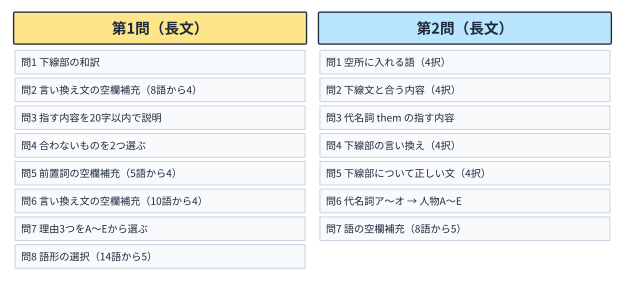
1. Choose the best option to fill in the blank 1.
- A although
- B because
- C unless
- D whether
2. Choose the statement that best matches the content of the underlined sentence (2).
- A Researchers learned that the settlers had to eat plants because fish were scarce.
- B Researchers were surprised to find that the settlers ate no fish.
- C Scientists have long believed that the settlers depended on the sea, and this result confirms it.
- D The result shows that the settlers were vegetarians who never went to sea.
3. Choose the option that best explains what the underlined part (3) them refers to.
- A the cliffs
- B the seabird colonies
- C the settlers
- D the researchers
4. Choose the option that best explains the underlined part (4) “a chemical diary”.
- A It shows how a person felt each day.
- B It records what a person ate over a long period.
- C It lists the people a person met.
- D It proves a person’s exact age.
5. Choose the correct statement about the underlined part (5) marine foods.
- A It referred only to fish caught in rivers.
- B Researchers found a new species of marine food in this study.
- C Marine foods were hardly a source of protein for the settlers.
- D Shellfish are considered to be one type of marine foods.
6. For each of the underlined parts (ア)〜(オ) in the passage, choose the person it refers to and answer using the corresponding letter. (Options may be used more than once.)
- A an archaeologist at Ridgemont University
- B the director of the Ridgemont Isotope Laboratory
- C an elderly villager on Harrow
- D a young boy who lived on Harrow
- E a professor at a university in Canada
7. Regarding the people involved in this study, choose the most appropriate word for each blank (①〜⑤) from the options below, and answer using the corresponding character. (Each option can be used only once.)
This study involved scholars such as Elena Marsh, who ① insights into ancient diets; Alan Petrov, who contributed from archaeological ②; and Kofi Okoye, who suggested that the settlers might have ③ the local seabird populations to a greater extent than is typically assumed. Together, their work helped ④ how the settlers ⑤ heavily on the sea.
あ lived い records う offered え shaped お noticed か salt き show く relied