📌 このページの使い方
- 過去問集をお持ちの方:本番と同じ70分で解き、解説で根拠の一文を確かめてから、最後の答え一覧で採点
- お持ちでない方:各小問の「どういう問題か」を読めば、問題の中身がそのまま分かります
- 最後にそっくり類題セット(PDF版あり)を70分で解き、初見でも同じ解き方ができるか確かめる
※ 著作権に配慮し、入試の英文・設問文は掲載していません(引用は短い語句まで)。解答番号(1〜50)は、本番のマークシートとの対応を示すためのものです。※ 選択肢の番号は赤本のページから読み取って決めています。英文の意味で決まる設問はスクリプトでは確かめられないため、判断が分かれうるものに「要確認」を付けています。
⚠️ 問題等で誤りを発見された場合、修正しますので、TMPS医学館までLINEを下さい。(迅速に確認・更新いたします)
LINEで誤りを連絡3分で分かる 2026年度の東北医科薬科大の英語
- ✅ 全4大問・解答番号1〜50、すべて選択肢から選ぶマーク式。試験時間は70分です。
- ✅ 第Ⅰ問は、はしか(measles)と免疫の科学ニュース(15問)。7つの段落と1枚の図を読み、内容一致・語句の意味・文の挿入位置・要約の空欄補充に答えます。医学部らしく、免疫の話題でした。
- ✅ 第Ⅱ問は、AIと偽情報(15問)。8つの段落と1つのグラフ。同じ型の設問ですが、グラフの数字の読み取りが加わります。
- ✅ 第Ⅲ問は、誤り指摘(10問)。"Linguistic determinism" の一続きの文章から、下線①〜④のうち文法・語法・文脈の誤りを含むものを選びます。
- ✅ 第Ⅳ問は、和文に合わせた整序(5問)。8〜10個の語句を並べ、3番目と6番目に入る語句だけを答えます(空欄41〜50)。
- ✅ 差がつくのは、第Ⅰ・Ⅱ問の「挿入位置」「NOT問題」と、第Ⅲ問・第Ⅳ問の取りこぼし。長文が速く読めるだけでなく、短い大問を落とさない設計です。



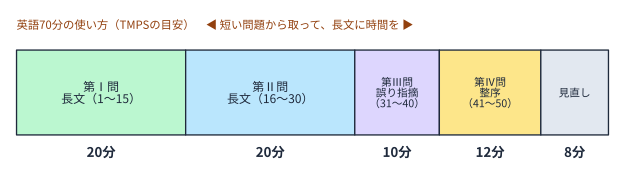
70分の立ち回りマップ
試験時間は70分。TMPSの目安を示します。解く順番と「捨てどころ」をセットで覚えておきましょう。
第Ⅰ問 はしか(measles)と免疫 ── 段落を読んだらすぐ解く
はしかウイルスが免疫細胞に感染し、免疫の「記憶」を失わせるという科学ニュース。7つの段落と感染の経過を示す図1枚。設問は段落順に1〜15(解答番号1〜15)で、内容一致、語句の意味、NOT問題、文の挿入、要約の空欄補充が並びます。
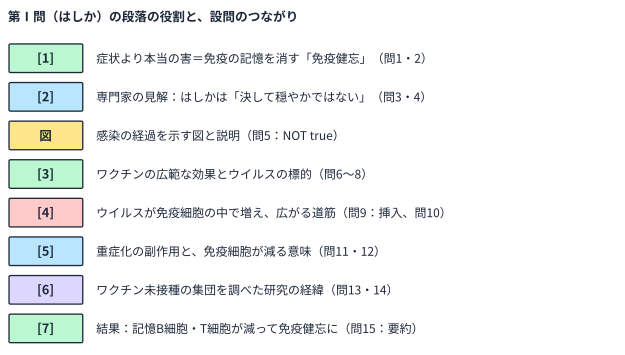
問1〜問4段落[1]・[2]:免疫の「記憶」を消す病気
段落[1]・[2]は導入。目立つ症状(発疹・熱)よりも深刻な本当の害を述べ、それを一言で表す語(免疫健忘)が出てくる。専門家の発言で「決して穏やかな病気ではない」と締める。
- 問1(1):段落[1]で述べる「本当の害」は何か
- 問2(2):「immune amnesia」が指すもの
- 問3(3):専門家の言う「the furthest thing from benign」の意味
- 問4(4):その専門家が述べる、はしかが人に及ぼす影響
問1(1) 内容一致
発疹・熱・咳は目立つ症状だが、本当の害は「免疫系への全面的な攻撃」だと書かれている。①②③は目立つ症状や合併症で、「本当の害」とは述べられていない。
答え:④
問2(2) 語句が指すもの
amnesia は「記憶喪失」。免疫系が、これまでに出会った感染症の記憶を「忘れる」ことを指す。③「強くなる」は逆、④「ウイルスに直接攻撃される」は原因であって amnesia そのものではない。
答え:②
問3(3) 語句の意味
benign は「害のない、良性の」。the furthest thing from benign は「害がないという状態からほど遠い」=「決して無害ではない」。④ anything but harmless。
答え:④
問4(4) 内容一致
段落[2]の専門家は、はしかが「他のあらゆる感染への感受性を高める」と述べている。①。
答え:①
問5図と説明:NOT問題
図は、感染の初期から回復までの経過を、日数・症状・ウイルス量・免疫細胞の様子で示す。選択肢4つのうち、図に合わないものが1つだけある。
- 問5(5):図とその説明文の内容に合わない(NOT true)ものを選ぶ
問5(5) NOT問題
図の最終段階は、記憶免疫細胞が「減っている(depleted)」状態。「回復後に記憶免疫細胞が増える」とする③が誤り。①感染はまずリンパ節、②症状はウイルス量のピークのあと、④ウイルスは血管を通って広がる、はいずれも図のとおり。
答え:③要確認
問6〜問9段落[3]・[4]:ワクチンの効果と、ウイルスの侵入経路
段落[3]はワクチンの広い効果と、ウイルスが免疫細胞の表面のタンパク質を使って入り込むこと。段落[4]は、細胞内で増えたウイルスが骨髄・脾臓などへ広がる様子。
- 問6(6):ワクチンの「広範な効果」の1つ
- 問7(7):「keep other disease-causing germs at bay」の意味
- 問8(8):ウイルスが免疫細胞に入る仕組み
- 問9(9):与えられた1文を段落[4]のどこに入れるか
問6(6) 内容一致(文の続き)
免疫系を1つのウイルスから守ることで、他の病原体も寄せつけにくくなる、という趣旨。①「他の感染からも守る」。②は逆、③はウイルスの標的の話。
答え:①
問7(7) 語句の意味
keep ~ at bay は「~を寄せつけない」。③「体内への侵入を防ぐ」が最も近い。④「次の犠牲者に移す」はウイルスの話。
答え:③
問8(8) 内容一致
ウイルスが免疫細胞に入る手段は、細胞表面の CD150 というタンパク質だと述べられている。④。
答え:④
問9(9) 文の挿入
挿入文は「新しくできたウイルス粒子が、最終的に呼吸器へ移る」という内容。直後の「そこから、咳で外に出て…」の From there が受ける場所は「呼吸器」なので、その直前(③)に入る。
答え:③要確認
問10〜問12段落[4]・[5]:NOT問題と語句の意味
段落[5]は、重症化したときの合併症と、免疫細胞が失われることで本来は撃退できる感染にかかりやすくなる、という話。
- 問10(10):段落[4]に書かれていないもの(NOT mentioned)
- 問11(11):重症のはしかについて正しいもの
- 問12(12):「fend off」の意味
問10(10) NOT mentioned
②細胞内で自分のコピーを作る、③脾臓や扁桃などへ広がる、④他の免疫細胞を探して感染する、は本文にある。「弱い免疫細胞を好んで感染する」とは書かれていない(「免疫細胞を好む」と書かれているだけ)。
答え:①
問11(11) 内容一致(true)
重症のはしかが肺炎や耳の感染を起こすことがある、と述べられている。①2週間以内、②脳の腫れは「まれ」、③免疫を強くする、は不適。
答え:④
問12(12) 語句の意味
fend off ~ は「~を撃退する」。② fight off。
答え:②
問13〜問15段落[6]・[7]:研究の経緯と要約
段落[6]は、ワクチンを接種しない共同体を対象に、流行の前後で血液を調べた経緯。段落[7]は、記憶B細胞・T細胞が減って免疫健忘になったという結果。
- 問13(13):研究チームにとって、なぜ好機だったか
- 問14(14):研究チームが調べようとしたこと
- 問15(15):段落[7]の要約文の空欄(1)〜(4)に4つの語を1回ずつ入れ、空欄(3)に当てはまるものを選ぶ
問13(13) 理由
共同体の子どもたちはワクチンを接種していなかったので、流行が起きたときに、感染前後の比較ができた。③。④「親が子を病気から守ろうとした」は、本文の事情(感染を避けるための工夫)と目的が違う。
答え:③
問14(14) 目的
子どもたちの免疫細胞を、感染の前後で比べることが目的。④。
答え:④
問15(15) 要約の空欄補充
(1)は「過去の infections」、(2)は「measles ウイルス」、(3)は「loss(減少)が免疫健忘につながる」、(4)は「ability(病気と闘う力)」。問われた(3)は③ loss。4つの語が1回ずつ入ることを確かめる。
答え:③
第Ⅰ問:設問タイプ別の型
| 設問 | 型 | 着眼点 |
|---|---|---|
| 問1・4・8・11・13・14 | 内容一致 | 設問の段落番号に戻り、該当する1文を根拠にする |
| 問2・3・7・12 | 語句の意味 | 前後の文脈と、語の構成(amnesia、benign など) |
| 問5・10 | NOT問題 | 3つの「合う」選択肢に印をつけ、残ったものを選ぶ |
| 問9 | 文の挿入 | 指示語・接続語で位置を絞る |
| 問15 | 要約の空欄補充 | 4語を1回ずつ使う。品詞(名詞・動詞)で絞る |
🩺【自己診断】第Ⅰ問で手が止まった人への処方箋
- 問1〜4段落の主旨がつかめない → 各段落の1文目と、人名のあとの発言(says)に線を引く
- 問5図が読めない → 図の説明文に「日数・ウイルス量・症状・免疫細胞」の4つがあることを確認し、選択肢と1つずつ照らす
- 問9位置が決まらない → 挿入文の指示語(From there、Those…)を探し、前に置ける語を探す
- 問15要約で迷う → 品詞で絞る。空欄(3)の前後が「The resulting _ leads to…」なら名詞
第Ⅱ問 AIと偽情報 ── グラフは「数字」で確かめる
AIが作る偽の画像・音声・文章が、政治・科学・日常にどう広がっているかを紹介する科学ニュース。8つの段落と1つのグラフ。設問は解答番号16〜30で、第Ⅰ問と同じ型(内容一致・語句・挿入・要約)に、グラフの読み取りが加わります。
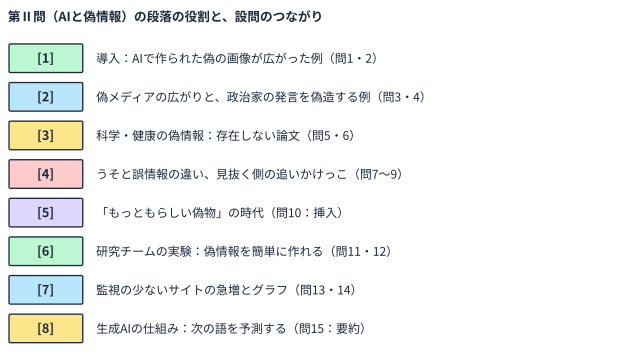
問1〜問4段落[1]・[2]:偽の画像と、悪用の例
段落[1]は、偽の画像が拡散した著名人の事例。段落[2]は、AIが作る偽メディアが著名人以外にも被害を与えること、政治の場でも使われたことを述べる。
- 問1(16):有名な歌手について、段落[1]に書かれていないもの(NOT mentioned)
- 問2(17):偽画像に対するファンの反応
- 問3(18):「heinous」の意味
- 問4(19):段落[2]で、deepfakeの悪用の例として挙げられているもの
問1(16) NOT mentioned
①複数の音楽賞、③被害者になった、④ニュースになった、は書かれている。「ファンのために画像を作った」とは書かれていない(偽画像を作ったのは別の人物)。②。
答え:②
問2(17) 内容一致
ファンは、ハッシュタグ付きの呼びかけで、公に支持を示した。④。
答え:④
問3(18) 語彙
heinous は「極悪な、憎むべき」。① wicked が最も近い。
答え:①要確認
問4(19) 例の選択
政治家の声を偽造した電話で、有権者に投票しないよう促した例。③「大統領の声の偽録音で有権者を惑わせる」。②は「ロシア」の政治家の動画の話で、政治家を欺く目的ではなく、「親ロシアの政党指導者を支持するように見えた」という内容。
答え:③
問5〜問9段落[3]・[4]:科学の偽情報と、見抜く側の課題
段落[3]は、存在しない論文を偽造した事例。段落[4]は、AIが偶然に誤情報を出すことと、偽物を見抜く側が追いつけなくなる懸念。
- 問5(20):風力発電に関する研究が捏造と分かった経緯
- 問6(21):段落[3]について正しいもの
- 問7(22):段落[4]の研究が示すこと
- 問8(23):専門家が懸念していること
- 問9(24):「an arms race」の意味
問5(20) 理由・経緯
雑誌の編集者が、その論文は存在しないと述べた。②。④「掲載された記事が誤りだった」では、存在しないという内容と違う。
答え:②
問6(21) 内容一致(true)
誰かがAIで偽の記事を作り、その雑誌から出たように見せかけた。④。
答え:④
問7(22) 研究が示すこと
AIモデルは、投票についての質問に、しばしば誤った・誤解を招く答えを返した。③。
答え:③
問8(23) 懸念
偽物を見抜く道具が、AIの進歩に追いつけなくなる懸念。①。②は逆(AIは作りやすくした)。
答え:①
問9(24) 語句の意味
arms race は「軍拡競争」。ここでは、お互いに相手より進んだ手段を作り合う競争。① a competition to develop more advanced tools than the other side。
答え:①
問10〜問15段落[5]〜[8]:挿入・実験・グラフ・要約
段落[5]は、偽物が簡単に作れるようになったこと。段落[6]は実験、段落[7]は偽ニュースサイトの急増(グラフ)、段落[8]は文章生成AIの仕組み。
- 問10(25):与えられた1文を段落[5]のどこに入れるか
- 問11(26):研究者が実験で発見したこと
- 問12(27):「shared」の意味
- 問13(28):偽ニュースサイトを見分けにくい理由
- 問14(29):段落[7]とグラフの内容に合うもの
- 問15(30):段落[8]の要約の空欄(3)
問10(25) 文の挿入
挿入文は、逆接(But)で「AIがこの1年で大きく進歩した」と述べる内容。「かつては偽物づくりに時間と技能が必要だった」という説明のあと、「いまや誰でも作れる」と続く直前に入れると、「昔は…」→「しかし進歩した」→「いまや誰でも…」と流れる。
答え:③要確認
問11(26) 実験の発見
2人のメンバーが1時間ほどで102本の記事を作ったという実験から、「説得力のある偽情報がいかに簡単に作れるか」を発見した。②。
答え:②
問12(27) 語句の意味
shared these findings は「研究結果を公に示した」。④ revealed。③ posted も近いが、雑誌に論文を発表する文脈では、公に明らかにする意味の④が自然。
答え:④要確認
問13(28) 理由
多くが、ニュースらしい名前を付けている。②。①運営者を明示している、は逆。
答え:②
問14(29) グラフの読み取り
49件(2023年5月)から、2023年12月までに600件超(12倍超)。つまり、①「ちょうど600件」は不可、②「12月に750超」は3月2024のことで不可、④「5月までにゼロ」は不可。③「8か月未満で12倍超」が正しい(5月→12月は7か月、600÷49=12.2)。
答え:③
問15(30) 要約の空欄補充
(1)は「大量の collections of text」、(2)は「words を predictions する」、(3)は「choices について corrections を受ける」、(4)は「この learning process」。問われた(3)は② corrections。
答え:②
第Ⅱ問:設問タイプ別の型
| 設問 | 型 | 着眼点 |
|---|---|---|
| 問1〜2・5〜8・11・13 | 内容一致 | 設問が指す段落に戻って、該当する1文を根拠にする |
| 問3・9・12 | 語句の意味 | 文脈と語の構成。arms race のように比喩のものは、前後の文で決める |
| 問4 | 例の選択 | 選択肢と本文の「誰が・何をしたか」を照らす |
| 問10 | 文の挿入 | 指示語・接続語。「But」「Now」の前後の対比に注意 |
| 問14 | グラフ | 選択肢の数字・時期を1つずつ確かめ、倍率は計算する |
| 問15 | 要約の空欄補充 | 4語を1回ずつ使う。品詞で絞る |
🩺【自己診断】第Ⅱ問で手が止まった人への処方箋
- 問1〜4段落の主旨がつかめない → 各段落の1文目を線で結び、「例」→「別の例」の流れを見る
- 問10挿入位置が決まらない → 挿入文の But や Now と、前後の時制(used to / now)の対比を探す
- 問14グラフ問題で時間がかかる → 選択肢の数字を、グラフの目盛りとだけ照らす。倍率は最後に概算
- 問15要約で迷う → 品詞(名詞・動詞)で絞り、4語が1回ずつ入るか確かめる
第Ⅲ問 誤り指摘 ── 1問1分で、誤りの型を見抜く
"Linguistic determinism"(言語が思考を決定するという考え)を扱う一続きの文章から、10問(解答番号31〜40)。各問、下線①〜④のうち、文法・語法・文脈の誤りを含む1つを選びます。
1〜3文の短い文章が10個、一続きの話として並ぶ。誤りの多くは、動詞の形・名詞の数・冠詞・数量詞・接続語(文脈)のどれか。
- 問1〜10(31〜40):下線①〜④から、誤りを含むものを1つ選ぶ
| 問 | 解答 | 誤りの型(TMPSの読み) |
|---|---|---|
| 問1(31) | ③ | 「being structured」の形。「thought processes … are structured」のように、動詞の形にするのが自然。 |
| 問2(32) | ① | 前の文と逆の関係を表す接続語。因果(結果)の流れなので、文脈上不適。 |
| 問3(33) | ④ | 「according to language they speak」。the language they speak のように、冠詞が必要。 |
| 問4(34) | ② | 「this hypotheses」。this は単数、hypotheses は複数形。 |
| 問5(35) | ④ | 「any quantity larger than that were」。主語は quantity(単数)なので、動詞は was。 |
| 問6(36) | ② | 「the larger a number involved」。比較級の構文では、the number(定冠詞)が自然。 |
| 問7(37) | ① | 「much shades」。shades は可算名詞なので many。 |
| 問8(38) | ② | 「regarded languages」。「~に関する言語」の意味なら regarding。 |
| 問9(39) | ③ | 「not indicating that…」。argue that の後ろの節に、動詞(do not indicate)が必要。 |
| 問10(40) | ③ | 「are also a major refutation」。主語(the language of thought hypothesis)は単数なので is。 |
第Ⅲ問:誤りの型
| 型 | 例 | 着眼点 |
|---|---|---|
| 動詞の形・主語との一致 | 問1・5・9・10 | 主語が単数か複数か、動詞があるか |
| 名詞の数・数量詞 | 問4・7 | this/these、much/many |
| 冠詞 | 問3・6 | the が必要な場面 |
| 接続語(文脈) | 問2 | 前の文との関係(因果・逆接) |
| 分詞・前置詞の語法 | 問8 | regarding など |
🩺【自己診断】第Ⅲ問で手が止まった人への処方箋
- 全体時間がかかる → 下線部を「主語と動詞」「名詞の数」「冠詞」「接続語」の4つの型で順にチェック
- 文脈の問題文法は合っているのに間違い → 前の文との関係(因果・逆接)を見る
- 迷ったとき2つで迷う → 直前の語(this/these、much/many)から決める
第Ⅳ問 和文に合わせた整序 ── 全部は並べず、「3番目と6番目」だけ
ハンチントン病(遺伝性の神経変性疾患)を扱う一続きの文章で、5問(空欄41〜50)。和文に合うように[ ]内の語句を並べ、空欄のうち3番目と6番目に入る語句の番号を答えます。1問につき2つの解答番号です。
和文の意味に合うように英文を作り、3番目・6番目の語句の番号を答える。語句は番号つきで8〜10個与えられ、すべて使う。
- 問1(41・42):病気の定義の文(genetic のあとに続く語句を並べる)
- 問2(43・44):「その病気を持つ親がいる人は誰でも50パーセントの確率で遺伝する」
- 問3(45・46):「以前に父親を検査して陽性を確認しながら、知らせなかった医師を訴える権利」
- 問4(47・48):「何もしなかったのは、検査結果を秘密にしてほしいという父親の主張に起因する」
- 問5(49・50):「『知ること』に伴う責任について、何を導き出せるか」
| 問 | 完成する英文の骨格(TMPSの整理) | 答え |
|---|---|---|
| 問1(41・42) | caused by a faulty version of a single gene | 41:⑤ by 42:③ of |
| 問2(43・44) | a parent with the disorder has a 50 percent chance of inheriting | 43:⑦ the disorder 44:③ 50 |
| 問3(45・46) | tested her father and found him positive for | 45:⑦ father 46:② him |
| 問4(47・48) | from the father's insistence that the test result be | 47:④ insistence 48:⑥ test |
| 問5(49・50) | can we conclude about any responsibilities that accompany | 49:⑥ conclude 50:① responsibilities |
問1(41・42) 過去分詞の後置修飾
「~によって引き起こされる」は過去分詞+by。disorder を後ろから修飾して caused by a faulty version of a single gene。3番目は by(⑤)、6番目は of(③)。
答え:41:⑤ 42:③
問2(43・44) 主語の説明と確率の表現
主語は a parent with the disorder で、動詞 has の後ろに a 50 percent chance of inheriting it。3番目は the disorder(⑦)、6番目は 50(③)。
答え:43:⑦ 44:③
問3(45・46) 並列と目的語
had earlier の後ろに tested her father and found him positive for the disease の2つの動詞句が並ぶ。3番目は father(⑦)、6番目は him(②)。
答え:45:⑦ 46:②
問4(47・48) 「~に起因する」と同格のthat節
arose from the father's insistence that ~ の形。that節の中は the test result be kept confidential(仮定法現在)。3番目は insistence(④)、6番目は test(⑥)。
答え:47:④ 48:⑥
問5(49・50) 疑問文の語順
What can we conclude about any responsibilities that accompany ~? の語順。3番目は conclude(⑥)、6番目は responsibilities(①)。
答え:49:⑥ 50:①
第Ⅳ問:整序の型
| 型 | 例 | 着眼点 |
|---|---|---|
| 過去分詞の後置修飾 | 問1 | 名詞の後ろに「過去分詞+by+名詞」 |
| 関係詞節・所有の動詞 | 問2 | 主語を修飾する節のあとに、本動詞 |
| 動詞句の並列 | 問3 | and で結ばれる2つの動詞句の形をそろえる |
| 同格のthat節 | 問4 | 名詞(insistence)の内容をthat節で説明 |
| 疑問文の語順 | 問5 | 疑問詞→助動詞→主語→動詞 |
🩺【自己診断】第Ⅳ問で手が止まった人への処方箋
- 全体並べられない → 和文の述語から、先に塊(過去分詞+by、of+名詞)を作る
- 問210個で時間がかかる → 最後にまわす。先に問1・3・4・5で確実に取る
- 問5疑問文で迷う → 疑問詞→助動詞→主語→動詞の語順を、先に書く
本番の答え一覧(採点用)
解説を読んだあとの採点用です。解答番号と、選ぶ選択肢の番号を並べました。赤本に解答編が無かったため、全50問をTMPSで自力で解いています。第Ⅳ問の整序はスクリプトで検算しましたが、英文の意味で決まる設問は検算できないので「要確認」を付けています。
第Ⅰ問(1〜15)
第Ⅱ問(16〜30)
第Ⅲ問(31〜40)
第Ⅳ問(41〜50)
※ 検算:第Ⅳ問の整序(41〜50)と第Ⅱ問 問14(29)の倍率、要約問題(15・30)の4語の使い方を確認し、すべて一致しました(verify_tmpu-2026-english_honban.py、ALL OK)。公開されている解答は参照していません。
東北医科薬科大2026型 そっくり類題セット
(全4大問・解答解説つき)
2026年度の本番と同じ4大問・同じ解答番号(1〜50)で、題材・数値・設定を変えたTMPSオリジナル問題です。段落ごとに解く長文読解、グラフを含む設問、誤り指摘、整序の「3番目と6番目」の練習に使ってください。英文は全文オリジナルで、人物・団体は架空です。
印刷して本番と同じように70分で解けます。解答・解説はこのページの下に掲載しています。
※ 東北医科薬科大学の入試問題ではありません。本文・設問・人物・団体(架空)はすべてTMPS医学館が作成したオリジナルで、出典のある引用ではありません。
次の英文を読み、空欄のある設問については、英文の内容に合うように①〜④から最も適切なものを一つ選び問題文を完成させよ。質問形式の設問については、最も適切な答えを①〜④の中から一つ選べ。[1]〜[7]はパラグラフ(段落)の番号を表している。
[1] The most obvious thing about a bad night's sleep is how tired you feel. Heavy eyes, a foggy head and a short temper make the next day painfully long. But those feelings distract from the real harm: a quiet attack on the memory system. The brain uses sleep to sort and store what it learned during the day. When sleep is cut short, much of that work is left undone. The resulting "memory gap" can leave students and workers unable to recall things they studied only hours earlier, researchers are finding. Missed details, forgotten names and slower learning are common side-effects.
[2] That makes sleep loss "anything but a small problem," says Dr. Hana Lindqvist. As a neuroscientist, she studies learning at Northgate University in Greenfield. Poor sleep lowers people's ability to take in new facts, she says. And that has big costs. Scientists now have a better picture of how the sleeping brain handles memories. They know which stage of sleep matters most and how much sleep is needed. Studies helped fill in the details. They came from experiments with lab mice and with volunteers who stayed in sleep labs. One experiment, in which volunteers learned lists of words, is summarized in Table 1.
Table 1 Recall test scores 24 hours after learning (out of 100)
| Group | Sleep after learning | Score |
|---|---|---|
| A | 8 hours | 82 |
| B | 4 hours | 61 |
| C | none | 44 |
Note: All groups took the same test. The groups were of similar age.
[3] This new view may help explain why a steady bedtime seems to have far-reaching effects. A regular routine protects more than just good grades, says Prof. Tomas Brandt. He is a sleep scientist at Eastfield Medical Center in Canada. By giving the brain enough time each night, a steady routine may help keep forgetting at bay. During deep sleep, brain cells replay the events of the day. That replay helps turn fresh memories into lasting ones. Experiments on lab mice show that a region called the hippocampus holds new memories at first.
[4] Inside the brain, the replay starts quickly. ( ① ) Brain cells fire in the same order as they did while the person was awake. ( ② ) The memory is then copied to the cortex, the outer layer of the brain. ( ③ ) Lindqvist's group traced how this happens by recording the activity of single cells in mice. ( ④ ) The researchers described their findings in the April 2022 issue of Night Science.
[5] Too little sleep is not only a problem for students. In adults it can bring mistakes at work and car accidents. In rare cases, years of poor sleep may also be linked to serious illness. On their own, those are worrisome side-effects, says Dr. Alicia Moreno. She is the director of the Midlands Institute of Sleep Research in England. But memory loss also can leave people open to errors that a rested brain would normally ward off.
[6] In 2019, Lindqvist and her colleagues had a chance to test the effects of sleep on school pupils. These pupils belonged to a boarding school in the north. The school agreed to start its first lesson one hour later for a single term. As a result, pupils could sleep longer each morning. The old timetable had been used for decades, so it was just a matter of time before someone asked what a change would do. The researchers got permission from parents to give the pupils memory tests. They wanted to see how the pupils' scores changed once they could sleep longer. And they didn't have to wait long. The new timetable began just as the team finished the first round of testing.
[7] The team had test scores from before and after the change for 120 pupils. Pupils who gained at least an hour of sleep scored higher on recall tests. The gain was largest for facts learned just before bedtime. That showed a clear link between sleep and memory, Lindqvist says. The team reported its findings on June 3, 2022 in Night Science.
問1 1 According to paragraph [1], what is the real harm caused by a bad night's sleep?
- ① Heavy eyes and a foggy head.
- ② Damage to the memory system.
- ③ A short temper the next day.
- ④ Slower learning at school.
問2 2 In paragraph [1], the phrase "memory gap" most closely refers to ( ).
- ① the brain growing new cells during sleep
- ② students feeling tired in class
- ③ the brain failing to store what it learned
- ④ a loss of hearing after a night without sleep
問3 3 In paragraph [2], what does Dr. Lindqvist mean when she says sleep loss is "anything but a small problem"?
- ① Sleep loss is a serious problem.
- ② Sleep loss is easy to fix.
- ③ Sleep loss is a minor matter.
- ④ Sleep loss is a problem only for mice.
問4 4 According to Dr. Lindqvist in paragraph [2], what effect does poor sleep have on people?
- ① It helps them take in new facts.
- ② It forces them to buy expensive equipment.
- ③ It makes their dreams more vivid.
- ④ It lowers their ability to take in new facts.
問5 5 Which of the following statements is NOT true according to Table 1 and its note below paragraph [2]?
- ① Group A had the highest score.
- ② Scores fell as the hours of sleep fell.
- ③ Group C scored higher than 50.
- ④ Group B slept for four hours.
問6 6 According to paragraph [3], one of the "far-reaching effects" of a steady bedtime is that it ( ).
- ① makes pupils sleep through lessons
- ② helps protect more than just good grades
- ③ causes brain cells to stop replaying events
- ④ shortens the time needed for deep sleep
問7 7 In paragraph [3], the phrase "keep forgetting at bay" is closest in meaning to ( ).
- ① to make forgetting happen
- ② to hide forgetting from others
- ③ to pass forgetting on to friends
- ④ to hold forgetting back
問8 8 According to paragraph [3], what happens during deep sleep?
- ① Brain cells stop all activity.
- ② Brain cells replay the events of the day.
- ③ The hippocampus grows larger.
- ④ New facts are quickly forgotten.
問9 9 Where would the following sentence fit best in paragraph [4]? Choose ( ① ), ( ② ), ( ③ ) or ( ④ ).
From there, it can be kept for years.
問10 10 Which of the following statements about what happens in the brain is NOT mentioned in paragraph [4]?
- ① Brain cells fire in the same order as when the person was awake.
- ② The memory is copied to the cortex.
- ③ The activity of single cells was recorded in mice.
- ④ The replay starts only after the person wakes up.
問11 11 According to paragraph [5], which of the following statements is true about long-term lack of sleep?
- ① It usually ends within a week.
- ② It can lead to mistakes at work and car accidents.
- ③ It makes the brain stronger.
- ④ It is rare among adults.
問12 12 In paragraph [5], the phrase "ward off" is closest in meaning to ( ).
- ① keep away
- ② invite
- ③ lose
- ④ give up
問13 13 According to paragraph [6], why did Lindqvist's team have a good opportunity to study the effects of sleep?
- ① Because no other school had ever changed its schedule.
- ② Because sleep problems were spreading across the country.
- ③ Because the school changed its timetable just as the first tests were finished.
- ④ Because parents wanted pupils to sleep less.
問14 14 According to paragraph [6], what did the team plan to study in the pupils?
- ① Whether they liked the new lessons.
- ② How their test scores changed after they slept longer.
- ③ How fast schedules were changing across the country.
- ④ Why their parents had agreed to the change.
問15 15 The following is a summary of paragraph [7]. Each of the blanks ( 1 ), ( 2 ), ( 3 ) and ( 4 ) corresponds to one of the options ①, ②, ③ or ④. Each option is used only once. Which option best fits blank ( 2 )?
A school started its first lesson later, so pupils got more ( 1 ) each morning. The team compared test ( 2 ) from before and after the change. The ( 3 ) was largest for facts learned just before bedtime, which shows that sleep strengthens ( 4 ).
① memory ② scores ③ gain ④ sleep
▶ 第Ⅰ問 の答えと解説を見る
第Ⅰ問 の答えと解説
- 問1(1):段落[1]は、疲れ・短気といった目立つ症状は「本当の害から目をそらさせる」と述べ、本当の害を「記憶の仕組みへの静かな攻撃」と言う。②。③と①は目立つ症状、④は副作用として挙げられたもの。
- 問2(2):睡眠が短いと、日中に学んだことを整理・保存する作業が終わらず、数時間前に勉強したことが思い出せなくなる。この「保存できていない状態」が memory gap。③。
- 問3(3):anything but ~ は「決して~ではない」。したがって「小さな問題どころではない=重大な問題」。①。②③は逆の意味。
- 問4(4):Poor sleep lowers people's ability to take in new facts と直接書いてある。④。
- 問5(5):表では C は睡眠なしで44点。50点より高いとする③が誤り。①A(82点)が最高、②睡眠が減るほど点が下がる(82→61→44)、④B は4時間、はいずれも表どおり。「NOTを選ぶ」ので③。
- 問6(6):規則的な就寝は「成績だけでなく、それ以上のものを守る」と述べられている。②。
- 問7(7):keep ~ at bay は「~を寄せつけない、食い止める」。④ hold back が最も近い。
- 問8(8):During deep sleep, brain cells replay the events of the day. ②。
- 問9(9):「From there」は直前に「場所」が出る必要がある。直前が「記憶が皮質にコピーされる」文である ( ③ ) に入れると、「そこ(皮質)から何年も保持される」とつながる。
- 問10(10):①②③は段落[4]に書かれている。「目が覚めてから再生が始まる」とは書かれていない(むしろ睡眠中に素早く始まる)。④。
- 問11(11):In adults it can bring mistakes at work and car accidents. ②。
- 問12(12):ward off ~ は「~を寄せつけない」。①。
- 問13(13):The new timetable began just as the team finished the first round of testing. ③。
- 問14(14):They wanted to see how the pupils' scores changed once they could sleep longer. ②。
- 問15(15):(1) は sleep(④)、(2) は test scores(②)、(3) は gain(③)、(4) は memory(①)。問われた (2) は ②。
次の英文を読み、空欄のある設問については、英文の内容に合うように①〜④から最も適切なものを一つ選び問題文を完成させよ。質問形式の設問については、最も適切な答えを①〜④の中から一つ選べ。[1]〜[8]はパラグラフ(段落)の番号を表している。
[1] A restaurant had a perfect score on a popular review site last spring. Hundreds of diners wrote glowing words about its soup and its friendly staff. But the restaurant did not exist. Someone had used artificial intelligence, or AI, to write the reviews and to invent the place. Real travelers read the praise, and a few even drove across town to find it.
[2] That scam is just one example of the wide range of false praise — including photos and videos — that almost anyone can now make with AI. Restaurants are not the only victims of such underhanded tricks. Last year, for example, a group of sellers posted thousands of five-star comments for a phone charger that caught fire. AI-written reviews can copy the voices of real customers. This type of content has been used to push up weak products. In May, a video of a well-known chef seemed to praise a kitchen knife that he had never used.
[3] AI has also produced false information about health. In late 2024, a seller of herbal tea claimed there was research showing the tea could cure a cold in a day. The seller pointed to a study seemingly published in the Journal of Nutrition Facts. But an editor of that journal said the article did not exist. Apparently, someone used AI to make up a fake article that falsely appeared to come from the journal.
[4] Many people use AI to lie, but AI can mislead by accident, too. One research team asked five AI models for advice on choosing a doctor. The answers were often wrong or out of date, the team reported in a 2024 paper for the Consumer Trust Project. Honest mistakes (misinformation) and deliberate lies (disinformation) have existed for years. But AI makes it easier, faster and cheaper to spread unreliable claims. And although some tools can spot or limit fakes, experts worry that the contest will become a cat-and-mouse game. AI will get better and better, and the people hunting fakes will struggle to catch up.
[5] The stakes are high. With a flood of convincing fakes, it is hard to know whom to trust. ( ① ) Writing a believable review used to take time and skill. ( ② ) A buyer could often spot a fake by its vague, repeated phrases. ( ③ ) Now almost anyone can create hundreds of lifelike reviews, sometimes within minutes. ( ④ )
[6] A team of consumer researchers recently showed just how easy this can be. Using a chat tool on a public AI platform, two team members wrote 240 hotel reviews in about an hour. The reviews contained more than 18,000 words of convincing praise for hotels that did not exist. "It was surprising how easily we could fool readers," says Marta Keller. She is a consumer-law researcher — or "fraud detective" — at Lakeside University in Toronto. She and her colleagues shared these findings last September in a journal called Market Review.
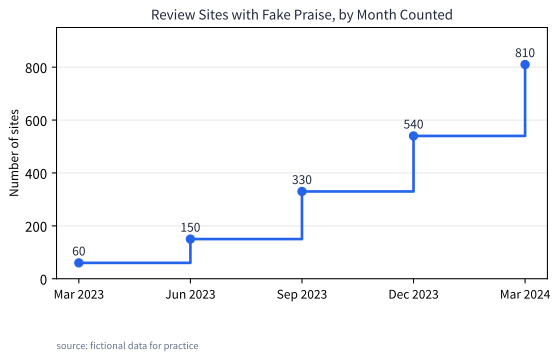
[7] Nobody needs to check every review before it appears, either. Websites can let thousands of comments through with little oversight. Many of these sites tell you little about who is behind them, says Daniel Okafor. He is an editor who follows online fraud at a watchdog group in Chicago. By March 2023, his group had counted 60 review sites full of fake praise. Within a year, that number had risen to more than 800. Many have honest-sounding names, such as Fair Stars or TrueTable. But their "reviews" may be made up.
[8] Detection tools work in different ways. Some look for unusual patterns in how a review is written, explains Ravi Desai. He is a graduate student studying computer science at Harborview University in Seattle. Others look at timing. When many reviews arrive at the same moment, a tool may mark them as suspicious. The tool then sends a warning to a human checker, who makes the final decision, Desai says.
問1 16 Which of the following statements about the restaurant is NOT mentioned in paragraph [1]?
- ① It had a perfect score.
- ② Its owner won a prize for the soup.
- ③ Hundreds of diners wrote praise for it.
- ④ It did not exist.
問2 17 According to paragraph [1], how did some travelers respond to the fake reviews?
- ① They reported the site to the police.
- ② They wrote fake reviews of their own.
- ③ Some drove across town to look for the restaurant.
- ④ They deleted their accounts.
問3 18 In paragraph [2], the word "underhanded" is closest in meaning to ( ).
- ① secret
- ② dishonest
- ③ expensive
- ④ clever
問4 19 In paragraph [2], which of the following is used as an example of fake endorsement?
- ① A chef writing a recipe book.
- ② A real customer posting a photo of a meal.
- ③ A shop owner thanking buyers politely.
- ④ A video of a chef praising a knife he never used.
問5 20 According to paragraph [3], how was the study about the tea found to be fabricated?
- ① An editor of the journal confirmed that the article did not exist.
- ② A member of the tea company admitted the study was fake.
- ③ The tea company was found to have written the article itself.
- ④ An editor found the published study to be incorrect.
問6 21 According to paragraph [3], which of the following statements is true?
- ① AI helped an editor check an article.
- ② A journal published an article that AI had corrected.
- ③ Someone used AI to make a fake article that seemed to come from a journal.
- ④ A seller asked a journal to print his study.
問7 22 What does the research mentioned in paragraph [4] suggest about AI models?
- ① They can replace doctors.
- ② They always refuse to answer.
- ③ They give reliable advice.
- ④ They often gave wrong or out-of-date answers.
問8 23 According to paragraph [4], what concerns do experts have regarding AI-generated fakes?
- ① Tools for detecting them may fall behind as AI improves.
- ② AI has made it harder to produce fakes.
- ③ There are no tools to detect them.
- ④ Using AI to spread lies is too costly.
問9 24 In paragraph [4], the phrase "a cat-and-mouse game" is closest in meaning to ( ).
- ① a game for children
- ② a long contest in which each side keeps trying to outdo the other
- ③ a way to find fake reviews
- ④ a fight between two animals
問10 25 Where would the following sentence fit best in paragraph [5]? Choose ( ① ), ( ② ), ( ③ ) or ( ④ ).
Those clues are now much harder to find.
問11 26 According to paragraph [6], what did the researchers discover in their experiment using the public AI platform?
- ① That AI tools cannot write convincing praise.
- ② How easy it is to produce convincing fake reviews.
- ③ That hotel reviews are always honest.
- ④ Why people trust real hotels.
問12 27 In paragraph [6], the word "shared" is closest in meaning to ( ).
- ① announced
- ② divided
- ③ lent
- ④ cut off
問13 28 According to paragraph [7], why is it difficult to distinguish unreliable review sites from real ones?
- ① They often clearly state who owns them.
- ② Many have names that sound honest.
- ③ Most publish only real events.
- ④ They are watched by the government.
問14 29 According to paragraph [7] and the graph below it, which statement is true?
- ① The group had found exactly 500 such sites by December 2023.
- ② The group found more than 800 such sites by December 2023.
- ③ The number of such sites grew by more than 13 times in about a year.
- ④ The group had not yet found any such sites by March 2023.
問15 30 The following is a summary of paragraph [8]. Each of the blanks ( 1 ), ( 2 ), ( 3 ) and ( 4 ) corresponds to one of the options ①, ②, ③ or ④. Each option is used only once. Which option best fits blank ( 4 )?
Detection tools search for unusual ( 1 ) in the way reviews are written. When many reviews arrive at the same ( 2 ), the tool may mark them as suspicious and send a ( 3 ) to a human checker, who makes the final ( 4 ).
① decision ② time ③ patterns ④ warning
▶ 第Ⅱ問 の答えと解説を見る
第Ⅱ問 の答えと解説
- 問1(16):①③④は段落[1]に書かれている。店主が賞を取ったという記述はない。②。
- 問2(17):a few even drove across town to find it。③。
- 問3(18):underhanded は「ずるい、不正直な」。②。
- 問4(19):段落末尾の、有名シェフが使ったこともない包丁を褒めているように見える動画が例。④。
- 問5(20):an editor of that journal said the article did not exist。①。④は「掲載された研究が間違っていた」で、存在しないという内容と違う。
- 問6(21):someone used AI to make up a fake article that falsely appeared to come from the journal。③。
- 問7(22):The answers were often wrong or out of date。④。
- 問8(23):the people hunting fakes will struggle to catch up。①。
- 問9(24):cat-and-mouse game は「追う側と逃げる側のいたちごっこ」。直後に「AIは進歩し、偽物を探す側は追いつくのに苦労する」とある。②。
- 問10(25):「Those clues」は直前に「手がかり」が出る必要がある。直前が「曖昧で繰り返しの多い表現で偽物を見抜けた」文である ( ③ ) が正解。
- 問11(26):「読者を簡単にだませる」ことに驚いた、とある。②。
- 問12(27):shared these findings in a journal は「研究結果を雑誌で公表した」。①。
- 問13(28):Many have honest-sounding names。②。
- 問14(29):3月2023の60件から3月2024の810件へ、810÷60=13.5倍。③。①Dec 2023は540件、②800超えは Mar 2024、④Mar 2023にすでに60件。
- 問15(30):(1) は patterns(③)、(2) は time(②)、(3) は warning(④)、(4) は decision(①)。問われた (4) は ①。
次の問1〜10に示された英文は "Urban heat islands" と題する一続きの文章である。各問において、下線を付した語句①〜④のうち、文法・語法上または文脈上の誤りを含むものを一つ選べ。
問1 31 Urban heat islands ①refer to cities that ②are warmer than the countryside around them. This happens when natural land is replaced ③with buildings and roads ④that absorbing heat during the day.
問2 32 ①On the other hand, a major consequence is ②that people who live in ③dense neighborhoods will ④face higher night-time temperatures.
問3 33 ①Many people ②who works outdoors may feel that they ③get exhausted ④more quickly than in rural areas.
問4 34 This effect is strongest at night. In the evening, ①concrete and asphalt ②slowly ③releases the heat ④they stored during the day.
問5 35 ①For example, researcher Lena Brandt has measured the temperature in Greenfield ②since three years. She found that the city center was ③warmer than the suburbs ④by three degrees.
問6 36 She also found that ①the more trees ②there were along a street, ③the cool ④the air felt.
問7 37 Other solutions include ①painting roofs white, ②to plant gardens on rooftops, and ③building parks ④between crowded blocks.
問8 38 In one town, planners ①are asked residents ②which streets ③felt the hottest. ④Based on the answers, they planted trees there.
問9 39 However, trees alone cannot solve the problem. In dry areas, ①planting many trees ②may use up ③too many water ④that local farmers need.
問10 40 Cities that invested in shade many years ago ①now enjoy ②lower summer energy bills, ③because they use ④fewer air conditioning.
▶ 第Ⅲ問 の答えと解説を見る
第Ⅲ問 の答えと解説
- 問1(31):④ that absorbing heat。関係代名詞 that の後ろに動詞がない(absorbing は -ing だけで文の動詞になれない)。buildings and roads が複数なので that absorb heat が正しい。(正:that absorb heat)
- 問2(32):① On the other hand。前の文は「原因(熱を吸収する地表)」で、この文は「その結果」。逆接・対比の On the other hand は文脈に合わない。As a result などが正しい。(正:As a result)
- 問3(33):② who works outdoors。先行詞 Many people は複数なので、関係詞節の動詞は work。(正:who work outdoors)
- 問4(34):③ releases the heat。主語 concrete and asphalt は複数なので releases は誤り。release が正しい。(正:release the heat)
- 問5(35):② since three years。since は「起点(時点)」を表し、期間には for を使う。for three years が正しい。(正:for three years)
- 問6(36):③ the cool。「the+比較級 ~, the+比較級 …」の構文。後半も比較級にして the cooler とする。(正:the cooler)
- 問7(37):② to plant。include の後ろに並べる要素は painting / planting / building と動名詞でそろえる(並列の形の不一致)。(正:planting gardens on rooftops)
- 問8(38):① are asked residents。ask A B の形で、planners は尋ねる側なので能動の asked が正しい。受け身の are asked だと後ろの residents が続かない。(正:asked residents)
- 問9(39):③ too many water。water は不可算名詞なので many ではなく much を使う。(正:too much water)
- 問10(40):④ fewer air conditioning。air conditioning は不可算なので fewer ではなく less。(正:less air conditioning)
次の問1〜5は一続きの文章である。それぞれの和文の意味に合うように[ ]内の語句を並べ替えて英文を作り、空欄に入るものを一つ選べ。(空欄 41〜50 のうち、各問の枠で囲まれた2つを答える。)
問1 糖尿病は、血液中の糖が多すぎることによって起こる慢性の病気である。
Diabetes is a ( ) ( ) ( 41 ) ( ) ( ) ( 42 ) ( ) ( ) .
[ ① sugar ② the blood ③ chronic ④ in ⑤ by ⑥ caused ⑦ too much ⑧ disease ]
問2 したがって、この薬を飲んでいる人は誰でも、数週間は運転を避けるべきである。
So anyone who ( ) ( ) ( 43 ) ( ) ( ) ( 44 ) ( ) ( ) ( ) ( ) .
[ ① avoid ② drug ③ for ④ is ⑤ several ⑥ should ⑦ taking ⑧ this ⑨ weeks ⑩ driving ]
問3 2020年、ある患者が、以前に自分の画像を検査して小さな腫瘍を見つけたのに知らせなかった診療所を訴える権利を勝ち取った。
In 2020, a patient won the right to sue the clinic that had earlier ( ) ( ) ( 45 ) ( ) ( ) ( 46 ) ( ) ( ) but had not told him.
[ ① tumor ② checked ③ found ④ small ⑤ his ⑥ scan ⑦ and ⑧ a ]
問4 彼らが沈黙していたのは、データを共有しないでほしいという教授の依頼によるものだった。
Their silence was ( ) ( ) ( 47 ) ( ) ( ) ( 48 ) ( ) ( ) .
[ ① be shared ② request ③ that ④ due ⑤ the data ⑥ to ⑦ not ⑧ the professor's ]
問5 医師は患者にどこまで伝えるべきか。「正直さ」に伴う義務について、私たちは何を学べるだろうか。
How much should a doctor tell a patient? What ( ) ( ) ( 49 ) ( ) ( ) ( 50 ) ( ) ( ) honesty?
[ ① that ② come ③ learn ④ the duties ⑤ about ⑥ with ⑦ we ⑧ can ]
▶ 第Ⅳ問 の答えと解説を見る
第Ⅳ問 の答えと解説
- 問1(41・42):Diabetes is a chronic disease caused by too much sugar in the blood.
「~によって起こる」は過去分詞 caused + by。sugar in the blood で「血液中の糖」。 - 問2(43・44):So anyone who is taking this drug should avoid driving for several weeks.
who の後ろは is taking this drug(現在進行形)。「~すべき」should、avoid + -ing、期間は for several weeks。 - 問3(45・46):… had earlier checked his scan and found a small tumor but had not told him.
had earlier + 過去分詞 checked ... and found ... の並列。a small tumor の語順(冠詞→形容詞→名詞)に注意。 - 問4(47・48):Their silence was due to the professor's request that the data not be shared.
be due to ~ =「~による」。request that + 主語 +(should)動詞原形 の形で、否定は that the data not be shared。 - 問5(49・50):What can we learn about the duties that come with honesty?
疑問詞 What + can we learn about ~ の語順。the duties that come with ~ で「~に伴う義務」。
※ 類題は、本番の設問の型(内容一致・語句の意味・NOT・文の挿入・要約・グラフ/誤り指摘/整序)を揃え、題材を変えて作っています。第Ⅰ問は睡眠と記憶、第Ⅱ問は偽レビューとAI、第Ⅲ問は都市のヒートアイランド、第Ⅳ問は医療に関する整序です。整序(41〜50)は語句の使い切りと箱の番号を、グラフの数値は本文との一致をスクリプトで確かめてあります。英文の意味で決まる設問は、スクリプトでは確かめられないため要確認です。
30秒 得点診断
本番の過去問、またはそっくり類題セットを70分で解いた結果を選んでください。次にやるべきことを表示します。
保護者の方へ:東北医科薬科大の英語で知っておきたい3つのこと
よくある質問
Q. 東北医科薬科大学 医学部の英語2026年度は、どの順番で解くのがよいですか?
TMPSの目安は、第Ⅰ問20分・第Ⅱ問20分・第Ⅲ問10分・第Ⅳ問12分・見直し8分の合計70分です。全50問がすべてマーク式で、第Ⅲ問(誤り指摘)と第Ⅳ問(整序)は1問ずつ独立しているので、長文で時間を使いすぎないことが得点の土台になります。
Q. 問題文が載っていなくても、どんな問題か分かりますか?
分かります。著作権に配慮して英文・設問文は掲載していませんが、各小問に「どういう問題か」として、設問の型・何を答えるか・解答番号の形をTMPSの言葉で説明しています。
Q. 答えは、どうやって確かめていますか?
赤本に解答編が無かったため、全50問をTMPSで自力で解きました。第Ⅳ問の整序は、並べた語句が英文として成立し、箱の位置の番号が答えと一致するかをスクリプトで確かめています。一方、英文の意味で決まる問題(長文の内容一致、語句の意味、誤り指摘)は、スクリプトでは検証できないため、判断が分かれうるものに「要確認」を付けています。公開されている解答は見ていません。
Q. そっくり類題セットとは何ですか?
2026年度と同じ4大問・同じ解答番号(1〜50)で、題材を変えたTMPSオリジナル問題です。英文は全文オリジナル(人物・団体は架空)で、全問の答え・解説をこのページに掲載し、本番形式の問題冊子PDF(10ページ)も無料で配布しています。
Q. 解説に誤りを見つけたらどうすればいいですか?
公式LINEからお知らせください。確認のうえ修正し、更新日を記載します。
問題等で誤りを発見された場合、修正しますので、TMPS医学館までLINEを下さい。
受験生・指導者の皆様からのご指摘を真摯に受け止め、最も信頼できる過去問解説・類題ライブラリーとして随時アップデートいたします。
🔥 次に読むならこちら
東北医科薬科大の英語を、
あなたの答案で攻略する
「どこで時間を失ったか」「どの小問を後回しにすべきだったか」「英文の読み方の癖」を、Mio先生があなたの答案から直接診断します。