解き方の型:①設問が指す段落に線を引く → ②選択肢を1つずつ、その段落の言葉と照らす → ③「本文にない内容」「言い過ぎ」「主語のすり替え」を消す。語句の意味型は、その語の前後の文で言い換えを探し、直前直後の語との「向き(増える/減る)」で決める。文の挿入型は、挿入文の指示語・接続語が何を受けるかを確かめ、前後の文がつながる位置を選ぶ。数字型は、人数と割合を暗算で確かめる。
📌 このページの使い方
- 過去問集をお持ちの方:本番と同じ70分で解き、答え一覧(ページの後半)で採点してから解説へ
- お持ちでない方:各大問の「どういう問題か」を読めば、問題の中身がそのまま分かります
- 最後にそっくり類題セット(PDF版あり)を解く
※ 著作権に配慮し、入試問題の英文・設問文は掲載していません。解答欄の番号(1〜37)と選択肢の番号(①〜)は、本番の問題と対応しています。※ 大問Ⅳ(並べ替え)は手元の資料に掲載がないため扱っていません。
⚠️ 問題等で誤りを発見された場合、修正しますので、TMPS医学館までLINEを下さい。(迅速に確認・更新いたします)
LINEで誤りを連絡3分で分かる 2024年度の東北医科薬科大の英語
- ✅ 解説の対象は大問Ⅰ〜Ⅲ・全37欄。すべて番号をマークする形式。記述・和訳・英作文はありません。(大問Ⅳは手元の資料に掲載がないため扱いません)
- ✅ Ⅰは長文(15欄)、Ⅱは長文(12欄)。段落に番号が振られ、設問の多くは「段落[n]について」と段落を指定してきます。探す場所が決まっているので、本文を最初から読み直す必要はありません。
- ✅ 語句の意味の問題(Ⅰ2問・Ⅱ2問)と、文の挿入問題(Ⅰ・Ⅱに1問ずつ)が出ます。語句は前後の文の言い換え、挿入は指示語・接続語で決まります。
- ✅ Ⅱには数字の問題があります。「4人に3人より多い」「半分」など、本文の数から簡単な計算をして選びます。
- ✅ Ⅲは誤り指摘(10問)。1つの文に下線部が4つ、誤りは必ず1つ。文法だけでなく、前置詞の脱落や疑問詞の取り違えも出ます。

Yuiちゃん
長文が2題もあって、時間が足りるか不安です…
Mio先生
大丈夫。設問が「段落[3]について」と指定しているから、読むのは1設問につき数行だけ。先に設問を眺めて、どの段落に何が書いてあるかの地図を作ってから読もう。
ニックニ先生
Ⅲは短時間で確実に取れる10欄です。先に8分で片付けてから長文に入ると、気持ちに余裕が生まれますよ。70分の立ち回りマップ
試験時間は70分。このページで扱うⅠ〜Ⅲに54分、掲載のない大問Ⅳに16分を見込んだ目安です。
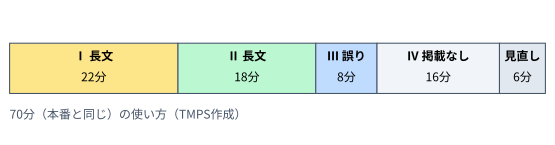
🧭 おすすめの解く順番
Ⅲ → Ⅰ → Ⅱ →(大問Ⅳ)→ 見直し(または、Ⅰ → Ⅱ → Ⅲ の順でも可)
短時間で決まるⅢを先に取ると、長文での焦りが減ります。長文は、1設問に2分以上かけない。どうしても決まらない欄は印をつけて飛ばし、最後の見直しに回します。
大問Ⅰ 長文(新型コロナと睡眠・10段落)── 体験談から研究へ、段落の役割で地図を作る
感染症にかかると眠りがどう変わるのかを紹介する科学ニュース記事です。ある人物の体験談から始まり、動物実験、人での研究へと進みます。10段落に番号が振られ、設問が「段落[n]について」と指定してきます。
現場戦略試験会場でのリアルな立ち回り(大問Ⅰ)
⏱ 目標時間 & 死守ライン目標22分。1欄あたり約1.5分。段落ごとに設問をまとめて処理する。
⚠️ 損切り・警戒ライン欄10・11の語句問題は前後の1文で決める。2分を超える欄は印をつけて先へ。
💡 初手の思考トリガー先に設問を全部眺め、「段落[n]→欄の番号」の対応表を余白に書く。
📝 どういう問題か?
感染症と睡眠の関係を紹介する英文記事を読み、段落を指定した設問に答える大問です。
- 欄1〜15:段落を指定した内容一致・空所補充・語句の意味(2問)・要約・文の挿入
- 欄1〜2は体験談、欄3〜9は研究の背景と動物実験、欄13〜15は人での調査の説明
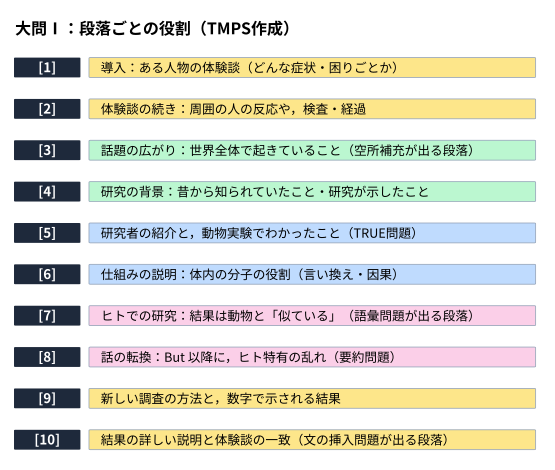
| 欄 | 段落 | 設問の型 | 決め手 |
|---|---|---|---|
| 1 | [1] | 内容一致(体験談) | 人物が「何をしたか」を段落の動詞で確かめる |
| 2 | [2] | 内容一致(周囲の人) | 登場人物ごとに「誰が何をしたか」を分けて読む |
| 3 | [3] | 空所補充(語句のかたまり) | 直後の not only … but also の流れで増減を決める |
| 4 | [3] | 研究が示したこと | 「~すると~が起きる」という因果が本文にあるか |
| 5 | [4] | 空所補充(内容) | 段落の結論の1文を探す |
| 6 | [5] | 研究の結果を補う | 動物実験の「何が増え・何が減るか」を整理 |
| 7 | [5] | TRUE問題 | 選択肢の主語・対象のすり替えに注意 |
| 8 | [6] | 空所補充(研究者の発言) | 発言の中の「分子の働き」を言い換えで照らす |
| 9 | [6] | 因果(何が起こるか) | 「Aを妨げるとBが起きる」の向きを確かめる |
| 10 | [7] | 語句の意味 comparable | 前後が「動物と人の比較」であることから決める |
| 11 | [7] | 語句の意味 enhanced | 直前の動詞との向きの対比(増減) |
| 12 | [8] | 要約 | But 以降の転換が要約の中心 |
| 13 | [9] | 研究の目的 | 段落冒頭の「何を調べたか」 |
| 14 | [9] | 数字を含む内容一致 | 数字(人数・割合)を本文と計算で照らす |
| 15 | [10] | 文の挿入 | 挿入文の指示語・接続語が何を受けるか |
🎯 欄1〜15の答え
1:②2:①3:③4:③5:③6:④7:①8:③9:④10:③11:②12:①13:②14:①15:②
⚠️ 欄10・11は、選択肢の語の意味を知っているかより、文脈で「向き」が決まる問題です。欄15は、挿入文の接続の言葉が前後どの文とつながるかを、位置を1つずつ当てはめて確かめます。この大問Ⅰは公開の解答編があり、TMPSの独立した読みと一致しています。
Yuiちゃん
「TRUE問題」って、どれも本文にありそうで迷います…Mio先生
選択肢を本文の1文と1対1で照らすの。「誰が」「何を」「どうした」が1か所でも違えば消える。見つかった選択肢が答えだよ。ニックニ先生
数字の問題は、本文の数字をその場で式にしておきましょう。「30人のうち28人」「4分の1」など、書き出すだけで迷いが減ります。TMPSコーチング診断
🩺【自己診断】大問Ⅰで手が止まった人への処方箋
- 全体読むのに時間がかかる → 先に設問を読み、段落の地図を作ってから本文へ
- 語句意味が分からない語 → 前後の文の言い換えと「増える/減る」の向きを探す
- 挿入位置が決まらない → 挿入文の指示語・接続語が受ける文を探す
- 数字本文の数字に迷う → 人数・割合を式に書き出す
大問Ⅱ 長文(人の血液から見つかった微小プラスチック・6段落)── 「誰が・何を・いくつ」を追う
人の血液の中から微小なプラスチックが見つかったという研究を紹介する記事です。研究者の名前や数字が多く出ますが、設問は「どの段落に何が書いてあるか」を問うだけです。段落は6つです。
現場戦略試験会場でのリアルな立ち回り(大問Ⅱ)
⏱ 目標時間 & 死守ライン目標18分。12欄なので1欄1.5分。
⚠️ 損切り・警戒ライン欄20(文の挿入)は2分を超えたら一旦飛ばす。数字の欄(22・23)は先に式を書く。
💡 初手の思考トリガー人物名ごとに「誰が・どこで・何をした」を1行メモにしておく。
📝 どういう問題か?
研究の発見と専門家のコメントを紹介する英文記事を読み、段落を指定した設問に答える大問です。
- 欄16〜27:語句の意味(2問)・内容一致・文の挿入・数字・NOT・TRUE・理由
- 数字の欄は,本文の人数から割合や半分を計算する
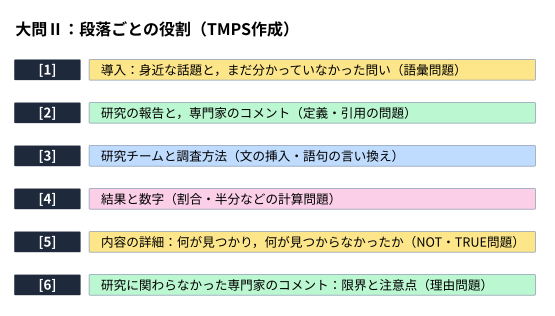
| 欄 | 段落 | 設問の型 | 決め手 |
|---|---|---|---|
| 16 | [1] | 語句の意味 tainting | 食べ物や水に「何が起きている」文脈か |
| 17 | [1] | 内容一致 | 「今回分かったこと」を段落末の1文から |
| 18 | [2] | 内容一致(technically) | 体に入る=血流に入る、という定義の区別 |
| 19 | [2] | 研究者の発言 | worrisome(不安)の中身を言い換えで探す |
| 20 | [3] | 文の挿入 | So が「前の問題→その解決」をつなぐ位置 |
| 21 | [3] | 語句の意味 For perspective | 直後の「大きさの比較」から |
| 22 | [4] | 数字(割合) | 17人÷22人を計算し、「4人に3人より多い」と照らす |
| 23 | [4] | 数字(半分) | 22人の半分を求める |
| 24 | [5] | NOT問題 | 3つは本文にある。残りの1つを選ぶ |
| 25 | [5] | TRUE問題 | 「探したが検出できない量」という表現 |
| 26 | [5]〜[6] | 内容一致 | 「誰の発言か」「研究に参加したか」を確かめる |
| 27 | [5]〜[6] | 理由 | because の理由が,段落内のどの文に当たるか |
解き方の型:Ⅰと同じ。さらに、人物と所属・やったことのすり替え(研究に参加していない人の発言を、参加した人のこととして書く選択肢)に気をつける。数字を問う設問は、本文の数字とその対象をセットで確認する。NOT問題は、3つの根拠を段落内で指さして確認し、残りを選ぶ。文の挿入は So・However などの接続語が前の文の何を受けるかを手がかりにする。
🎯 欄16〜27の答え
16:①17:②18:①19:①20:②21:④22:③23:②24:③25:①26:④27:④
⚠️ 欄22は 17÷22≈77% なので「75%(4人に3人)より多い」。欄23は、22人の半分=11。この2問は、本文の人数を式に書けば確実に取れます。欄25〜27は公開された解答がなく、TMPSの読みで決めています(要確認)。
ニックニ先生
人物名が多くて混乱する人は、名前の横に「何をした人か」を1語書いておくと、設問が出てきたときに迷いません。Yuiちゃん
なるほど、名前ごとに役割のメモですね!Mio先生
もう1つ。「この人は研究に参加した?」という引っかけは定番。本文の He did not take part… のような一文を見逃さないでね。TMPSコーチング診断
🩺【自己診断】大問Ⅱで手が止まった人への処方箋
- 人物人と行動がごちゃごちゃ → 名前の横に役割を1語メモ
- 数字数字を問われる → 人数と割合を式にしてから選択肢へ
- NOT全部あるように見える → 3つの根拠を段落内で指さして確認
- 挿入位置が決まらない → 挿入文の接続語が受ける内容を探す
大問Ⅲ 誤り指摘 ── 「文法」と「欠けている語」の両方で下線を疑う
「文化による知識のとらえ方」を扱った一続きの文章の10文について、下線部①〜④のうち誤りを含むものを1つ選びます。1問あたり約45秒で処理します。
現場戦略試験会場でのリアルな立ち回り(大問Ⅲ)
⏱ 目標時間 & 死守ライン目標8分。1問45秒。
⚠️ 損切り・警戒ライン1問で1分を超えたら印をつけて次へ。後で時間が余れば戻る。
💡 初手の思考トリガー下線部を、接続表現・動詞の形(時制・態・主述の一致)・数(多い・少ない)・前置詞・疑問詞・代名詞の観点で順にあたる。
📝 どういう問題か?
話題がつながった短い文章を読み、文法・語法・文脈上の誤りを探す大問です。
- 欄28〜37:10文それぞれの下線部①〜④から、誤りを含むものを1つ選ぶ
誤りのパターン(2024年度):(1) 接続表現の形(addition と in addition)、(2) 前置詞の脱落(動詞や名詞に必要な前置詞がない)、(3) 動詞の主述の一致(三単現の s)、(4) 数の表現(much と many)、(5) 分詞の形(現在分詞と過去分詞)、(6) 熟語の形(make up of と made up of)、(7) 主語と動詞の数の一致、(8) 疑問詞の取り違え(which と what)、(9) 代名詞の人称(their と your)。
| 欄 | 段落 | 設問の型 | 決め手 |
|---|---|---|---|
| 28 | — | 接続表現の形 | 文頭の副詞句。冠詞や前置詞を確認(別の候補②もあり要確認) |
| 29 | — | 前置詞の脱落 | 下線部を元の形に戻すと前置詞がない(要確認) |
| 30 | — | 三単現・主述の一致 | 主語(単数)に対する動詞の形 |
| 31 | — | 前置詞の脱落 | who の直前に前置詞が必要か(要確認) |
| 32 | — | much と many | 比較級 more の直後の名詞が数えられるか |
| 33 | — | 分詞の形 | 「見積もられた」なので過去分詞 |
| 34 | — | 熟語の形 | 受け身の形 made up of |
| 35 | — | 主述の一致 | 主語の数(複数)と動詞の形 |
| 36 | — | 疑問詞 | which と what の取り違え(要確認) |
| 37 | — | 代名詞の人称 | 文中の you とそろえる |
🎯 欄28〜37の答え
28:③ 「addition」→「in addition」29:② 前置詞 from の脱落30:② 「incline」→「inclines」31:② 前置詞 on の脱落32:③ 「much more cultures」→「many more cultures」33:① 「estimating」→「estimated」34:② 「make up of」→「made up of」35:③ 「belongs」→「belong」36:④ 「Which」→「What」37:④ 「their」→「your」
⚠️ 欄28・29・31・36は、別の候補が成り立つ余地があり、判断が割れやすい欄です(要確認)。TMPSの読みを示しますが、手元の問題と照らして確認してください。大問Ⅲは公開された解答がなく、全欄TMPSが自力で導いたものです。
TMPSコーチング診断
🩺【自己診断】大問Ⅲで手が止まった人への処方箋
- 観点見つからない → 接続・形・数・前置詞・疑問詞・人称を順に当てる
- 脱落文法が全部正しく見える → 前置詞が抜けていないか下線の前後を確認
- 時間1問で1分超え → 印をつけて飛ばす
本番の答え一覧(採点用)
解説を読んだあとの採点用です。「欄の番号:選択肢の番号」の形で書いています。大問Ⅰ(欄1〜15)は公開の解答編と一致しました。大問Ⅱ・Ⅲ(欄16〜37)は公開された解答がなく、TMPSが自力で導いた答えです。スクリプトで確かめたのは数字の欄(22・23)と番号の範囲までで、意味・文法の判断は読解によります。特に判断が割れうる欄(28・29・31・36)は要確認です。大問Ⅳは掲載がないため載せていません。
Ⅰ 長文(欄1〜15)
1:②2:①3:③4:③5:③6:④7:①8:③9:④10:③11:②12:①13:②14:①15:②
Ⅱ 長文(欄16〜27)
16:①17:②18:①19:①20:②21:④22:③23:②24:③25:①26:④27:④
Ⅲ 誤り指摘(欄28〜37)
28:③29:②30:②31:②32:③33:①34:②35:③36:④37:④
※ 選択肢の番号は、問題冊子をTMPSが読み取ったものです。手元の問題と照らして確認してください。
採点したら → 30秒の得点診断へ
TMPS ORIGINAL
東北医科薬科大2024型 そっくり類題セット
東北医科薬科大2024型 そっくり類題セット
(全3大問・37欄・解答解説つき)
2024年度の本番と同じ3大問・同じ37欄の形式(選んで番号をマーク)で、題材を変えたTMPSオリジナル問題です。「騒音と学習」、「コケの壁と大気」の長文と、誤り指摘10問の練習に使ってください。
時間の目安 54分長文2題・誤り指摘
📄 本番形式の問題冊子PDFをダウンロード(全8ページ)
印刷して、本番と同じペース(Ⅰ22分・Ⅱ18分・Ⅲ8分)で解けます。解答・解説はこのページの下に掲載しています。
※ 東北医科薬科大学の入試問題ではありません。本文・設問・人物・団体(架空)はすべてTMPS医学館が作成したオリジナルで、出典のある引用ではありません。
類題 【I】
次の英文を読み,問1〜15の設問の解答として,もしくは設問中の空欄に入るものとして最も適切なものを選択肢①〜④から一つ選び,その番号をマークせよ。なお,[1]〜[10]はパラグラフ(段落)の番号を表している。
[1] Priya Nandakumar still remembers the spring her street was torn up. Workers spent months replacing old water pipes outside her apartment, and drills roared from morning to evening. A university student at the time, Priya was preparing for her final exams. She tried studying at home with a pillow over her head, then in the library, then with music in her ears. Nothing seemed to help. She kept rereading the same page. "I felt like my head was full of static," she says.
[2] Priya passed her exams, but her marks were lower than she had hoped. Her roommate, who studied in a quiet town an hour away, did much better, though the two had worked equally hard. Priya wondered whether the noise had been partly to blame. At first she thought she was only making excuses. Her friends laughed and said everyone gets distracted. But the question stuck with her.
[3] Priya is not alone. As cities have grown, there have been more and more complaints about trouble with noise, not only near building sites but also in homes, schools and open offices. Some people say they still cannot concentrate in the weeks and months after a noisy project ends. But proving that sound is the cause is harder than it seems.
[4] Scientists have long suspected that noise harms learning. In the 1970s, researchers who studied children living beside a railway found that those pupils read more slowly than classmates from quieter streets. Since then, studies have shown that loud, unpredictable sounds can disturb memory and attention more than a steady hum does. Even so, for many years noise was seen mainly as a minor annoyance rather than a health issue.
[5] Henrik Vos directs the Listening Lab at Calder University in Denmark. When he asks volunteers to memorize word lists while recordings of street traffic play, they remember fewer words than people working in silence. The volunteers also give up sooner on the hardest puzzles, the ones that demand the most attention. Simple tasks, by contrast, take about the same time with or without the traffic noise.
[6] Stress hormones, chemicals that prepare the body to react to danger, appear to play a major role, Vos says. When volunteers hear sudden loud sounds, levels of the hormone cortisol rise, causing their attention to narrow. When scientists give volunteers a drug that lowers cortisol, the noise bothers them less — even when the sounds stay just as loud.
[7] It's harder to do the same kind of research in schools, and results are mixed about how noise changes real learning. But studies suggest that, at least to some extent, children react in ways comparable to adults. In studies from the 2000s, researcher Anita Roos and colleagues played recordings of classroom chatter to pupils and found that even moderate noise lowered reading scores and heightened tiredness.
[8] But once the noise went on for weeks, people showed patterns not typically seen in short experiments. "A short burst of noise makes people work harder for a while," Vos says. "But over time, that extra effort wears you down."
[9] To see how long-term noise affects students, Vos and colleagues recruited 120 first-year students who lived near a busy road. For one semester, the students kept a detailed study diary and wore a small sensor on their wrists that measured sleep. Thirty students withdrew before the end. Overall, the students who lived on the noisiest side of the building slept less and studied longer each week, the researchers reported in 2023.
[10] ( ① ) But the extra hours did not pay off. ( ② ) Students on the noisy side needed longer to finish the same tasks and made more errors on weekly quizzes. ( ③ ) Anecdotally, that matches what many students say about living near roadwork: long hours at a desk with little progress. ( ④ ) The effort of ignoring the sound seems to use up energy that would otherwise go to learning, Vos says.
問1 According to paragraph [1], Priya ( 1 ).
- ① moved away from her street before the exams
- ② tried several ways of studying but none helped
- ③ stopped studying after the first week
- ④ found that music cleared her mind
問2 According to paragraph [2], Priya's roommate ( 2 ).
- ① worked less hard than Priya
- ② took the exams a year later
- ③ studied in a quiet town and did much better
- ④ also had drills outside her home
問3 According to paragraph [3], as cities have grown, there has/have been ( 3 ) trouble with noise, not only near building sites but also in homes, schools and offices.
- ① few reports of
- ② a decline in complaints about
- ③ an increase in complaints about
- ④ a cure for
問4 According to paragraph [4], what have studies shown? 4
- ① Sudden, loud sounds can disturb memory and attention.
- ② A steady hum is harder to ignore than sudden sounds.
- ③ Quiet streets cause memory problems in children.
- ④ Noise helps children read more slowly.
問5 According to paragraph [4], for many years noise was ( 5 ).
- ① thought to improve concentration
- ② treated as a serious health risk
- ③ blamed only for slow reading
- ④ seen mainly as a minor annoyance
問6 According to Henrik Vos in paragraph [5], experiments with traffic recordings show that noise can ( 6 ).
- ① lengthen the word lists people see
- ② lower the number of words people remember
- ③ make volunteers forget the recordings
- ④ speed up simple tasks
問7 According to paragraph [5], which of the following is TRUE? 7
- ① People hearing traffic gave up sooner on the hardest puzzles.
- ② People in silence recalled fewer words.
- ③ People hearing traffic finished simple tasks sooner.
- ④ Only the easiest puzzles were affected by noise.
問8 According to Vos in paragraph [6], increased levels of cortisol can ( 8 ).
- ① block loud sounds
- ② narrow a person's attention
- ③ widen a person's attention
- ④ lower a person's stress
問9 According to paragraph [6], what happens when the level of cortisol is lowered? 9
- ① The sounds become quieter.
- ② People fall asleep sooner.
- ③ Their attention narrows further.
- ④ They are bothered less by the noise.
問10 The word "comparable" in paragraph [7] is closest in meaning to ( 10 ).
- ① different
- ② limited
- ③ similar
- ④ opposite
問11 The word "heightened" in paragraph [7] is closest in meaning to ( 11 ).
- ① lowered
- ② examined
- ③ hid
- ④ raised
問12 Paragraph [8] can be summarized as follows: ( 12 ) in humans.
- ① short bursts of noise are harmful but long noise is harmless
- ② noise can help at first, but exposure over weeks can wear people down
- ③ extra effort during noise improves results in the long run
- ④ weeks of noise improve people's scores
問13 According to paragraph [9], Vos and colleagues ( 13 ).
- ① measured how loud the roads in the city were
- ② proved that wrist sensors improve sleep
- ③ tried to show that noise is harmless
- ④ investigated how long-term noise may affect students
問14 According to paragraph [9], which of the following is true of their research? 14
- ① Exactly one-quarter of the students left the study early.
- ② All the students studied longer than before.
- ③ The students recorded their grades every day.
- ④ The sensors measured the volume of traffic.
問15 Look at the paragraph [10]. Where would the following sentence best fit in the paragraph? Choose ( ① ), ( ② ), ( ③ ) or ( ④ ). 15
They also lost focus most often when traffic was heaviest.
▶ 【I】 の答えと解説を見る
【I】 の答えと解説
1:②2:③3:③4:①5:④6:②7:①8:②9:④10:③11:④12:②13:④14:①15:③
- 問1(欄1):② tried several ways of studying but none helped [1]:枕をかぶる・図書館・音楽と場所や方法を変えたが,「何も役に立たなかった」。③は「やめた」,④は音楽が効いたという逆の内容。
- 問2(欄2):③ studied in a quiet town and did much better [2]:ルームメイトは1時間離れた静かな町で勉強し,ずっと良い成績だった。努力の量は同じ(①は不適)。
- 問3(欄3):③ an increase in complaints about [3]:都市が大きくなるにつれ,騒音のトラブルへの苦情が「ますます増えた」。→ an increase in complaints about。
- 問4(欄4):① Sudden, loud sounds can disturb memory and attention. [4]:大きく予測できない音は,一定の低い音より記憶と注意を乱しやすい。②は比べる向きが逆。
- 問5(欄5):④ seen mainly as a minor annoyance [4]末尾:長年,騒音は健康問題ではなく,ちょっとした迷惑と見られていた。②は逆。
- 問6(欄6):② lower the number of words people remember [5]:交通の録音を聞かせると,覚えられる単語が減る。簡単な作業の所要時間は変わらない(④は不適)。
- 問7(欄7):① People hearing traffic gave up sooner on the hardest puzzles. [5]:騒音下の人は,一番難しいパズルを早くあきらめた。②は逆,③は「簡単な作業はほぼ同じ時間」,④は難しい問題が影響を受けたので不適。
- 問8(欄8):② narrow a person's attention [6]:コルチゾールの値が上がると,注意が狭まる。
- 問9(欄9):④ They are bothered less by the noise. [6]末尾:コルチゾールを下げる薬を与えると,音の大きさが同じでも,騒音が気にならなくなる。
- 問10(欄10):③ similar comparable は「同等の,似た」。「ある程度は,子どもも大人と似た反応をする」という文脈。
- 問11(欄11):④ raised heighten は「高める」。「読解の点数を下げ,疲れを高めた」。lowered と対になる動詞の向きに注意。
- 問12(欄12):② noise can help at first, but exposure over weeks can wear people down [8]:短い騒音は一時的に頑張らせるが,長く続くとその余分な努力が人を疲れさせる。
- 問13(欄13):④ investigated how long-term noise may affect students [9]:長期の騒音が学生にどう影響するかを調べるため,学生を募った。
- 問14(欄14):① Exactly one-quarter of the students left the study early. [9]:120人のうち30人が途中で辞めた。30÷120=4分の1。センサーは睡眠を測るもの(④は不適)。
- 問15(欄15):③ 文頭の They は「騒音側の学生」,also は直前に別の不調が挙がっていることを示す。「かかる時間が長く,ミスも多い」の直後の③。②だと They が指す人がまだ登場せず,④では「多くの学生」と主語が合わない。
類題 【II】
次の英文を読み,問1〜12の設問の解答として,もしくは設問中の空欄に入るものとして最も適切なものを選択肢①〜④から一つ選び,その番号をマークせよ。なお,[1]〜[6]はパラグラフ(段落)の番号を表している。
[1] Walk past a gray concrete wall in a busy city and you might not give it a second look. But some walls wear a thin green coat of moss. Scientists have long known that moss traps bits of dust from the air. No one knew whether a moss wall could really clean the air beside a busy road — until now. A study has just given a first answer.
[2] Researchers in Portugal reported the results in the journal Urban Ecology Letters. The worry is fine dust. Technically, a particle is called "fine" if it is smaller than 2.5 micrometers. Such particles can slip deep into the lungs. And that's what makes city air hard to clean, says Tiago Ferreira, an engineer in Porto. Ordinary filters miss most of it. Amira Haddad is a public health specialist in Cairo, Egypt. She did not take part in the new study. Fine dust, she adds, "has been linked to asthma." Cities need cheap ways to cut it.
[3] Inês Carvalho and Tomás Rocha were part of a team at the University of Porto. As materials scientists, they test ways to clean the air. ( ① ) No one had tested moss walls on real streets before. ( ② ) Counting fine dust in open air isn't easy. You can't just watch the air and count. ( ③ ) They fixed moss panels to 30 walls along busy roads and placed a sensor beside each one. ( ④ ) Each sensor counted particles smaller than 2.5 micrometers (0.0001 inch) across. For perspective, a grain of table salt is about 100 times wider.
[4] After one year, the team compared dust beside the moss with dust at 30 bare walls nearby. Fewer particles were counted next to the moss at 24 of the 30 sites. That's four in every five. Half of those 24 sites had moss thicker than 5 centimeters. Where the moss had dried out in the hot summer, the walls did no better than bare concrete.
[5] The team also traced where the dust came from. Much of it was bits worn off tires. Smaller shares came from brake pads and from construction work. The team also looked for soot from diesel engines but found none. If it was present, they say, it was at levels too low to detect.
[6] "Cities are full of walls," says Kofi Mensah. He is an urban planner at the University of Lagos in Nigeria. He did not take part in the Porto study. But in a March review, he helped examine green walls in hot countries. The data are so limited that "we don't really know how well they work," he cautions. "It's hard to judge," he adds, partly because "moss stops growing in hot, dry weather, and every site is different."
問1 The word "traps" in paragraph [1] is closest in meaning to ( 16 ).
- ① releases
- ② creates
- ③ catches
- ④ ignores
問2 According to paragraph [1], scientists have long known that ( 17 ).
- ① moss grows only on concrete walls
- ② moss catches bits of dust
- ③ walls near roads are always green
- ④ city air is clean near moss
問3 According to paragraph [2], technically, a particle is called "fine" if ( 18 ).
- ① it is smaller than a set size
- ② it comes from traffic
- ③ it can be caught by ordinary filters
- ④ it reaches the lungs
問4 According to Tiago Ferreira in paragraph [2], ordinary filters ( 19 ).
- ① are too expensive for cities
- ② remove most fine dust
- ③ are made of moss
- ④ miss most of the fine dust
問5 Look at the paragraph [3]. Where would the following sentence best fit in the paragraph? Choose ( ① ), ( ② ), ( ③ ) or ( ④ ). 20
So this team found a way.
問6 The phrase "For perspective" in paragraph [3] is closest in meaning to ( 21 ).
- ① To give a sense of scale
- ② As a result
- ③ In conclusion
- ④ Unfortunately
問7 According to paragraph [4], fewer particles were counted next to the moss at ( 22 ) of the sites.
- ① fewer than half
- ② about one in three
- ③ more than three in every four
- ④ all
問8 According to paragraph [4], how many sites had both less dust and moss thicker than 5 centimeters? 23
- ① 6
- ② 12
- ③ 18
- ④ 24
問9 According to paragraph [5], which of the following is NOT mentioned as a source of the dust? 24
- ① Chimneys of factories.
- ② Tire wear.
- ③ Brake pads.
- ④ Construction work.
問10 According to paragraph [5], which of the following is TRUE? 25
- ① Diesel soot was found at very high levels.
- ② The team looked for diesel soot but found too little to detect.
- ③ Moss trapped more soot than tire dust.
- ④ Cooking smoke was the main source.
問11 According to paragraph [6], which of the following is TRUE of Kofi Mensah? 26
- ① He led the study in Porto.
- ② He tested moss walls in Lagos.
- ③ He measured dust in Cairo.
- ④ He did not take part in the Porto study.
問12 According to Mensah in paragraph [6], it is hard to judge how well green walls work because ( 27 ).
- ① moss grows too quickly to measure
- ② walls are too tall to reach
- ③ the data are limited and every site is different
- ④ nobody wants to build them
▶ 【II】 の答えと解説を見る
【II】 の答えと解説
16:③17:②18:①19:④20:③21:①22:③23:②24:①25:②26:④27:③
- 問1(欄16):③ catches trap は「捕らえる」。コケがほこりを「つかまえる」。
- 問2(欄17):② moss catches bits of dust [1]:コケが空気中のほこりを捕らえることは前から知られていた。分かっていなかったのは「道路脇の空気を実際にきれいにできるか」。
- 問3(欄18):① it is smaller than a set size [2]:「微小」とは,2.5マイクロメートルより小さい粒子のこと(定義)。肺に入りうるのは性質であって定義ではない。
- 問4(欄19):④ miss most of the fine dust [2]:「ふつうのフィルターはその大部分を見逃す」。
- 問5(欄20):③ So は「そこで」。直前に「測るのが難しい」という問題があり,直後にその方法(パネルを30の壁に設置)が来る③が最適。①②では解決すべき問題がまだ出ておらず,④は方法の説明が終わったあと。
- 問6(欄21):① To give a sense of scale for perspective は「大きさの感覚をつかんでもらうために」。直後に塩粒との大きさの比較が来る。
- 問7(欄22):③ more than three in every four 24÷30=80%(5つに4つ)。4分の3(75%)より多い。
- 問8(欄23):② 12 ほこりが減った24か所の半分で,コケが5cmより厚かった。24÷2=12。
- 問9(欄24):① Chimneys of factories. [5]に出てくるのは,タイヤの摩耗・ブレーキパッド・工事。工場の煙突は出てこない。
- 問10(欄25):② The team looked for diesel soot but found too little to detect. [5]末尾:ディーゼルのすすも探したが,検出できなかった(あったとしても検出できない低さ)。
- 問11(欄26):④ He did not take part in the Porto study. [6]:Mensah はポルト(Porto)の研究には参加していない。Lagos の大学に所属するが,そこでコケの壁を試したとは書かれていない。
- 問12(欄27):③ the data are limited and every site is different [6]:データが少なく,コケは暑く乾いた天候では育たず,場所ごとに条件も違うので,判断が難しい。
類題 【III】
次の問1〜10に示された英文は"Learning from Mistakes"と題する一続きの文章の冒頭である。各問いにおいて,下線を付した語句①〜④のうち,文法・語法上または文脈上の誤りを含むものを一つ選び,その番号をマークせよ。
問1 28
Schools do not only teach facts. ①Addition, they ②help students ③learn how to ④think.
Schools do not only teach facts. ①Addition, they ②help students ③learn how to ④think.
問2 29
Students are often afraid ①of ②ask questions ③in class ④because they fear being laughed at.
Students are often afraid ①of ②ask questions ③in class ④because they fear being laughed at.
問3 30
The ①number of ②students who take part in clubs ③have ④increased recently.
The ①number of ②students who take part in clubs ③have ④increased recently.
問4 31
①Much of the ②students ③in my class ④enjoy reading.
①Much of the ②students ③in my class ④enjoy reading.
問5 32
The story was so ①bored that ②many students ③fell ④asleep.
The story was so ①bored that ②many students ③fell ④asleep.
問6 33
This is the room ①in ②that we ③hold ④our meetings.
This is the room ①in ②that we ③hold ④our meetings.
問7 34
By the time we ①arrived at school, the lesson ②had ③already ④begin.
By the time we ①arrived at school, the lesson ②had ③already ④begin.
問8 35
Please ①lay ②down on the mat ③and ④relax.
Please ①lay ②down on the mat ③and ④relax.
問9 36
It is ①important that every student ②to have ③a ④clear goal.
It is ①important that every student ②to have ③a ④clear goal.
問10 37
Each student must bring ①his or her own lunch, ②because ③there ④are no shop nearby.
Each student must bring ①his or her own lunch, ②because ③there ④are no shop nearby.
▶ 【III】 の答えと解説を見る
【III】 の答えと解説
28:①29:②30:③31:①32:①33:②34:④35:①36:②37:④
- 問-2(欄28):① 正しくは In addition。文頭の副詞句は In addition「そのうえ」。冠詞のない Addition だけでは文頭の接続表現にならない。
- 問-1(欄29):② 正しくは asking。afraid of の of は前置詞なので,後ろは動名詞。ask → asking。
- 問0(欄30):③ 正しくは has。The number of ~(~の数)は単数扱い。have → has。(a number of ~ なら複数扱い)
- 問1(欄31):① 正しくは Many。students は数えられる名詞なので Much ではなく Many。
- 問2(欄32):① 正しくは boring。物事が「退屈な」は boring,人が「退屈している」は bored。主語は the story。
- 問3(欄33):② 正しくは which。前置詞の直後に関係代名詞 that は置けない。in which にする。
- 問4(欄34):④ 正しくは begun。過去完了 had + 過去分詞。begin → begun。
- 問5(欄35):① 正しくは lie。「横になる」は自動詞 lie。lay は「~を置く」で目的語が必要。
- 問6(欄36):② 正しくは have。重要・必要を表す形容詞のあとの that 節は,動詞を原形(または should +原形)にする。to have は不可。
- 問7(欄37):④ 正しくは is。no shop は単数。there are → there is。
※ 類題の英文・設問はすべてTMPSのオリジナルで、人物・団体・研究は架空です。全欄の答えは、スクリプトで(数字の欄は計算まで)確かめてあります。
30秒 得点診断
本番の過去問、またはそっくり類題セットを解いた結果を選んでください。次にやるべきことを表示します。
保護者の方へ:東北医科薬科大の英語で知っておきたい3つのこと
① 解答は番号をマークする形式
和訳や英作文はありません。そのかわり、単語・文法・読解の力を満遍なく問われるので、基礎の穴を作らないことが大切です。② 70分の時間配分
長文2題で40分前後、誤り指摘で8分。長文に時間をかけすぎると、取りやすい短い大問が犠牲になります。③ 秋からは「答案を見てもらう」
選択式でも、時間の使い方や消去法の癖が出ます。独学では気づきにくい癖を、第三者の目で見てもらうと最短で伸びます。よくある質問
Q. 東北医科薬科大学 医学部の英語2024年度は、どの順番で解くのがよいですか?
試験時間は70分です。このページで扱う大問Ⅰ〜Ⅲ(全37欄)の目安は、Ⅰ(長文)22分、Ⅱ(長文)18分、Ⅲ(誤り指摘)8分、見直し6分。大問Ⅳ(並べ替え)は手元の資料に掲載がないため解説を載せていませんが、16分ほど見込んでおくと合計70分になります。短時間で取れるⅢを先に解くと、長文で焦りにくくなります。
Q. 問題文が載っていなくても、どんな問題か分かりますか?
分かります。著作権に配慮して英文・設問文は掲載していませんが、各大問の最初に、段落ごとの役割と、設問の型・答え方をTMPSの言葉で説明しています。
Q. 答えの番号は何に対応していますか?
問題冊子の解答欄の番号(1〜37)と、その欄の選択肢の番号です。大問Ⅲは、下線部①〜④のうち誤りを含むものの番号です。
Q. 大問Ⅳがないのはなぜですか?
手元の資料に大問Ⅳが「掲載なし」とされていたため、このページでは扱っていません。そのため、答えの欄も1〜37までです。
Q. そっくり類題セットとは何ですか?
2024年度と同じ3大問・同じ37欄の形式で、題材を変えたTMPSオリジナル問題です。騒音と学習の長文、コケの壁と大気の長文、誤り指摘10問です。全欄の答えと解説をこのページに載せ、問題冊子PDFも無料で配布しています。
Q. 解説に誤りを見つけたらどうすればいいですか?
公式LINEからお知らせください。確認のうえ修正し、更新日を記載します。
安心安全・継続更新システム
問題等で誤りを発見された場合、修正しますので、TMPS医学館までLINEを下さい。
受験生・指導者の皆様からのご指摘を真摯に受け止め、最も信頼できる過去問解説・類題ライブラリーとして随時アップデートいたします。
🔥 次に読むならこちら
東北医科薬科大の英語を、
あなたの答案で攻略する
「どこで時間を失ったか」「どの設問の消去法が弱いか」を、Mio先生とニックニ先生があなたの答案から直接診断します。