解き方の型:①設問が指す段落に線を引く → ②選択肢を1つずつ、その段落の言葉と照らす → ③「本文にない内容」「言い過ぎ」「主語のすり替え」を消す。NOT mentioned型は、3つが本文にあることを確かめて残りを選ぶ(4つ全部を探さない)。語句の意味型は、その語の前後の文で言い換えを探す。挿入位置型は、挿入文の指示語・接続語(this/also など)が何を受けるかを確かめる。
📌 このページの使い方
- 過去問集をお持ちの方:本番と同じ70分で解き、答え一覧(ページの後半)で採点してから解説へ
- お持ちでない方:各大問の「どういう問題か」を読めば、問題の中身がそのまま分かります
- 最後にそっくり類題セット(PDF版あり)を70分で解く
※ 著作権に配慮し、入試問題の英文・設問文は掲載していません。解答欄の番号(1〜50)と選択肢の番号(①〜)は、本番の問題と対応しています。
⚠️ 問題等で誤りを発見された場合、修正しますので、TMPS医学館までLINEを下さい。(迅速に確認・更新いたします)
LINEで誤りを連絡3分で分かる 2025年度の東北医科薬科大の英語
- ✅ 全4大問・全50欄、70分。すべて番号をマークする形式。記述・和訳・英作文はありません。
- ✅ Ⅰ・Ⅱは長文(各15欄)。段落ごとに番号が振られ、設問は「段落[n]について」と段落を指定してくる型が中心です。探す場所が決まっているので、本文を最初から読み直す必要はありません。
- ✅ Ⅲは誤り指摘(10問)。1つの文に下線部が4つ、誤りは必ず1つ。文法だけでなく、前後の意味に合わない語が誤りのこともあります。
- ✅ Ⅳは並べ替え(5問・10欄)。日本語の意味に合わせて語を並べ、指定された2か所に入る語を答えます。全部の語を並べ終えてから、箱の位置を数えます。
- ✅ 得点の中心は、設問が指定する段落だけを読むこと。選択肢の言い換えを、本文の該当箇所と1対1で照合すれば決まる欄がほとんどです。

Yuiちゃん
長文が2題もあって、70分で終わるか不安です…
Mio先生
大丈夫。設問が「段落[3]について」と指定しているから、読むのは1設問につき数行だけ。先に設問を眺めて、どの段落に何が書いてあるかの地図を作ってから読もう。
ニックニ先生
時間はⅢ・Ⅳを先に10分で片付けるという手もあります。短時間で確実に取れる20欄を先に押さえると、長文に落ち着いて入れますよ。70分の立ち回りマップ
試験時間は70分。大問ごとの目安時間と「捨てどころ」をセットで覚えておきましょう。
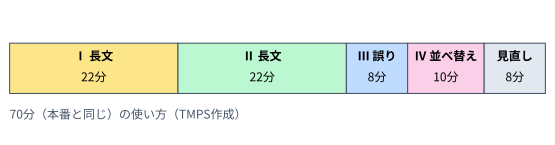
🧭 おすすめの解く順番
Ⅳ → Ⅲ → Ⅰ → Ⅱ → 見直し(または、Ⅰ → Ⅱ → Ⅲ → Ⅳ の順でも可)
短時間で決まるⅢ・Ⅳを先に取ると、長文での焦りが減ります。長文は、1設問に2分以上かけない。どうしても決まらない欄は印をつけて飛ばし、最後の見直しに回します。
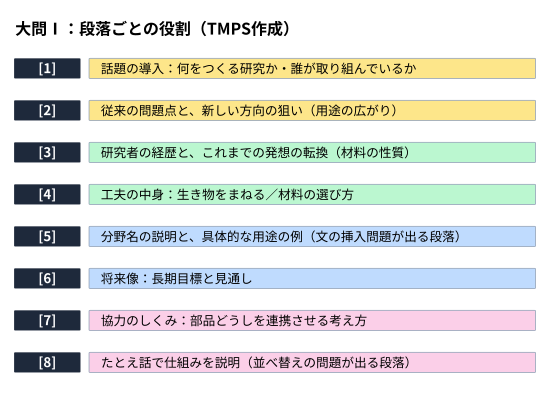
大問Ⅰ 長文(科学ニュース系・8段落)── 段落の役割で地図を作る
人工的に小さな機械を作る研究を紹介する科学記事です。8つの段落に番号が振られ、設問が「段落[n]について」と指定してきます。
現場戦略試験会場でのリアルな立ち回り(大問Ⅰ)
⏱ 目標時間 & 死守ライン目標22分。1欄あたり約1.5分。段落ごとに設問をまとめて処理する。
⚠️ 損切り・警戒ライン欄2・10・11のように、本文と選択肢の言い換えを慎重に照らす欄で2分を超えたら印をつけて先へ。
💡 初手の思考トリガー先に設問を全部眺め、「段落[n]→欄の番号」の対応表を余白に書く。
📝 どういう問題か?
最新の研究を紹介する英文記事を読み、段落を指定した設問に答える大問です。
- 欄1〜15:段落の内容を問う設問(内容一致・NOT mentioned・語句の意味・挿入位置など)
- 設問は段落順に並ぶ。挿入位置を決める欄・段落の主眼を問う欄が含まれる
🎯 欄1〜15の答え
1:②2:④3:③4:①5:①6:③7:②8:②9:④10:④11:②12:③13:②14:①15:①
⚠️ 欄2・10・11は、選択肢の「言い過ぎ」や、本文の言い換えの幅で判断が割れやすい欄。TMPSの判断を示しますが、ご自身の手元の問題と照らして確認してください(要確認)。
Yuiちゃん
「NOT mentioned」って、どれも本文にありそうで迷います…Mio先生
3つは本文に根拠がある、1つだけ根拠がない(または逆のことが書いてある)。だから「根拠が見つかった選択肢」から順に消していくの。見つからなかった1つが答えだよ。TMPSコーチング診断
🩺【自己診断】大問Ⅰで手が止まった人への処方箋
- 全体読むのに時間がかかる → 先に設問を読み、段落の地図を作ってから本文へ
- NOT型全部あるように見える → 3つの根拠を段落内で指さして確認
- 語句意味が分からない語 → 前後の文の言い換えを探す
- 挿入位置が決まらない → 挿入文の this/also/however が受ける内容を探す
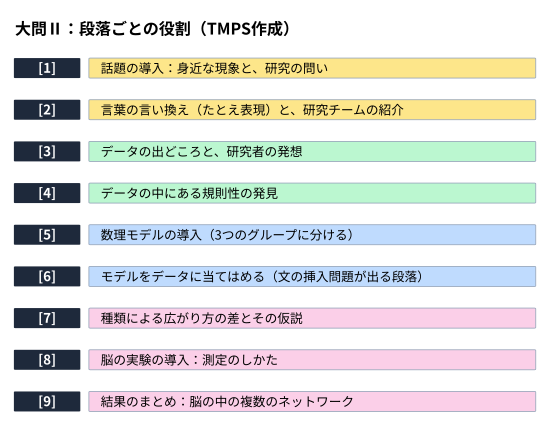
大問Ⅱ 長文(研究紹介・9段落)── 「人物と発見」を追う
身近な現象を数理モデルや脳の実験で調べる研究チームの紹介です。人物名や数字が多く出ますが、設問は「どの人が何をしたか」を段落ごとに問うだけです。
現場戦略試験会場でのリアルな立ち回り(大問Ⅱ)
⏱ 目標時間 & 死守ライン目標22分。Ⅰと同じ。9段落なので、設問の段落指定を先に拾う。
⚠️ 損切り・警戒ライン欄23(段落の主眼を問う設問)と欄25(挿入位置)は2分を超えたら一旦飛ばす。
💡 初手の思考トリガー人物名ごとに「誰が・どこで・何をした」を1行メモにしておく。
📝 どういう問題か?
研究者の取り組みを紹介する英文記事を読み、段落を指定した設問に答える大問です。
- 欄16〜30:段落ごとの内容一致・NOT mentioned・語句の意味・挿入位置・主眼・動詞や名詞を選ぶ設問
- 最後の設問は、脳の実験の結果の理解を確かめる
解き方の型:Ⅰと同じ。さらに、人物と所属・やったことのすり替え(A氏がやったことをB氏のこととして書く選択肢)に気をつける。数字(回数・年数・サイズ)を問う設問は、本文の数字とその対象をセットで確認する。主眼を問う設問は、その段落で一番繰り返されている話題を選び、「一部だけ正しい」選択肢を消す。
🎯 欄16〜30の答え
16:③17:①18:④19:②20:②21:④22:③23:②24:①25:④26:①27:①28:②29:④30:④
⚠️ 欄23(主眼)と欄25(挿入位置)、欄28は、判断が割れやすい欄です。TMPSの読みを示しますが、手元の問題で確認してください(要確認)。
ニックニ先生
人物名が多くて混乱する人は、名前の横に「何をした人か」を1語書いておくと、設問が出てきたときに迷いません。Yuiちゃん
なるほど、名前ごとに役割のメモですね!TMPSコーチング診断
🩺【自己診断】大問Ⅱで手が止まった人への処方箋
- 人物人と行動がごちゃごちゃ → 名前の横に役割を1語メモ
- 数字数字を問われる → 数字とその対象をセットで本文に戻る
- 主眼段落の主眼が選べない → その段落で一番繰り返される話題を探す
大問Ⅲ 誤り指摘 ── 「文法」と「意味」の両方で下線を疑う
一続きの短い文章の10文について、下線部①〜④のうち誤りを含むものを1つ選びます。1問あたり約45秒で処理します。
現場戦略試験会場でのリアルな立ち回り(大問Ⅲ)
⏱ 目標時間 & 死守ライン目標8分。1問45秒。
⚠️ 損切り・警戒ライン1問で1分を超えたら印をつけて次へ。後で時間が余れば戻る。
💡 初手の思考トリガー下線部を、接続詞・関係詞・冠詞・数・時制・語形・前置詞・意味(前後と逆)の8つの観点で順にあたる。
📝 どういう問題か?
話題がつながった短い文章を読み、文法・語法・文脈上の誤りを探す大問です。
- 欄31〜40:10文それぞれの下線部①〜④から、誤りを含むものを1つ選ぶ
誤りのパターン:(1) 接続詞の選択(while と that の取り違えなど)、(2) 動詞の自動詞・他動詞(rise と arise など)、(3) 冠詞・前置詞を含む熟語(in the case of など)、(4) 名詞の単数・複数(generalizations など)、(5) 代名詞の形(one と the one など)、(6) 分詞・動名詞の形(現在分詞と過去分詞)、(7) 関係詞(in which と which)、(8) 意味の逆転(前後の文の流れと合わない副詞)、(9) 受動態と能動態。
🎯 欄31〜40の答え
31:③32:①33:①34:②35:②36:③37:③38:①39:①40:③
⚠️ 欄39は文法ではなく文脈で決まる。前後の文がどういう流れ(良い結果か悪い結果か)なのかを確認する。
TMPSコーチング診断
🩺【自己診断】大問Ⅲで手が止まった人への処方箋
- 観点見つからない → 8つの観点を順に当てる
- 意味文法が全部正しく見える → 前後の文の流れ(逆転)を疑う
- 時間1問で1分超え → 印をつけて飛ばす
大問Ⅳ 語句の並べ替え ── 全部並べてから箱を数える
日本語の意味に合うように[ ]内の語句を並べ、指定された2か所(箱)に入る語句の番号を答えます。5問・10欄です。
現場戦略試験会場でのリアルな立ち回り(大問Ⅳ)
⏱ 目標時間 & 死守ライン目標10分。1問2分。
⚠️ 損切り・警戒ライン1問3分を超えたら飛ばす。
💡 初手の思考トリガー日本語から文型の骨組み(疑問文・倒置・分詞構文・関係詞)を先に決め、固定された語を手がかりに全体を並べる。
📝 どういう問題か?
並べ替えた文の、指定位置の語句を答える大問です。
- 欄41〜50:5問の並べ替え文について、3番目と6番目(または7番目)の位置に入る語句を選ぶ
解き方の型:①日本語から文のタイプを決める(疑問文・強調の否定倒置・so/such構文・関係詞など)→ ②固定された語の前後から大きなかたまりを作る → ③すべての語を並べ終えてから、箱の位置(左から何番目か)を数える。全5問の語順は、スクリプトで全語の使い切りと位置を検算しました。
🎯 欄41〜50の答え
41:⑤42:⑥43:④44:⑤45:③46:④47:⑧48:⑦49:①50:③
⚠️ 「並べ替えは合っているのに答えの番号が違う」ミスが多い。箱の位置は、空所の数を数えて(空所自体が何番目か)確かめ、解答欄に書く番号は語句の番号(空所の番号ではない)であることを再確認する。
Mio先生
番号は「語句につけられた番号」。何番目に入るかではないの。ここで取り違える人が毎年いるから、最後に指さし確認をしよう。Yuiちゃん
並べ終わったら、箱の位置の語を指さして、その語の番号を書く、ですね。TMPSコーチング診断
🩺【自己診断】大問Ⅳで手が止まった人への処方箋
- 骨組み並べ始められない → 日本語から文のタイプ(疑問文・倒置など)を先に決める
- 固定語手がかりがない → 文頭・文末の固定された語から前後を組む
- 番号答えがずれる → 並べ終えてから箱の位置の語の番号を指さしで確認
本番の答え一覧(採点用)
解説を読んだあとの採点用です。「欄の番号:選択肢の番号」の形で書いています。大問Ⅳ(欄41〜50)は、語順をスクリプトで検算しました。大問Ⅰ・Ⅱ・Ⅲ(欄1〜40)は読解・文法の判断で、スクリプトでは意味の正誤まで確かめられません。特に判断が割れうる欄(2・10・11・23・25・28)は要確認です。
Ⅰ 長文(欄1〜15)
1:②2:④3:③4:①5:①6:③7:②8:②9:④10:④11:②12:③13:②14:①15:①
Ⅱ 長文(欄16〜30)
16:③17:①18:④19:②20:②21:④22:③23:②24:①25:④26:①27:①28:②29:④30:④
Ⅲ 誤り指摘(欄31〜40)
31:③32:①33:①34:②35:②36:③37:③38:①39:①40:③
Ⅳ 並べ替え(欄41〜50)
41:⑤42:⑥43:④44:⑤45:③46:④47:⑧48:⑦49:①50:③
※ 選択肢の番号は、問題冊子をTMPSが読み取ったものです。手元の問題と照らして確認してください。
採点したら → 30秒の得点診断へ
TMPS ORIGINAL
東北医科薬科大2025型 そっくり類題セット
東北医科薬科大2025型 そっくり類題セット
(全4大問・50欄・解答解説つき)
2025年度の本番と同じ4大問・同じ50欄の形式(選んで番号をマーク)で、題材を変えたTMPSオリジナル問題です。「ソフトロボット」、「笑いの科学」の長文、「習慣」の誤り指摘、並べ替え5問の練習に使ってください。
試験時間の目安 70分長文・誤り指摘・並べ替え
📄 本番形式の問題冊子PDFをダウンロード(全9ページ)
印刷して本番と同じように70分で解けます。解答・解説はこのページの下に掲載しています。
※ 東北医科薬科大学の入試問題ではありません。本文・設問・人物・団体(架空)はすべてTMPS医学館が作成したオリジナルで、出典のある引用ではありません。
類題 【I】
次の英文を読み,問1〜15の設問の解答として,もしくは設問中の空欄に入るものとして最も適切なものを選択肢①〜④から一つ選び,その番号をマークせよ。なお,[1]〜[8]はパラグラフ(段落)の番号を表している。
[1] Ingrid Halvorsen builds robots. That's not unusual for an engineer. But instead of stiff metal arms, she makes soft ones that bend like an octopus's tentacle. She leads a research group that works on "soft machines" at the Linden Institute in Bergen, Norway. Hard robots are already common in our world. They carry out many tasks in industry. Many lift car doors. Some tighten bolts on assembly lines. Others carry boxes across warehouses or help surgeons cut with great precision. But a hard robot can hurt whatever it touches.
[2] That's a problem when robots work around people. A stiff arm can bruise a person who stands too close. It can also crush a fragile object, such as an egg or a ripe peach. That's why engineers are looking at how soft machines might take over delicate jobs. They might pick fruit without damaging it. Or they might wrap gently around an injured organ during surgery. And the potential goes beyond easier jobs. Some researchers hope that, by combining enough soft parts, they could build machines that explore places no human can reach.
[3] When a machine breaks — say, part of a car's engine — we replace it with a stronger one. So if a robot arm is too hard, why not just build it from rubber? Back when Tomas Reyes was a student, he asked his teachers just that. Now a roboticist at Marlow College in Bristol, England, Reyes has answered his own question. "Turns out," he says, we are "not very good at copying how muscles work." Making a soft arm is difficult — and for several reasons. First, soft materials stretch unevenly, so an arm may bend in an unexpected direction. Second, the air that moves the arm must be pumped through tiny channels in exactly the right order. Another problem: soft materials wear out. Repeated bending causes small cracks, and the cracks grow. That makes soft robots tricky and costly to maintain.
[4] Engineers like Reyes and Halvorsen found a workaround. They're building robots that borrow tricks from animals. With the right design, these robots can move more easily and at lower cost. They also can last longer — and need fewer parts. To build them, researchers can work with many kinds of materials. Some use silicone, like that in kitchen tools. Reyes uses fabric woven with tiny air tubes. Halvorsen and a few others even use gels that swell when heated.
[5] ( ① ) Such engineers are part of a field known as soft robotics. That's the study of machines made from bendable materials. ( ② ) Pedro Alves is a soft roboticist at Westbrook University in Ohio. In a 2022 interview, he described a bold goal: Rather than send hard-shelled robots into collapsed buildings, he'd send soft ones that squeeze through gaps. Picture a machine that could flatten itself like a pancake, he said. ( ③ ) Maybe it slips beneath a heavy beam to reach a trapped hiker. Or maybe it crawls through a pipe to check for leaks. ( ④ )
[6] "Say you want a robot that climbs a wall like a gecko," Alves said in the interview. "If we really understood how that animal sticks to surfaces," soft roboticists could design one. Such technology is already underway, he said, with the goal of helping rescue crews, assisting older adults and more. "It would work almost anywhere except underwater." It's a distant goal, he admitted — in fact, one he may not see completed. But he believes later teams will: "I think it's achievable."
[7] A fully soft robot that can rival a human nurse appears to be out of reach. Engineers have, however, learned to make small soft fixes. Robots and their sensors must work together. Think of them like "the crew of a ship," Reyes says. Turn the wheel, and the ship changes course. That's a big-scale effect. But each small crew member must do the job properly to get that result. Soft machines are similar. Their many small parts must work as teams.
[8] Here's one example. An octopus arm contains a soft muscle that runs along its whole length. When the animal wants to grab a shell, nerves send a signal along the arm, and the muscle tightens in a wave. That wave pushes the tip forward and wraps it around the shell. Copying that wave is like knocking over a line of dominoes. If one domino fails, the chain stops. Similarly, if the signal is lost, the arm cannot grip. But soft robotics, Halvorsen says, can replace a faulty section or re-route the signal. It might even tackle the problem of robot hands that drop things. They slip when their sensing skin cannot detect pressure properly.
問1 According to paragraph [1], Ingrid Halvorsen ( 1 ).
- ① repairs metal arms for factories
- ② builds a robot shaped like an octopus
- ③ makes bendable robots that move like tentacles
- ④ studies how hard robots hurt people
問2 According to paragraph [1], which of the following is NOT mentioned as a job of hard robots? 2
- ① Lifting car doors.
- ② Tightening bolts.
- ③ Carrying boxes in warehouses.
- ④ Sorting letters at post offices.
問3 According to paragraph [2], what makes hard robots a problem around people? 3
- ① They move too slowly in crowded rooms.
- ② They can injure people or crush fragile things.
- ③ They use too much electricity.
- ④ They cannot lift light objects.
問4 The following is a summary of paragraph [2]. The blanks ( 1 ), ( 2 ), ( 3 ) and ( 4 ) each match one of the options ①, ②, ③ or ④. Each option is only used once. Which option fits into blank ( 3 )? 4
Engineers are exploring ways to ( 1 ) hard robots with softer ones, because soft machines can ( 2 ) fragile objects without damage. Researchers are investigating the potential to ( 3 ) soft machines in surgery and fruit picking. Ultimately, they may be able to ( 4 ) robots into places that no human can reach.
① handle ② replace ③ use ④ send
問5 The phrase "wrap gently around" in paragraph [2] is closest in meaning to ( 5 ).
- ① cut carefully
- ② surround carefully
- ③ push hard against
- ④ lift up
問6 According to paragraph [3], what did Tomas Reyes think of rubber when he was a student? 6
- ① Rubber was too weak to move anything.
- ② A robot made of rubber could be a solution.
- ③ Rubber was cheaper than fixing an engine.
- ④ A rubber arm was like a damaged car part.
問7 According to paragraph [3], what did Reyes realize as a roboticist? 7
- ① It is impossible to make soft arms with modern air pumps.
- ② We need more powerful engines to copy muscles.
- ③ Copied muscles work surprisingly well.
- ④ We are not skilled at copying how muscles work.
問8 According to paragraph [3], to make a soft arm bend correctly, the air must ( 8 ).
- ① be pumped through the channels in the right order
- ② stay inside the arm at all times
- ③ cool the rubber quickly
- ④ stretch the material evenly
問9 In paragraph [4], which of the following is NOT mentioned about the robots that engineers like Reyes and Halvorsen are building? 9
- ① They borrow tricks from animals.
- ② They can move easily at lower cost.
- ③ They last longer than earlier models.
- ④ They run only on batteries that are easy to recharge.
問10 Where would the following sentence best fit in paragraph [5]? Choose ( ① ), ( ② ), ( ③ ) or ( ④ ). 10
These are only two of many possible jobs.
問11 According to paragraph [6], the technology that could create "a robot that climbs a wall like a gecko" ( 11 ).
- ① tells rescue crews how to build robots
- ② will be completed during Alves's career
- ③ could potentially work almost anywhere except underwater
- ④ is something Alves hopes never to see
問12 The phrase "out of reach" in paragraph [7] is closest in meaning to ( 12 ).
- ① just around the corner
- ② too heavy to lift
- ③ already finished
- ④ not yet possible
問13 According to paragraph [7], what kind of cooperation does Reyes say is needed? 13
- ① Engineers and nurses.
- ② Ships and crews.
- ③ Robots and their sensors.
- ④ Wheels and engines.
問14 According to paragraph [8], if you arrange ①, ②, ③, and ④ in the order that shows how an octopus arm grabs something, which one would be the third? 14
- ① The tip wraps around the object.
- ② The muscle tightens in a wave.
- ③ A signal travels along the arm.
- ④ The animal wants to grab something.
問15 According to paragraph [8], what is the cause of robot hands dropping things? 15
- ① Failure to detect pressure with the sensing skin.
- ② Broken rubber in the fingers.
- ③ A shortage of air in the arm.
- ④ A faulty switch in the muscle.
▶ 【I】 の答えと解説を見る
【I】 の答えと解説
1:③2:④3:②4:③5:②6:②7:④8:①9:④10:④11:③12:④13:③14:②15:①
- 問1(欄1):③ makes bendable robots that move like tentacles [1]に「硬い金属の腕ではなく,タコの触手のように曲がる柔らかい腕をつくる」とある。②は「タコの形のロボット」で,タコの触手のように曲がるだけ。
- 問2(欄2):④ Sorting letters at post offices. [1]に書かれているのは,ドアを持ち上げる・ボルトを締める・倉庫で箱を運ぶ・手術を助ける,の4つ。手紙の仕分けは出てこない。
- 問3(欄3):② They can injure people or crush fragile things. [2]の冒頭〜2文目:硬い腕は近くに立つ人にあざをつくり,卵や桃のような壊れやすいものをつぶすことがある。
- 問4(欄4):③ use 文意から ( 1 ) replace「硬いロボットを柔らかいものに置き換える」,( 2 ) handle「壊れやすいものを扱う」,( 3 ) use「手術や果物の収穫に柔らかい機械を使う」,( 4 ) send「ロボットを人が行けない場所へ送る」。( 3 ) は ③ use。
- 問5(欄5):② surround carefully wrap around は「〜を包む,巻きつく」。gently(やさしく)に合うのは,②「注意深く(そっと)取り囲む」。
- 問6(欄6):② A robot made of rubber could be a solution. [3]:学生のころ,教師に「硬い腕が問題なら,ゴムで作ればいいのでは」と尋ねた。つまり,ゴムのロボットが解決策になりうると考えていた。
- 問7(欄7):④ We are not skilled at copying how muscles work. [3]:「筋肉の働きをまねるのは,私たちはあまり得意でない」と,自分の問いに答えを出した。
- 問8(欄8):① be pumped through the channels in the right order [3]の2つ目の理由:腕を動かす空気は,細い通路を「ちょうど正しい順序で」送り込まなければならない。④は「材料は不均一に伸びる」という1つ目の理由と食い違う。
- 問9(欄9):④ They run only on batteries that are easy to recharge. [4]に出てくるのは,動物の工夫を借りる・動かしやすく低コスト・長持ちして部品が少ない,の3点。電池は出てこない。
- 問10(欄10):④ 「これらは数ある仕事のうちの2つにすぎない」は,2つの例(梁の下に入る/パイプを進む)を挙げ終えた直後,つまり④に入る。③は「Maybe it…」が例を始める位置なので,その前には置けない。
- 問11(欄11):③ could potentially work almost anywhere except underwater [6]:「水中を除けば,ほとんどどこでも使える」。Alves は自分が生きているうちには完成を見ないかもしれないと述べているので,②は不適。
- 問12(欄12):④ not yet possible out of reach は「手が届かない」。直後の However(しかし小さな修復はできる)とのつながりから,「まだ実現できない」。
- 問13(欄13):③ Robots and their sensors. [7]:「ロボットとそのセンサーは一緒に働かなければならない」。船の乗組員は,たとえ話に使われているだけ。
- 問14(欄14):② 順序は ④ つかみたい → ③ 信号が腕を伝わる → ② 筋肉が波のように縮む → ① 先端が対象に巻きつく。3番目は②。
- 問15(欄15):① Failure to detect pressure with the sensing skin. [8]末尾:感知する「皮膚」が圧力をうまく検出できないと,ロボットの手は物を落とす(滑る)。
類題 【II】
次の英文を読み,問1〜15の設問の解答として,もしくは設問中の空欄に入るものとして最も適切なものを選択肢①〜④から一つ選び,その番号をマークせよ。なお,[1]〜[9]はパラグラフ(段落)の番号を表している。
[1] Laughter seems to be everywhere — even when we're alone with a funny thought. It's part of every culture around the world. Laughter brings people together, signals friendliness and sometimes hides embarrassment. But why? Researchers are investigating what laughter does for us and why — whether it's easing tension, building trust or tricking us into feeling better. They're also studying the ways laughter spreads between people. They're even looking at how our brains react to a joke. And some are finding ways to use laughter to help patients.
[2] Some people laugh at almost anything. Others hold back until a joke is truly funny. People often say that a good laugh is "contagious." When a giggle passes from one person to the next, we say it has caught on. Those words might be more accurate than we ever imagined, find researchers at Redfield University in Dunedin, New Zealand.
[3] Hana Lindgren is a sound researcher. One day, she was chatting with comedian and engineer Sam Okafor. Okafor had recordings of 2.1 million audience laughs from 41 theaters. "It was from the period when theaters first began recording their shows," Lindgren explains. Some ten years ago, this was before most comedians had started putting clips online. Okafor knew which shows had been recorded. He also knew when they'd been recorded and in which city the audience was sitting at the time.
[4] And she found curious clusters of laughs. Some jokes had drawn big laughs on just a few evenings over a few weeks. Those patterns looked familiar to Lindgren. She studies how habits spread. And those laugh data resembled the kind of data she saw with gossip. "We wondered whether that kind of spread from person to person could be how audiences decide that a joke is funny," Lindgren recalls.
[5] Graduate student Marco Pellegrini joined the project. He had been working with a mathematical model. He used it to predict how rumors travel through a town. The model compared three groups of people over time. One hadn't heard the rumor yet. A second group was currently passing it along. A third group was people who had passed it on but stopped. As a rumor develops, people move from being unaware into the passing group, then the stopped one. It's such a consistent pattern, it can be described with math.
[6] The team now used the same model with the laugh data. ( ① ) They looked at the 500 most recorded comedy shows in Canada, dividing them by style. ( ② ) For popular shows, laughs rose rapidly from night to night, much like a rumor passing through a crowd. ( ③ ) Slapstick and dry wit did not behave in the same way. ( ④ ) "The people who enjoy dry humor aren't the same as the people who like slapstick. They're different audiences," Lindgren says. "And some of those audiences are much more likely to share things quickly."
[7] Surprisingly, slapstick wasn't the most contagious. It spread, but not as quickly as some other styles. Wordplay, on the other hand, was super contagious. Lindgren has a hypothesis about why. Those fans "are probably super connected online and swapping clips" more than people who prefer other kinds of comedy. "We think of gossip as strictly negative," Lindgren says. That's especially true in small towns. "But that same process of spreading works for other things in life," she now concludes. Like sharing a favorite joke with your closest friends.
[8] Sometimes you hear a joke and just know it's going to be a classic. Maybe you burst out laughing. Or you might feel a warm rush of joy. That's why you want to hear it again — and why you're likely to tell it to others. What causes such strong responses? That's a question neuroscientist Elena Vogt has been studying. She works at Halden University in Oslo. People who take part in her research watch comedy clips as they lie in an fMRI scanner. All the while, the machine scans their brain. Vogt also asks the participants how funny they find each clip. Those scans hint that brain activity changes in response to humor.
[9] Specific parts of the brain respond together to humor, her studies reveal. "The brain is always active," Vogt says. And there isn't a single "humor spot." But several networks, or linked groups of brain regions, become more active. Such networks are made up of "regions in the brain that tend to switch on together and in sync," she explains. Some of these ramp up activity when jokes are told. And they're involved in lots of different things. The *limbic network processes emotions. The language network lets us understand wordplay. The motor network moves our smile. And the auditory network, of course, responds to sounds.
*limbic 大脳辺縁系の
問1 In paragraph [1], which of the following is NOT mentioned as a potential effect of laughter? 16
- ① It builds trust.
- ② It eases tension.
- ③ It helps people sleep longer.
- ④ It signals friendliness.
問2 In paragraph [1], which of the following is NOT mentioned as a focus of researchers? 17
- ① Why comedians choose certain words.
- ② How laughter spreads between people.
- ③ How the brain reacts to a joke.
- ④ Whether laughter can help patients.
問3 According to paragraph [2], when people say laughter is "contagious," they mean that it ( 18 ).
- ① is very attractive to children
- ② is always planned by comedians
- ③ is so quiet that we barely hear it
- ④ passes from person to person easily
問4 The phrase "caught on" in paragraph [2] is closest in meaning to ( 19 ).
- ① spread among people
- ② made us sad
- ③ become quiet
- ④ stopped suddenly
問5 According to paragraph [3], Sam Okafor ( 20 ).
- ① recorded 2.1 million laughs himself
- ② knew when, where, and at which shows the laughs were recorded
- ③ worked at a theater in Dunedin
- ④ knew when comedians began putting clips online
問6 According to paragraph [4], "clusters of laughs" were curious because ( 21 ).
- ① Lindgren was familiar with those comedians
- ② the laughs were recorded within a month
- ③ they occurred in the same cities where rumors spread
- ④ the laugh pattern resembled how habits and gossip spread
問7 According to paragraph [5], which of the following is TRUE of Marco Pellegrini? 22
- ① He took over the project from Lindgren.
- ② He applied Okafor's recordings to his model.
- ③ He used his model to predict how rumors travel.
- ④ He applied his model to people with three types of rumors.
問8 According to paragraph [5], what is the primary focus of Marco Pellegrini's work? 23
- ① Studying how people forget rumors.
- ② Analyzing the spread of rumors through a town.
- ③ Developing a model of how people move to new towns.
- ④ Making sure rumors spread consistently.
問9 According to paragraph [6], the pattern of laughs differs depending on ( 24 ).
- ① the style of comedy
- ② the rumor model
- ③ the size of the theater
- ④ the time of the performance
問10 Where would the following sentence best fit in paragraph [6]? Choose ( ① ), ( ② ), ( ③ ) or ( ④ ). 25
These data, too, fit the rumor model.
問11 In paragraph [7], Lindgren suggests that wordplay spread more quickly than slapstick because those fans ( 26 ).
- ① have negative attitudes toward comedy
- ② were more influenced by small towns
- ③ have not shared clips with other groups
- ④ are more closely linked to each other
問12 The phrase "burst out laughing" in paragraph [8] is closest in meaning to "( 27 )."
- ① suddenly start laughing
- ② slowly stop smiling
- ③ quietly smile
- ④ barely react
問13 According to paragraph [8], Elena Vogt found that ( 28 ).
- ① brain activity changes according to the participants' ages
- ② brain activity is influenced by the humor being enjoyed
- ③ the brain quickly responds to the first part of a joke
- ④ the brain uses its own system for humor
問14 Regarding Vogt's studies, which of the following is NOT mentioned in paragraph [8]? 29
- ① Participants were positioned in an fMRI scanner.
- ② Participants had their brain activity continuously monitored.
- ③ Participants were asked how funny they found each clip.
- ④ Participants received a prize for each laugh.
問15 According to paragraph [9], Vogt found that ( 30 ).
- ① one single region of the brain responds to humor
- ② every part of the brain responds to humor in the same way
- ③ smiling typically happens while a joke is told
- ④ humor activates multiple linked networks in the brain
▶ 【II】 の答えと解説を見る
【II】 の答えと解説
16:③17:①18:④19:①20:②21:④22:③23:②24:①25:②26:④27:①28:②29:④30:④
- 問1(欄16):③ It helps people sleep longer. [1]に出てくるのは,人を結びつける・友好のしるし・緊張をほぐす・信頼を築く,など。睡眠は出てこない。
- 問2(欄17):① Why comedians choose certain words. 研究者の関心として[1]に出てくるのは,笑いの伝わり方・脳の反応・患者への活用など。コメディアンの言葉選びは出てこない。
- 問3(欄18):④ passes from person to person easily [2]:くすくす笑いが「次の人へ,次の人へと」伝わるとき,笑いは「うつる」と言う。
- 問4(欄19):① spread among people catch on は「広まる,流行する」。「うつる」と言われる文脈(人から人へ)に合う。
- 問5(欄20):② knew when, where, and at which shows the laughs were recorded [3]末尾:どのショーが録音され,いつ,どの都市の観客だったかを知っていた。録音そのものは劇場が行ったもので,Okafor 自身が録ったとは書かれていない。
- 問6(欄21):④ the laugh pattern resembled how habits and gossip spread [4]:笑いの集まり方が,Lindgren の研究している「習慣の広まり」やうわさ話のデータに似ていた。
- 問7(欄22):③ He used his model to predict how rumors travel. [5]:うわさがどう伝わるかを予測するのに数理モデルを使っていた。①は「引き継いだ」でなく「加わった」。④の「3つ」は,うわさの種類ではなく人の集団の数。
- 問8(欄23):② Analyzing the spread of rumors through a town. [5]:彼が取り組んでいたのは,うわさが町の中をどう伝わるか(未経験→伝達中→終了)を数理モデルで表すこと。
- 問9(欄24):① the style of comedy [6]:スタイル(slapstick と dry wit など)で分けると,広まる速さが違った。
- 問10(欄25):② 「このデータも,うわさのモデルに当てはまった」は,「スタイル別に分けた」と述べた直後の②。その次の文の「人気のショーでは笑いが急速に増え…」が,当てはまり方の具体例になる。①だと「these data」が指すものがない。
- 問11(欄26):④ are more closely linked to each other [7]:ことば遊びのファンは,ネット上で強くつながっていて,クリップをやりとりしている(=互いにより密接に結びついている)。
- 問12(欄27):① suddenly start laughing burst out ~ing は「急に〜しだす」。
- 問13(欄28):② brain activity is influenced by the humor being enjoyed [8]末尾:スキャンの結果,ユーモアへの反応として脳活動が変わることが示唆された。
- 問14(欄29):④ Participants received a prize for each laugh. [8]に出てくるのは,fMRIに横たわる・脳をずっとスキャンする・面白さを尋ねる,の3点。賞品は出てこない。
- 問15(欄30):④ humor activates multiple linked networks in the brain [9]:「ユーモア専用の1か所」はなく,複数のネットワーク(連動する脳領域のまとまり)が活発になる。
類題 【III】
次の問1〜10に示された英文は"Habits"と題する一続きの文章の冒頭である。各問いにおいて,下線を付した語句①〜④のうち,文法・語法上または文脈上の誤りを含むものを一つ選び,その番号をマークせよ。
問1 31
Procrastination is ①defined as ②the act of delaying a task ③in spite we know ④it will cause trouble.
Procrastination is ①defined as ②the act of delaying a task ③in spite we know ④it will cause trouble.
問2 32
Many students believe ①that they work ②best under pressure, ③which ④make it hard to start early.
Many students believe ①that they work ②best under pressure, ③which ④make it hard to start early.
問3 33
Psychologists have found that people ①are ②more likely to delay a task ③when it seems ④boringly.
Psychologists have found that people ①are ②more likely to delay a task ③when it seems ④boringly.
問4 34
①Instead of ②to make a long to-do list, it is often better to ③begin with ④one small step.
①Instead of ②to make a long to-do list, it is often better to ③begin with ④one small step.
問5 35
If you ①will start preparing a week early, you ②are ③far ④less likely to panic.
If you ①will start preparing a week early, you ②are ③far ④less likely to panic.
問6 36
The more we think of a task as a huge mountain, ①the harder it ②becomes ③for ④starting.
The more we think of a task as a huge mountain, ①the harder it ②becomes ③for ④starting.
問7 37
①Each of the ②students ③were asked to keep ④a diary of their habits.
①Each of the ②students ③were asked to keep ④a diary of their habits.
問8 38
This method is ①much ②effective ③than ④the old one.
This method is ①much ②effective ③than ④the old one.
問9 39
①Despite ②of his best efforts, ③he ④missed the deadline.
①Despite ②of his best efforts, ③he ④missed the deadline.
問10 40
A habit is ①something ②whom ③people ④repeat without thinking.
A habit is ①something ②whom ③people ④repeat without thinking.
▶ 【III】 の答えと解説を見る
【III】 の答えと解説
31:③32:④33:④34:②35:①36:④37:③38:②39:②40:②
- 問1(欄31):③ 正しくは in spite of / even though。in spite は後ろに of が要る(in spite of ~)。節(we know…)を続けるなら even though。
- 問2(欄32):④ 正しくは makes。which は前の内容全体(圧力の下で最もよく働く,ということ)を受け,単数扱い。make → makes。
- 問3(欄33):④ 正しくは boring。seem の後ろは形容詞。boringly(副詞)→ boring。
- 問4(欄34):② 正しくは making。前置詞 instead of の後ろは動名詞。to make → making。
- 問5(欄35):① 正しくは start。時・条件の副詞節では,未来のことも現在形で表す。will start → start。
- 問6(欄36):④ 正しくは to start。「〜するのが(人にとって)難しい」は,難しい+ for +人+ to 不定詞。starting → to start。(the harder it becomes for us to start)
- 問7(欄37):③ 正しくは was。Each of ~ は単数扱い。were → was。
- 問8(欄38):② 正しくは more effective。than があるので比較級が必要。effective → more effective。
- 問9(欄39):② 正しくは (of を取る)。despite は前置詞で,of は付けない(in spite of ならよい)。
- 問10(欄40):② 正しくは that / which。先行詞は something(物)なので,関係代名詞は whom ではなく that / which。
類題 【IV】
次の問1〜5の和文の意味に合うように[ ]内の語句を並べ替えて英文を作り,空欄(41)〜(50)に入るものを一つ選び,その番号をマークせよ。なお,文頭にくる語句も小文字で記されている。
問1 この薬は,どのような点で他の薬と違うのですか。
41 42 others?
[ ① this ② from ③ is ④ ways ⑤ what ⑥ medicine ⑦ in ⑧ different ]
41 42 others?
[ ① this ② from ③ is ④ ways ⑤ what ⑥ medicine ⑦ in ⑧ different ]
問2 これは,睡眠不足に関連するすべての要因が調べられた最初の研究である。
This is the first study 43 44 have been examined.
[ ① sleep ② in ③ which ④ to ⑤ related ⑥ factors ⑦ loss ⑧ all ]
This is the first study 43 44 have been examined.
[ ① sleep ② in ③ which ④ to ⑤ related ⑥ factors ⑦ loss ⑧ all ]
問3 近年の患者数の増加は,食生活の変化,すなわち砂糖の摂取量の増加によるものと考えられている。
The recent increase in patients is thought 45 diet, 46 in sugar intake.
[ ① to ② be ③ caused ④ by ⑤ changes ⑥ in ⑦ namely ⑧ a ⑨ rise ]
The recent increase in patients is thought 45 diet, 46 in sugar intake.
[ ① to ② be ③ caused ④ by ⑤ changes ⑥ in ⑦ namely ⑧ a ⑨ rise ]
問4 私は知らなかったが,私たちのチームには経験と信頼が依然として欠けていた。
Little 47 , 48 in our team.
[ ① still ② trust ③ I ④ experience ⑤ and ⑥ did ⑦ were ⑧ know ⑨ lacking ]
Little 47 , 48 in our team.
[ ① still ② trust ③ I ④ experience ⑤ and ⑥ did ⑦ were ⑧ know ⑨ lacking ]
問5 強いプレッシャーを受けると体はアドレナリンを出し,それが筋肉を緊張させるため,緊張した話し手の手が震えるのも不思議ではない。
Since under heavy pressure the body releases adrenaline, 49, 50 speakers also have trembling hands.
[ ① tightens ② that ③ the muscles ④ which ⑤ nervous ⑥ wonder ⑦ it's ⑧ no ]
Since under heavy pressure the body releases adrenaline, 49, 50 speakers also have trembling hands.
[ ① tightens ② that ③ the muscles ④ which ⑤ nervous ⑥ wonder ⑦ it's ⑧ no ]
▶ 【IV】 の答えと解説を見る
【IV】 の答えと解説
41:③42:⑧43:③44:⑤45:③46:⑦47:③48:①49:③50:⑥
- 問1(欄41・42):③・⑧ In what ways is this medicine different from others?(in(1) what(2) ways(3) is(4) this(5) medicine(6) different(7) from(8))。4番目は is ③,7番目は different ⑧。
- 問2(欄43・44):③・⑤ This is the first study in which all factors related to sleep loss have been examined.(in(1) which(2) all(3) factors(4) related(5) to(6) sleep(7) loss(8))。2番目は which ③,5番目は related ⑤。
- 問3(欄45・46):③・⑦ The recent increase in patients is thought to be caused by changes in diet, namely a rise in sugar intake.(to(1) be(2) caused(3) by(4) changes(5) in(6),diet,namely(7) a(8) rise(9))。3番目は caused ③,7番目は namely ⑦。
- 問4(欄47・48):③・① Little did I know, experience and trust were still lacking in our team.(did(1) I(2) know(3),experience(4) and(5) trust(6) were(7) still(8) lacking(9))。2番目は I ③,8番目は still ①。
- 問5(欄49・50):③・⑥ Since under heavy pressure the body releases adrenaline, which tightens the muscles, it's no wonder that nervous speakers also have trembling hands.(which(1) tightens(2) the muscles(3),it's(4) no(5) wonder(6) that(7) nervous(8))。3番目は the muscles ③,6番目は wonder ⑥。
※ 類題の英文・設問はすべてTMPSのオリジナルで、人物・団体・研究は架空です。全欄の答えは、スクリプトで(並べ替えは語順まで)確かめてあります。
30秒 得点診断
本番の過去問、またはそっくり類題セットを70分で解いた結果を選んでください。次にやるべきことを表示します。
保護者の方へ:東北医科薬科大の英語で知っておきたい3つのこと
① 全50欄が選択式
番号をマークする形式です。和訳や英作文はありません。そのかわり、単語・文法・読解の力を満遍なく問われるので、基礎の穴を作らないことが大切です。② 70分の時間配分
長文2題で44分、誤り指摘と並べ替えで18分、見直し8分。長文に時間をかけすぎると、取りやすい短い大問が犠牲になります。③ 秋からは「答案を見てもらう」
選択式でも、時間の使い方や消去法の癖が出ます。独学では気づきにくい癖を、第三者の目で見てもらうと最短で伸びます。よくある質問
Q. 東北医科薬科大学 医学部の英語2025年度は、どの順番で解くのがよいですか?
試験時間は70分、全50欄(すべて番号をマークする形式)です。TMPSのおすすめは、Ⅰ(長文)22分、Ⅱ(長文)22分、Ⅲ(誤り指摘)8分、Ⅳ(並べ替え)10分、見直し8分。ⅢとⅣは短時間で得点しやすいので、長文で時間を使い切らないことが大切です。
Q. 問題文が載っていなくても、どんな問題か分かりますか?
分かります。著作権に配慮して英文・設問文は掲載していませんが、各大問の最初に、段落ごとの役割と、設問の型・答え方をTMPSの言葉で説明しています。
Q. 答えの番号は何に対応していますか?
問題冊子の解答欄の番号(1〜50)と、その欄の選択肢の番号です。大問Ⅳは、並べ替えた文の指定位置に入る語句の番号です。
Q. そっくり類題セットとは何ですか?
2025年度と同じ4大問・同じ50欄の形式で、題材を変えたTMPSオリジナル問題です。ソフトロボット、笑いの科学、習慣、並べ替えの5問に変えてあります。全欄の答えと解説をこのページに載せ、問題冊子PDFも無料で配布しています。
Q. 解説に誤りを見つけたらどうすればいいですか?
公式LINEからお知らせください。確認のうえ修正し、更新日を記載します。
安心安全・継続更新システム
問題等で誤りを発見された場合、修正しますので、TMPS医学館までLINEを下さい。
受験生・指導者の皆様からのご指摘を真摯に受け止め、最も信頼できる過去問解説・類題ライブラリーとして随時アップデートいたします。
🔥 次に読むならこちら
東北医科薬科大の英語を、
あなたの答案で攻略する
「どこで時間を失ったか」「どの設問の消去法が弱いか」を、Mio先生とニックニ先生があなたの答案から直接診断します。