本文を読めない場合の進め方:問1の語義は文脈なしでも意味が決まる語が多いので、選択肢から先に取る(下の表)。問2の空所は本文の文構造に依存するため、本文を確認してから決める。問3は、設問の先読み(誰が何について言ったかを問う型)で、探す箇所を決める。
📌 このページの使い方
- 過去問集をお持ちの方:本番と同じ80分で解き、答え一覧(最後にあります)で採点してから解説へ
- お持ちでない方:各大問の「どういう問題か」と「段落の流れ」を読めば、問題の中身が分かります
- 最後にそっくり類題セット(PDF版あり)を80分で解き、初見でも同じ解き方ができるか確かめる
※ 著作権に配慮し、英文の本文・設問文は掲載していません(引用は短い語句のみ)。選択肢の番号は本番のマークシートとの対応を示すためのものです。※ 大問Ⅴの自由英作文は、解答例を載せています(採点基準ではありません)。
⚠️ 問題等で誤りを発見された場合、修正しますので、TMPS医学館までLINEを下さい。(迅速に確認・更新いたします)
LINEで誤りを連絡3分で分かる 2024年度の順天堂大の英語
- ✅ 80分・大問5つ。注意事項に「最後の大問Ⅴに自由英作文があるので、時間配分に注意すること」とあります。
- ✅ 大問Ⅰはインタビュー記事(AIと医療)。下線語の同義語、空所補充、内容一致の3種類。本文は過去問集では省略されています。
- ✅ 大問Ⅱ〜Ⅳは長文。Ⅱは月の所有権と宇宙法、Ⅲは植物が出す超音波、Ⅳはクマムシのゲノム。どれも「同義語5問(Ⅳは4問)+内容一致5問(Ⅳは6問)」の4択です。
- ✅ 大問Ⅴは自由英作文。所属する集団が自分のアイデンティティをどう形づくったか、多文化の場にどう貢献するか。導入・本論・結論のある1つの英文を、19.8cm×22行に収めます。
Yuiちゃん
長文が3つ続いて、最後に英作文…。時間が足りなくなりそうです。
Mio先生
大丈夫です。Ⅱ〜Ⅳは設問の型が同じなので、先に語彙問題の5問だけを全部取ると、1題あたり4〜5分で終わります。内容問題は、設問の順番が本文の順番に近いので、根拠の段落に印をつけながら進めましょう。
ニックニ先生
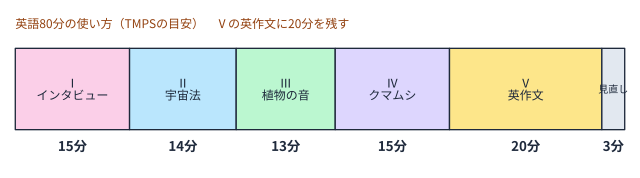
英作文の20分は最初に確保。時計を見て、残り25分で必ずⅤに移るんだ。英語 80分の立ち回りマップ
試験時間80分(本番は英語1科目)の配分の目安です。
🧭 おすすめの解く順番
Ⅰ → Ⅱ → Ⅲ → Ⅳ → Ⅴ(Ⅳは残り25分で切り上げ)→ 見直し3分
本番の指示にあるとおり、Ⅴの時間を確保するのが最優先です。Ⅳの内容問題で迷ったら印をつけて飛ばし、Ⅴのあとに戻ります。
大問Ⅰ インタビュー(AIと医療) ── 語彙を先に取り、設問から探す
インタビュー形式の本文と、語彙・空所・内容一致の3種類の設問。会話文は「誰が」「何と言ったか」の区別が大切です。
現場戦略試験会場でのリアルな立ち回り(大問Ⅰ)
⏱ 目標時間 & 死守ライン目標15分。問1の語彙4問は2分、問2の空所3問は3分、問3は6分。
⚠️ 損切り・警戒ライン本文が長く感じたら、問3から先に(設問順に)根拠を探す。空所の問2は、選択肢の品詞を見て消去する。
💡 初手の思考トリガーインタビューは「発言者 → 主張」の対応表を作りながら読む(Dr. Obermeyer が何を言ったか、など)。
📝 どういう問題か?
医療系雑誌(NEJM)の企画で、2名の医師に行ったインタビュー。本文は過去問集では「著作権の都合上、省略」とされている。設問から、AIの活用(事務作業への利用、人口全体の健康管理に使われてきたアルゴリズムと人種間の不均衡、医師の燃え尽きの解決)が話題だと分かる。
- 問1(1)〜(4):下線の語(fastidious、compassionate、combat、revenue)に最も近い意味を4択から選ぶ
- 問2:文の空所 A・B・C に入る語を4択から選ぶ(A=動詞、B=名詞、C=前置詞の選択肢)
- 問3(1)〜(3):インタビューの内容に合う答えを4択から選ぶ
大問Ⅰ:問1の語義
選択肢から決められる4問
| 番号 | 下線語 | 答え | 意味 |
|---|---|---|---|
| (1) | fastidious | 4 | 細かい点まで注意を払う → careful |
| (2) | compassionate | 2 | 思いやりのある → sympathetic |
| (3) | combat | 1 | ~と戦う → resist |
| (4) | revenue | 3 | 収入 → income |
🎯 問1 の答え
問1(1):4問1(2):2問1(3):1問1(4):3(要確認:本文の文脈は未確認)
問2(A・B・C):選択肢は、A=freezes / composes / transfers / elaborates、B=frequencies / applications / codes / sensations、C=under / across / upon / against。本文の文構造が必要なため、未確定(本文を確認できていません)。
問3:(1) 事務目的のAIについて推測できること(4択)、(2) 人口の健康管理で歴史的に使われてきたアルゴリズムについて言えること、(3) AIが医師の燃え尽きをどう解決しうるか。
(2) は、選択肢のうち「Obermeyer医師が医療アルゴリズムの人種的な偏りを調べるきっかけになった」(4)が、問いの趣旨(アルゴリズムの歴史と偏り)に合う。(3) は「医師が患者に集中できるようになる」(3)が、燃え尽きの解決策として最も自然。ただし、どちらも本文未確認の暫定です。
🎯 問2・問3 の答え(暫定)
問2(1)〜(3):未確定問3(1):未確定問3(2):4(暫定)問3(3):3(暫定)
⚠️ 要確認:大問Ⅰの本文(NEJM『Intention to Treat』第6回)は、出典の記事を読み込めず確認できていません。上の暫定の答えは、設問の選択肢から推定したもので、本文の確認はしていません。お手元の過去問の原文で必ず確かめてください。
Yuiちゃん
本文が読めないと、問2が全然わかりません…。Mio先生
問2は本文の1文の中の空所なので、前後の語から決まることが多いです。「動詞の選択肢」なら、主語と目的語の組み合わせで考えましょう。ニックニ先生
分からない問は印をつけて飛ばす。語彙で稼いだ時間を、Ⅴに回すんだ。Mio先生の総整理表
大問Ⅰ:型と着眼点
| 問 | 型 | 着眼点 |
|---|---|---|
| 問1 | 同義語 | 文脈なしでも決まる語は選択肢から。反対の意味を消す |
| 問2 | 空所補充 | 選択肢の品詞と、前後とのつながり |
| 問3 | 内容一致 | 発言者と主張の対応、設問の先読み |
TMPSコーチング診断
🩺【自己診断】大問Ⅰで手が止まった人への処方箋
- 問1語義が出ない → 語のイメージを選択肢に当てはめ、反対の意味の選択肢を先に消す
- 問2空所が決まらない → 選択肢の品詞を見て、前後の語との相性(動詞なら主語、前置詞なら動詞とのつながり)で絞る
- 問3誰の発言か分からない → 設問の人名・語を本文で探し、その段落の直前直後だけ読む
大問Ⅱ 月の所有権と宇宙法 ── 段落ごとに根拠を印をつける
10段落の長文。法学の話題ですが、条約の名前が多いだけで、論理は「領有は禁止、でも基地は曖昧」の1本です。
現場戦略試験会場でのリアルな立ち回り(大問Ⅱ)
⏱ 目標時間 & 死守ライン目標14分。語彙5問に3分、内容5問に9分、見直し2分。
⚠️ 損切り・警戒ライン(4) のように「目的」を問う選択肢で迷ったら、2択に絞って飛ばし、あとで戻る。
💡 初手の思考トリガー固有名詞(OST、UDHR、Artemis)は記号と考え、「誰が何をするか」の動詞を追う。
📝 どういう問題か?
月に立てられた国旗は、所有権の主張になるのか、という問いから始まる記事。1967年の宇宙条約(OST)、月面基地の法的な扱い、アルテミス合意、資源採取への批判、そして今後の課題を、法学者の発言を交えて説明している。①〜⑩は段落番号。
- 問1(1)〜(5):下線の語(unfurled、pertaining、holds sway、thwart、literally)に最も近い意味を選ぶ
- 問2(1)〜(5):本文の内容に合う答えを4択から選ぶ
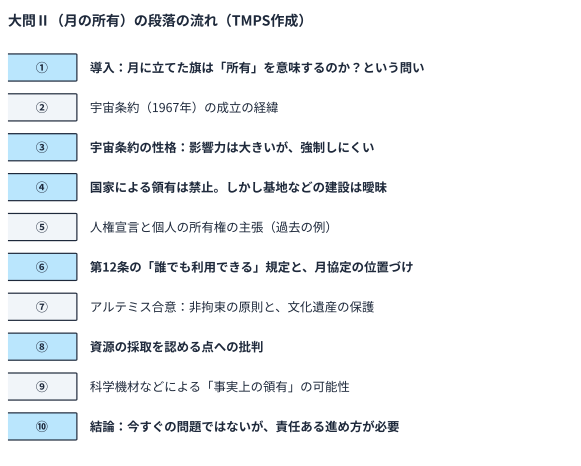
問1(1)語彙:unfurled(第①段落)
unfurled:下線の語は文脈から意味を決める。「旗が(風がないのに)広がって垂れ下がる」の文脈。広げる=opened。stained(汚れた)や damaged と取り違えない。
🎯 問1(1) の答え
答え:4
⚠️ 語の形が似ている選択肢に注意。文脈で意味を決める。
問1(2)語彙:pertaining(第②段落)
pertaining:下線の語は文脈から意味を決める。pertaining to ~ = ~に関する。relating が最も近い。
🎯 問1(2) の答え
答え:1
⚠️ 語の形が似ている選択肢に注意。文脈で意味を決める。
問1(3)語彙:holds sway(第⑤段落)
holds sway:下線の語は文脈から意味を決める。hold sway = 支配力をもつ。has influence。stands by(支持する)は意味が近そうで違う。
🎯 問1(3) の答え
答え:3
⚠️ 語の形が似ている選択肢に注意。文脈で意味を決める。
問1(4)語彙:thwart(第⑥段落)
thwart:下線の語は文脈から意味を決める。thwart = ~を阻む。block。enhance(高める)、support は逆。
🎯 問1(4) の答え
答え:2
⚠️ 語の形が似ている選択肢に注意。文脈で意味を決める。
問1(5)語彙:literally(第⑧段落)
literally:下線の語は文脈から意味を決める。literally = 文字どおり。actually が最も近い。possibly と取り違えない。
🎯 問1(5) の答え
答え:4
⚠️ 語の形が似ている選択肢に注意。文脈で意味を決める。
問2 (1)〜(5)内容一致
(1) 旗を「落書き」と呼ぶ含意(第1段落):旗は所有の主張ではなく象徴にすぎない、という文脈 → 2(「所有権を認めるものではない、単なる象徴」)。
(2) 宇宙条約について正しいもの:第3段落の「最も影響力のある法文書だが強制しにくい。行動規範ではなく指針と原則」→ 4(広く認められた、提案を示す文書)。3の「厳しい罰則」は逆。
(3) 月の基地の法的地位:第6段落で、第2条(領有禁止)と第12条(誰でも利用できる)の調整が課題 → 2(規定が衝突し、法的地位は不確か)。
(4) アルテミス合意の目的:第7・8段落。非拘束の原則を定め、資源の採取・利用を認める点に特徴 → 1(商業目的の資源採取を認める)。2(所有権の明確な法)は「拘束力のない」原則と矛盾、3・4は本文と逆。
(5) 月の領有問題の将来:第10段落「今すぐの問題ではないが、責任をもって進める必要」、第6段落「今後数十年の法的な争点」 → 3(長く議論される複雑な問題)。
🎯 問2 の答え
問2(1):2問2(2):4問2(3):2問2(4):1(要確認)問2(5):3
⚠️ 極端な語(only、any、all、significant punishments)が入った選択肢は、本文で言い切られているかを確かめる。(2) の3、(3) の1は典型。要確認:(4) は選択肢が「目的」を問う型で、判断が割れる可能性があります(本文の記述から1と判断)。
Yuiちゃん
条約の名前がたくさん出てきて混乱しました。Mio先生
覚えなくて大丈夫です。「領有を禁じる条約」「誰でも使える原則」の2つの対立だけ押さえれば、設問はほぼ解けます。ニックニ先生
分からない固有名詞は、四角で囲んで読み飛ばす。内容問題で聞かれたときだけ戻るんだ。Mio先生の総整理表
大問Ⅱ:型と着眼点
| 問 | 型 | 着眼点 |
|---|---|---|
| 問1 | 同義語5問 | 文脈で決める。形が似た別語に注意 |
| 問2(1)〜(3) | 含意・事実 | 段落の根拠を1か所に絞る |
| 問2(4)(5) | 目的・将来 | 本文の語を言い換えた選択肢を選ぶ |
TMPSコーチング診断
🩺【自己診断】大問Ⅱで手が止まった人への処方箋
- 問1語義が選べない → 下線を空所に見立て、選択肢を代入して意味が通るか確かめる
- 問2根拠が見つからない → 設問の語(Outer Space Treaty など)がある段落を探し、その段落だけ読む
- 問2極端な選択肢に引っかかる → only・any・all の語に印をつけ、本文で言い切られているか確認
大問Ⅲ 植物が出す超音波 ── 慎重な表現に注意する
7段落と短めの長文。研究の事実と、専門家の慎重な意見が交互に出ます。
現場戦略試験会場でのリアルな立ち回り(大問Ⅲ)
⏱ 目標時間 & 死守ライン目標13分。語彙5問に3分、内容5問に8分、見直し2分。
⚠️ 損切り・警戒ライン(3) のように選択肢の言い回しが広い問は、他の3つの誤りを確かめて消去する。
💡 初手の思考トリガー最終段落の懐疑的な意見(but、however)が、設問の最後の問に直結する。
📝 どういう問題か?
水不足やけがでストレスを受けた植物が、超音波の「ポンッ」という音を出すという研究の記事。実験の方法、AIでストレスの原因を判別したこと、応用の可能性、そして、音はコミュニケーションの証拠ではないという専門家の懐疑までを述べる。①〜⑦は段落番号。
- 問1(1)〜(5):下線の語(sags、prompt、prospect、subside、exploit)に最も近い意味を選ぶ
- 問2(1)〜(5):本文の内容に合う答えを4択から選ぶ
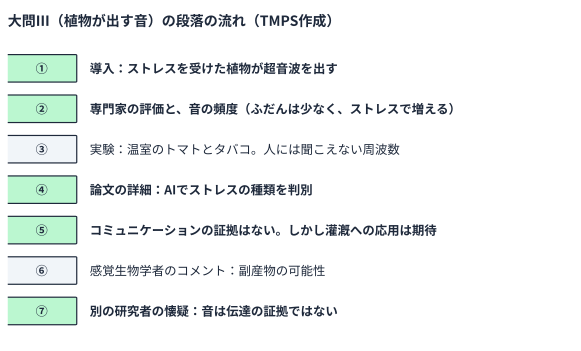
問1(1)語彙:sags(第①段落)
sags:下線の語は文脈から意味を決める。the head sags = 頭がうなだれる。bends down が最も近い。grows up は逆。
🎯 問1(1) の答え
答え:1
⚠️ 品詞に注意。動詞か名詞かで意味が変わる語がある。
問1(2)語彙:prompt(第①段落)
prompt:下線の語は文脈から意味を決める。prompt A to do = Aに~するよう促す。encourage。command(命令する)は強すぎる。
🎯 問1(2) の答え
答え:2
⚠️ 品詞に注意。動詞か名詞かで意味が変わる語がある。
問1(3)語彙:prospect(第③段落)
prospect:下線の語は文脈から意味を決める。raising the prospect that ~ = ~という見通し(可能性)を生む。possibility。
🎯 問1(3) の答え
答え:4
⚠️ 品詞に注意。動詞か名詞かで意味が変わる語がある。
問1(4)語彙:subside(第④段落)
subside:下線の語は文脈から意味を決める。peak at day five or six and then subside = ピークの後、おさまる。decrease。
🎯 問1(4) の答え
答え:3
⚠️ 品詞に注意。動詞か名詞かで意味が変わる語がある。
問1(5)語彙:exploit(第⑥段落)
exploit:下線の語は文脈から意味を決める。名詞の「exploit(偉業)」と混同しない。ここでは動詞:情報を活用する。use。
🎯 問1(5) の答え
答え:1
⚠️ 品詞に注意。動詞か名詞かで意味が変わる語がある。
問2 (1)〜(5)内容一致
(1) 専門家が「刺激的で考えさせられる」と評した発見:第2段落。植物の王国は思ったほど静かではない → 4(ストレスを受けると、より多く音を出す)。
(2) ハダニー氏のグループの研究が示すこと:第3段落。人間の耳には高すぎる周波数だが、蛾やネズミなどは感知できる → 2。
(3) AIの役割:第4段落。音だけで植物の種類とストレスの原因を判別するようAIを訓練 → 1(音を出した原因を示唆した)。選択肢の表現はやや広いが、最も近い。
(4) 第5段落が示すこと:マイクとセンサーで水不足を検知し、灌漑を効率化できるかもしれない → 3(研究成果が作物の生産の改善に役立つ)。
(5) ビシエント氏の主張:第7段落。音の存在は、植物が伝達している証拠ではない → 1。
🎯 問2 の答え
問2(1):4問2(2):2問2(3):1(要確認)問2(4):3問2(5):1
⚠️ 「〜かもしれない」と「〜である」の区別。本文は「証拠はない」「可能性」と慎重に書いているので、断定した選択肢((4) の2、(5) の2・4)は不可。要確認:(3) は選択肢の言い回しが本文より広く、判断が割れる可能性があります。
Yuiちゃん
「証拠はない」と書いてあるのに、選択肢で断定されているとき、どう判断しますか?Mio先生
本文が慎重に書いているのに、選択肢が言い切っていたら、まず疑います。ニックニ先生
「may」「might」「no evidence」に丸をつけて読むと、選択肢の断定が見抜けるぞ。Mio先生の総整理表
大問Ⅲ:型と着眼点
| 問 | 型 | 着眼点 |
|---|---|---|
| 問1 | 同義語5問 | 品詞と文脈 |
| 問2(1)(2) | 事実 | 第2・3段落の根拠 |
| 問2(3)(4) | 含意 | 「何のためにAIを使ったか」「何に役立つか」 |
| 問2(5) | 主張 | 最終段落の懐疑的な意見 |
TMPSコーチング診断
🩺【自己診断】大問Ⅲで手が止まった人への処方箋
- 問1語義に迷う → 品詞を確認し、前後の語とのつながりで決める
- 問2根拠が見つからない → 設問の語(Hadany、AI、Vicient)がある段落を探す
- 問2断定の選択肢を選ぶ → 本文の may・might・no evidence に印をつけ、断定を避ける
大問Ⅳ クマムシのゲノム ── 「前の研究との違い」を軸に読む
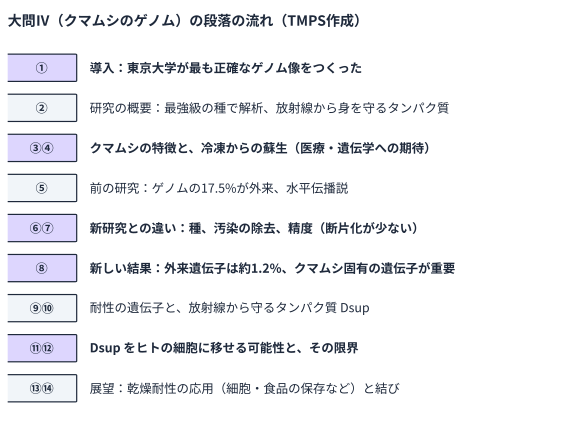
14段落と一番長い長文。段落の数は多いが、「前の研究 → 新研究の違い → 結果 → 展望」の流れに沿って読めば、迷いません。
現場戦略試験会場でのリアルな立ち回り(大問Ⅳ)
⏱ 目標時間 & 死守ライン目標15分。語彙4問に3分、内容6問に10分、見直し2分。
⚠️ 損切り・警戒ライン長いので、時間が足りないときは、問2(1)・(2)・(6) のような全体を問う設問を先に取る。
💡 初手の思考トリガー「前の研究は…、しかし新研究は…」の対比(第5〜8段落)が、設問の中心。
📝 どういう問題か?
東京大学の研究グループがクマムシのゲノムを高い精度で解読し、前の研究(外来遺伝子が多いとする説)と違う結果を出したという記事。放射線から身を守るタンパク質(Dsup)、ヒトへの応用の可能性とその限界が述べられる。①〜⑭は段落番号。
- 問1(1)〜(4):下線の語・語句(neat、resilient、counteract、impervious to)に最も近い意味を選ぶ
- 問2(1)〜(6):本文の内容に合う答えを4択から選ぶ(最後は記事の最適なタイトル)
問1(1)語彙:neat(第①段落)
neat:下線の語は文脈から意味を決める。the neat tricks = 面白い(すてきな)工夫。interesting。suspicious や dumb は文脈に合わない。
🎯 問1(1) の答え
答え:3
⚠️ 文脈で決める。(1) の neat は「きちんとした」ではなく「巧みな」。
問1(2)語彙:resilient(第⑥段落)
resilient:下線の語は文脈から意味を決める。the most resilient species = 最も強靭な種。tough。weak は逆。
🎯 問1(2) の答え
答え:4
⚠️ 文脈で決める。(1) の neat は「きちんとした」ではなく「巧みな」。
問1(3)語彙:counteract(第⑨段落)
counteract:下線の語は文脈から意味を決める。counteract oxidative stress = 酸化ストレスに対抗する。work against。
🎯 問1(3) の答え
答え:1
⚠️ 文脈で決める。(1) の neat は「きちんとした」ではなく「巧みな」。
問1(4)語彙:impervious to(第⑩段落)
impervious to:下線の語は文脈から意味を決める。impervious to radiation = 放射線をものともしない。not affected by。
🎯 問1(4) の答え
答え:2
⚠️ 文脈で決める。(1) の neat は「きちんとした」ではなく「巧みな」。
問2 (1)〜(6)内容一致とタイトル
(1) 東京大学の研究者が成し遂げたこと:第1・2・7段落。ゲノムを高い精度で解読 → 3(より良いDNAの地図をつくった)。
(2) 第3・4段落が示すこと:クマムシの耐性(凍結・乾燥・宇宙空間)と、医療・遺伝学への期待 → 4(健康科学に役立つかもしれない)。2の「300年」は本文の「30年」と数字が違う。
(3) 第5〜8段落の要点:前の研究が示した「外来遺伝子が多い」という見方を、新研究が覆した → 2。
(4) 本文と一致するもの:第10・11段落。Dsup による放射線耐性は他の細胞に移せる可能性がある → 1。
(5) 国枝氏について推測できること:第12・13段落。限界を認めながら、将来に楽観的 → 3。4(乾燥耐性は他の種で実現しない)は本文と逆。
(6) 最適なタイトル:記事全体の主題(解読の成果と、非凡な動物の秘密)→ 3。
🎯 問2 の答え
問2(1):3問2(2):4問2(3):2問2(4):1問2(5):3問2(6):3(要確認)
⚠️ 数字の違い(30年と300年、17.5%と1.2%)は、典型的な誤りの選択肢。要確認:(6) のタイトルは、選択肢が全体の主題を言い換えたもので、判断が割れる可能性があります。
Yuiちゃん
14段落もあると、最初から最後まで読む時間がありません…。Mio先生
全部を同じ濃さで読まなくていいです。導入の第1・2段落、対比の第5〜8段落、展望の第12〜14段落が、設問の中心です。ニックニ先生
時計が残り25分になったら、ここで切り上げてⅤへ。未回答の問は、勘で埋めておくんだ。Mio先生の総整理表
大問Ⅳ:型と着眼点
| 問 | 型 | 着眼点 |
|---|---|---|
| 問1 | 同義語4問 | 文脈で決める |
| 問2(1)(2) | 成果と含意 | 導入と第3・4段落 |
| 問2(3) | 要点 | 第5〜8段落の対比 |
| 問2(4)(5) | 事実と人物像 | 第10〜13段落 |
| 問2(6) | タイトル | 全体の主題 |
TMPSコーチング診断
🩺【自己診断】大問Ⅳで手が止まった人への処方箋
- 問1語義が出ない → 下線を空所に見立て、文脈に合う選択肢を選ぶ
- 問2(1)(2)(6)全体を問う問が解けない → 第1・2段落と最終段落だけで主題を決める
- 問2(3)〜(5)細部で迷う → 数字と固有名詞を本文で照合する
大問Ⅴ 自由英作文 ── 設問の指示に答え、構成を守る
最後に自由英作文がある、と最初の注意書きにあるとおり、ここで時間を使い切らないことが最重要です。
現場戦略試験会場でのリアルな立ち回り(大問Ⅴ)
⏱ 目標時間 & 死守ライン目標20分。構想5分、執筆12分、見直し3分。
⚠️ 損切り・警戒ライン書き出しで20分以上迷ったら、「集団の紹介」の1文だけ先に書き、残りを埋める。
💡 初手の思考トリガー(1) と (2) の2つの問いを、そのまま本論の2段落にする。
📝 どういう問題か?
出題の指示に、「量と質の両面から評価する」「テーマに答えているかも評価する」とある。つまり、(1) と (2) の両方に答え、十分な語数を書くことが条件。
- テーマ:自分が属する集団(スポーツ・学校の部活動を除く)が、(1) 自分のアイデンティティをどのように形づくったか、(2) 多文化の環境に貢献する上でどう役立つか、を英語で述べる
- 導入・本論・結論のある1つのエッセイ。本文を読んでいない人に向けて書く。解答欄は19.8cm×22行
答案の設計図
20分で書く手順
| 時間 | やること | ポイント |
|---|---|---|
| 2分 | 集団を1つ決める | 部活動以外(地域の活動、アルバイト、習い事、ボランティアなど)。「具体的な場面」が書けるもの |
| 3分 | (1) と (2) を1文ずつ決める | (1) 自分の変化、(2) 医師として・多文化の場で何をするか |
| 12分 | 書く | 導入1文+本論2段落+結論1文。1文を短く、つなぎ語(First, Second, In conclusion)を使う |
| 3分 | 見直し | 時制、主語と動詞の一致、冠詞、語数 |
解答例(TMPS作成・採点基準ではありません)
Among the groups I belong to, the one that has shaped me most is a community orchestra that rehearses every Saturday in a local hall. Its members range from a high school student to a retired pharmacist, and several of them grew up in other countries.
This group has formed my identity in two ways. First, playing in an ensemble taught me to listen before I act. A melody sounds beautiful only when each player hears the others, and I have learned that the same is true of conversation. Second, I used to believe that being good meant never making mistakes, but my fellow players showed me that people improve fastest when they help one another without blame.
These lessons will help me contribute to a multicultural environment. In a diverse community, misunderstandings are unavoidable, and the habit of listening carefully will let me notice what others need before I assume I know. As a future doctor, I will meet patients whose languages and customs differ from mine, and I want to treat each of them as a partner who knows something I do not.
In conclusion, my orchestra has taught me that a group becomes strong when its members listen, and I hope to bring this attitude to every team I join.
語数:213語。構成は、導入(集団の紹介)→ 本論((1) 自分への影響、(2) 多文化の場での活かし方)→ 結論の4段落。「スポーツや部活動を除く」という条件を満たすため、地域の楽団を例にしている。
⚠️ 課題の条件の見落としが最大の失点。「スポーツ・部活動を除く」を見落とさない。(1) と (2) のどちらか片方だけに偏らない。要確認:自由英作文の評価基準は公表されていないため、解答例は一例です。語数の目安(200語前後)は、22行の解答欄から推定したものです。
Yuiちゃん
英作文は、何から書き始めればいいか分かりません。Mio先生
最初の1文は「自分が属している集団」を紹介する文で大丈夫です。そのあとに、(1)、(2) を1段落ずつ書きましょう。ニックニ先生
名文を書こうとしない。短い文を正確に。これが一番点が伸びる。Mio先生の総整理表
大問Ⅴ:型と着眼点
| 項目 | 内容 |
|---|---|
| 課題 | 集団が自分を形づくった → 多文化の場に貢献 |
| 構成 | 導入・本論(2つ)・結論 |
| 語数 | 200語前後が目安(要確認) |
| 条件 | スポーツ・部活動を除く |
TMPSコーチング診断
🩺【自己診断】大問Ⅴで手が止まった人への処方箋
- 構想集団が決まらない → 「自分が最も長く続けたこと(部活動以外)」を1つ選ぶ
- 執筆英語が出ない → 簡単な文を重ねる(主語+動詞+目的語)。難しい語は使わない
- 見直しミスが多い → 時制(過去と現在)、a/the、三単現の s を順に確認
本番の答え一覧(採点用)
解説を読んだあとの採点用です。数字は選択肢の番号です。
大問Ⅰ(インタビュー)
問1(1):4問1(2):2問1(3):1問1(4):3問2(1):未確定問2(2):未確定問2(3):未確定問3(1):未確定問3(2):4(暫定)問3(3):3(暫定)
大問Ⅱ(宇宙法)
問1(1):4問1(2):1問1(3):3問1(4):2問1(5):4問2(1):2問2(2):4問2(3):2問2(4):1問2(5):3
大問Ⅲ(植物の音)
問1(1):1問1(2):2問1(3):4問1(4):3問1(5):1問2(1):4問2(2):2問2(3):1問2(4):3問2(5):1
大問Ⅳ(クマムシ)
問1(1):3問1(2):4問1(3):1問1(4):2問2(1):3問2(2):4問2(3):2問2(4):1問2(5):3問2(6):3
大問Ⅴ(自由英作文)
解答例は上の大問Ⅴの解説(1)(2) の両方に答え、導入・本論・結論の構成にする
⚠️ 要確認:(a) 大問Ⅰの本文は、出典の記事を読み込めず、確認できていません。問2(1)〜(3)・問3(1)は未確定、問3(2)(3)は暫定です。(b) 大問Ⅱ 問2(4)、大問Ⅲ 問2(3)、大問Ⅳ 問2(6) は、選択肢の言い回しから判断が割れる可能性があります。(c) 大問Ⅱ〜Ⅳの答えは、本文と照らしてTMPSが導いたもので、公式の解答は参照していません。
※ 答えの範囲(1〜4)、設問数、自由英作文の語数と構成は、スクリプトで確かめています。意味の正しさは機械では確かめられないため、上記の要確認の扱いにしています。
採点したら → 30秒の得点診断へ
TMPS ORIGINAL
順天堂大2024型 そっくり類題セット
順天堂大2024型 そっくり類題セット
(全5大問・解答解説つき)
2024年度の本番と同じ構成(インタビュー、長文3題、自由英作文)で、題材・本文・設問をすべて新しく作ったTMPSオリジナル問題です。語彙を先に取る、段落に根拠の印をつける、英作文に20分を残すの練習に使ってください。
試験時間の目安 80分インタビュー・長文3題・自由英作文
📄 本番形式の問題冊子PDFをダウンロード(全9ページ)
印刷して本番と同じように80分で解けます。解答・解説はこのページの下に掲載しています。
※ 順天堂大学の入試問題ではありません。本文・設問・人物・団体(架空)はすべてTMPS医学館が作成したオリジナルで、出典のある引用ではありません。
類題 大問Ⅰ
次のインタビュー記事を読み、以下の設問に答えなさい。
The following is an interview with two physicians, conducted by a health magazine.
Last year, a growing number of hospitals began to hand out wearable devices to patients who had been sent home after heart surgery. We spoke to two physicians about what these devices can and cannot do. Dr. Naomi Calder is a cardiologist, and Dr. Idris Okafor works in primary care.
Calder: "The strength of a wearable is that it is always on. A clinic visit gives me one snapshot every few months, but a watch records thousands of heartbeats a day. When the rhythm changes, the device detects it and sends an alert to our team, sometimes before the patient feels anything." She is quick to add that the technology is not magic. "Our staff must still be meticulous about checking each alert, because a large share of them turn out to be false alarms."
Okafor sees a different challenge. "My older patients are often reluctant to wear anything that tracks them. They worry about who will see their data," he said. "We spend more time explaining privacy than explaining the heart." To address this, his clinic created a one-page guide in plain language, and nurses sit with each patient to set up the device.
Both doctors agree that the most important change is cultural rather than technical. When data arrive daily, doctors can step in early, and small problems are less likely to grow into emergencies. "In the past we waited for patients to come to us," Calder said. "Now we can reach out first." Okafor warned, however, that outreach has a cost. "If every alert leads to a phone call, the staff will burn out. We need software that can sort the signals so that humans see only the ones that matter." Such a tool, he said, could also curb unnecessary hospital visits and save money.
Asked about the gap between rich and poor patients, Calder admitted that it worries her. "A device that costs a month's rent will never reach the people who need it most." Okafor hopes that insurers will one day pay for devices the way they pay for medication. Until then, both doctors insist that the patient's outcome, not the number of gadgets sold, should be the measure of success.
問1(1) The word meticulous is closest in meaning to .
- 1. hasty
- 2. thorough
- 3. generous
- 4. costly
問1(2) The word reluctant is closest in meaning to .
- 1. eager
- 2. certain
- 3. unwilling
- 4. curious
問1(3) The word curb is closest in meaning to .
- 1. limit
- 2. expand
- 3. measure
- 4. ignore
問1(4) The word outcome is closest in meaning to .
- 1. request
- 2. cause
- 3. delay
- 4. result
問2(1) The wearable ( A ) changes in the heart's rhythm and alerts the hospital team.
- 1. detects
- 2. ignores
- 3. invents
- 4. hides
問2(2) Older patients are often anxious about the ( B ) of their personal data.
- 1. price
- 2. color
- 3. privacy
- 4. speed
問2(3) Dr. Okafor hopes that insurers will pay ( C ) these devices as they pay for medication.
- 1. for
- 2. to
- 3. at
- 4. with
問3(1) What does Dr. Calder say about the alerts sent by wearables?
- 1. Most of them are false alarms that staff can safely ignore.
- 2. Some of them arrive before the patient notices any symptoms.
- 3. They make it unnecessary for patients to visit the clinic.
- 4. They are rarely received by the hospital team.
問3(2) According to Dr. Okafor, why are some older patients unwilling to wear the devices?
- 1. They cannot afford the devices.
- 2. They believe the devices are not accurate.
- 3. They prefer to see a specialist.
- 4. They are worried about who can see their data.
問3(3) What does Dr. Okafor suggest is needed to prevent staff from burning out?
- 1. Software that sorts the signals for humans
- 2. More nurses working in the clinic
- 3. Fewer patients who use the devices
- 4. Cheaper devices for every patient
▶ 大問Ⅰ の答えと解説を見る
大問Ⅰ の答えと解説
問1(1)
答え:2
- meticulous = 細部まで注意を払う。thorough(徹底した)が最も近い。hasty は逆。
問1(2)
答え:3
- reluctant = 気が進まない。unwilling が近い。eager は逆。
問1(3)
答え:1
- curb = ~を抑える。limit が近い。expand は逆。
問1(4)
答え:4
- outcome = 結果。result。cause(原因)と取り違えない。
問2(1)
答え:1
- 第2段落:「the device detects it and sends an alert」に対応。
問2(2)
答え:3
- 第3段落:「who will see their data」「explaining privacy」から privacy。
問2(3)
答え:1
- pay for ~ = ~の代金を払う。第5段落「pay for devices the way they pay for medication」。
問3(1)
答え:2
- 第2段落「sometimes before the patient feels anything」。1は誤り(staff must still be meticulous = 無視してよいわけではない)。
問3(2)
答え:4
- 第3段落「They worry about who will see their data」。
問3(3)
答え:1
- 第4段落「We need software that can sort the signals so that humans see only the ones that matter」。
類題 大問Ⅱ
次の英文を読み、下記の設問に答えなさい。①〜⑧は段落番号を表す。
①Far below the waves, on plains of mud and rock that no sunlight has ever touched, lie millions of metal-rich lumps called nodules. For decades they sat unnoticed. Now, as the demand for batteries grows, companies are eager to bring them up. But a simple question stands in the way: who has the right to take them?
②The answer begins with a treaty. In 1982, the United Nations Convention on the Law of the Sea (UNCLOS) divided the oceans into zones. Within 200 nautical miles of a coast, a country may use the water and the seabed for its own purposes. Beyond that lies the high seas, and the seabed there is described as the "common heritage of mankind."
③To manage this shared seabed, the convention created the International Seabed Authority (ISA), based in Jamaica. No company can work in the area without a contract from the ISA, and any profit is supposed to be shared with the world, including countries without a coastline. "It was a bold idea," said Dr. Lena Marlowe, an ocean-law scholar at the University of Brightwell. "It still is."
④But the system has gaps. The ISA has issued many licenses for exploration, yet it has not finished the detailed rules for actual commercial mining. In 2021, a small island nation in the Pacific started a two-year clock that obliges the ISA to consider any mining application, whether or not the rules are ready.
⑤Some countries argue that mining should be paused until its effects on marine life are better understood. Scientists warn that the deep sea is home to slow-growing animals, and that scars left on the seabed may take centuries to heal. "We are moving faster than our knowledge," Marlowe said.
⑥Others take a different view. They say that the minerals are needed to build electric cars and wind turbines, and that mining the seabed may cause less harm than digging up forests on land. The United States, which has not ratified UNCLOS, has also suggested that it could license its own companies under domestic law, a step many lawyers consider risky.
⑦Unlike a flag planted on bare ground, a mining ship leaves physical marks, so disputes are unlikely to stay theoretical. A single license could affect fisheries thousands of kilometres away, and it is unclear who would pay if something went wrong.
⑧"This is not a problem for the distant future," Marlowe said. "The ships are being built now." Whatever the ISA decides in the coming years, the outcome will show whether the idea of a shared ocean can survive contact with commercial interest.
注1:nodule 団塊(金属を含む塊) 注2:obliges ~に義務づける 注3:ratified 承認した
問1(1) The word eager in paragraph ① is closest in meaning to .
- 1. afraid
- 2. unable
- 3. keen
- 4. slow
問1(2) The word divided in paragraph ② is closest in meaning to .
- 1. joined
- 2. separated
- 3. repeated
- 4. measured
問1(3) The word bold in paragraph ③ is closest in meaning to .
- 1. cheap
- 2. obvious
- 3. careful
- 4. daring
問1(4) The word paused in paragraph ⑤ is closest in meaning to .
- 1. hidden
- 2. doubled
- 3. suspended
- 4. celebrated
問1(5) The word heal in paragraph ⑤ is closest in meaning to .
- 1. recover
- 2. appear
- 3. spread
- 4. repeat
問2(1) According to the passage, what is true of the seabed beyond a country's 200-nautical-mile zone?
- 1. Any country may mine it freely.
- 2. It is treated as belonging to all of humanity.
- 3. It is owned by the International Seabed Authority.
- 4. It belongs to the nearest coastal country.
問2(2) What is the role of the ISA?
- 1. To pay for mining ships in developing countries
- 2. To collect fees from fishing fleets
- 3. To decide who may carry out activities on the shared seabed
- 4. To protect the coastlines of island nations
問2(3) What can be inferred from the move made by the island nation in 2021?
- 1. It started a deadline that pushes the ISA to act on mining applications.
- 2. It permanently banned mining in the Pacific.
- 3. It ended the authority of the ISA.
- 4. It reduced the number of exploration licenses.
問2(4) Which of the following is mentioned as an argument in favor of seabed mining?
- 1. It will create new fishing grounds.
- 2. It will lower the temperature of the oceans.
- 3. It is cheaper than recycling old batteries.
- 4. It supplies minerals for electric cars and may cause less harm than mining on land.
問2(5) What does the passage suggest about the future of this issue?
- 1. It has already been settled by a treaty.
- 2. It will become urgent only in the distant future.
- 3. It is a pressing question whose outcome will test the idea of a shared ocean.
- 4. It is a minor concern compared with other problems of the sea.
▶ 大問Ⅱ の答えと解説を見る
大問Ⅱ の答えと解説
問1(1)
答え:3
- be eager to ~ = ~したがっている。keen が近い。
問1(2)
答え:2
- divide = 分ける。separated。joined は逆。
問1(3)
答え:4
- bold idea = 大胆な考え。daring。careful は逆。
問1(4)
答え:3
- pause = 一時停止する。suspended。
問1(5)
答え:1
- heal = 回復する。recover。
問2(1)
答え:2
- 第2段落「common heritage of mankind」。ISA は所有者ではなく管理者(第3段落)。
問2(2)
答え:3
- 第3段落「No company can work in the area without a contract from the ISA」。
問2(3)
答え:1
- 第4段落「a two-year clock that obliges the ISA to consider any mining application」。
問2(4)
答え:4
- 第6段落「needed to build electric cars and wind turbines」「less harm than digging up forests on land」。
問2(5)
答え:3
- 第8段落「not a problem for the distant future」「whether the idea of a shared ocean can survive」。
類題 大問Ⅲ
次の英文を読み、下記の設問に答えなさい。①〜⑥は段落番号を表す。
①A crow does not forget a face. In a long-running study led by Dr. Hiro Tanabe of the University of Westbury, researchers wore rubber masks while catching and tagging wild crows in a city park. Years later, when the same masks reappeared, crows that had never been caught scolded the wearer loudly, as if they too knew who the enemy was.
②Tanabe describes the result as "unsettling and wonderful at once." His team recorded the birds' reactions for six years. Crows that had been caught remembered the mask for at least five years, and the number of birds that scolded it kept growing. Many of the angry crows were young birds that had not even hatched at the time of the capture.
③How did the news spread? The scientists believe there are two routes. Young crows learn by watching their parents react, while others pick up the alarm calls of their neighbors and link them to the mask they see. Brain scans of crows shown the dangerous mask showed more activity in regions linked to fear and memory than scans of birds shown a neutral mask.
④The findings may help explain why crows live so successfully in cities. A species that can pass on knowledge about danger can adapt quickly when new hazards, such as cars or poison, appear.
⑤Not everyone is convinced. Dr. Maria Quint, a behavior specialist at the Ardent Institute, praised the study but cautioned against reading too much into it. "Scolding a mask is not the same as holding a grudge," she said. "A bird may simply react to anything that looks like a threat." She also noted that the study followed crows in one city, so the result may not apply elsewhere.
⑥Tanabe agrees that more work is needed. His next step is to test whether crows can recognize human faces in photographs, which would show that they do not depend on a single feature such as a mask. If they can, he says, we may need to rethink how much information birds take from the people around them.
注1:grudge 恨み 注2:hatch 孵化する
問1(1) The word unsettling in paragraph ② is closest in meaning to .
- 1. familiar
- 2. pleasing
- 3. disturbing
- 4. cheap
問1(2) The word hazards in paragraph ④ is closest in meaning to .
- 1. dangers
- 2. rewards
- 3. habits
- 4. tools
問1(3) The word convinced in paragraph ⑤ is closest in meaning to .
- 1. tired
- 2. persuaded
- 3. invited
- 4. puzzled
問1(4) The word cautioned in paragraph ⑤ is closest in meaning to .
- 1. asked
- 2. thanked
- 3. invited
- 4. warned
問1(5) The word rethink in paragraph ⑥ is closest in meaning to .
- 1. repeat
- 2. resist
- 3. reconsider
- 4. report
問2(1) What did the researchers find about the crows that had never been caught?
- 1. They ignored the mask.
- 2. They also scolded the mask.
- 3. They flew away from the park.
- 4. They were tagged later.
問2(2) What does the study imply about the crows' memory?
- 1. It can last for several years.
- 2. It is stronger in older birds.
- 3. It fades after about a year.
- 4. It is limited to masks.
問2(3) How might the news about the mask have spread among crows?
- 1. Through chemical signals left on trees
- 2. By crows reading the faces of the researchers
- 3. By young crows learning from their parents' reactions and neighbors' alarm calls
- 4. By the researchers teaching the crows in cages
問2(4) What is implied by paragraph ④?
- 1. Cities are safer than forests for crows.
- 2. Crows are more intelligent than all other birds.
- 3. Cars and poison are not a danger to crows.
- 4. Sharing knowledge about danger helps crows live in cities.
問2(5) Which of the following is closest to the argument made by Dr. Quint?
- 1. The study proves that crows recognize faces.
- 2. A crow's reaction does not necessarily show a lasting grudge.
- 3. Crows in other cities ignore masks.
- 4. The study was too short to be useful.
▶ 大問Ⅲ の答えと解説を見る
大問Ⅲ の答えと解説
問1(1)
答え:3
- unsettling = 心をざわつかせる。disturbing。
問1(2)
答え:1
- hazard = 危険。dangers。
問1(3)
答え:2
- Not everyone is convinced = 全員が納得したわけではない。persuaded。
問1(4)
答え:4
- caution against ~ = ~しないよう警告する。warned。
問1(5)
答え:3
- rethink = 考え直す。reconsider。
問2(1)
答え:2
- 第1段落「crows that had never been caught scolded the wearer」。
問2(2)
答え:1
- 第2段落「remembered the mask for at least five years」。
問2(3)
答え:3
- 第3段落「Young crows learn by watching their parents react, while others pick up the alarm calls」。
問2(4)
答え:4
- 第4段落「A species that can pass on knowledge about danger can adapt quickly」。
問2(5)
答え:2
- 第5段落「Scolding a mask is not the same as holding a grudge」。
類題 大問Ⅳ
次の英文を読み、下記の設問に答えなさい。①〜⑨は段落番号を表す。
①Axolotls, sometimes called "walking fish," are small salamanders that can regrow a lost leg, a damaged heart, and even parts of their brain. Researchers at the Northfield Institute have now produced the most complete map yet of the axolotl genome, shedding light on how the animal performs such astonishing feats.
②The task was far from easy. The axolotl genome is about ten times larger than the human one, and much of it is made of repeating sequences that confuse sequencing machines. Earlier attempts left many gaps. "It was like assembling a puzzle with thousands of nearly identical pieces," said geneticist Dr. Samira Voss, who led the project.
③To solve the problem, the team combined two technologies: one that reads long stretches of DNA, and another that reads short stretches with high accuracy. The result is a genome with far fewer gaps than any earlier version. Axolotls have long fascinated doctors. Humans heal wounds by forming scars, while an axolotl simply regrows what it has lost, with bones, muscles, and nerves all in the right place.
④Scientists hope that understanding this process could one day help patients with spinal injuries or damaged hearts. A few months ago, another group reported that axolotl cells placed in a mouse kept some of their ability to form new tissue. Such results are encouraging, though they remain far from clinical use.
⑤Many scientists had assumed that regeneration must depend on a small set of genes found only in salamanders. The new genome challenges this view. Voss's team found that most of the genes involved in regrowth also exist in humans and other animals.
⑥What differs is how those genes are switched on. After an injury, the axolotl activates a group of them in a precise order within hours, something mammals do not do. The team identified several stretches of DNA that act like switches, and showed that some of them become active only near wounds.
⑦In an experiment, the researchers removed one of these switches from young axolotls. The animals grew normally, but their ability to regrow a limb was reduced by about half. "The switch is helpful, but it is not the whole story," Voss said.
⑧The study also found that axolotls carry extra copies of genes that repair damaged DNA, which may protect cells during rapid growth. Whether these copies contribute to regeneration is not yet known.
⑨Voss is cautious about the prospects for people. "We will not be regrowing human arms any time soon," she said. "But if we can learn when to turn the switches on, we may be able to help the body heal better than it does now." For now, the little salamander has again shown that nature still has many lessons to teach us.
注1:salamander サンショウウオの仲間 注2:sequence (塩基の)配列 注3:regeneration 再生
問1(1) The word astonishing in paragraph ① is closest in meaning to .
- 1. ordinary
- 2. amazing
- 3. cruel
- 4. silent
問1(2) The word combined in paragraph ③ is closest in meaning to .
- 1. limited
- 2. sold
- 3. joined
- 4. broke
問1(3) The word encouraging in paragraph ④ is closest in meaning to .
- 1. shocking
- 2. boring
- 3. confusing
- 4. hopeful
問1(4) The word precise in paragraph ⑥ is closest in meaning to .
- 1. random
- 2. exact
- 3. rapid
- 4. simple
問2(1) According to the article, what did the researchers at the Northfield Institute achieve?
- 1. They identified new species of salamander.
- 2. They created a more complete map of axolotl DNA.
- 3. They grew a human limb in a laboratory.
- 4. They discovered why axolotls are so large.
問2(2) What is implied by paragraphs ③ and ④?
- 1. Axolotl research may become useful for treating human injuries.
- 2. Axolotls are difficult animals to keep in laboratories.
- 3. Humans will soon be able to regrow lost limbs.
- 4. Scars are the best way for the body to heal.
問2(3) What is the main point of paragraphs ⑤ through ⑧?
- 1. Axolotls have genes that are found in no other animal.
- 2. Axolotls are the only animals that can repair damaged DNA.
- 3. New research has challenged an old assumption about regeneration.
- 4. Gene switches are found only in salamanders.
問2(4) Based on the article, which of the following statements is true?
- 1. Removing a switch stopped limb regrowth completely.
- 2. Humans do not have any of the genes used in regrowth.
- 3. Axolotl cells cannot survive outside the animal.
- 4. Some stretches of DNA become active only near a wound.
問2(5) According to the article, what can be inferred about Dr. Voss?
- 1. She expects people to regrow arms in the near future.
- 2. She is hopeful about the research but realistic about its limits.
- 3. She believes that extra repair genes are the cause of regeneration.
- 4. She doubts that the research will ever help human patients.
問2(6) Which of the following would be the best title for the article?
- 1. Mapping the Secrets of a Self-Healing Animal
- 2. Why Humans Cannot Regrow Their Limbs
- 3. The Discovery of a New Salamander Species
- 4. Gene Switches Are the Cure for Spinal Injuries
▶ 大問Ⅳ の答えと解説を見る
大問Ⅳ の答えと解説
問1(1)
答え:2
- astonishing = 驚くべき。amazing。
問1(2)
答え:3
- combine = 組み合わせる。joined。
問1(3)
答え:4
- encouraging = 希望の持てる。hopeful。
問1(4)
答え:2
- precise = 正確な。exact。random は逆。
問2(1)
答え:2
- 第1段落「the most complete map yet of the axolotl genome」。
問2(2)
答え:1
- 第3・4段落「help patients with spinal injuries or damaged hearts」「far from clinical use」。3は言い過ぎ。
問2(3)
答え:3
- 第5段落「The new genome challenges this view」が要点。
問2(4)
答え:4
- 第6段落「some of them become active only near wounds」。第7段落は「reduced by about half」なので1は誤り。
問2(5)
答え:2
- 第9段落「not regrowing human arms any time soon」「may be able to help the body heal better」。
問2(6)
答え:1
- 全体の主題は、アホロートルのゲノム解読と再生の仕組みの手がかり。
類題 大問Ⅴ
自由英作文問題 下記テーマについて、英語で自分の考えを述べなさい。書体は活字体でも筆記体でもよいが、解答は所定の範囲内に収めなさい。
You are expected to write one complete essay. Your essay should include an introduction, main text, AND conclusion. Please write as if you are writing for someone who has not read the topic question.
Everyone belongs to groups that help shape who they are. Think about a group or community you have belonged to outside of school classes. Please describe how your experiences in that group (1) have shaped the way you listen to and learn from others and (2) will help you work with people of different backgrounds as a doctor. Exclude your family and your private tutors.
(解答欄)19.8 cm × 22 行(目安:本番は 19.8 cm × 22 行)
▶ 大問Ⅴ の答えと解説を見る
大問Ⅴ の答えと解説
解答例(自由英作文)
答えは一例です
When I was twelve, I joined a local volunteer group that delivered meals to older people living alone. At first, I thought I was only helping them, but I soon learned that I was the one receiving something. The group included retired teachers, college students, and a few recent immigrants, and each of them looked at the same neighborhood in a different way. Listening to their stories taught me to ask questions before forming opinions, and it showed me that every person has knowledge that I do not.
These experiences will help me contribute to a multicultural environment in two ways. First, I have learned that people feel respected when they are listened to without being interrupted, and this habit will help me build trust with classmates from many backgrounds. Second, I have seen how a group solves problems better when everyone is invited to speak. In the future I want to be a doctor who asks patients about their lives, not only their symptoms.
In conclusion, the group I belonged to shaped me into a person who listens first, and I hope to carry that habit into every community I join.
構成:導入(自分の所属集団)→ 本論((1) 自分への影響、(2) 多文化の場での活かし方)→ 結論。語数 192。課題の除外条件(家族・家庭教師)には触れていない。
※ 類題は、本番の設問の型と数(語彙→空所→内容、長文の語彙5問+内容5問、自由英作文)は残し、題材(ウェアラブル機器、深海の所有権、カラスの記憶、アホロートルの再生)・本文・設問はすべて新しく作っています。人物・団体は架空です。答えの範囲・設問数・語数はスクリプトで確かめてあります。選択肢が一つに決まるかは、TMPSが本文と照らして確認しています。
30秒 得点診断
本番の過去問、またはそっくり類題セットを80分で解いた結果を選んでください。次にやるべきことを表示します。
保護者の方へ:順天堂大の英語で知っておきたい3つのこと
① 長文は「型」で解ける
大問Ⅱ〜Ⅳは、語彙と内容一致の4択という同じ型です。型を知っていれば、初見の英文でも時間配分が読めます。② 自由英作文は「配点が大きい」ので時間を確保
最後の大問に自由英作文があります。長文に時間を使い切ってしまうと、書く時間がなくなります。配分を決めて練習することが大切です。③ 秋からは「答案を見てもらう」
英作文の添削や、時間配分は独学では直しにくい部分です。第三者の目で見てもらうと最短で伸びます。よくある質問
Q. 順天堂大学 医学部の英語2024年度は、どの順番で解くのがよいですか?
TMPSのおすすめは、大問Ⅰ(インタビュー)15分、Ⅱ 14分、Ⅲ 13分、Ⅳ 15分、Ⅴ(自由英作文)20分、見直し3分です(80分)。Ⅱ〜Ⅳは長文の形が同じ(語彙5問+内容5問、Ⅳだけ4問+6問)なので、先に語彙問題だけ全部取り、そのあと内容問題を解くと時間が読めます。自由英作文の20分は最初に確保しておきます。
Q. 問題文(英文)が載っていなくても、どんな問題か分かりますか?
分かります。著作権に配慮して英文の本文・設問文は掲載していませんが、各大問の「段落の流れ」の図と、設問ごとの「どういう問題か」で、設問の型・根拠の取り方を説明しています。
Q. 大問Ⅰの答えに「未確定」があるのはなぜですか?
手元の過去問集では、大問Ⅰのインタビュー本文が著作権の都合で省略されています。TMPSでは出典(NEJMのポッドキャストの記事)の本文を確認しようとしましたが、読み込めませんでした。そのため本文に依存する4問は未確定とし、語義や設問から推定できる問いだけ答えを示しています。お手元の過去問の原文で確かめてください。
Q. そっくり類題セットとは何ですか?
2024年度と同じ構成(大問5つ、設問の型と数)で、題材・本文・設問をすべて新しく作ったTMPSオリジナル問題です(人物・団体は架空)。全問の答えと解説をこのページに載せ、本番形式のPDFも無料で配布しています。
Q. 解説に誤りを見つけたらどうすればいいですか?
公式LINEからお知らせください。確認のうえ修正し、更新日を記載します。
安心安全・継続更新システム
問題等で誤りを発見された場合、修正しますので、TMPS医学館までLINEを下さい。
受験生・指導者の皆様からのご指摘を真摯に受け止め、最も信頼できる過去問解説・類題ライブラリーとして随時アップデートいたします。
🔥 次に読むならこちら
順天堂大の英語を、
あなたの答案で攻略する
「どこで時間を失ったか」「どの設問を後回しにすべきだったか」「英作文の書き方の癖」を、先生があなたの答案から直接診断します。