下線部の直前の文に、〈それを見ると忘れてしまうかもしれない出来事を思い出させる〉という説明があり、その具体例として古い手紙・プログラム・旅の思い出の品が並ぶ。説明に入れる要素:①自分だけのために取っておきたいもの ②忘れてしまうかもしれない出来事を思い出させる ③具体例(手紙・プログラム・旅の思い出の品)。
解答例 解答例:忘れてしまうかもしれない出来事を思い出させてくれる、古い手紙・プログラム・旅の思い出の品など、自分だけのために取っておきたい個人的な品々。
問題文は掲載できませんが、
解説を読むだけでどんな問題かもわかる!
さらに、そっくり類題PDFを見れば、実際の問題イメージもわかるよ!
各設問を「どういう問題か」から説明し、考え方を1行も飛ばさずに解説。最後に、本番と同じ3大問の構成で作ったそっくり類題セット(全問解答つき)で、2025年度を丸ごと演習できます。
📌 このページの使い方
※ 著作権に配慮し、入試問題の英文の本文・設問文は掲載していません。設問番号・選択肢の記号は、本番の解答欄との対応を示すためのものです。※ 説明・和訳・和文英訳は「解答例」です。選択・語句の問題は、TMPSが本文から独自に導いた答えです(過去問集の解答は参照していません)。
⚠️ 問題等で誤りを発見された場合、修正しますので、TMPS医学館までLINEを下さい。(迅速に確認・更新いたします)
LINEで誤りを連絡

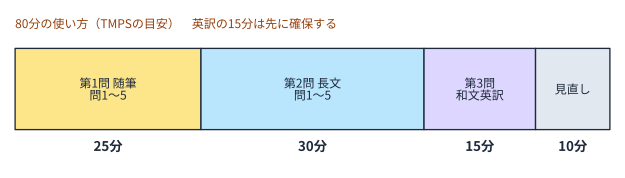
時間はTMPSの目安です。解く順番と「先に確保する時間」をセットで覚えておきましょう。
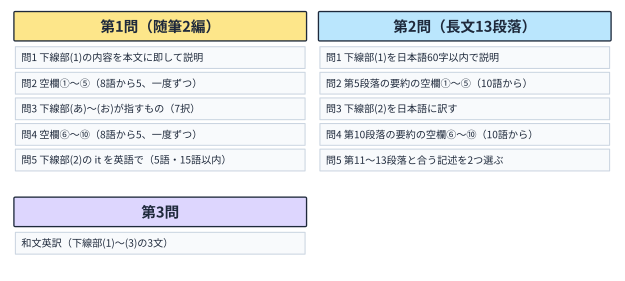
一人称の随筆が2編続きます。前半は人生の整理の中で、自分だけのために取っておく小さな思い出の箱、後半は家族が世界各地に離れて暮らす中での手紙のやりとりが題材です。下線部は(1)(2)と、代名詞(あ)〜(お)、空欄は①〜⑩があり、設問は問1〜問5です。
本文の最初で、作者は「自分だけのために取っておきたいもの」について語る。下線部は、その集まりを一括して指している。
下線部の直前の文に、〈それを見ると忘れてしまうかもしれない出来事を思い出させる〉という説明があり、その具体例として古い手紙・プログラム・旅の思い出の品が並ぶ。説明に入れる要素:①自分だけのために取っておきたいもの ②忘れてしまうかもしれない出来事を思い出させる ③具体例(手紙・プログラム・旅の思い出の品)。
解答例 解答例:忘れてしまうかもしれない出来事を思い出させてくれる、古い手紙・プログラム・旅の思い出の品など、自分だけのために取っておきたい個人的な品々。
随筆の前半(「捨てる前に取っておく箱」の話)にある5つの空欄に、動詞を1つずつ入れる。
①=ア amuse:「手紙や写真が、子どもたちを〈楽しませる〉だろう」。目的語が人(my dear ones)で、主語がもの。②=オ get:「いつも思い出の中に〈はまり込む〉」=get stuck。stuck は形容詞(過去分詞)で、get + stuck の形。
③=エ decide:「小さなものを取っておこうと〈決める〉と、ほっとする」。decide to ~の形。④=ク remind:「大切な日々や出来事を〈思い出させる〉」=remind A of B。⑤=イ choose:「大きな箱を〈選んで〉はいけない(靴の空き箱で十分)」。
使わない語:ウ clean、カ justify、キ remember。
随筆の後半(手紙のやりとり)にある、5つの下線部の代名詞(they / them)が何を指すかを答える。
(あ)=イ:「お金がもっと必要になれば」と手紙に書いてくるのは、旅行や留学をしている子どもたち。(い)=エ:「それらの多くを私はとっておいた」の them は、子どもたちが書いたカードや手紙。
(う)=ウ:「封筒の宛名の書き方さえ知っているか納得できない」の they は、直前の孫たち。(え)=イ:「(私たちの)子どもが小さいころ、お礼状を書かされた」の they は子どもたち。(お)=カ:「義母が青いビニール袋に入れて返した」ものは、作者が義母に書いた手紙。
手紙のやりとりの後半にある5つの空欄に、語を1つずつ入れる。副詞・形容詞・名詞が混ざる。
⑥=キ too:「読み書きするには〈幼すぎる〉」=too young to ~。⑦=ウ did:「姉や兄たちが(書いた)のと同じように」=like her older sister and brothers did。did は wrote の代動詞。
⑧=オ old:「わずか6歳〈だった〉」=six years old。⑨=エ later:「ずっと〈あとに〉私はマルタを訪れた」=much later。⑩=イ contact:「その種の〈連絡〉」=that kind of contact(遠くの人と話せること)。
使わない語:ア age、カ soon、ク write。
「(2) 私はそれを捨てるつもりはない」の it が何かを、英語で答える。
it が指すのは、直前に話題になっていた袋(義母が手紙を入れて返した袋)。 that contains の後ろは、その中身=作者が義母に書いた手紙のすべて。
解答例 解答例:(a) the blue plastic bag(4語)/ (b) all the letters the author wrote to her mother-in-law(9語)。
letters の前に「作者が義母に」という限定が必要。「the letters」だけでは減点されやすい。
| 問 | 型 | 着眼点 |
|---|---|---|
| 問1 | 下線部の説明(記述) | 直前の文の定義と具体例を、本文の言葉で |
| 問2 | 空欄①〜⑤(8語から5) | 動詞。目的語・後ろの語(stuck・to・of)から |
| 問3 | 代名詞(7択・重複可) | 動詞をした人物を色分けして決める |
| 問4 | 空欄⑥〜⑩(8語から5) | 副詞・形容詞・名詞。慣用表現(too ~ to、~ years old) |
| 問5 | 英語での言い換え(語数制限) | 指す名詞+その中身。語数を数える |
言語学の教授が、画面で読むと紙で読むとでは理解がどう違うか、そしてポッドキャストや動画で学ぶことを、研究をもとに整理した13段落の長文です。小見出しが3つあり、設問は問1〜問5です。
「both questions」にあたる2つの問いを、第2段落から読み取って、1文にまとめる。
第2段落に疑問文が2つある。1つ目:画面で読んでも、紙で読んでも、理解は同じか。2つ目:聞いたり見たりすることは、同じ内容を書かれた言葉で読むのと同じくらい効果的か。
解答例 解答例:画面と紙で読むときの理解度は同じか、聞く・見るは読むのと同じくらい効果的かという2つの問い。(46字)
第5段落は、「紙で読むことの利点」が、課題が難しくなるほどはっきり出る、という内容。その要約文の空欄を埋める。
①=paper:「紙で読むことの利点」。②=tasks:「課題が難しくなる」。複数形に変える。③=remember:「深い意味を理解し、細部を〈覚えている〉のが楽」。to のあとの原形。
④=color:「俳優の髪の〈色〉」。⑤=events:「物語の中の〈出来事〉の順序」。複数形に変える。
使わない語:assert、depth、drink、research、screen(screen は「画面」で、本文の主張と逆)。
〈Rather than + 動名詞〉の構文を含む1文を、自然な日本語に訳す。
構造は〈Rather than + 動名詞(学生に読ませてテストを受けさせる), we asked how they perceived ...(どう感じたか尋ねた)〉。訳す順番:①Rather than ~(〜するのではなく)→ ②we asked(尋ねた)→ ③how they perceived their overall learning(全体的な学習をどう受け止めたか)→ ④when they used ~(印刷物またはデジタルの読み物を使ったとき)。
解答例 解答例:学生に読んでテストを受けさせるのではなく、印刷物とデジタルの読み物を使ったときに、全体的な学習をどう受け止めたかを尋ねた。
採点の要点:Rather than の処理/perceived =受け止めた/overall learning =全体的な学習/print or digital =印刷物またはデジタル。
第10段落は、反転授業とポッドキャスト・動画の広がりで、読む課題が聞く・見るに置き換わり、コロナ禍で加速した、という内容。
⑥=increase:「反転授業の〈増加〉」。直前が an なので、母音で始まる increase(rise は a になる)。⑦=podcasts:「より多くの〈ポッドキャスト〉や動画」。複数形に変える。
⑧=reading:「多くの〈読む〉課題が、聞く・見るに置き換わった」。⑨=health:「〈衛生(健康)〉上の危機」。⑩=online:「〈オンライン〉学習への移行」。
使わない語:economic、incineration、match、rise、speaking。
第11〜13段落(動画の研究、デジタルの特徴、結論)の内容に合う記述を、5つから2つ選ぶ。
ア ×:動画を見た児童より、読んだ児童の方が統合が進んだ(逆)。イ ○:研究者は「動画を娯楽と結びつけているのではないか」と推測している。ウ ×:集中は「低下」で、学習を制限する特徴。エ ×:見直しは「より少ない」。オ ○:最終段落で、教育者と親は、メディアがすべて同じと仮定すべきでない、と述べている。
| 問 | 型 | 着眼点 |
|---|---|---|
| 問1 | 下線部の説明(60字) | 2つの疑問文を拾い、1文にまとめる |
| 問2 | 要約の空欄(10語から5、形を変える) | 品詞と複数形。語群に逆の意味の語が混ざる |
| 問3 | 和訳 | Rather than の処理。間接疑問の訳し方 |
| 問4 | 要約の空欄(10語から5、形を変える) | 冠詞 an など、前の語が決め手になる空欄を先に |
| 問5 | 合う記述を2つ(5択) | 「減少」「逆」など、本文と反対の語に注意 |
異文化間のコミュニケーションを扱う、3つの下線部(1)〜(3)を英語にする問題です。日本語の原文は掲載しません。要点と解答例で、書き方を押さえます。
主語が長い1文。「必要な技能」を主語にするか、〜は…によって異なる、の形にする。
構造は〈主語(効果的なコミュニケーションに必要な技能)+ differ greatly + from culture to culture〉。主語の「必要な」は過去分詞の後置修飾(needed for ~)で簡単にできる。
解答例 解答例:The skills needed for effective communication differ greatly from culture to culture.
「ある文化では〜、他の文化では…」という対比の文。
構造は〈In some cultures, ~, whereas in others, ~〉の対比。「できるだけ明確に」は as clearly as possible、「行間を読む」は read between the lines。
解答例 解答例:In some cultures, good communication requires speakers to be as clear as possible, whereas in other cultures listeners need to read between the lines.
「したがって」で前の文を受け、比較(同じくらい)を使う。
構造は〈Therefore, + 動名詞(良い聞き手であること)+ is often as important as + 動名詞(良い話し手であること)〉。〈as important as〉を使う。
解答例 解答例:Therefore, being a good listener is often as important as being a good speaker.
採点の要点:Therefore の位置/動名詞2つの対応/as ~ as の比較。
| 文 | 型 | 使う構文 |
|---|---|---|
| (1) | 主語+動詞+副詞句 | 過去分詞の後置修飾(needed for ~)、differ from culture to culture |
| (2) | 対比(ある〜、他の…) | In some ~, whereas in others ~ / require A to ~ |
| (3) | 比較 | Therefore / as ~ as / 動名詞の主語 |
解説を読んだあとの最終確認用です。説明・和訳・和文英訳は「解答例」で、唯一の正解ではありません(採点で見られる要点は各設問に書きました)。
第1問(随筆)
第2問(長文)
第3問(和文英訳・解答例)
※ 選択・語句の問題の答えは、TMPSが本文から独自に導いたものです(過去問集の解答は参照していません)。選択肢の範囲・重複使用・語数・字数は、検算スクリプトで確認しました。意味の正しさは、人の目で確認しています。
採点したら → 30秒の得点診断へ2025年度の本番と同じ3大問・同じ設問構成(第1問の問1〜5、第2問の問1〜5、和文英訳3文)で、題材と設定を変えたTMPSオリジナル問題です。説明・8語/10語からの空欄補充・代名詞・語数制限つき英語・和訳・和文英訳まで、本番の型をそのまま演習できます。
印刷して本番と同じように80分で解けます。解答・解説はこのページの下に掲載しています。
※ 大阪医科薬科大学の入試問題ではありません。本文・設問・人物・団体(架空)はすべてTMPS医学館が作成したオリジナルで、出典のある引用ではありません。
以下の英文を読み、問いに答えよ。(本文は架空の随筆をもとにしたTMPSオリジナルです)
THE “KEEP” ENVELOPE
There are a few things that I want to keep for myself alone. They are things that bring back moments I might otherwise forget: old tickets, school notes, postcards from trips. I have gathered (1)all of these small treasures in an envelope that I have marked “Keep.”
As you sort through your drawers, perhaps you will find postcards in which a friend calls you “my favorite travel companion” or says other kind things that you would like to read again and would rather not toss in the bin. When I find things like these, things that are worth nothing to anyone else but a great deal to me, I go and fetch my “Keep” envelope. When I am gone, the envelope can be thrown out.
I know the first thing my daughters will do is to check the contents of the envelope. But they do not have to. I have decided what others can throw away without guilt. Although I imagine that some of the postcards and photographs would ① my dear ones if they do look at them before emptying the drawer.
It is hard to finish one’s last tidying. All the time I ② myself in different memories. At the same time, it is nice, in a way. I feel a certain relief when I ③ something small—a dried leaf, a smooth stone, a tiny shell—and put it in the envelope. The envelope is for small things that are just valuable to me, as they ④ back special days and happenings. It is very important that you do not ⑤ a huge box—a shoebox should do.
LETTERS ACROSS THE SEA
In our house we have exchanged lots and lots of letters, mostly because my husband’s work took him around the world. My mother-in-law used to complain, “My son is like a kite—he is always flying off and often so far away!”
As our family moved to places far from home, we kept in touch with relatives and friends by post. Telephone calls were very expensive then, and only used for urgent news. When the children grew older and visited friends, went on trips, and later studied abroad, they used to send cards or letters telling us what they were up to, or if (あ)they needed more money. I saved many of (い)them.
E-mail and video calls did not exist yet, so it took time and effort to stay in touch. We had to be content that at least letters did not wait for the post ship; at least they could travel by air to arrive sooner.
I really do not know if my grandchildren can write by hand at all. I know they are good at typing, but considering the number of thank-you notes I have received lately, I am not convinced that (う)they even know how to address an envelope, or if my gifts ever arrived. As such, social media is a good thing: through it I can see that a gift has arrived and maybe even that it was liked.
When our kids were small, (え)they had to sit down and write thank-you notes. Considering the effort someone had made to choose and send a gift, and the joy of receiving it, I think everybody felt it was worth the trouble.
When a child is ⑥ young to read and write in a foreign language, writing is a hard task. Our youngest wanted to write to her friends back home ⑦ like her older sister and brothers. She worked so hard, and I heard her sigh. ⑧ after she began, she said, “Mom, could you write for me?” Years later I visited a school where a boy was chatting with classmates abroad on a screen, and I thought how much my husband would have loved ⑨ a chance. Our first overseas call had taken place thirty years ⑩.
For my mother-in-law it was hard when her only son moved the whole family overseas, so that a weekend visit was out of the question. So once a week I wrote a letter to her, telling her about our life and especially what her grandchildren were up to. She put all these letters in a green cloth bag and gave (お)them back to me when we returned home. A whole family diary! I am so happy for that bag today. And I am not going to throw (2)it away.
If I have time, I will make a copy of each letter and give one to each of my children. In case I do not have time, I have marked every envelope with what it contains and who it is about.
1. 下線部(1)の内容を本文に即して説明せよ。
2. 空欄①〜⑤に入る最も適切な語を下記から選び記号で答えよ。ただし選択肢は一度しか使えない。
3. 下線部(あ)〜(お)は、それぞれ何を示しているか。最も適切なものを選び記号で答えよ。(同じ記号を複数回使用可)
4. 空欄⑥〜⑩に入る最も適切な語を下記から選び記号で答えよ。ただし選択肢は一度しか使えない。
5. 下線部(2)について、(a)(b)に英語の語句を書き入れて下記の文を完成させよ。ただし(a)は5語以内、(b)は15語以内とする。(ハイフン付きの語は1語とする)
The word “it” refers to (a) that contains (b).
Read the passage and answer the questions that follow. (本文は架空の研究についてのTMPSオリジナルです)
[1] During the pandemic, many university teachers dropped live lectures and moved to recorded video lessons, and students began to type their notes instead of writing them by hand.
[2] As a cognitive psychologist, I have been studying how note-taking methods affect learning. Do students remember the same amount whether they write by hand or type? And is watching a recorded lecture as effective as attending it live?
[3] The answers to (1)both questions are often “no.” The reasons involve several factors, including shallow processing, a habit of copying word for word, and a tendency to multitask while studying on a screen.
Handwriting versus typing
[4] When a lecture lasts an hour or more, students who write notes by hand generally remember more than students who type them. Many experiments confirm this finding.
[5] The benefits of handwriting are especially visible as tasks move from simple ones—like naming the topic of a talk—to ones that demand abstract thinking—such as drawing conclusions from an argument. Handwriting also improves recall of details—like “What color was the speaker’s jacket?”—and of the order of events: “Did the vote come before or after the speech?”
[6] Studies show that both high-school students and university students expect to score higher on a test if they have taken notes on a laptop. And yet, they actually score higher when they have written their notes by hand before being tested.
[7] My own research and that of colleagues took a different approach. (2)Instead of simply testing students after the lecture, we asked how they judged their own understanding when they studied from handwritten notes or from typed ones. Both groups overwhelmingly rated handwritten notes as better for focus, learning and recall.
[8] Part of the difference is physical. A notebook page offers a fixed layout, and the hand moves across it. People often link their memory of a point to where it appeared on the page.
[9] Equally important is mental attitude, which researchers call the “fast-typing hypothesis.” Typists tend to copy the speaker’s words quickly, with a mindset suited to taking dictation, and think less about meaning than when they write by hand.
Recorded lectures
[10] Given the spread of flipped classrooms—where students watch a recorded lecture before class—together with the growing number of free talks and lecture videos online, many tasks that once required writing have been replaced by listening or watching. These changes have sped up during the health crisis and the move to online teaching.
[11] Research on recorded lectures mirrors what we see with typing. In a study in Norway, students who took notes while watching a lecture video showed far greater integration of ideas than students who only watched it. The authors suspect that people “watch” video passively because they associate it with entertainment, not with study.
[12] The collective research shows that digital tools have common features and habits that can limit learning. These include word-for-word copying, a tendency to multitask, a lack of a fixed physical reference point, and less frequent review of what was written or heard.
[13] Typed notes and recorded lectures all have educational roles, especially when they provide resources that handwriting cannot. However, for maximizing learning where focus and reflection are required, teachers—and parents—should not assume all methods are the same, even when the content is identical.
1. 下線部(1)が指す内容を、句読点を含めて60字以内の日本語で説明せよ。
2. The following is a summary of the fifth paragraph. Choose the most appropriate word from the box below and fill in the blanks. Change the form, as necessary. Write only one word for each blank. You may not use the same word more than once.
The benefits of writing by ① are clear when ② become more challenging. For example, it is easier to understand deeper ③ and ④ details, like the ⑤ of someone’s jacket or the order of events.
3. 下線部(2)を日本語に訳せ。
4. The following is a summary of the tenth paragraph. Choose the most appropriate word from the box below and fill in the blanks. Change the form, as necessary. Write only one word for each blank. You may not use the same word more than once.
With the ⑥ of flipped classrooms, where students watch a recorded lecture before class, and with more free ⑦ and videos available, many ⑧ tasks are now replaced by listening or watching. This change has sped up during the ⑨ crisis and the move to ⑩ teaching.
5. Based on paragraphs [11]〜[13], choose two statements that are true.
下線部を英訳せよ。
(1)効果的に学習するために必要な方法は、人によって大きく異なる。
(2)ある生徒は声に出して覚えることを好むが、別の生徒は図にまとめて整理する必要がある。
(3)したがって、良い教師であることは、しばしば、良い説明者であることと同じくらい、生徒をよく観察することにかかっている。
※ 和文英訳は解答例です。文法・語法が正しく、日本文の内容がもれなく入っていれば、別の表現でも得点できます。
※ 類題は、本番の型を残しつつ題材を変えています(第1問は思い出の封筒と海外との手紙、第2問は手書きとタイピングのノート、第3問は学び方の個人差)。人物・団体・研究は架空です。
本番の過去問、またはそっくり類題セットを80分で解いた結果を選んでください。次にやるべきことを表示します。
TMPSのおすすめは、第1問(随筆)→第2問(長文)→第3問(和文英訳)の順に、25分・30分・15分、見直しに10分です。第3問は短くても配点があるので、最後に慌てて書かないよう、時間を先に確保しておきます。
分かります。著作権に配慮して英文の本文・設問文は掲載していませんが、各設問の最初に「どういう問題か」として、設問の型・何を答えるか・根拠の探し方をTMPSの言葉で説明しています。
これらは唯一の正解がない設問なので、TMPSの「解答例」と、採点で見られる要点を示しています。要点が入っていれば、表現は別でも構いません。選択・語句の問題はTMPSが本文から独自に導いた答えで、過去問集の解答は参照していません。
2025年度と同じ3大問・同じ設問構成(第1問の問1〜5、第2問の問1〜5、和文英訳3文)で、題材を変えたTMPSオリジナル問題です。本文・設問はすべて新しく作ったもので、全問の答え・解説をこのページに掲載し、本番形式の問題冊子PDFも無料で配布しています。
公式LINEからお知らせください。確認のうえ修正し、更新日を記載します。
問題等で誤りを発見された場合、修正しますので、TMPS医学館までLINEを下さい。
受験生・指導者の皆様からのご指摘を真摯に受け止め、最も信頼できる過去問解説・類題ライブラリーとして随時アップデートいたします。
「どこで時間を失ったか」「和訳・英訳でどの要点が抜けたか」「長文のどこで迷うか」を、Mio先生があなたの答案から直接診断します。