Read the passage below and answer the questions about it. Choose the most appropriate answers based on what is stated or implied in the passage. Choose ONE answer unless other instructions are given. Boxes (☐) in the passage indicate missing information.
¶1Different parts of your body slow down at different rates—but they all slow down. For example, when sports scientists track a group's sprint speed and jumping height over time, they report different sets of numbers for the two measures. To complicate matters, (1) they also find large differences between groups of people. Teenage swimmers, for example, recover faster than teenage rowers, and both groups recover faster than middle-aged swimmers. However, every group shows a decline with age.
¶2Scientists also track other signs of fitness, such as heart rate, grip strength and balance. Sprint speed has its own course of decline with age; so [ 27 ] flexibility, among many others. As a result, there are many different fitness curves, not just one, and they all look somewhat different: some decline in a steady, almost straight line, while others curve downward, showing a faster rate of decline later on. Also, group differences aside, individuals (2) vary widely in how fit they are at the start and in how well they keep their fitness over time, so ranges are more informative than single curves. However, no matter which measure you look at or how many curves you combine, 70-year-olds are clearly less fit than 25-year-olds.
¶3To some extent, the speed of this decline is up to you. The more regularly you train, the [ 28 ] your decline will be. For example, the heart-rate curve for regular runners is much flatter than the curve for people who rarely exercise. Yes, you will slow down, but you have a say in how much. That is a good thing, because the better you keep your fitness during your lifetime, the more enjoyable your free time can be. [ 29 ] it is important to remember that no matter how hard you train, you will not run faster at 60 than you did at 25, assuming you were in normal shape as a 25-year-old.
¶4On a personal level, I have become more deliberate in my decisions about what to do and when. Over the summer, a few friends and I entered a mountain race, and I thought about whether to try the full distance. At age 50, could I still (3) keep pace with my younger teammates? Probably. Could I do the same seven years from now? Definitely not. So this race had to happen now or never, and I decided to go for it. I do not want to reach the end of my active years and realize that there were things I wanted to try but did not, when I was able to. Your ability to enjoy a sport depends on your body, but time also plays a part, because training takes many hours. Therefore, you had better use your best years while you still have them.
¶5Here is the point: too many of us still imagine ourselves as being in our twenties, even though our real age is somewhere in our fifties, sixties, or even seventies. While it is admirable to feel young at heart, it is also necessary to be more realistic and honest about your body and how it is aging. [ 30 ] how young you feel at heart, you have to be mindful of your physical limits, and of how they are steadily affecting you as you get older.
¶6I first started thinking about these things after the time I gave my father a bicycle and found that he simply could not ride it for more than ten minutes. All he really wanted to do at that point was sit on the porch and watch the road. I started noticing the same kind of thing with other older relatives, and I thought, These are my ancestors, so I am probably going to be that person, too, at some point. It occurred to me that everybody becomes like that eventually. As you get older, your fitness declines and your interests gradually narrow. When you are extremely old and weak, no matter what you once loved, just about all you can do is sit and drink tea. At that point, hard training is useless to you because all you need is a chair and a quiet afternoon. This was my conclusion: the value of hard physical effort declines with age.
¶7It was also clear to me that [ 35 ]. When we are infants, we get very little out of hard effort. Babies are busy, true, but [ 36 ]. When you are a baby, [ 37 ]. In a way, [ 38 ]. The value of hard training is nearly zero at the very beginning and the very end of life.
¶8What happens in between? When I was in my twenties, I could always find new ways to use my body. Effort in your twenties has a lot of value. When I looked at these three points—the baby, the twenty-something, and the old person—I realized that there must be a curve. In other words, if the horizontal axis on a graph represents your age, and the vertical axis represents the benefit you get from hard training, then if you plotted your potential benefit by age, you would see some kind of curve. Think of it this way: given the same number of training hours each year (let us say 300), you will get a lot more out of those hours at certain points in your life than at others.
¶9The value of training changes over time, and it does so in a fairly predictable way: starting sometime in your twenties, your body begins to slow in a subtle way, causing a matching decline in the benefit you get from hard effort. This thought immediately suggested practical implications: if your capacity to benefit is higher at some ages than at others, then it makes sense to spend more of your hours at certain ages than at others. For example, because 300 hours have more value in your forties than in your seventies, and your goal is to get the most out of your body and your life, it is in your best interest to shift at least some of those hours from your seventies into your forties. For the same reason, it is in your best interest to shift some of them to your twenties and thirties, as well. Making these conscious shifts essentially creates a lifetime training plan that takes into account the changing value of effort.
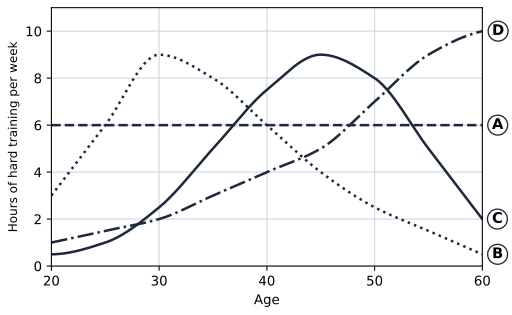
¶10Whenever you shift your hours, you are also shifting your rest. For example, instead of training about 6 hours a week throughout your working years (20–60 years old), some people would be better off training almost nothing in their early twenties, then gradually increasing their hours during their late twenties and thirties as their schedule frees up. Then they should train even more than 6 hours a week in their forties, and then slow down so that by age 60 they are down to about two hours a week.
¶11Notice that I am being careful to say that some people would be better off doing this. Everybody's situation is different. For example, some people's favorite activities, such as easy walking, cost very little effort, and others do not require top fitness. How you should plan also depends on how fast your fitness falls from year to year, where you live, and how much free time you have. Because of all these variables, and all the possible combinations they produce, there is no one-size-fits-all rule. It makes sense to train harder at some ages than at others, so it makes sense to adjust your balance of effort and rest over the years accordingly.